
On a misty December afternoon in 1968, an artist named John Kollock stood on a drab strip of concrete storefronts in north Georgia and saw, instead, the Bavaria he had known as a young soldier. The story of the Germans in Helen, Georgia begins there, in an act of imagination rather than migration. But over the half century since, a real German thread has woven itself into this Appalachian valley: bakers from Schwabach, restaurateurs born in Heidelberg, and the longest-running Oktoberfest in the United States.
The Place
Helen sits at the headwaters of the Chattahoochee River in White County, about sixty miles north of Athens and tucked into the southern folds of the Blue Ridge Mountains. Its elevation is 1,444 feet, and the town proper is barely two square miles. The 2020 census counted just 531 residents.
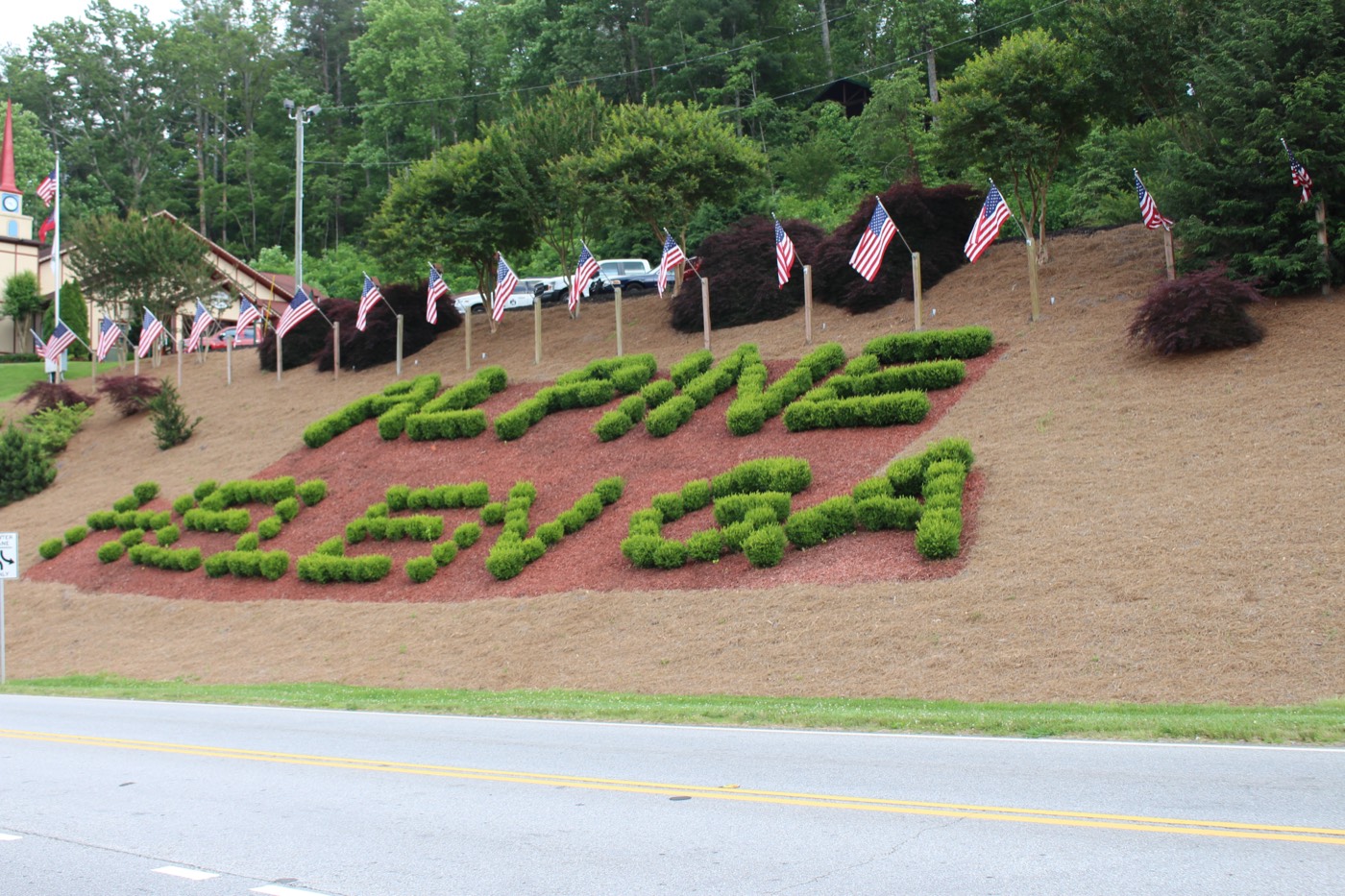
That makes Helen one of the smallest incorporated places in Georgia. It is also, improbably, the state’s third most visited destination, after Atlanta and Savannah, drawing up to 1.5 million tourists in a busy year. Almost every one of them comes for the same reason: to walk through a town that looks like it was lifted whole from the Bavarian Alps and set down among the laurels of Appalachia.
How It Became German
Helen was never a German settlement. It has no founding congregation of Lutheran farmers, no chain migration from a single Old World village. Its German identity was invented, deliberately and almost overnight, by people trying to save a dying town. That makes Helen unusual among the places Atlas of Home documents, and it makes the genuine German lives that grew up here all the more interesting.
A lumber town at the headwaters
The town emerged in the early twentieth century on land that had belonged to the Cherokee and, later, to gold miners. Around 1910 the Byrd-Matthews Corporation established a sawmill at the river’s edge, and a railroad soon linked the new settlement to Gainesville. The place took its name from the daughter of one of the company’s partners.
For a generation the mill hummed. Then the timber ran out and the Great Depression finished the job. By the middle of the century Helen had dwindled to what the New Georgia Encyclopedia describes as a bleak row of concrete block structures with only nine businesses left. The clothing mills that followed, Wilco Hosiery and Orbit Manufacturing, could not hold the town together. By 1970 fewer than 300 people lived there.
The misty afternoon in 1968
The turn came when three local businessmen, weary of watching their town fade, approached John Kollock, a regional artist and theatrical set designer from nearby Clarkesville. They wanted, as one account puts it, simply to add some colour to Helen.
Kollock visited on a grey December day, and the low cloud over the mountains reminded him of villages he had seen in Bavaria while serving in the United States Army in the 1950s. He went home and produced a series of watercolours reimagining the plain concrete storefronts as an alpine village: steep gabled roofs, timber framing, gingerbread trim and painted shutters.
The merchants, led by Pete Hodkinson, decided to build what Kollock had painted. There were no government grants and no outside investors. Business owners, many of whom had never travelled farther than Atlanta, spent their own money covering concrete facades with stucco and timber and rebuilding their rooflines into steep alpine pitches. By 1972, the encyclopedia notes, Kollock’s paintings had taken tangible form.
The first Oktoberfest
Architecture alone was not the plan. In 1970, Hodkinson and his neighbours staged Helen’s first Oktoberfest, a modest two-weekend affair held in a tent on the riverbank. It would grow into the longest-running festival of its kind in the United States.
Today the celebration fills a riverside hall called the Festhalle and stretches across September, October and into November. Bands play polkas, dancers in dirndls and lederhosen lead the crowd, and the beer flows in litre steins. The town later named Füssen, in Bavaria, as its official sister city, a gesture that bound the imitation to a real place in the German Alps.
Then the real Germans arrived
Here the invented story turns genuine. Once Helen looked German, actual Germans came to make it taste and sound German too. Horst and Gerda Hofer had emigrated from Schwabach, in Bavaria, in the late 1950s. They opened Hofer’s of Helen, baking breads in a stone hearth oven and turning out family recipes brought from home.
In the mid 1970s Harold and Terry Link, both born in Heidelberg, built what became The Heidelberg, the first thoroughly authentic German restaurant in town. Schnitzel, wurst, Kartoffelpuffer and giant Riesenbrezel pretzels appeared on the menu, served by people who had grown up eating them. The theme had summoned the substance, and a handful of real German families gave Helen a kitchen and a bakery worthy of the costume it had put on.
The Landmarks
The Heidelberg, 8660 North Main Street. Founded in the mid 1970s by Harold and Terry Link, both natives of Heidelberg, Germany, this three-floor restaurant, pub and music hall anchors the back of Helen’s main square. The outdoor terrace they added in the late 1980s is now enclosed as the Bierhimmel Music Hall, and the kitchen still turns out schnitzel and every kind of wurst.
Hofer’s of Helen, 8758 North Main Street. Horst and Gerda Hofer arrived from Schwabach in the late 1950s and built a bakery and cafe around a stone hearth oven. Its breads, strudels and Black Forest cake remain among the most genuinely German things in town, baked from recipes the family carried across the Atlantic.
Old Bavaria Inn, 8619 North Main Street. Perched above the Chattahoochee, this restaurant pairs Old World plates with a balcony view of the tubers drifting down the river below. It is one of a cluster, alongside Bodensee and the Hofbrauhaus, that gives Helen a working German dining scene rather than a single token restaurant.
The Festhalle, on the riverbank in the town centre. A walled pavilion built to host the Oktoberfest, it is the permanent home of the longest-running celebration of its kind in the country. From September through November it fills with brass bands, dancers and the smell of bratwurst and roasted almonds.
Unicoi State Park, just northeast of town off Highway 356. This 1,050-acre park surrounds a 53-acre lake and offers the hikes, cabins and lodge rooms that turn a day trip to Helen into a weekend. Its trails connect to the wider Chattahoochee National Forest and reach toward Anna Ruby Falls.
Anna Ruby Falls, within the Chattahoochee National Forest above Unicoi. A rare double waterfall formed where Curtis and York creeks tumble together, reached by a short paved trail. Named for Anna Ruby Nichols, it is the natural counterpoint to the manufactured village below, a reminder of why this valley drew people long before the gingerbread trim went up.
Old Sautee Store, in nearby Sautee Nacoochee. Established in 1872, this nineteenth-century general store sits a few miles from Helen and once held one of the largest collections of Scandinavian and European folk goods in the South. It grounds the area’s costumed present in a genuinely old past.
Where They Came From
There is no single sending village behind Helen, the way Hessen stands behind the Germans in Jasper, Indiana or the Alsace borderlands stand behind Castroville’s settlers in Texas. Helen’s German story is two stories layered together.
The first is a memory of Bavaria carried home by an American soldier. John Kollock never lived in Germany as a migrant; he passed through its alpine villages in uniform in the 1950s and brought back an image vivid enough to redraw a Georgia town.
The second is the real migration of a few German families in the decades after the theme took hold. The Hofers came from Schwabach, in the Franconian region of Bavaria. The Links came from Heidelberg, in Baden-Württemberg. They were drawn not by farmland or industry but by a town that had advertised itself as German and then needed Germans to make the promise true. It is migration in reverse: the costume came first, and a handful of people arrived to fill it.
Helen Today
Helen today is a paradox that wears its contradictions lightly. It is a town of barely 531 permanent residents that hosts well over a million visitors a year, supporting some 150 shops and around 40 restaurants and generating more than 100 million dollars of spending across White County. The 2020 census recorded the population as more than 96 per cent white, with German, English and Irish among the most commonly reported ancestries, the German entry as much a product of the broader Appalachian South as of the village theme.
Honesty requires acknowledging what Helen is and is not. It is not an organic German immigrant community in the way that, for instance, Boerne or Brenham, Texas grew from nineteenth-century chain migration. The architecture is mandated by a zoning code first adopted in 1969, and the Bavarian look is, in part, theatre. Writers have long debated whether the result honours German culture or merely costumes it.
Yet the genuine threads are real and worth honouring. The bread at Hofer’s is baked from a Schwabach family’s recipes. The accents in The Heidelberg’s kitchen were once Heidelberg accents. The Oktoberfest, however it began, is now more than fifty years old, which makes it a tradition by any reasonable measure. Helen sits in a corner of Georgia that has welcomed newcomers in many forms, from the Ethiopian refugees who remade Clarkston to the Brazilian families who settled around Marietta. It belongs to that wider story of how the South keeps remaking itself, one improbable village at a time.
Frequently Asked Questions
Are there really Germans in Helen, Georgia?
Yes, though not in the way most diaspora towns came to be. The Germans in Helen, Georgia are a small number of immigrant families, such as the Hofers from Schwabach and the Links from Heidelberg, who arrived after the town reinvented itself as an alpine village. Helen was never founded by German settlers; its German character was designed in 1968 and then partly populated by real Germans afterward.
Why does Helen, Georgia look like a Bavarian village?
In 1968, three local businessmen asked artist John Kollock to help revive their failing lumber town. Kollock, who had seen Bavaria while serving in the Army in the 1950s, sketched the storefronts as an alpine village, and merchants rebuilt them at their own expense. A zoning code adopted in 1969 has kept the look consistent ever since.
When did Helen become an alpine town?
The transformation began in 1968 and 1969, and by 1972 the artist’s watercolour designs had largely been built. The first Oktoberfest followed in 1970, held in a tent on the riverbank, and grew into the longest-running festival of its kind in the United States.
What is there to do in Helen, Georgia?
Visitors tube down the Chattahoochee River, eat at German restaurants like The Heidelberg and the Old Bavaria Inn, browse more than 150 shops, and attend the autumn Oktoberfest at the Festhalle. Nearby Unicoi State Park and the double cascade of Anna Ruby Falls offer hiking and lakeside cabins in the surrounding Chattahoochee National Forest.
How many people live in Helen, Georgia?
The 2020 census counted just 531 permanent residents, up from 510 in 2010 and 430 in 2000. Despite that tiny population, Helen is Georgia’s third most visited city and welcomes well over a million tourists a year.
Is the German food in Helen authentic?
Some of it genuinely is. Hofer’s bakery was founded by Horst and Gerda Hofer from Schwabach, Bavaria, and bakes German breads and cakes from family recipes, while The Heidelberg was built by Harold and Terry Link, both born in Heidelberg, Germany. These businesses brought real German cooking to a town that had only the look of one.
If your family’s story passed through Helen, or any of the places Germans have made home in America, Atlas of Home can trace that journey. From a hearth oven in Schwabach to a bakery on North Main Street, to wherever you are now.