
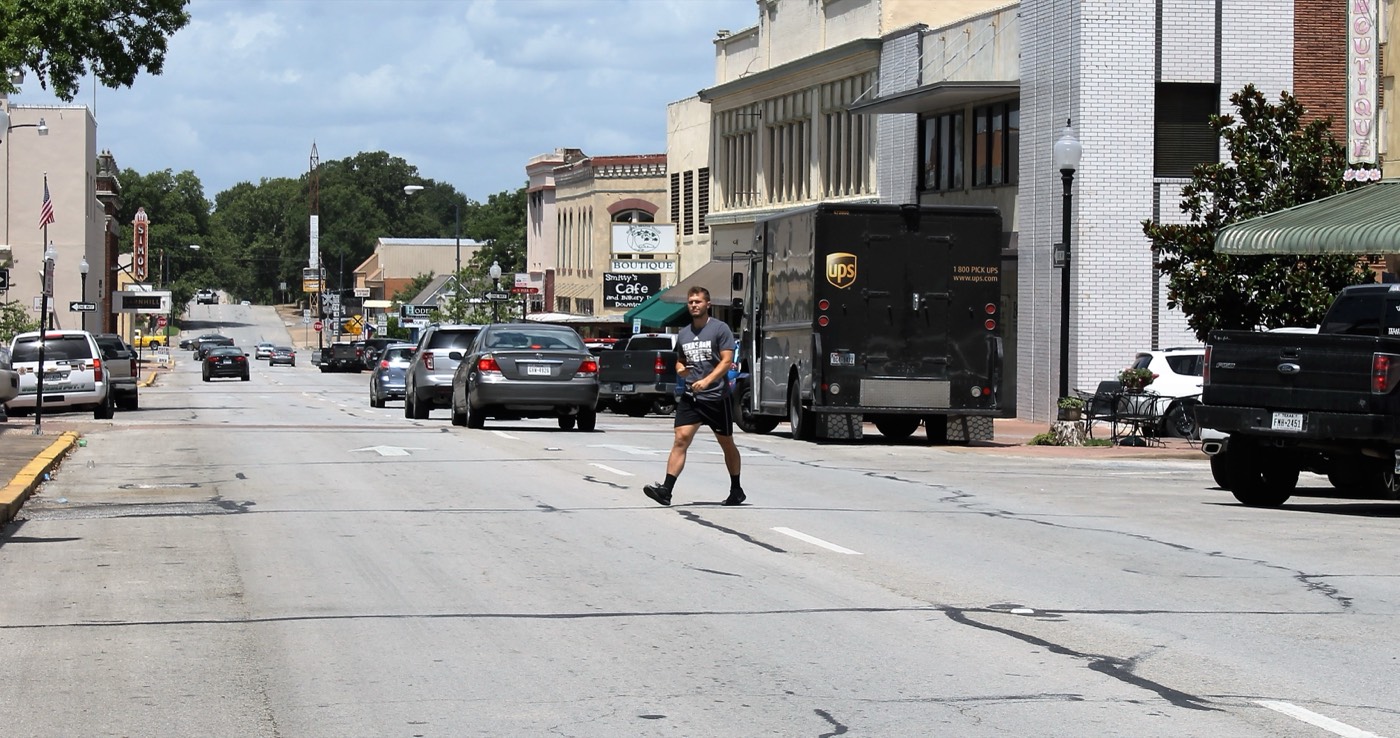
On the first Saturday of May, a parade winds through downtown Brenham past a 1939 courthouse and a string of two-storey brick storefronts, and somewhere in the crowd a child is crowned at a coronation that has been staged, with breaks only for two world wars, since 1881. The Germans in Brenham did not merely settle this corner of Washington County. They gave it a festival older than any other in Texas, a Lutheran spire, a Methodist college, and a butter co-operative that would one day put the town’s name on freezer doors across the country.
The Place
Brenham sits in the rolling, oak-dotted prairie of Washington County, roughly seventy miles northwest of Houston and a similar distance east of Austin, in the same central Texas belt that runs down toward the old Tejano and German quarters of San Antonio. It is the county seat, a town of around 17,000 people that punches well above its size in name recognition, largely thanks to the ice cream made here.
The surrounding countryside is the heart of Texas bluebonnet season. Each spring, fields off the back roads near Brenham turn an improbable blue and draw photographers from across the state.
The town itself is compact and walkable, anchored by a downtown historic district of late-nineteenth and early-twentieth-century commercial buildings. It is prosperous in a quiet, agricultural way: dairy, cattle, small manufacturing, tourism, and a junior college all feeding a stable local economy.
How It Became German
Brenham began as Hickory Grove, a settlement in one of the earliest-opened parts of Anglo Texas. In 1843 the community renamed itself in honour of Dr Richard Fox Brenham, a hero of the Republic of Texas, and on 4 February 1844 the people of Washington County chose it as their county seat. It was incorporated in 1858.
This was, in its first years, an Anglo-American town in a cotton economy. The German story begins almost immediately afterwards, and then accelerates over the following four decades until it reshaped the place entirely.
The first arrivals, from the 1840s
German immigrants began settling in and around Brenham as early as 1846. They were part of the broader wave that brought educated, professional, and farming Germans to central Texas in the 1840s, the same migration that built the German community in New Braunfels, Texas and the hill-country town of Fredericksburg a little further west. Men such as Christian Giesecke and Adolf Fuchs emigrated from the German states to Texas in that decade and left their mark on Washington County’s records.
The Brazos River was the artery that made it possible. By the late 1840s as many as a dozen steamboats regularly worked the river near the county, carrying passengers and freight up from the coast at Velasco and Quintana and opening the interior to newcomers.
The 1848 revolutions and the chain that followed
Many of the Germans who came to Brenham in the mid-nineteenth century arrived in the years after the failed liberal revolutions of 1848 in the German states. They were joining a settlement that already had a German nucleus, and the presence of countrymen pulled more behind them.
One of the clearest early markers is religious. The first German Lutheran congregation in the area began in 1855 in the tiny rural community of Berlin, just outside Brenham, where the Rev Johann Ebinger had first visited in December 1854. Faith travelled with the immigrants and gave the new community its earliest institutions.
The peak, the 1870s and 1880s
The economy was stimulated by the thousands of immigrants, many of them from Germany, who moved into Washington County during the late 1860s and the 1870s. German immigration to Brenham peaked in the early 1880s, the high-water mark of the community’s growth.
By 1860 only about 920 people lived in Brenham. By 1870 the town had grown to 2,221, and the population climbed steadily through the German decades that followed. The newcomers brought farming knowledge that shaped Washington County’s agricultural landscape, and a cultural influence that is still plainly visible today.
Churches, schools, and a college
As the German community grew, it built. St Mary’s Catholic parish formed in 1870, the German Methodist congregation in 1873, and the German Evangelical Lutheran church, later St Paul’s, organised in 1890 and called the Rev Gottlieb Langner as its pastor. These congregations, alongside the Presbyterians, were a direct product of European immigration into the county.
Education followed the same German current. In 1883 the Southern German Conference of the Methodist Episcopal Church founded Mission Institute in Brenham to train ministers. President Carl Urbantke and a first class of three students met in the German Methodist Church. The school went co-educational in 1888 and the next year was renamed Blinn Memorial College, after the Rev Christian Blinn of New York, whose gift made it possible.
A festival becomes the town’s clock
The most enduring German institution in Brenham is its calendar. Townspeople began holding an annual Volksfest, a German folk festival, in 1874, and in 1881 it formally became Maifest. It is the oldest festival in Texas, held every year since except for several wartime breaks.
In 1884 the firefighters of Brenham purchased land and outfitted the grounds specifically to host the celebration, creating what is still called Fireman’s Park. The fire department ran the festival from the early years until 1942. Maifest paused during the Second World War, was revived in 1948, and by 1951 had a formal Maifest Association behind it.
The Landmarks
St Paul’s Evangelical Lutheran Church, 305 West Third Street. The German Lutheran congregation organised here in 1890 and built its first sanctuary in 1891. That building was destroyed in the September 1900 storm that devastated Galveston, and the cornerstone of a replacement was laid before the year was out. Houston architect Alfred C. Finn designed the sanctuary dedicated here in 1925.
Fireman’s Park, 901 North Park Street. Bought by the town’s firefighters in 1884 to host Maifest, the park is the physical home of the German celebration that gives Brenham its rhythm. Its antique carousel and shaded grounds still anchor the festival each spring.
The Simon Theatre, 109 West Main Street. Built in 1925 by James Simon and designed by Alfred C. Finn, the same architect behind St Paul’s new sanctuary, the theatre is a contributing landmark of the downtown historic district. Restored and reopened as the Barnhill Center, it still hosts performances on Main Street.
Brenham Heritage Museum, 105 South Market Street. Housed downtown, the museum tells the story of the town and county, including the German immigration that shaped it. It is the place to read the names and dates behind the festivals and the families.
Blue Bell Creameries, FM 577 at the edge of town. Founded in 1907 as the Brenham Creamery Company, a Washington County dairy-farmers’ co-operative that converted an abandoned cotton gin into a creamery. It began making ice cream in 1911 and took the name Blue Bell, after a native Texas wildflower, in 1930. Run by the Kruse family since 1919, it became the best-known thing the town produces.
Brazos Valley Brewing Company, 206 South Jackson Street. A craft brewery in downtown Brenham with an outdoor yard, food trucks, and games, it is a modern descendant of a German town’s long relationship with beer and gathering. It draws both enthusiasts and families to the old commercial core.
St Mary’s Catholic Church, 701 Church Street. The parish that German and other Catholic immigrants formed in 1870. The present church on Church Street was completed in 1935 and remains an active congregation, one of the original immigrant-founded churches of the town.
Where They Came From
The Germans who settled Brenham came from the patchwork of German states in the decades before and after unification in 1871. Many arrived in the 1840s and 1850s, and a large share came in the years following the failed revolutions of 1848, when liberal and educated Germans looked abroad for a freer footing. The same forces seeded German colonies far from Texas, from the planned villages of the Amana Colonies in Iowa to the Bavarian-styled streets of Leavenworth, Washington and the farming town of Cullman, Alabama.
They were drawn to Washington County by land, by the Brazos River trade that made the interior reachable, and above all by the Germans already there. Chain migration did the rest: a congregation in Berlin, a Methodist conference, a circle of farming families, each pulling relatives and neighbours from the old country.
The depth of that root shows in the numbers. In the 2000 census, 33.6 per cent of Washington County residents identified German ancestry, far and away the largest group, ahead of American, English, Irish, and Polish lines. It was, and remains, a German county at its core.
Brenham Today
Brenham today is a prosperous small Texas town that has learned to live well off its heritage. The population stood at 17,369 in the 2020 census, and the downtown historic district, listed on the National Register in 2004, has been restored rather than razed, its Simon Theatre and 1939 courthouse intact.
The German imprint is not a museum piece here. Maifest still fills the streets every May with a parade, coronations, German-style food, and a carnival at Fireman’s Park, drawing visitors from across the region. The Lutheran, Catholic, and Methodist congregations the immigrants founded are still active, and Blinn College, born in the German Methodist church, is now a large public junior college.
What sells the town now is a blend of all of it: Blue Bell tours, the bluebonnet fields, the Antique Rose Emporium gardens nearby in Independence, the craft beer at Brazos Valley, and the antique shops of a walkable downtown. The Germans gave Brenham its festivals, its faith, its college, and its creamery. The town has spent the years since turning that inheritance into the thing it is known for.
Frequently Asked Questions
When did Germans first settle in Brenham, Texas?
German immigrants began settling in and around Brenham as early as 1846, soon after the town became the Washington County seat in 1844. The Germans in Brenham grew through the 1850s, then arrived in much larger numbers after the failed German revolutions of 1848 and during the 1870s.
Why did so many Germans come to Brenham?
They were drawn by available farmland, by the Brazos River steamboat trade that opened the county’s interior, and by Germans already settled there who pulled relatives and neighbours behind them. Many were liberal or educated Germans leaving the unrest that followed the 1848 revolutions.
What is Maifest and how old is it?
Maifest is Brenham’s German heritage festival, held each May with a parade, coronations, food, and a carnival at Fireman’s Park. It grew out of a Volksfest started in 1874, became Maifest in 1881, and is the oldest festival in Texas.
Is Blue Bell ice cream really from Brenham?
Yes. Blue Bell began in 1907 as the Brenham Creamery Company, a Washington County dairy-farmers’ co-operative. It started making ice cream in 1911 and took the Blue Bell name in 1930, and has been run by the Kruse family of Brenham since 1919.
How German is Brenham today?
Deeply. In the 2000 census, 33.6 per cent of Washington County residents claimed German ancestry, the largest single group. The Germans in Brenham left lasting churches, Blinn College, and the Maifest festival that still defines the town’s calendar.
What German landmarks can you visit in Brenham?
You can see St Paul’s Evangelical Lutheran Church on West Third Street, Fireman’s Park where Maifest is held, the 1925 Simon Theatre, St Mary’s Catholic Church, and the Brenham Heritage Museum downtown. Together they trace the immigrant churches, schools, and festivals the Germans built.
If your family’s story passed through Brenham, or any of the places Germans have made home in America, Atlas of Home can trace that journey. From the post-1848 German states, to a Lutheran congregation in Washington County and a parade that has run since 1881, to wherever you are now.