
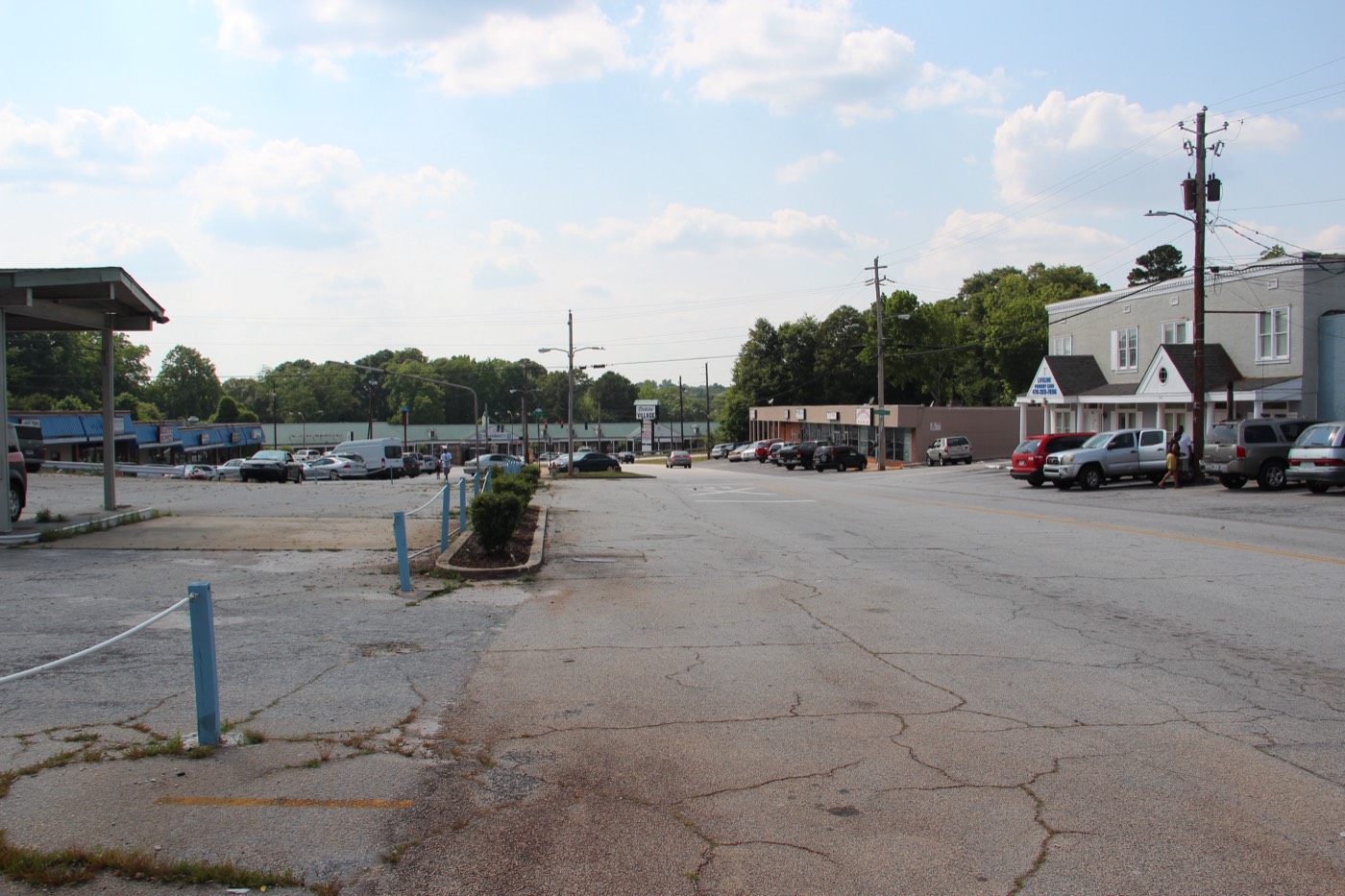
There is a one-square-mile town just east of Atlanta where the smell of berbere drifts out of strip-mall kitchens, where Amharic and Tigrinya carry across the bus stop, and where a coffee ceremony is as ordinary as a drive-through latte. The Ethiopians in Clarkston, Georgia did not arrive to a place that looked like home. They made it look like home.
The Place
Clarkston sits in DeKalb County, about ten miles east of downtown Atlanta, hugging the line of the old Georgia Railroad. It is small by any measure, roughly 1.86 square miles, with a population of 14,756 at the 2020 census. For most of its history it was a quiet, white, railroad-stop suburb.
Today it is widely described as “the most diverse square mile in America,” a phrase that follows the town through nearly every story written about it. Locals have embraced a second nickname too: “the Ellis Island of the South.” More than half of Clarkston’s residents are foreign-born, and many of them are refugees.
Of all the communities woven into that one mile, the Ethiopians are among the largest and most visible. At the 2020 census, Ethiopian was the second most reported ancestry in Clarkston, claimed by 12.0 percent of the population.
How It Became Ethiopian
To understand why Ethiopians put down roots in a former goat-farming railroad town in Georgia, you have to start two continents away, and then follow the quiet machinery of American resettlement policy.
A town built on a railroad siding
Clarkston was incorporated on 12 December 1882, growing from a stop on the Georgia Railroad once known as “New Siding.” It was named in honour of Colonel W. W. Clark, a director of the railroad. Local folklore even gave it the nicknames “Goatsville” and “Angora Heights,” from a turn-of-the-century fashion for keeping goats, which were said to carry a certain prestige.
For nearly a century it stayed a modest, residential, overwhelmingly white town. What made it unremarkable in 1970 is exactly what made it ideal for what came next: cheap apartments, a stop on the bus and rail lines into Atlanta, and easy access to the city’s job market.
The flight from the Derg
The Ethiopian story in America begins with catastrophe at home. After the 1974 revolution, the military government known as the Derg seized power, and the years that followed brought the “Red Terror,” civil war, and the devastating famine of the mid-1980s. Well over a million people are estimated to have died.
Hundreds of thousands fled. During the mid-1980s famine alone, roughly 600,000 Ethiopians crossed into neighbouring Sudan. From camps in Sudan, Djibouti, Somalia and Kenya, the United Nations referred survivors for resettlement, and the U.S. Refugee Act of 1980 had just created the legal channel to receive them.
The scale was striking. Between 1982 and 1990, Ethiopians accounted for around 90 percent of all African refugees resettled in the United States. Many of the earliest arrivals were highland Christians, Amhara and urban Tigrayans, the very groups the Derg had targeted. The same exodus seeded other American enclaves, from the Ethiopians in Silver Spring, Maryland to the long-rooted community of Ethiopians in Seattle, Washington.
Why Clarkston, of all places
Clarkston was not chosen by accident. In the 1990s, refugee resettlement agencies identified the town as an unusually good fit for newly arrived families. The reasons were practical rather than romantic.
The apartment complexes along Montreal Road and Indian Creek Drive were affordable and had vacancies. The town sat on public transport that ran straight into Atlanta, so a newcomer without a car could still reach work. And the low-wage service and warehouse jobs of metro Atlanta were within reach.
Once the first Ethiopian families settled, chain migration did the rest. A cousin sponsored a cousin. A church drew a congregation. A grocer who could source teff and berbere became a reason to stay rather than move on. Each new arrival made the next arrival easier, and the community thickened year by year.
From goat farms to global village
The transformation was rapid and, for the old residents, total. A town that had been roughly 90 percent white not many years earlier became majority non-white within a single generation. By the 2010s, more than 60 nationalities and dozens of languages were packed into that one square mile.
The Ethiopians were never the only group. Vietnamese and other Southeast Asian refugees came first in the 1980s, followed over the decades by Bosnians, Somalis, Burmese, Congolese, Bhutanese, Syrians and Afghans. But within that crowd, the Ethiopian presence became one of the most established, with its own churches, restaurants, grocers and associations.
Clarkston is not the only Georgia suburb reshaped by recent migration. A short drive away, the wider metro region holds communities such as the Nigerians in Snellville, Georgia and the Brazilians in Marietta, Georgia, each a thread in metro Atlanta’s wider immigrant story.
The Landmarks
Ledet Restaurant, 447 N Indian Creek Drive, Clarkston. Tucked into a strip near the heart of the community, Ledet serves Ethiopian and Eritrean food to a crowd that knows the difference. Regulars praise the quality of its meat and the freshness of its injera, and its long hours make it a fixture for late-evening gatherings.
Ethiopian Community Association in Atlanta, 752 N Indian Creek Drive, Clarkston. Incorporated as a Georgia non-profit, the association exists to serve, empower and advance the interests of Ethiopian and Ethiopian-American families across metro Atlanta. From its Clarkston base it offers a point of contact for newcomers navigating a new country.
Debre Bisrat St Gabriel Ethiopian Orthodox Church, 3518 Clarkston Industrial Boulevard, Clarkston. For a faith that has anchored Ethiopian life for more than 1,500 years, the church is more than a building. It is calendar, language school and community hall, where saints’ days and fasts keep the rhythm of home in a Georgia suburb.
Refuge Coffee Co., 4170 East Ponce de Leon Avenue, Clarkston. Founded by Kitti Murray in 2015, this non-profit roaster trains and employs resettled refugees, several of them from East Africa. It began as a single red truck and grew into a gathering place that has come to symbolise Clarkston’s whole experiment in welcome.
Thriftown International Market, 926 Montreal Road, Clarkston. A grocery store that mirrors the town itself, its aisles run from Asian to East African staples. For Ethiopian cooks it is a place to find the spices, pulses and grains that a standard American supermarket does not stock.
Clarkston High School, Clarkston. The public high school has long drawn students from dozens of countries, and it became, through the Fugees soccer programme, a symbol of the town. The story of refugee children finding their feet through sport was told in Warren St. John’s book “Outcasts United.”
The Fugees Academy, Clarkston. Founded in 2004 by Luma Mufleh, herself granted asylum in 1999, the academy grew from pickup street soccer into a school built for refugee children. Its graduating classes, drawn from many homelands including Ethiopia, have sent first-generation students on to college.
Where They Came From
Clarkston’s Ethiopians do not come from a single village or province. The first refugee waves of the 1980s were heavily highland Christian, Amhara from the central plateau and Tigrayans from the north, fleeing a regime that viewed them with suspicion.
Later arrivals broadened the picture. As the civil war ended in 1991 and migration patterns shifted, family reunification and the diversity visa brought a wider range of Ethiopians, including Oromo families and people from Addis Ababa and the larger regional towns. The pattern echoed older Ethiopian gateways such as the Ethiopians in Alexandria, Virginia and the fast-growing Ethiopians in Aurora, Colorado.
What they shared was not a single hometown but a single doorway: a refugee camp in the Horn of Africa, a referral from the United Nations, and a one-way flight that, often enough, ended at an apartment off Montreal Road. The Ethiopian Orthodox calendar and the Amharic language did the rest of the work of holding a scattered people together.
Clarkston Today
Clarkston in 2026 is a town still defined by arrival. The Ethiopians who came in the 1980s and 1990s are now the established generation, the ones whose children grew up bilingual and whose restaurants the newer refugees, Afghan and Congolese and Syrian, now eat in.
The pressure is real and ongoing. A town of fewer than 15,000 people, packed into less than two square miles, absorbs wave after wave of newcomers, and the strain on housing, schools and services is constant. Recent arrivals, including large numbers of Afghans, have tested the town’s famous capacity to welcome.
Yet the Ethiopian thread runs through it all, steady and visible. It is in the Orthodox crosses on Clarkston Industrial Boulevard, the injera at Ledet, the teff on the shelves at Thriftown, and the staff pulling espresso at Refuge Coffee. For a community that arrived with almost nothing, in a town that had never seen anyone like them, that is a remarkable kind of permanence.
Frequently Asked Questions
Why are there so many Ethiopians in Clarkston, Georgia?
The Ethiopians in Clarkston, Georgia arrived largely through refugee resettlement that began in the 1980s and accelerated in the 1990s, when agencies identified Clarkston’s cheap apartments, public transport and access to Atlanta jobs as a good fit. Once early families settled, chain migration through relatives and churches drew many more.
What share of Clarkston is Ethiopian?
At the 2020 census, Ethiopian was the second most reported ancestry in Clarkston, claimed by 12.0 percent of residents. The town’s total population was 14,756, and more than half of all residents were foreign-born.
Why did Ethiopians leave Ethiopia in the first place?
Most early arrivals fled the Derg, the military regime that took power in 1974 and presided over the “Red Terror,” civil war and the mid-1980s famine. Hundreds of thousands escaped to camps in Sudan and neighbouring countries, and from there were resettled in the United States under the 1980 Refugee Act.
Where can you find Ethiopian food and culture in Clarkston?
The Ethiopians in Clarkston, Georgia have built churches, restaurants and grocers across the town. Ledet Restaurant on North Indian Creek Drive serves Ethiopian and Eritrean dishes, Thriftown on Montreal Road stocks East African staples, and Ethiopian Orthodox churches such as Debre Bisrat St Gabriel anchor religious life.
Why is Clarkston called the most diverse square mile in America?
Clarkston earned the nickname because more than 60 nationalities and dozens of languages are concentrated within its roughly 1.86 square miles, the result of decades of refugee resettlement. The town is also called “the Ellis Island of the South.”
What is the Fugees connection to Clarkston?
The Fugees, a soccer programme for refugee children founded by Luma Mufleh in 2004, grew into the Fugees Academy in Clarkston. Its story was told in Warren St. John’s book “Outcasts United,” and its students have included children from Ethiopia and many other homelands.
If your family’s story passed through Clarkston, or any of the places Ethiopians have made home in America, Atlas of Home can trace that journey. From the highlands of Ethiopia and the refugee camps of the Horn of Africa, to a one-square-mile town off Montreal Road, to wherever you are now.