
On a Tuesday evening in June, a brass band gathers under the gazebo on Boerne’s Main Plaza and plays a polka that has been carried, almost without interruption, since 1860. The crowd unfolds lawn chairs in the warm Hill Country dusk. Listen for an hour in this Texas town and you understand something the census only hints at: the Germans in Boerne did not just settle here. They composed the place.
The Place
Boerne sits about thirty miles northwest of San Antonio, on the banks of Cibolo Creek, where the flatter coastal plain begins to fold up into the limestone hills. It is the county seat of Kendall County and, by 2020, home to roughly 18,000 people, with the wider county holding around 44,000.
It is an affluent town. The median household income runs above 84,000 dollars, the poverty rate sits under seven per cent, and the cypress-lined streets carry an unhurried, prosperous calm. Antique shops and bistros line a Main Street that locals still call by its German name.
That name is Hauptstrasse. It is not a marketing flourish. It is the oldest thing in town.
How It Became German
To understand why a Texas hill town keeps a German shooting club, a German singing tradition and a street called Hauptstrasse, you have to start in Europe in 1848, with a failed revolution and a generation of disappointed idealists.
The Forty-Eighters and the Latin colonies
When the German revolutions of 1848 collapsed, a particular kind of immigrant began crossing the Atlantic to Texas. They were the Forty-Eighters: educated, liberal, often abolitionist, suspicious of both crown and church. Many were classically schooled men who could converse in Latin, and the small utopian settlements they founded in the Hill Country became known as the Latin colonies.
About a thousand of these freethinkers eventually scattered across the hills, founding Comfort, Sisterdale, Luckenbach, Castell, Bettina and others. They prized reason over authority and democracy over hierarchy, and they wanted land where they could live by those convictions.
In 1849 a group of these colonists, drifting from the short-lived commune at Bettina, camped on the north side of Cibolo Creek about a mile west of the present town. With characteristic learning, they named their settlement Tusculum, after Cicero’s country retreat outside Rome.
From Tusculum to Boerne
The Adelsverein, the noble society that had organised much of German immigration to the Texas Hill Country, supported these experimental communities for only about a year. When the funding ran dry and the inevitable disagreements set in, the settlers moved a short distance to firmer ground.
In 1852, John James and Gustav Theissen, who had helped settle nearby Sisterdale, platted the new townsite. They renamed it Boerne, honouring the German author and satirist Karl Ludwig Börne, who had died in 1837. The spelling was Anglicised, but the homage was unmistakably German.
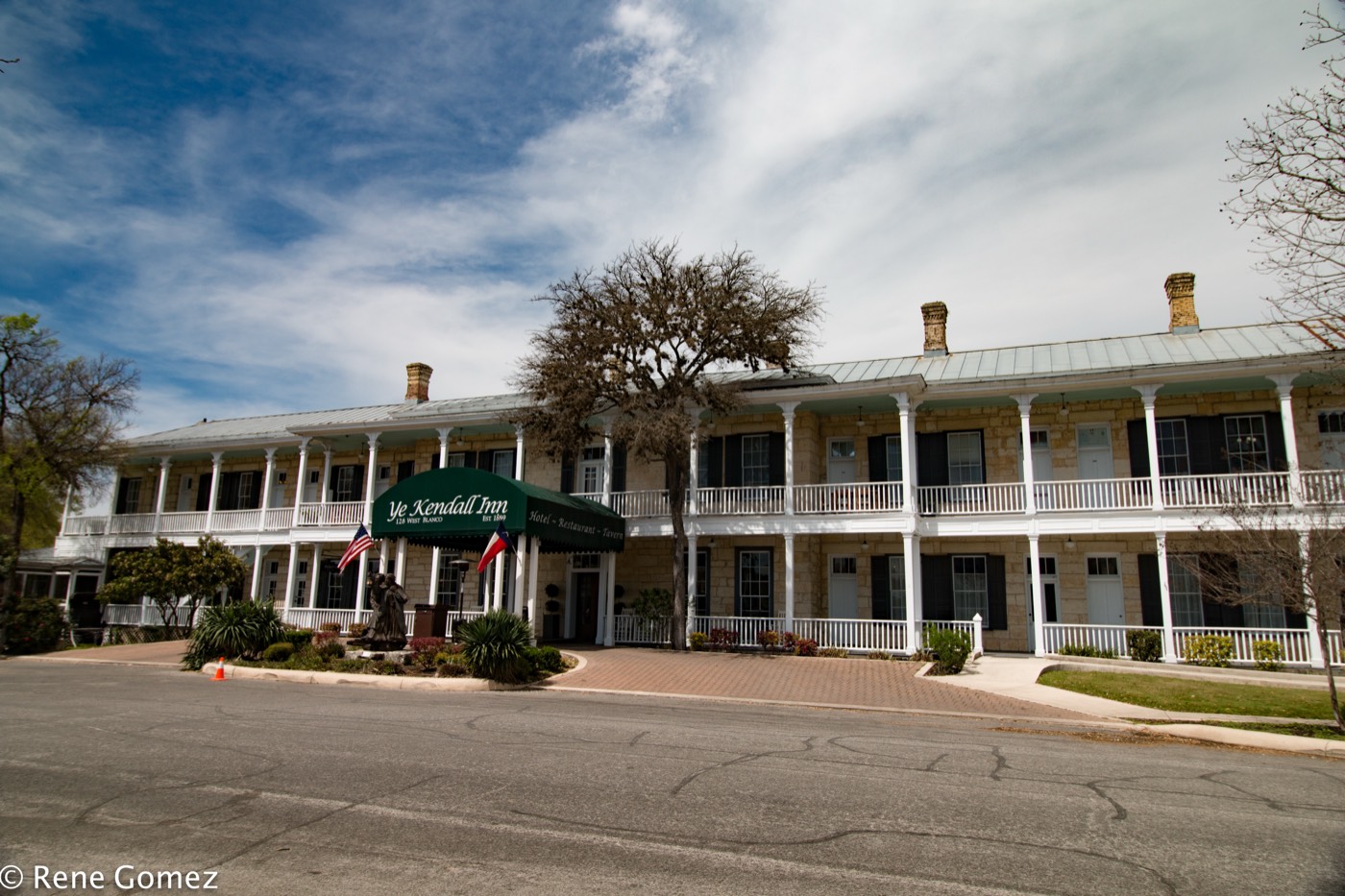
Growth was patient. A post office opened in 1856, with August Staffell as postmaster. By 1858 there were ten wooden cabins. In 1859 the building that became Ye Kendall Inn went up beside the creek, and in 1862, by a margin of just sixty-seven votes, Boerne won the contest to become county seat of the newly formed Kendall County.
Building a German town
The early Boerne Germans did what their countrymen did across the Hill Country: they built institutions before they built wealth. In 1860 they organised a Gesangverein, a singing society, and the Boerne Village Band, founded the same year by Karl Dienger, a musician who had emigrated from Germany in 1855.
In 1864 they formed the Boerne Schuetzen Verein, a shooting club in the old German tradition. By 1870 the population had reached 250, and the county raised a courthouse that still stands as one of the oldest in Texas. These were not transplanted decorations. They were the working machinery of a German community on the frontier.
Commerce followed the same hands. In 1884 Joseph Dienger built a combined dry-goods store and family residence on Main Street, a sturdy two-storey building that anchored downtown. The year before, in 1885, the German pharmacist William Kuhlmann, born in 1856, built the house on Historic Hill that the town would one day turn into a museum.
The German character held even as the railroad arrived and the wider world pressed in. By the turn of the century Boerne counted about 800 residents, and the town finally incorporated in 1909, the same year its independent school district was established. Through the twentieth century the population dipped and climbed, but the cultural inheritance never broke.
Some traditions did fade. The Gesangverein, after more than a century of singing, finally disbanded in 1977. But the band played on, and in 1967 the town launched Berges Fest, an annual festival of the hills that gathered the old German spirit into a single weekend each June. The story of the Germans in Boerne is, more than anything, a story of continuity. Compare it with the more spectacular preservation of the Germans in Leavenworth, Washington, where a whole town was rebuilt in Bavarian style, and Boerne looks quieter and more genuine: nothing here was staged, because nothing had to be.
The Landmarks
Hauptstrasse (Main Street), downtown Boerne. The town’s central thoroughfare still carries its German name, lined with limestone storefronts, galleries and cafes. Walking it is the simplest way to read the town’s history, building by building, from the 1850s outward.
Ye Kendall Inn, 128 West Blanco Road. The land was sold in 1859 to Erastus and Sarah Reed for 200 dollars, and the inn beside Cibolo Creek has welcomed travellers ever since. It was added to the National Register of Historic Places in 1976 and remains a hotel and restaurant on the Main Plaza, now styled simply as The Kendall.
The Dienger Trading Co., 210 North Main Street. Joseph Dienger built this corner landmark in 1884 as a grocery and family home. Over more than a century it has housed a dry-goods store, a team of geologists, and the town’s public library, and today it holds a bakery, espresso bar and bistro across Blanco Road from the gazebo.
Kuhlmann-King Historical Complex, 402 East Blanco Street. Built around 1885 for the German-born pharmacist William Kuhlmann, this house on Historic Hill has belonged to the city since 1951. The Boerne Area Historical Preservation Society now runs it as a museum of local artefacts, with free tours on the second and fourth Saturdays of the month.
Main Plaza and the gazebo, downtown Boerne. The heart of the German town is its plaza, where the Boerne Village Band plays its Abendkonzerte, evening concerts, every other Tuesday in June and July from 7.30 to 9. Audiences spread blankets and folding chairs around the gazebo, exactly as their grandparents did.
Cibolo Center for Conservation, 140 City Park Road. Formerly the Cibolo Nature Center, this reserve protects more than six miles of trails along the cypress-lined creek that drew the first German colonists in 1849. The 96-mile Cibolo, a tributary of the San Antonio River, is the geographic reason Boerne exists where it does.
Bear Moon Bakery, 401 South Main Street. Established in 1995 in a historic corner building on Hauptstrasse, Bear Moon has become a Main Street institution in its own right, the kind of bakery that anchors a German town’s morning life. It is a modern link in a very old chain of bread and coffee on this street.
Where They Came From
The Germans who made Boerne were not a random cross-section of the old country. They were disproportionately educated, idealistic and politically liberal, shaped by the upheavals of the German states in the 1840s and 1850s: overpopulation, crop failures, industrialisation, compulsory military service and the crushed revolution of 1848.
Many came by way of the Adelsverein’s organised migration, surviving the two-month Atlantic crossing to land at the Texas coast and push inland to the Hill Country. The Forty-Eighters among them gave Boerne its intellectual flavour, the freethinker’s preference for reason and self-government that set the Latin colonies apart from more conventional settlements.
They were part of a far larger German movement into Texas that built the Germans in New Braunfels, Texas down the road, and that would later seed German communities as far afield as the Germans in Cullman, Alabama and the colony farmers of the Germans in Amana, Iowa. Boerne was the hill town in that constellation, the one where the cedar-covered slopes and the spring-fed creek reminded the settlers most of home.
Boerne Today
Boerne today is a prosperous, fast-growing town that has learned to live off its own past without quite turning into a theme park. Its population has more than doubled since 2010, as families priced out of San Antonio move up into the hills, and new subdivisions push against the old grid of German street names.
The German inheritance is no longer the whole story. Boerne is now a commuter and tourism town, its weekends thick with visitors browsing the Hill Country Mile, and its newcomers are as likely to come from elsewhere in Texas as from Bavaria. The wider region’s diversity has grown too, from the long Mexican-American presence in nearby San Antonio to the South Asian families settling in suburbs like Carrollton further north.
And yet the old culture refuses to become merely decorative. The Boerne Village Band, organised in 1860, is acclaimed as the oldest continuously organised German band in the world outside Germany itself, recognised by the Federal Republic of Germany, by the Texas legislature in 1991, and by German President Roman Herzog, who awarded it the Pro-Musica Plakette in 1996. Every June the Berges Fest fills the streets with a parade, dachshund races and German folk music. The band still plays its Abendkonzerte under the gazebo. In Boerne, the German story is not preserved behind glass. It is still, gently and stubbornly, going on.
Frequently Asked Questions
Why is the town called Boerne?
Boerne was named in 1852, when John James and Gustav Theissen platted the townsite, in honour of Karl Ludwig Börne, a German author and satirist who had died in 1837. The settlement had originally been called Tusculum, after Cicero’s country home, by the educated German freethinkers who founded it in 1849.
When did the Germans settle in Boerne?
The Germans in Boerne arrived from 1849 onward, when freethinker colonists from the short-lived Bettina commune camped on Cibolo Creek and named their settlement Tusculum. The town was platted and renamed Boerne in 1852, and German cultural institutions followed within a decade.
Who were the freethinkers who founded Boerne?
They were Forty-Eighters, educated German liberals and idealists who fled the failed German revolutions of 1848. Known as the Latin settlers because many could converse in Latin, they founded a string of utopian Hill Country colonies, of which Tusculum, the future Boerne, was one.
What German traditions survive in Boerne today?
Several. The Boerne Village Band, founded in 1860, still performs, and the Boerne Schuetzen Verein shooting club dates from 1864. The town holds its Berges Fest each June and stages the band’s Abendkonzerte, evening concerts, under the Main Plaza gazebo through the summer.
What is the Boerne Village Band?
Founded in 1860 by Karl Dienger, who had emigrated from Germany in 1855, it is acclaimed as the oldest continuously organised German band in the world outside Germany itself. It has been honoured by the German federal government, the Texas legislature in 1991, and German President Roman Herzog in 1996.
What can you see of German Boerne on a visit?
Walk Hauptstrasse, the German-named Main Street, and you pass Ye Kendall Inn from 1859, the 1884 Dienger Trading Co. building, and the Main Plaza gazebo. A short way up Historic Hill, the Kuhlmann-King Historical Complex, built around 1885, preserves the home of a German pharmacist as a free museum.
If your family’s story passed through Boerne, or any of the places Germans have made home in America, Atlas of Home can trace that journey. From a crushed revolution in the German states to a gazebo on a Hill Country plaza, to wherever you are now.