
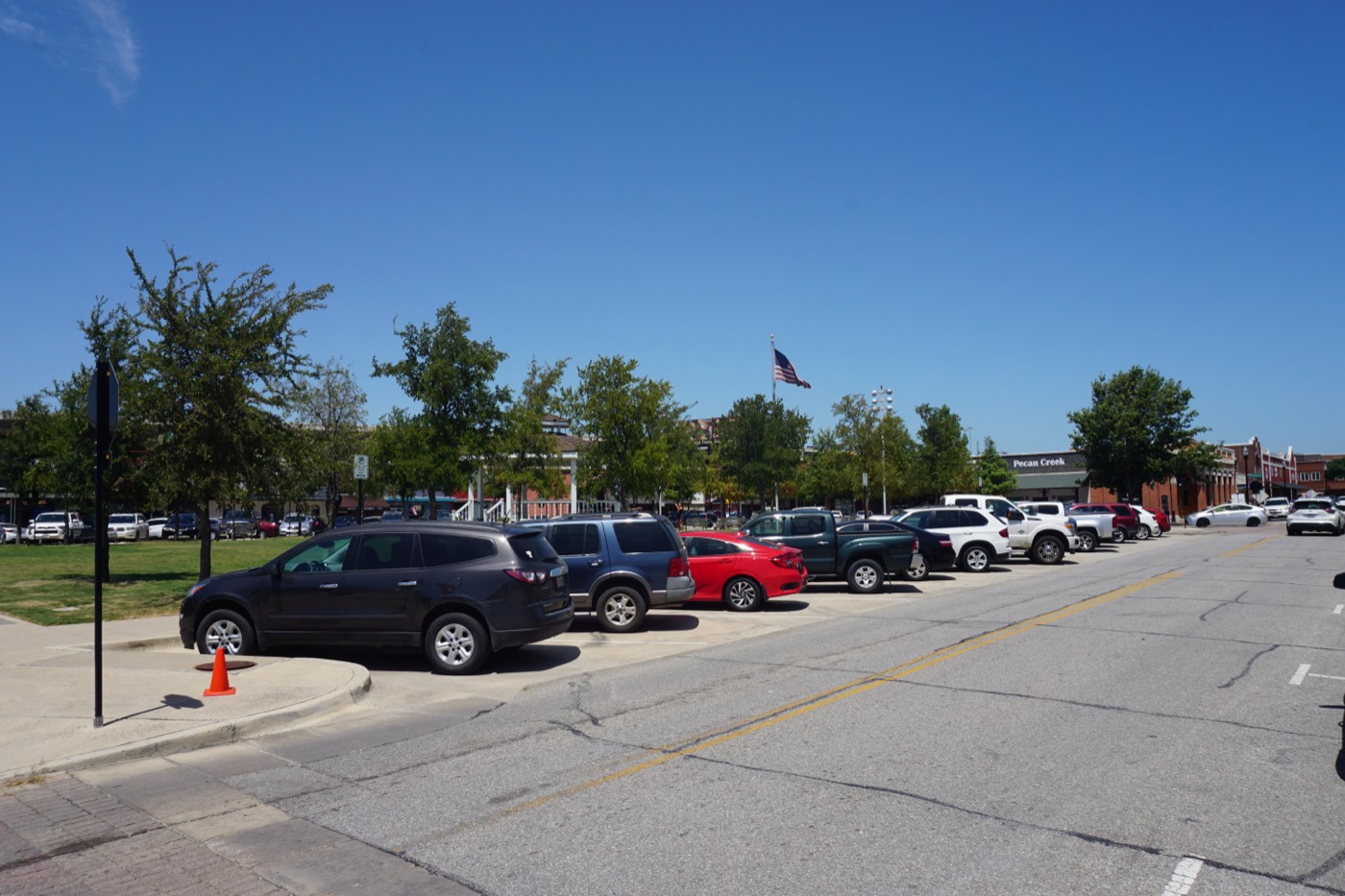
Drive north on State Highway 121 on a Saturday morning and the Indians in Carrollton, Texas announce themselves long before you reach a temple or a town sign. The car parks fill with families carrying empty cloth bags into India Bazaar. The signage shifts between English, Telugu and Malayalam. Somewhere a pressure cooker is whistling, and the smell of fried curry leaves drifts across a strip mall that, forty years ago, sold tyres and fishing tackle.
This is one of the quietest and most consequential immigrant stories in North Texas. Carrollton did not set out to become a centre of Indian life. It simply offered good schools, cheap land and a short drive to the hospitals and tech campuses where the first arrivals went to work. The rest followed, family by family.
The Place
Carrollton sits about twenty miles north of downtown Dallas, stretched awkwardly across three counties: Dallas, Denton and Collin. It began in the 1840s as a farming settlement, named most likely by pioneers who had come from Carrollton, Illinois. For decades it was nothing more than fertile blackland prairie dotted with cotton gins.
The railroads made it. When the Missouri-Kansas-Texas line came through in 1881 and the Cotton Belt crossed the Katy tracks in 1888, Carrollton became a shipping point for livestock, grain and cotton, as the Texas State Historical Association records. It incorporated in 1913 with a population still in the hundreds.
The real transformation came after the Second World War. Carrollton held 1,610 people in 1950, 13,855 by 1970, and roughly 133,000 today. It is now an established middle-class suburb where roughly one in six residents is of Asian descent, and a large share of those are Indian. The same suburban pull has reshaped towns across the metroplex, from the Nigerian families of Frisco to the Venezuelans who settled in Katy outside Houston.
How It Became Indian
To understand why Indian families landed in Carrollton, you have to start far away from it, in the hospital corridors of Irving and the immigration law of 1965.
Before there was anyone
For most of the twentieth century there was almost no Indian presence in Texas at all. By 1930, census records counted just forty-nine Indians in the entire state. The country had effectively closed its doors to Asian immigration, and Texas was not an obvious destination for the few who slipped through.
That changed in 1965, when the Immigration and Nationality Act abolished the national-origin quotas that had kept Indians out. The door opened slowly at first, then all at once.
The nurses came first
The first significant wave of South Asians into this corner of Dallas was not engineers. It was nurses. In the late 1960s and 1970s, as American hospitals struggled to staff wards in the aftermath of the Vietnam War, trained nurses from South India, and from Kerala in particular, were actively recruited.
They settled near the hospitals where they worked, which clustered around Irving, just south of Carrollton. Many were Malayali Christians from Kerala, and they brought husbands, then parents, then cousins. This is why the Carrollton and Farmers Branch area is still known among locals as the Malayali corridor, home to the highest concentration of Malayalam speakers in the entire metroplex.
The students and the engineers
Through the 1980s a different stream arrived: graduate students drawn to Southern Methodist University and the University of Texas at Dallas, many studying engineering and computer science. They were young, they stayed, and when they finished they wanted the same thing every Texas family wanted, which was a house with a yard and a good school district nearby.
Then came the 1990s and the H-1B visa. As the technology sector boomed, Indian software engineers poured into the Dallas-Fort Worth corridor to fill jobs at telecom and IT firms. Carrollton, with its newer subdivisions and easy access to the Telecom Corridor in nearby Richardson, was an obvious place to put down roots. The same pattern played out in the booming suburbs to the north, where the Indian community in Frisco grew up around its tech corridor and school districts.
From a trickle to a presence
The numbers tell the story plainly. As recently as the year 2000, the Indian community across Texas was still relatively small. Across Dallas-Fort Worth, the Indian population stood at 106,694 in 2010 and more than doubled to 235,642 by 2021, roughly three per cent of the entire metro area. Collin County alone, on Carrollton’s eastern edge, now counts more than 100,000 residents of Indian origin, around nine per cent of the county.
Carrollton became a particular kind of hub. The Irving North, Coppell and Carrollton band holds the single highest concentration of Tamil speakers in the metroplex, alongside thousands of Malayalis and a growing Telugu presence. By the 2010s the strip malls along Highway 121 and Old Denton Road had quietly tilted toward South Asia. The same suburb had earlier drawn a substantial Korean community to Carrollton, and the two diasporas now share many of the same shopping centres.
Carrollton’s Indian story rhymes with others across the country. From the research-park suburbs of New England, where the Indians of Westborough and the Indians of Shrewsbury clustered near biotech and software firms, to the Cincinnati exurbs of the Indians in West Chester and the Indians in Hilliard, the formula repeats: good schools, new houses, and a grocer who opens once enough families arrive.
The Landmarks
India Bazaar, 4132 State Highway 121, Suite 100. The anchor grocer of Indian Carrollton, India Bazaar is part of a chain that has spread across Dallas-Fort Worth with more than a dozen locations. Its Carrollton shop carries fresh okra and bitter gourd, sacks of basmati and toor dal, dosa batter and the frozen parathas that stock half the freezers in the neighbourhood. On weekends the aisles are a slow procession of families comparing the firmness of curry leaves.
Apna Bazaar Grocery and Grill, 2000 Old Denton Road. Part shop, part kitchen, Apna Bazaar sits in the older western half of Carrollton and reflects the area’s mix of Indian, Pakistani and Nepali shoppers. Alongside the spices and lentils it runs a grill counter, the kind of place where a single stop can mean a bag of groceries and a hot lunch carried out together.
Biryani Nation, 1016 East Hebron Parkway, Suite 148. Tucked into a Carrollton strip centre, Biryani Nation does exactly what its name promises, plating the layered Hyderabadi rice that the metroplex’s large Telugu community grew up on. It is the sort of unassuming, fluorescent-lit restaurant that locals defend fiercely and visitors never find by accident.
New Kerala Kitchen, 3600 Huffines Boulevard. A nod to the Malayali families who arrived first, this Carrollton restaurant serves the food of the Kerala coast: appam, fish curry, beef fry, the dishes that the nursing community carried with them from the backwaters. For many older residents it is a taste of home that did not exist here in 1975.
The DFW Hindu Temple, Irving-Coppell area. Established in 1981, this was for years the modest spiritual centre that served Hindus across the northern suburbs, including Carrollton, long before the grander temples arrived. Generations of Carrollton families marked their first Texas Diwalis and weddings within its walls.
Karya Siddhi Hanuman Temple, 12030 Independence Parkway, Frisco. A short drive east, this temple opened on 23 July 2015 and is among the largest Hindu temples in the Western Hemisphere. A week after opening it hosted a Guinness World Record for the longest continuous chanting, more than twenty-four hours of the Hanuman Chalisa. Its seventy-two-foot tower, completed in 2019, rises over the Frisco plain and draws worshippers from across Carrollton.
The DFW Diwali Mela. Run by the DFW Indian Cultural Society since 2006, the region’s festival of lights has grown to draw crowds reported above seventy thousand. For Carrollton’s Indian families it is the calendar’s fixed point, the weekend when the whole metroplex’s diaspora gathers in one place.
Where They Came From
Carrollton’s Indians are not from one place, and that is the point. The earliest and still one of the most distinctive groups came from Kerala, on India’s far south-western coast: Malayali nurses and their families, many of them Syro-Malabar and other Christians, who gave the Carrollton and Farmers Branch area its Malayali corridor.
Layered over them came the Telugu speakers from Andhra Pradesh and Telangana, now the largest Indian language group in Dallas-Fort Worth with more than forty thousand speakers, drawn by the technology boom of the 1990s and 2000s. Tamil families from the south arrived in the same waves, concentrating in the Irving, Coppell and Carrollton band.
Each group followed the same logic. The first arrival found a job, then a house, then told a sibling or a college friend that the schools were good and a grocer had opened nearby. Chain migration did the rest, knitting villages in Kerala and towns in Telangana into the subdivisions of a Texas suburb.
Carrollton Today
Today the Indian presence in Carrollton is woven into ordinary life rather than fenced into a single district. You see it in the cricket whites at the city parks on weekends, in the Bharatanatyam dance schools tucked between insurance offices, in the gold jewellers and the sari shops that share parking lots with taquerias and Korean barbecue.
It is not a museum-piece enclave. Carrollton is a working suburb where second-generation kids move easily between Telugu at home and Texan drawl at school, where a temple visit on Saturday and a high-school football game on Friday belong to the same family’s week. The grandparents who once felt marooned now have a grocer, a temple and a doctor who speaks their language all within a few miles.
What changed is permanence. The nurses and students who arrived uncertain whether they would stay have raised children who consider Carrollton home in a way their parents never quite dared to. The strip malls along Highway 121 are not a waystation any more. They are the centre of a community that intends to remain.
Frequently Asked Questions
How many Indians live in Carrollton, Texas?
Carrollton does not publish a precise count of residents of Indian origin, but roughly one in six residents is of Asian descent, a large share of them Indian. The wider Dallas-Fort Worth metroplex was home to about 235,642 Indian Americans as of 2021, with Carrollton among its key centres.
Why did so many Indians settle in Carrollton?
The Indians in Carrollton, Texas arrived in distinct waves: Malayali nurses recruited to nearby Irving hospitals in the 1960s and 1970s, graduate students in the 1980s, and software engineers on H-1B visas in the 1990s. Good schools, affordable housing and proximity to tech and hospital jobs kept them there.
What is the Malayali corridor in Carrollton?
The Carrollton and Farmers Branch area holds the highest concentration of Malayalam speakers in Dallas-Fort Worth, a legacy of the Kerala nursing families who first settled near the Irving hospitals. Locals refer to it informally as the Malayali corridor.
Where can I find Indian groceries and food in Carrollton?
India Bazaar at 4132 State Highway 121 and Apna Bazaar at 2000 Old Denton Road are the main grocers. For eating out, Biryani Nation on East Hebron Parkway and New Kerala Kitchen on Huffines Boulevard serve Hyderabadi and Keralan cooking respectively.
What temples serve the Indians in Carrollton, Texas?
The historic DFW Hindu Temple, established in 1981 in the Irving-Coppell area, served the community for decades. Many Carrollton families now also worship at the vast Karya Siddhi Hanuman Temple in nearby Frisco, opened in 2015.
What regions of India are Carrollton’s Indians from?
The community draws heavily from Kerala (the Malayali nurses and their descendants), from Andhra Pradesh and Telangana (the metroplex’s large Telugu population), and from Tamil Nadu. Each group arrived in overlapping waves through chain migration.
If your family’s story passed through Carrollton, or any of the places Indians have made home in America, Atlas of Home can trace that journey. From a recruiting letter to a Kerala nurse, to a Saturday queue at India Bazaar on Highway 121, to wherever you are now.