
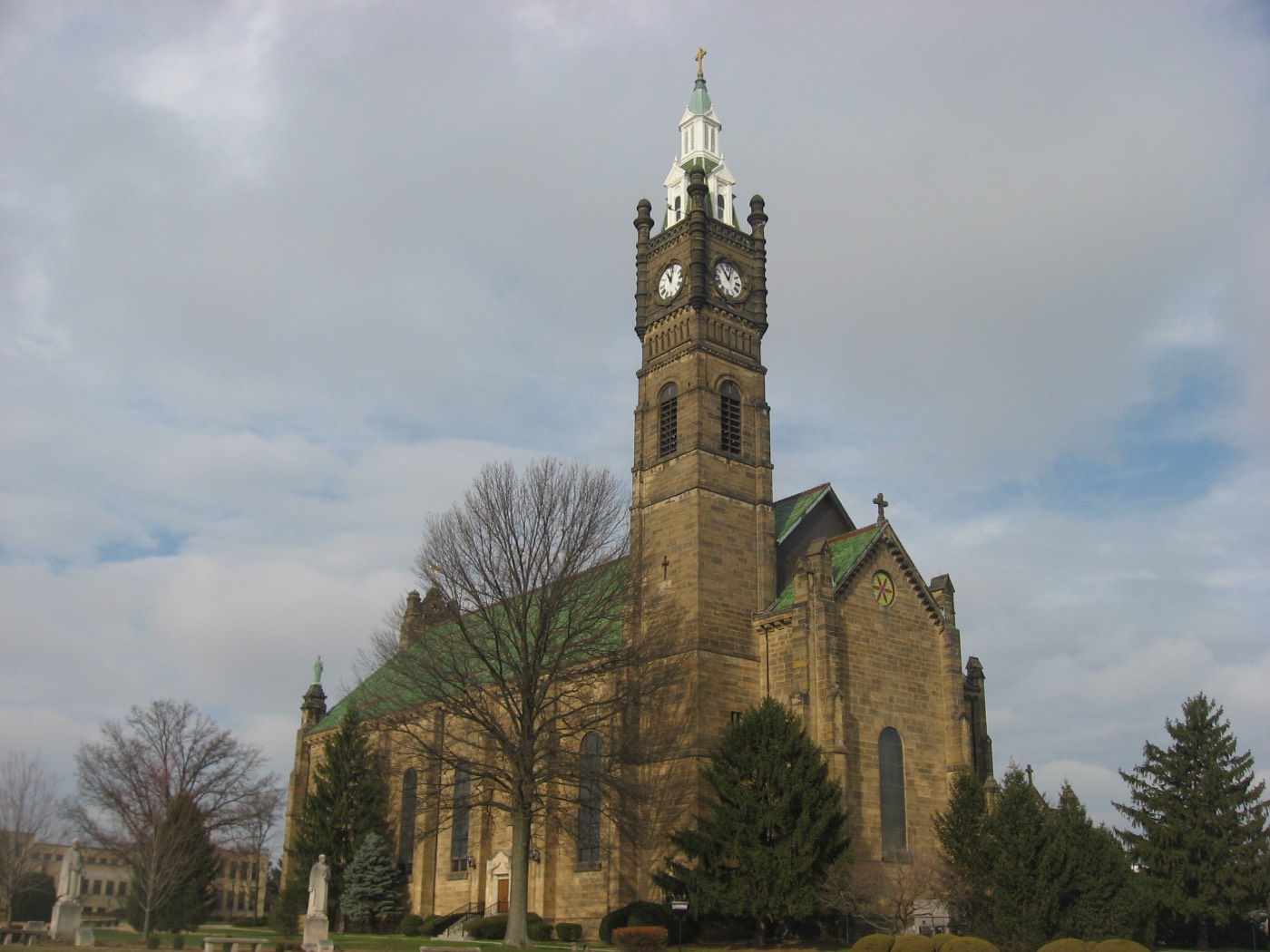
In a small Indiana city on the East Fork of the White River, the church bells still ring over a courthouse square laid out by people who crossed an ocean to keep their faith and their language. To understand the Germans in Jasper, Indiana, start at the sandstone walls of St Joseph, six feet thick in places, raised by farmers who quarried the stone and felled the timber themselves. This is a town that did not import its German heritage for the tourists. It simply never put it down.
The Place
Jasper sits in Dubois County in southwestern Indiana, the county seat since 1830 and a city since 1915. It was founded in 1818 on rolling, wooded country between the White River and the Ohio, terrain that newcomers from central Europe found unsettling in its familiarity.
Today around 16,700 people live here, according to the 2020 census. It is a manufacturing town with an unusual specialism, wood furniture, and an even more unusual reputation: one of the most thoroughly German corners of the American Midwest, where surnames like Eckerle, Schmidt and Stenftenagel still fill the phone book.
The downtown is compact and intact, a district of late nineteenth and early twentieth century brick storefronts gathered around the Dubois County Courthouse. The names on the older facades read like a passenger manifest from Baden. Jasper is one strand in Indiana’s deep immigrant fabric, alongside the Polish community of South Bend to the north and the newer Indian community of Westfield near Indianapolis.
How It Became German
Jasper did not begin as a German town. For its first two decades it was a thinly settled frontier outpost, and Germans were a distinct minority. Before the late 1830s only a handful of German families lived anywhere in the area.
What changed everything was a priest.
Father Kundek and the recruiting of a colony
In 1838 a young missionary named Joseph Kundek, born in Croatia and fluent in German, was assigned to St Joseph’s parish in Jasper. The parish itself had been organised the year before, in 1837, its first services held for fifteen families in a log structure.
Kundek understood that a Catholic colony needed people, and he set about recruiting them deliberately. He placed advertisements in German language newspapers in Cincinnati and Louisville, the two great German river cities of the Ohio Valley, describing the cheap, fertile land waiting in Dubois County.
He also did something quieter and more effective. He urged the Germans already settled around Jasper to write home to their relatives in the old country and tell them what was possible here. The letters worked. By 1841 the parish had grown from fifteen families to nearly a hundred, and a larger brick church had to be built to hold them.
The Pfaffenweiler crossing
The migration that defined Jasper came from one small place in particular. In 1847, eighty five residents of Pfaffenweiler, a village in the foothills of the Black Forest in Baden, boarded the sailing ship Tallahassee for a voyage to America that took fifty two days.
The family names they carried, Baumann, Beck, Brucker, Daeschle, Eckerle, Eckert, Kiefer, Lang, Schmidt, Steinle, Stenftenagel, Zipfel, became the founding names of Jasper and the villages around it. Many later settlers came from Pfaffenweiler and its neighbouring parishes too, so that whole sections of Dubois County were effectively transplanted from one stretch of southwest Germany.
The newcomers were Catholic, German speaking, and used to a landscape of forest and vine covered hills. Jasper offered timber, stone and farmland, and they took to it. The pattern echoes other German Catholic and pietist colonies of the era, from the communal Germans of Amana, Iowa to the Texas Hill Country settlement of New Braunfels.
Building the great church
By the 1860s the parish had outgrown its second building, and the community set out to raise something that would last. Work on the present St Joseph Church began in 1867 under Pastor Fidelis Maute, who served as both architect and foreman.
It was a project of extraordinary self reliance. Parishioners quarried and hauled the sandstone, whose finished walls run four to six feet thick. They felled and milled the yellow poplar for the fourteen great timber columns that rise from the nave, part of a roof structure said to contain more than a million board feet of hardwood. Construction stretched to 1880, and the church was consecrated in 1888.
The result is one of the most imposing Romanesque Revival buildings in rural Indiana, a cathedral in scale if not in title, built by a farming congregation with its own hands. It was listed on the National Register of Historic Places in 1980.
The wood capital takes shape
The same instinct for craft that raised the church found its way into industry. The forests around Jasper gave the German settlers timber, and timber gave them a trade. Over generations the town became a centre of furniture and cabinet making, eventually earning the nickname Wood Capital of the World.
The defining firm grew out of a struggling local concern. In 1950 a group of investors led by Arnold F. Habig took over the Midwest Manufacturing Company of Jasper, a small operation with around thirty employees. It became the Jasper Corporation and later Kimball International, which purchased the venerable W. W. Kimball piano company in 1959 and went on to make office furniture and pianos on a national scale.
Kimball was never alone. Jasper Group, Indiana Furniture, MasterBrand Cabinets and other makers turned the town into a furniture cluster with few rivals anywhere, all of it rooted in a German tradition of patient, exacting woodwork. It is a craft economy not unlike the Bavarian themed timber town of Leavenworth, Washington, though Jasper’s furniture trade grew from the land rather than from reinvention.
Keeping the heritage, then reviving it
For a long time the German character of Jasper simply was the place: the language in church, the names on the shopfronts, the food at home. After the First World War, anti German feeling across America put pressure on such communities to keep their heads down, and overt celebration faded.
There was a Pioneer German Days festival in 1957, but the tradition then lapsed for two decades. It was revived in 1979, when members of the Jasper business community launched the first Strassenfest. The annual street festival, held in late summer around the downtown square, has run ever since, and the town formally adopted Pfaffenweiler as its sister city in 1985. The persistence of German identity here parallels other concentrated heartland colonies such as Cullman, Alabama, founded as a German colony in the Deep South.
The Landmarks
St Joseph Catholic Church, 1029 Kundek Street. The great sandstone church, begun in 1867 and consecrated in 1888, is the heart of German Jasper and the reason the town exists in its present form. Its street is named for the priest who built the colony.
The Schnitzelbank Restaurant, 393 Third Avenue. Opened as a tavern in 1961 and turned into a full German restaurant in 1971, the Schnitzelbank has long served schnitzel, sauerbraten and house made sausage from local family recipes. A glockenspiel in its clock tower and Old World decor make it the town’s most visible German institution after the church.
Dubois County Courthouse, courthouse square. Built between 1909 and 1911 in a Renaissance Revival style by the firm Milburn and Heister, the courthouse anchors the downtown square that the city’s German founders laid out and around which their commerce still turns.
Dubois County Museum, 2704 Newton Street. One of the largest county museums in Indiana, its exhibits document the German settlement of the county, the furniture trade and the daily life of the immigrant farming families who built it.
The Astra Theatre, downtown Jasper. A 1936 movie house on the square, restored and reopened for live performance, the Astra is a survivor of the era when Jasper’s German American townsfolk filled its seats. It remains a centre of downtown life.
The Strassenfest, downtown square. Held annually since 1979 in late summer, the four day street festival fills downtown with bratwurst, beer gardens, polka and a parade. Visitors from the sister city of Pfaffenweiler frequently attend, renewing a link nearly two centuries old.
The Jasper Downtown Historic District. Listed on the National Register, the district preserves the county’s largest collection of late nineteenth and early twentieth century commercial buildings, the streetscape the German community built and still uses.
Where They Came From
The Germans of Jasper were overwhelmingly Catholic and overwhelmingly from the southwest of Germany, above all from Baden. The village of Pfaffenweiler, just south of Freiburg in the foothills of the Black Forest, sent the founding wave on the Tallahassee in 1847 and many more after.
Pfaffenweiler is an old place, more than twelve hundred years of recorded history, known for its stone quarries and its vineyards. Its emigrants traded one landscape of forest, stone and hillside for another that looked much the same, which was no accident: settlers chose Dubois County in part because its dense woods and rolling terrain reminded them of home.
They came for land and for the freedom to remain Catholic and German together, drawn by Father Kundek’s advertisements, by the letters of relatives, and by the gravitational pull of a colony where the Mass was said in a familiar tongue and the neighbours bore familiar names.
Jasper Today
Jasper is not a museum piece. It is a working manufacturing city of some sixteen thousand people, its economy still bound up with the furniture and cabinet plants that descend from its woodworking past. The German inheritance is woven through daily life rather than staged for visitors.
You hear it in the surnames, see it in the sandstone bulk of St Joseph rising over the town, taste it at the Schnitzelbank. Each summer the Strassenfest turns the square into a beer garden, and every few years a delegation crosses the Atlantic from Pfaffenweiler, or one from Jasper goes the other way, keeping a partnership alive that began with a 52 day crossing.
What is striking is how unforced it all feels. Many American towns rediscovered an immigrant past in time for the tourism brochures. Jasper, by contrast, mostly kept it: the faith, the food, the trades, the family names. The heritage here was never lost and so never had to be reinvented.
Frequently Asked Questions
Why are there so many Germans in Jasper, Indiana?
The Germans in Jasper, Indiana, trace mainly to the recruiting work of Father Joseph Kundek, who from 1838 advertised the area’s cheap land in German newspapers in Cincinnati and Louisville and urged settlers to write home. A founding group of eighty five emigrants from Pfaffenweiler in Baden arrived in 1847, and chain migration from southwest Germany followed.
Where in Germany did Jasper’s settlers come from?
Most came from the southwest of Germany, particularly the village of Pfaffenweiler near Freiburg in Baden, in the foothills of the Black Forest. Many settlers chose Dubois County because its wooded, rolling landscape reminded them of home.
What is St Joseph Church in Jasper?
St Joseph is the great Romanesque Revival Catholic church built by Jasper’s German community between 1867 and 1880 and consecrated in 1888. Parishioners quarried its sandstone, whose walls run four to six feet thick, and milled the yellow poplar columns themselves. It was listed on the National Register of Historic Places in 1980.
What is the Jasper Strassenfest?
The Strassenfest is a four day German street festival held in downtown Jasper each year since 1979, with bratwurst, beer gardens, polka and a parade. It revived a heritage celebration that had lapsed since the Pioneer German Days of 1957 and reflects the deep German roots of the Germans in Jasper, Indiana.
Why is Jasper called the Wood Capital of the World?
Jasper’s German settlers turned the timber of the surrounding forests into a furniture and cabinet making industry. Firms such as Kimball International, which grew out of a local company taken over in 1950, and others made the town one of the largest centres of wood office furniture anywhere, earning the nickname.
Is Pfaffenweiler Jasper’s sister city?
Yes. Jasper formally adopted Pfaffenweiler, the Baden village that sent its founding settlers in 1847, as its sister city in 1985. Delegations from the two communities continue to exchange visits, often timed to the Strassenfest.
If your family’s story passed through Jasper, or any of the places Germans have made home in America, Atlas of Home can trace that journey. From a village in the Black Forest to a sandstone church on the Indiana frontier, to wherever you are now.