
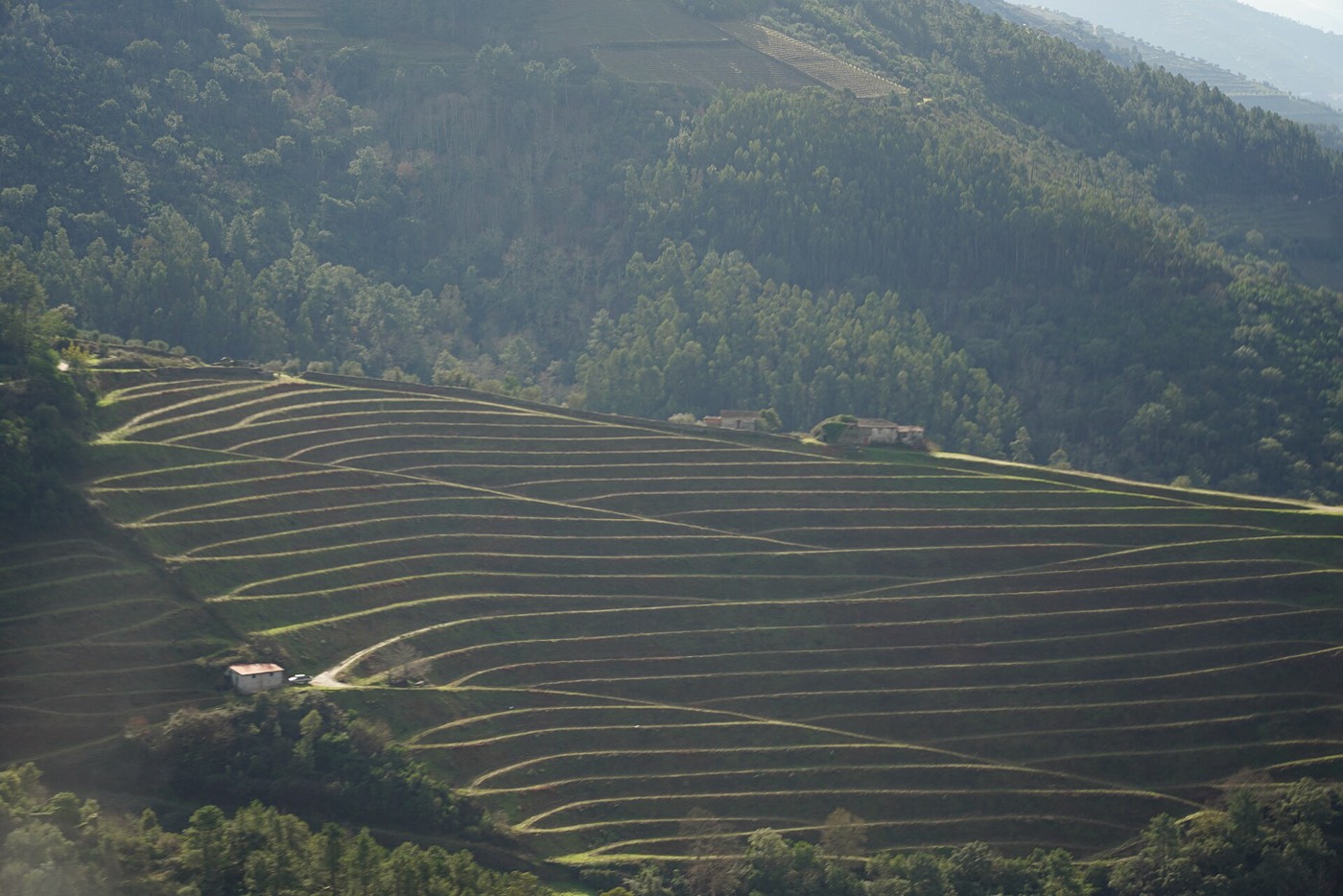
The Costa surname is a topographic name from the Latin costa, meaning a rib, which in the Romance languages came to mean a slope, a hillside or a coast. It began in Portugal, Galicia, Catalonia and northern Italy, separately, wherever families lived on the side of a hill.
What Does the Surname Costa Mean?
Costa means “the slope” or “the coast”. It comes from the Latin costa, “rib”, and the sense travelled the way anatomy often does in language: from the rib of a body to the flank of a hill, and from there to the flank of the land where it meets the sea.
So a Costa family took its name from where it lived. On a ridge, on the steep side of a valley, on a shoreline. That is the whole of it, and the plainness explains everything else about the name.
The Portuguese and Galician form often carries a particle: da Costa, in which da is a contraction of de and a, so the full sense is “of the slope”. It is a description of an address, not a claim of nobility, which is a distinction worth holding onto when you meet the fancier-looking versions of the name later.
Where the Costa Name Comes From
Costa arose independently in at least four places: Portugal, Galicia, Catalonia and northern Italy. None of these strands descends from the others. The Portuguese-speaking world holds the overwhelming majority of bearers today, but that is a result of empire and population, not of a single origin point.
Portugal and Galicia
In Portugal, Costa is one of the most common surnames in the country, sitting in the same top tier as Silva, Santos, Ferreira and Pereira. Like those names it is descriptive rather than familial, and it hardened into a fixed surname across the late medieval centuries as Portuguese record-keeping demanded stable names.
Its neighbours in the Portuguese top ten work the same way, which is why Costa behaves so much like the Rocha surname. Rock, woodland, slope. A landscape vocabulary turned into a directory of people.
The da Costa families and the Sephardi diaspora
This is the strand with the deepest paper trail. After the forced conversion of Portugal’s Jews in 1497, many New Christian families took ordinary Portuguese surnames, and Costa was among the most frequently adopted. Over the following two centuries, families under Inquisition pressure left for cities where they could live openly as Jews again.
They went to Amsterdam, Hamburg, London, Bordeaux, Livorno and the Caribbean, and the name went with them, often compounded: Mendes da Costa, Nunes da Costa, Curiel alias da Costa. Uriel da Costa, born Gabriel da Costa in Porto around 1585, studied canon law at Coimbra and held church office before the family fled to Amsterdam in 1614, where he reclaimed Judaism and then fell out spectacularly with the rabbinate over it. Alvaro Jacob da Costa (1646 to 1716) is often named as a founder of the Anglo-Sephardi community in London, whose Bevis Marks synagogue opened in 1701 and still stands.
Two cautions, both important. Not every da Costa is of converso descent, because the name was extremely common among Old Christian Portuguese families too. And the surname alone proves nothing either way. It is a lead for research, not a verdict.
Italy: Liguria and Piedmont
The Italian Costa is a separate name with the same Latin root and the same meaning. It is northern-weighted, clearly concentrated in Liguria, where it is among the commonest surnames in the region, and in Piedmont, with a further pocket in Sardinia. Recorded instances go back to the twelfth century.
A Ligurian Costa and a Portuguese Costa share an etymology and nothing else. Two hillsides, two languages, two unconnected families.
Spelling Variants and Related Names
The main variants are da Costa, Da Costa, Dacosta, Acosta, Costas and Della Costa, plus the Castilian cognate Cuesta. Compound Portuguese forms such as Costa e Silva and Mendes da Costa are common, and in Brazil the particle drops in and out of records freely.
Acosta deserves a note of its own. It is largely a Spanish reworking of da Costa, the particle absorbed into the name, which is why Uriel da Costa is also written Uriel Acosta in older scholarship. Catalan gives Costa and Costas; French gives the parallel formations Lacoste, Delacoste and Côte, from the same Latin word by a different route.
Two names look related and are not. Costanzo, the Italian name, is from the Latin personal name Constantius, “steadfast”, and has nothing to do with ribs or slopes. Costello is Irish, an anglicisation of Mac Oisdealbhaigh, the Gaelicised name taken by the descendants of the Norman Jocelyn de Angulo in Connacht. It is thought to be the earliest case of a Norman family adopting a Mac surname, and it is a pure coincidence of spelling. A Costello has no more connection to a Costa than to a Murphy.
The Costas in America
American Costas arrived in distinct waves: Azorean and mainland Portuguese from the whaling and textile era, Cape Verdeans on the packet ships, Italians in the great migration, and Brazilians from the 1980s onward.
The 2010 Census shows how that mixture reads today. Of Americans surnamed Costa, 83.16 per cent identified as White, 10.25 per cent as Hispanic, 2.26 per cent as Black, 2.11 per cent as two or more races and 1.82 per cent as Asian or Pacific Islander. Those are self-identification figures recorded on a form in 2010, not measures of ancestry, and the Portuguese and Brazilian strands sit largely inside that White share because the Census does not count Portuguese as Hispanic.
The oldest concentration is in southeastern New England, where Azorean crews joined the whaling fleet and then the mills. The Portuguese community in New Bedford, Massachusetts is the anchor of it, with a parallel settlement among the Portuguese of East Providence, Rhode Island.
Cape Verdean Costas came on the same ocean by their own route, sailing their own schooners to New Bedford and then moving inland, which is why the Cape Verdeans of Brockton carry the name in numbers. Brazilian Costas are the newest and fastest-growing group, most visibly among the Brazilians of the Ironbound in Newark. The Italian Costas landed separately and settled in the industrial north, including among the Italians of Schenectady, New York.
The colonial mechanism that carried Portuguese surnames to Brazil, Cape Verde, Goa, Angola and Mozambique in the first place is set out in our page on the Silva name, and it applies to Costa in exactly the same way.
Notable People Named Costa
Uriel da Costa (c. 1585 to 1640), born in Porto to a New Christian family, philosopher and one of the sharpest sceptics of his century, twice excommunicated in Amsterdam.
Lorenzo Costa (1460 to 1535), Italian Renaissance painter of the Ferrarese school who worked in Bologna and later for the Gonzaga court at Mantua.
Isaäc da Costa (1798 to 1860), Dutch poet from an aristocratic Amsterdam Sephardi family, and a nephew of the economist David Ricardo through his mother Rebecca.
Lúcio Costa (1902 to 1998), Brazilian architect and urban planner who designed the master plan for Brasília.
Gal Costa (1945 to 2022), Brazilian singer, a central voice of Tropicália and one of the great interpreters of the Brazilian songbook.
António Costa (born 1961), Prime Minister of Portugal from 2015 to 2024 and President of the European Council. His father was the Goan-Portuguese novelist Orlando da Costa, born in Lourenço Marques in colonial Mozambique, which puts three continents of the Portuguese world into one family in a single generation.
How Common Is Costa Today?
Costa is the 904th most common surname in the United States, carried by 38,265 Americans at the 2010 Census. Worldwide it is far bigger than that suggests: Brazil alone accounts for roughly seven in ten bearers, and it is a top-tier name in Portugal, Mozambique, Guinea-Bissau and East Timor.
| US rank (2010 Census) | #904 |
|---|---|
| Americans with the name | 38,265 |
| Origin | Portuguese, Italian, Galician and Catalan (independently) |
| Meaning | Slope, hillside or coast, from Latin costa, “rib” |
Frequently Asked Questions
What does the surname Costa mean?
It means slope, hillside or coast. The root is the Latin costa, “rib”, which shifted in the Romance languages to describe the flank of a hill and then a coastline. It was given to families who lived on such ground.
Is Costa Portuguese or Italian?
Both, genuinely and separately. The name arose on its own in Portugal, Galicia, Catalonia and northern Italy, from the same Latin word in each place. Numerically the Portuguese-speaking world dominates, with Brazil holding around 71 per cent of bearers worldwide, while the Italian Costa is concentrated in Liguria and Piedmont.
Where does the Costa family come from?
There is no single Costa family. The name attached itself to unrelated households across Portugal, Galicia, Catalonia and northern Italy, then spread through the Portuguese empire to Brazil, Cape Verde, Goa, Angola, Mozambique and Timor. Tracing your own line means tracing a parish, not a clan.
How common is the surname Costa?
In the United States it ranks 904th, with 38,265 bearers recorded in the 2010 Census. Globally it is far more common, standing among the top handful of surnames in Portugal and Brazil.
Is there a Costa family crest or coat of arms?
No, and this is worth being blunt about. In every serious heraldic tradition, arms are granted to an individual and pass to their direct descendants, never to everyone who happens to share a surname. With a topographic name that arose independently in four countries, the idea is doubly meaningless. A site selling you a “Costa family crest” is selling a decoration, not a lineage.
Is the da Costa name Jewish?
Sometimes, but not usually, and never automatically. Costa was one of the surnames commonly taken by Portuguese New Christians after 1497, and several famous Sephardi families in Amsterdam, Hamburg, London and Bordeaux carried it. It was equally common among Old Christian Portuguese families, so the name is a starting point for research rather than evidence of descent.
If your family carries the Costa name, its route from a Portuguese or Italian hillside to America is traceable. Atlas of Home can follow it from the parish on the slope to the port your family sailed from, to wherever they landed, and to wherever you are now.
Sources include the Wikipedia surname study for Costa and the Jewish Museum London on the Sephardi resettlement era.