
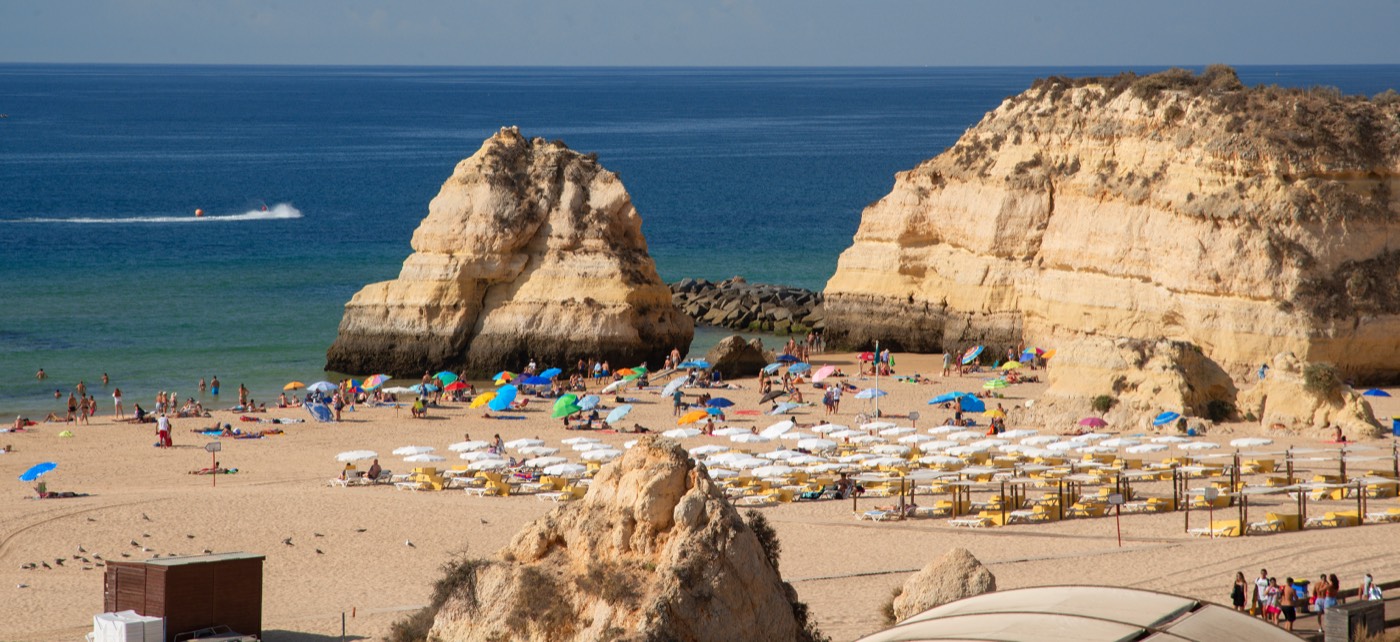
The Rocha surname means “rock”. It is a topographic name from Portugal and Galicia, given to families who lived beside a distinctive crag or outcrop, and it is now carried by well over a million people from the Algarve to the San Joaquin Valley.
What Does the Surname Rocha Mean?
Rocha means rock, crag or cliff. It is a topographic surname from the Portuguese and Galician word rocha, given to a family because of where they lived rather than who their father was or what work they did.
The word itself comes from Vulgar Latin rocca, meaning a rocky mass. That root is genuinely obscure. Some philologists trace it to a pre-Latin substrate word, possibly Celtic, comparing Breton roch. Others derive the Romance forms instead from Latin rupes, “rocks”. The honest position is that the ultimate origin is unsettled, and reputable dictionaries say so.
What is not disputed is the mechanism. A medieval clerk needed to tell one João from another, and the simplest way was to say where he lived: João da Rocha, John of the rock. The rock in question was a real, visible thing, a headland, a boulder above a field, a crag with a fortified house on it.
That is why the name is so common. Rocky ground is not rare in Iberia, and every parish with a notable outcrop could produce its own Rocha family, independently, without any connection to the next one over the hill.
Where the Rocha Name Comes From
Rocha comes from Portugal and from Galicia in north-western Spain, where it began as a place name attached to rocky ground and then transferred to the people who lived on it. It spread from there across the Portuguese and Spanish empires.
The Portuguese and Galician heartland
Portugal is full of small places called Rocha, and the word survives in living toponyms: Praia da Rocha, the cliff-backed beach at Portimão in the Algarve, is literally “beach of the rock”. Galicia has its own, including Rocha de Ginzo in the province of Pontevedra.
Surnames fixed and became heritable in Iberia between roughly the thirteenth and fifteenth centuries, and Rocha was one of the descriptive labels that hardened into a family name during that long process. Today it is the thirty-first most common surname in Portugal, borne by around one Portuguese person in 187.
da Rocha, and what the particle means
The full form is da Rocha, “of the rock”. The particle is not a mark of nobility, whatever crest sellers imply. It is a grammatical fossil that tells you exactly what kind of surname this is: a place, not a person.
Many families dropped it. In Spanish records the same construction appears castilianised as de la Rocha, the form carried by the family of Rage Against the Machine’s singer. American clerks shortened almost all of it to plain Rocha.
Across the Atlantic and the empire
Portuguese expansion took the name to Brazil, Cape Verde, Angola, Mozambique and Goa, and Spanish settlement took its Galician branch into the Americas from the sixteenth century. The result is a name that is now overwhelmingly a New World one. Brazil alone holds roughly 722,000 Rochas, making it the forty-sixth most common surname in the country, while Cape Verde has the highest density of Rochas anywhere on earth.
Mexico is the second largest concentration, with about 143,000 bearers. That figure matters more than it looks, because it is the reason the American Rocha story is not the one most people expect.
Spelling Variants and Related Names
The main variants are Rocha, da Rocha, Darocha, de la Rocha and Rochas. Because the root spread through every Romance language, Rocha also has a large family of cognates that look like relatives but usually are not.
- Spanish and Catalan: Roca, with the Catalan plural Roques and the compound Rocafort.
- Italian: Rocca, Rocchi, La Rocca and Della Rocca.
- French: Roche, La Roche, Laroche, Delaroche and Rocher.
- English: Roach and Rock, from Old French roche by way of Norman settlement, though English Roach can also come from the fish.
These are parallel inventions, not branches of one tree. A Rocha in Braga, a Rocca in Calabria and a Roche in Normandy share a Latin word and a landscape feature, not an ancestor. It is worth saying plainly, because a great deal of amateur genealogy has been built on the opposite assumption.
The Rochas in America
Rochas reached America along four distinct routes: Mexican families moving north, Portuguese whalers and mill hands into New England, Cape Verdeans on the packet ships, and Brazilians from the 1980s onwards. The Mexican strand is by far the largest.
The 2010 Census recorded how Americans named Rocha described themselves, and the answer is decisive: 81.08 per cent identified as Hispanic and 16.45 per cent as white. Those are self-identification proportions, not a measure of descent, but they tell you where the weight of the American name sits. Rocha in the United States is chiefly a Mexican American surname carried on a Portuguese and Galician word.
Those Mexican Rochas descend from Iberian settlers in New Spain and moved north with the labour migrations of the twentieth century, into Texas, Illinois, Arizona and above all California’s agricultural interior, where Mexican families in Fresno built one of the largest such communities in the country.
The Portuguese route is older and much smaller. Azorean and mainland crews joined New England whalers from the early nineteenth century and stayed, and their descendants filled the cotton mills of southern Massachusetts. You still find the name thick on the ground among the Portuguese of New Bedford and the Portuguese of Taunton, alongside the other great Lusophone names such as Silva and Santos.
The same whaling ships carried Cape Verdeans, who came on their own account from the 1860s and ran the packet trade in their own vessels. The Cape Verdeans of New Bedford brought a Rocha population that, per head, was denser than Portugal’s own.
Brazilians arrived last and fastest, from the 1980s, settling in the Ironbound in Newark and in Framingham, Massachusetts, often into streets Portuguese Rochas had reached a century earlier.
Notable People Named Rocha
Glauber Rocha (1939 to 1981) was the driving figure of Brazil’s Cinema Novo, director of Black God, White Devil and winner of best director at Cannes in 1969 for Antonio das Mortes.
Zack de la Rocha (born 1970) is the singer and lyricist of Rage Against the Machine. He was born in Long Beach, California, to the Chicano painter and Los Four member Beto de la Rocha.
Ephraim “Red” Rocha (1923 to 2010), born in Hilo to a Portuguese Hawaiian family, played nine seasons in the NBA, won the 1955 title with the Syracuse Nationals and later coached the University of Hawaii.
Chuck Rocha (born 1970), a Mexican American from Tyler, Texas, went from rubber workers’ union organiser to one of the Democratic Party’s best-known Latino campaign strategists.
Simone Rocha (born 1986) is a Dublin-born fashion designer, daughter of the designer John Rocha, whose Portuguese and Chinese family came from Hong Kong.
How Common Is Rocha Today?
Rocha is the 613th most common surname in the United States, carried by 55,251 Americans at the 2010 Census. Worldwide it is far more common than that suggests, with over a million bearers concentrated in Brazil, Mexico and Portugal.
| US rank (2010 Census) | #613 |
|---|---|
| Americans with the name | 55,251 |
| Origin | Portuguese and Galician-Spanish (topographic) |
| Meaning | Rock, crag, cliff |
Frequently Asked Questions
What does the surname Rocha mean?
Rocha means “rock” or “crag” in Portuguese and Galician. It was given to families who lived beside a prominent rock, outcrop or cliff, which makes it a topographic surname rather than one taken from a father’s name or a trade.
Is Rocha Portuguese or Mexican?
The word and the name are Portuguese and Galician in origin, but most Rochas alive today are Brazilian or Mexican. In the United States the balance tips decisively towards Mexican heritage: 81.08 per cent of Americans named Rocha identified as Hispanic in 2010.
Where does the Rocha family come from?
There is no single Rocha family. The name arose separately in dozens of places across Portugal and Galicia wherever a distinctive rock stood, so unrelated Rocha lines were created independently. Tracing yours means tracing a parish, not a clan.
How common is the surname Rocha?
It ranks 613th in the United States with 55,251 bearers, and it is far more common in the Lusophone world. Brazil has around 722,000 Rochas and Portugal about 55,700, while Cape Verde has the highest concentration of any country.
Is there a Rocha family crest or coat of arms?
No. In Portuguese, Spanish and every other European heraldic tradition, arms are granted to an individual and pass to their direct descendants, never to everyone who happens to share a surname. Sites selling a “Rocha family crest” are selling a decoration, not a lineage, and given how many unrelated Rocha lines exist the idea is doubly meaningless here.
What does “da Rocha” mean, and why do some families have it?
Da Rocha means “of the rock”, and the particle is the original grammar of the name rather than any badge of rank. Many families dropped it over time, and Spanish speakers castilianised the same construction as “de la Rocha”.
If your family carries the Rocha name, its route from an Iberian crag to America is traceable. Atlas of Home can follow it from the parish that named the rock to wherever your family landed, and to wherever you are now.
Further reading: the Rocha surname entry at Wikipedia, and the Wiktionary entry for Latin rocca on the disputed root.