
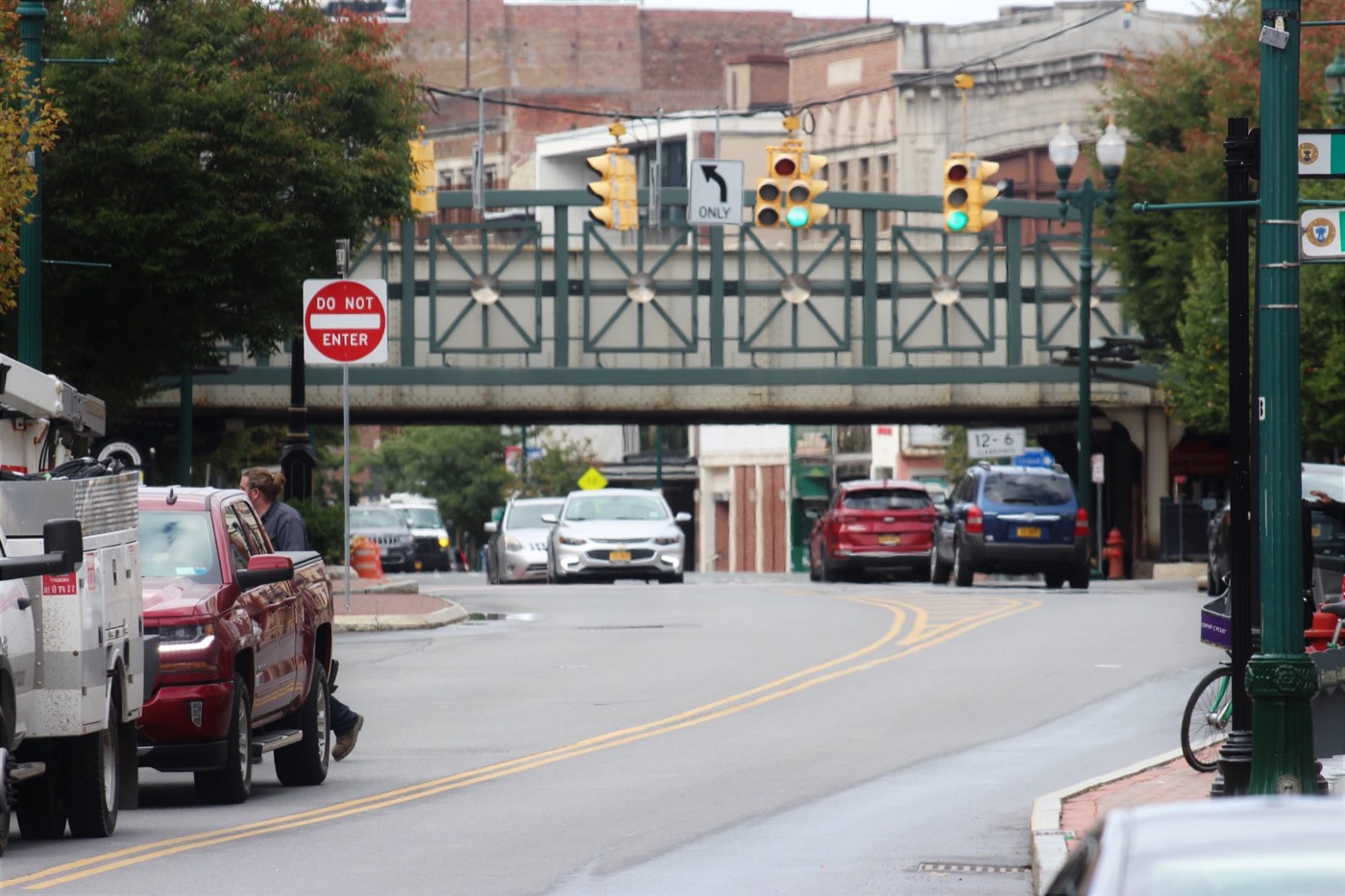
On North Jay Street, before the city is fully awake, the smell reaches the pavement first. Salt, char, the deep nutty scent of bread pulled from a coal-fired brick oven that has not gone cold since 1914. That oven, and the family that has tended it for more than a century, is the clearest surviving thread of the story of the Italians in Schenectady, New York, a community that came for the factories, stayed for the streets they built, and turned a corner of an upstate mill city into a place still called Little Italy.
The Place
Schenectady sits on the Mohawk River in New York’s Capital District, a short drive northwest of Albany. For most of the twentieth century it was a one-word town: factories. General Electric had its headquarters and sprawling works here, and the American Locomotive Company, known as ALCO, built engines that ran across the continent.
The two giants gave the city its nickname, the Electric City, and its lifeblood. They also gave it people. Between 1880 and 1930, tens of thousands of immigrants poured into Schenectady to work the shop floors, and a large share of them came from Italy.
They did not settle evenly. They clustered, by ward and by street, near the work and near each other, in neighbourhoods that still carry the shape of those years.
How It Became Italian
The factories that called them
The pull was simple and industrial. By 1910, roughly one-third of employed Italian and Polish men in Schenectady worked at General Electric. Others took the heavier, better-paid work at ALCO, where boilermakers and iron moulders could earn three to four dollars a day, against the two and a half to three dollars paid to electrical apparatus workers.
Italians, more than Poles, gravitated toward GE and toward the building trades and small commerce that grew up around a booming city. Where there were wages, there were boarders, then families, then whole streets. The pattern repeated across the industrial Northeast, from the Italians in Worcester, Massachusetts to the brass-mill Italians in Waterbury, Connecticut.
Front Street and the first colony
The earliest and largest Italian neighbourhood formed in the First Ward, along Front Street, in the old Stockade end of the city. By 1910 that single ward counted 1,368 foreign-born Italians, the densest Italian quarter in Schenectady.
It was crowded, poor, and close to the river and the rail. It was also the seedbed. From Front Street the community spread outward as families found steadier work and a little more room.
The spread to Mont Pleasant
The neighbourhood most associated with Schenectady’s Italians today is Mont Pleasant, the hillside Ninth Ward above the southern flats. In 1910 it held about 410 Italians. By 1927 that number had grown to roughly 4,300, a tenfold rise in less than two decades.
Mont Pleasant was a working person’s neighbourhood of two-family homes, shared with Polish and Jewish neighbours, each group keeping its own churches, clubs, and corner shops, in the same way the downstate Jews in Midwood, New York and Jews in Forest Hills, New York built their own parallel worlds. For the Italians it became the centre of gravity, the place where the festivals were held and the family bakeries stayed open.
Other pockets filled in alongside it. Weaver Street, near the GE works in the Fifth Ward, held some 713 Italians. Strong Street in the Thirteenth Ward had around 420. Manhattan Street grew quickly. Across these streets the community swelled: an estimated 1,500 Italian adults and 1,200 children around 1904, roughly 9,000 by 1917, and by the 1920s a citywide Italian population of nearly 17,000.
Building the institutions
A community that size needed its own places to gather and pray. St. Anthony’s, the Italian national parish, was organised in 1902 in a former Presbyterian chapel on Park Place, a modest room seating only 162. It grew into the heart of Italian Catholic life in the city.
Mont Pleasant got its own anchor in the mid-1920s with Our Lady of Mount Carmel, built on Pleasant Street. Around it gathered banks, barbers, and benefit societies. Pasquale DiMarco, a barber who also ran a small bank, served as a trustee of St. Anthony’s, the kind of figure who held a hard-pressed community’s savings and its sacraments at once.
The wall of the city
Acceptance came slowly. Schenectady’s established families were not eager to share. City officials were reluctant to hire immigrants for municipal jobs, and the Italians were barred from social institutions such as the Mohawk Golf Club.
So the community built parallel ones. Mutual-benefit societies, regional clubs tied to home towns, Italian-language banks like La Banca Italiana, and a long row of Italian-owned shops along North Jay Street that locals simply called Little Italy. By the 1950s, that tight-knit street life was at its height.
The Landmarks
Perreca’s Bakery, 33 North Jay Street. In 1913 Salvatore and Carmella Perreca left the village of Nola, just outside Naples, and came to Schenectady to make bread. They opened in 1914 and built a coal-fired brick oven that has been baking the same hard-crusted loaf ever since. Owned by the same family for more than a century, now run by the founders’ descendants including Maria Perreca Papa, it is the single most famous Italian institution in the city.
More Perreca’s Italian Kitchen, North Jay Street. Next door to the bakery, the family’s restaurant turns that bread into full meals: pasta, seafood, and the Easter pies, the ham pie called pizzagaina, the rice and ricotta pies that mark the calendar for Italian-American families across the region.
Our Lady of Mount Carmel Church, 1255 Pleasant Street. The parish church of Mont Pleasant and the keeper of the city’s great Italian feast. Each July, around the feast of Our Lady of Mount Carmel on the sixteenth, the parish grounds fill with food, music, carnival rides, and raffles for the Mount Carmel Festa, a tradition tended by parishioners year after year.
St. Anthony’s Church. The mother parish of Italian Catholic Schenectady, organised in 1902. Its June feast of St. Anthony of Padua remains one of the community’s anchor celebrations, a continuity that reaches back to the first Front Street colony.
The Little Italy Memorial, North Jay Street. Dedicated in 2004 by the City of Schenectady, the memorial honours the Italian immigrants who arrived at the close of the nineteenth century, worked the local industries, opened businesses, and held onto their language and traditions. It stands on the same street where the shops once ran two dozen deep.
Civitello’s, North Jay Street. One of the long-standing Italian businesses across from Perreca’s, part of the cluster of nearly two dozen Italian-owned shops that gave North Jay Street its Little Italy name. The street, more than any single address, is the landmark.
Order Sons of Italy in America, Gabriele d’Annunzio Lodge No. 321. The local lodge of the national fraternal order carries the community’s organisational life forward, the modern descendant of the mutual-benefit societies that once filled the gap left by a city that would not let Italians join its clubs.
Where They Came From
The Italians of Schenectady came overwhelmingly from the south, the Mezzogiorno, the part of Italy that sent the great waves of migrants to America between the 1880s and the 1920s. The Perreca family’s village of Nola, in the hills outside Naples in Campania, is typical of that origin.
Others traced back to Sicily and to Calabria, the toe of the peninsula. The regional clubs that formed in the city, tied to specific towns and provinces such as Fondi, Alvignano, and the Abruzzi, are a map of those home places, each one a knot of relatives and neighbours who followed each other across the Atlantic.
This was chain migration in its purest form. One man came for a GE wage, sent word and money home, and brought a brother, a cousin, a future wife. The streets of Mont Pleasant and Front Street were, in effect, the old villages reassembled around a factory whistle, much as they were for the Italians in Rochester, New York and the shoe-factory Italians in Endicott, New York further west.
Schenectady Today
The factories that built the community are largely gone. GE shrank its Schenectady footprint over the decades, ALCO closed its locomotive works, and the city went through the long, hard middle years that hollowed out so many northeastern mill towns. Mont Pleasant, like much of Schenectady, carries the marks of that decline.
Yet the Italian thread did not snap. Schenectady County still counts close to 27,000 residents of Italian ancestry, around one in six people, and the city itself holds roughly 7,000. The names, the parishes, and the food remain woven into the place.
The clearest proof is the easiest to taste. Perreca’s still lights its 1914 oven every morning, drawing visitors from across the country, and More Perreca’s keeps the table set next door. Our Lady of Mount Carmel still throws its July festa. The Little Italy memorial still stands on North Jay Street. The community that the Electric City once tried to keep at its edges is now, quietly, one of the things the city is best known for.
If your family’s story passed through Schenectady, or any of the places Italians have made home in America, Atlas of Home can trace that journey. From a village outside Naples to a coal-fired oven on North Jay Street, to wherever you are now.
Frequently Asked Questions
Where did the Italians in Schenectady, New York settle?
The first and largest Italian colony formed along Front Street in the First Ward, near the river and rail lines. As families grew more settled they spread to Mont Pleasant, Weaver Street, Strong Street, and Manhattan Street, with Mont Pleasant becoming the lasting centre of Italian life. The shops clustered on North Jay Street, still known as Little Italy.
Why did Italians move to Schenectady?
They came for industrial work. General Electric and the American Locomotive Company were hiring on a vast scale between 1880 and 1930, and Italian immigrants, like Polish ones, filled the factory floors. By 1910 about a third of employed Italian men in the city worked at General Electric.
What is Perreca’s Bakery?
Perreca’s is a family bakery at 33 North Jay Street, opened in 1914 by Salvatore and Carmella Perreca, who emigrated from the village of Nola near Naples. It still bakes its hard-crusted Italian bread in the original coal-fired brick oven, and has been run by the same family for more than a hundred years.
What festivals do the Italians in Schenectady, New York hold?
The best-known is the Mount Carmel Festa, held each July at Our Lady of Mount Carmel on Pleasant Street, around the feast day of the sixteenth. St. Anthony’s parish holds its own feast of St. Anthony of Padua in June. Both feature Italian food, music, and family gatherings rooted in the old neighbourhoods.
How many Italians live in Schenectady today?
Schenectady County is home to roughly 27,000 residents of Italian ancestry, about 16.8 percent of the county’s population. The city of Schenectady itself counts around 7,000 residents of Italian descent, keeping it one of the most Italian places in the Capital District.
Where did Schenectady’s Italian immigrants come from in Italy?
Most came from southern Italy, the Mezzogiorno, including Campania around Naples, Sicily, and Calabria. The regional clubs that formed in the city were tied to specific home towns and provinces such as Fondi, Alvignano, and the Abruzzi, reflecting the chain migration that linked Schenectady street by street to particular Italian villages.