
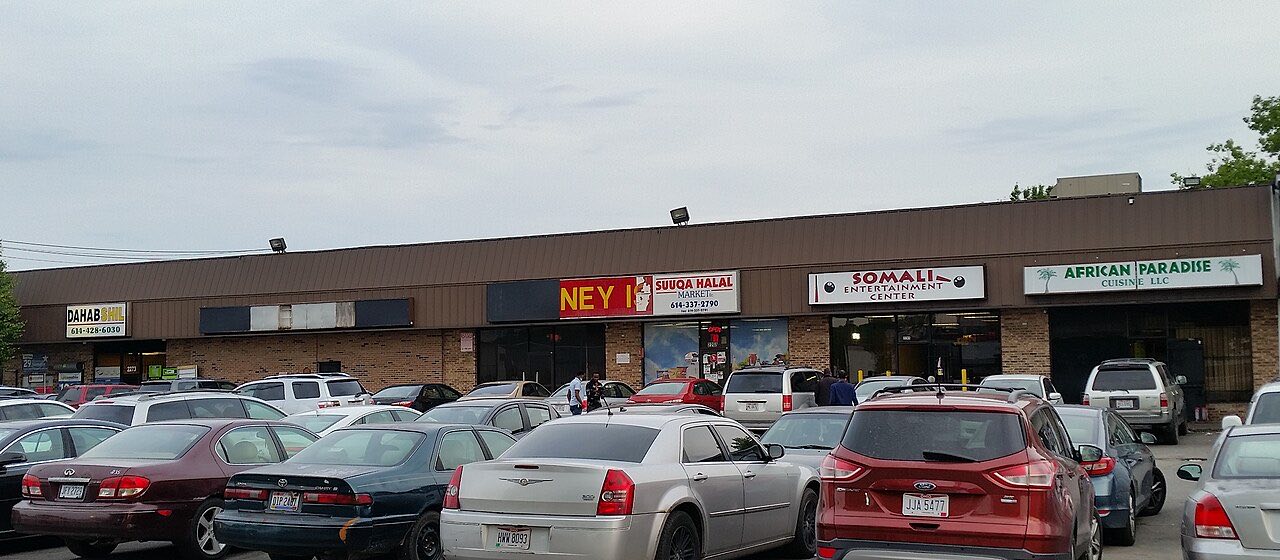
On a weekday afternoon along Morse Road, the parking lot of a low brick plaza fills up the way a town square once did. A sign for Dahabshiil, the money-transfer house that wires cash to Mogadishu and Hargeisa, hangs beside Suuqa Halal Market, a Somali entertainment shop, and an African restaurant. Women in bright direh dresses move between a tailor and a grocer stacked with sacks of basmati and frankincense. Men drink cardamom tea and argue politics in Somali. This stretch of north Columbus is home to the second-largest Somali community in the United States, and on Morse Road you can hear it, smell it, and taste it.
Columbus: The Place
Columbus sits in the flat center of Ohio, the state capital and its largest city, laid out around the Scioto and Olentangy rivers. The Somali community clusters on the north and northeast sides: the Northland district around Morse Road, and the North Linden corridor along Cleveland Avenue, both threaded by Interstates 71 and 270. The housing here is mid-century apartment complexes and modest postwar homes, much of it built for a suburban retail boom that has since moved on.
How Columbus Became a Somali Capital
Before the Somalis
For a generation, north Columbus revolved around Northland Mall. It opened on August 13, 1964, the first of the city’s four directionally named shopping centers, anchored by Sears, Lazarus, and JCPenney. Through the 1980s it was one of the most prosperous addresses in central Ohio, drawing shoppers from the affluent northern suburbs.
Then the suburbs kept moving outward. New malls at Easton and Polaris opened in the late 1990s and early 2000s, and in the fall of 2001 all three Northland anchors decamped to Polaris at once. The mall closed for good on October 31, 2002, after thirty-eight years, and was torn down in 2004. The big-box stores along Morse Road emptied out behind it. Cleveland Avenue, once a busy commercial spine, became a place people drove through rather than stopped in.
The Somalis Arrive
Somalia collapsed into civil war in 1991. As the central government fell and famine spread, hundreds of thousands fled, most into refugee camps in Kenya and Ethiopia. The United States began resettling Somali refugees that same year, and Columbus, with its cheap rent and steady demand for warehouse and factory labor, quickly became a destination.
The first arrivals were small in number, but they did the work that built everything after. Earlier settlers welcomed newly arrived relatives, and word traveled fast. Somalis who had been placed in colder, costlier cities, including the Twin Cities, heard about the affordable housing and open jobs and packed up. This secondary migration, not initial resettlement alone, is what made Columbus grow. People moved to be near family, near a mosque, near a grocer who stocked halal meat and spoke their language.
Ohio’s affordable cities drew other refugee populations the same way, among them the Bhutanese community that resettled in Akron. For Somalis, Columbus offered the rare combination of cheap rent, abundant work, and a community already large enough to feel like home.
In 1996, a handful of these immigrants founded the Somali Community Association of Ohio, the first grassroots organization to serve the new arrivals, helping with housing, English classes, job placement, and the paperwork of starting over. The Twin Cities had a head start on services, built decades earlier for Hmong refugees, and Minnesota’s Somali community around Cedar-Riverside in Minneapolis stayed the larger of the two. Columbus, though, was where the entrepreneurs went.
Columbus at Its Peak
The community’s defining move was retail. In 2000, Somali entrepreneurs converted an empty warehouse off Cleveland Avenue, near the shuttered Northern Lights shopping center, into the first Somali mall, known to everyone as Banadir after the region around Mogadishu. A landlord partitioned the floor into roughly fifty kiosks and rented them cheap. One of the partners, Abdullahi Warsame, who had started with a single grocery store, eventually bought the building and grew it toward seventy and then eighty small shops.
Two years later came the landmark that crystallized the whole story. When Northland Mall died in 2002, a Somali clothing seller named Ahmed Mohamed found an abandoned TJ Maxx on Morse Road, leased it, and invited other Somalis to fill it with stalls. He called it the Global Mall. It still operates today at 2210 Morse Road with around thirty businesses under one roof.
By the mid-2000s, halal grocers, hawala money-transfer offices, travel agencies, tailors, barbers, and restaurants lined Morse Road and Cleveland Avenue. The Somali population climbed into the tens of thousands. Today estimates for central Ohio run from roughly 45,000 to upward of 60,000, with the community supporting somewhere between 500 and well over 1,000 Somali-owned businesses, one of the highest rates of business ownership of any Somali community in the country.
The Change
The second generation changed the center of gravity. Children who arrived as toddlers, or were born in Columbus, grew up speaking English in the city’s public schools and went on to The Ohio State University. They became attorneys, engineers, nurses, and teachers, and then they entered public life.
The breakthrough came in November 2022, when Columbus voters sent Ismail Mohamed and Munira Abdullahi to the Ohio House of Representatives. They were the first Somali Americans ever elected to the state legislature, sworn in together for the 135th General Assembly. The malls their parents built had produced the state’s first Somali lawmakers.
The Landmarks of Somali Columbus
Global Mall (2210 Morse Road) is the community’s commercial heart. Ahmed Mohamed opened it in 2002 in the carcass of a TJ Maxx after Northland Mall collapsed, and it grew into a warren of roughly thirty Somali-owned shops, a grocery selling Somali, Kenyan, and Pakistani goods, a barber, an accounting firm, and a prayer room. Vendors who could never afford a standalone storefront got a stall and a built-in crowd.
Banadir Mall (around 3246 Cleveland Avenue) was first. Somali traders carved up an old warehouse into kiosks in 2000, and Abdullahi Warsame, who began with one grocery, bought the building and expanded it to dozens of shops: truck and transport companies, travel agents, gold dealers, healthcare agencies, and money-transfer counters. It anchored the revival of a Cleveland Avenue corridor that had been fading for years.
The Somali Community Association of Ohio (3422 Cleveland Avenue) has been the community’s institutional backbone since 1996. Founded by immigrants for immigrants, it has served thousands with job training, family literacy, after-school programs, and interpretation, the quiet infrastructure behind the storefronts.
Abubakar Asiddiq Islamic Center began in 2004 in a small storefront on Sullivant Avenue in the Hilltop. The congregation raised about $2.8 million and moved in 2014 to a 30,000-square-foot mosque on roughly ten acres at 591 Industrial Mile Road. Around 7,000 worshippers come each week, and its dugsi classes teach Quran and Arabic to a generation born in Ohio. It is the largest Somali-run mosque among the city’s roughly twenty mosques.
Hoyo’s Kitchen brought Somali food into the mainstream. Brothers AB and Mohamed Hassan, working with their mother, opened the first location in 2014 near 161 and Cleveland Avenue. Hoyo means mother in Somali, and bowls of chicken suqaar and sambusas won over diners far beyond the community. Hoyo’s now sells its food from a stall at the downtown North Market alongside Columbus’s best-known vendors.
Northland Mall (demolished, near Morse Road and Karl Road) is the ghost at the center of the story. The 1964 retail palace that drew Columbus’s suburban shoppers closed in 2002 and was leveled in 2004, replaced by the Northland Village government and retail complex. Its death emptied the storefronts that the Somali community would soon fill.
Where the Columbus Somalis Came From
Most trace their roots to southern and central Somalia, the regions hit hardest when the state collapsed in 1991, including the area around Mogadishu that gives Banadir Mall its name. Few traveled in a straight line. Families spent years in the Kenyan refugee camps at Dadaab and Kakuma, or in Ethiopia, before a resettlement number came through, which is why so many Columbus Somalis also speak Swahili.
A distinct thread is the Somali Bantu, a long-marginalized minority targeted during the war. Around 12,000 were resettled across some fifty American cities through a special United Nations program in the early 2000s, and many later made their way to Columbus to join relatives and a community that already had mosques, halal food, and interpreters. They settled into the same northeast-side corridors and added their own institutions to the mix.
Somali Columbus Today
The plazas are thriving. Morse Road and Cleveland Avenue carry a density of halal grocers, restaurants, money-transfer offices, and small shops that has few rivals outside Minnesota, and the entrepreneurial energy that built them has not slowed. New markets keep opening in the same strip malls that big-box retail abandoned.
The community is also visibly American now. Its representatives sit in the Ohio Statehouse, its young people fill OSU lecture halls and Columbus hospitals and law offices, and every July 1 the city lights up for Somali Independence Day, with City Hall washed in the pale blue of the Somali flag. The second generation moves easily between a Friday sermon at Abubakar Asiddiq and a shift downtown.
Like Somali communities elsewhere, including the smaller one that put down roots in Lewiston, Maine, Columbus’s has weathered suspicion and political hostility. It has answered the way it always has, by opening another store, electing another neighbor, raising another child who calls Ohio home. The dead malls of north Columbus gave the city its largest immigrant success story, and that story is still being written.
Frequently Asked Questions
Why did Somalis settle in Columbus, Ohio?
Somalis came to Columbus starting in the early 1990s because rent was cheap and warehouse and factory jobs were plentiful. Early arrivals welcomed relatives, and many Somalis in colder, costlier cities moved here through secondary migration. That chain migration made the Somalis in Columbus the second-largest such community in the country.
Is the north side of Columbus still a Somali area today?
Yes. The Northland district along Morse Road and the North Linden corridor on Cleveland Avenue remain the heart of Somali Columbus, lined with halal grocers, restaurants, money-transfer offices, and Somali-owned malls. The community continues to grow rather than disperse.
What are the most famous Somali landmarks in Columbus?
The best known is the Global Mall at 2210 Morse Road, opened in 2002 in a former TJ Maxx, along with Banadir Mall on Cleveland Avenue. Hoyo’s Kitchen brought Somali cuisine into the downtown North Market, and the Abubakar Asiddiq Islamic Center is the largest Somali-run mosque in the city.
Where did the Somalis in Columbus come from?
Most came from southern and central Somalia, the regions worst affected by the civil war that began in 1991. Many spent years in refugee camps in Kenya or Ethiopia first. A distinct group, the Somali Bantu, arrived through a special United Nations resettlement program in the early 2000s.
When did Somalis first arrive in Columbus?
The first Somali refugees reached Columbus in the early 1990s, after Somalia’s government collapsed in 1991. Numbers grew quickly through the mid-1990s and 2000s as secondary migration drew Somalis from other US cities. By the 2000s, Columbus held the second-largest Somali community in the United States.
If your family’s story passed through the plazas of Morse Road or a refugee camp on the road to Ohio, that history is worth keeping.