
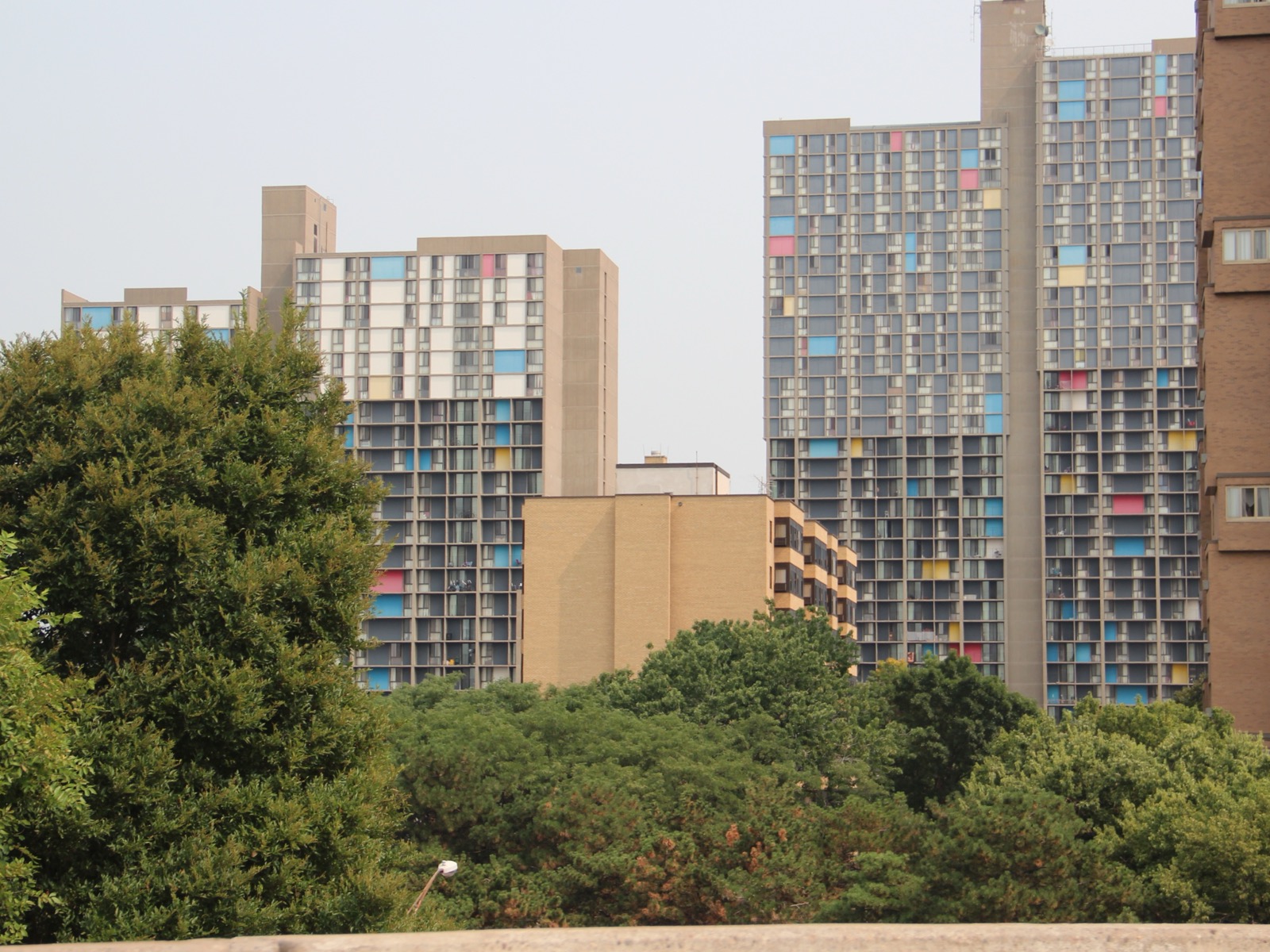
They call it Little Mogadishu. You will not find that name on any street sign. But step off the Blue Line at the West Bank station on a summer evening in Ramadan, and the air carries sambusas frying in oil and cardamom-spiced shaah brewing in steel pots. Women in jilbabs cross Cedar Avenue toward Dar Al-Hijrah for maghrib. Above it all, the towers of Riverside Plaza catch the last of the light, red and blue and yellow panels glowing against the Minneapolis skyline.
This is the largest Somali community in the United States, built here in a single generation.
Cedar-Riverside, The Place
Cedar-Riverside sits in a tight pocket of the city, hemmed in by Interstate 94 to the north, the Mississippi River to the east, and the West Bank campus of the University of Minnesota wrapping the south. The neighborhood is barely a square mile. It is also one of the most densely populated places in the state.
The spine is Cedar Avenue, a short commercial strip lined with Somali restaurants, coffee shops, halal grocers, and the green awnings of Dar Al-Hijrah Mosque. The residential heart is Riverside Plaza, the six-building modernist apartment complex that holds more than 1,300 units on two city blocks. Up close, the colored panels hold the lives of around 4,000 people, the majority Somali.
The Blue Line runs through the neighborhood. So does the Green Line, and the buses connecting downtown to Augsburg University and the U of M. By transit geography, it is one of the easiest places in the city to reach. By cultural geography, it is one of the most particular.
How Cedar-Riverside Became Somali
Before the Somalis
Long before it was Little Mogadishu, Cedar Avenue had another nickname. Snoose Boulevard, Snusgatan in Swedish, named for the Scandinavian snuff that lumber mill workers spat onto the pavement. By 1910 the neighborhood held nearly 20,000 people, more than half Scandinavian, mostly Norwegian and Swedish. Danish was spoken at the deli. Norwegian was sung at Dania Hall.
The Scandinavians thinned out through the mid-twentieth century, replaced first by Eastern European postwar arrivals and then, in the 1960s, by University of Minnesota students who turned the neighborhood into what locals called the Haight-Ashbury of the Midwest. Hippies, antiwar protestors, and folk musicians filled storefronts the Norwegians had emptied.
In 1973, on land cleared for a federal urban renewal experiment called the New Town-In Town program, architect Ralph Rapson opened Cedar Square West. The original plan called for 12,500 units across four neighborhoods, a utopia for 30,000 people. Only the first phase was ever built. The project went into receivership in 1988 and was renamed Riverside Plaza. By then, the federal experiment was complete, and the buildings were waiting for the people who would actually live in them.
The Somalis Arrive
In January 1991, Mogadishu fell. The dictator Mohamed Siad Barre fled the capital, and Somalia collapsed into the clan-based civil war that has not fully ended in the thirty-five years since. More than a million Somalis left the country. Most went first to refugee camps in Kenya and Ethiopia, places like Dadaab and Hartisheik, where they waited, sometimes for years, for a place that would take them.
The United States began issuing refugee visas to Somalis in 1992. Minnesota accepted its first primary refugees in 1993. The state already had infrastructure: Lutheran Social Services and Catholic Charities had been resettling Hmong and Southeast Asian refugees through the 1970s and 1980s, and the volags, as the voluntary agencies were known, knew how to find housing, schools, and English classes for people arriving with nothing.
The first Somalis directly resettled from camps to Minneapolis arrived in 1996. Many were from Mogadishu itself. They came to a state where the work was steady and the public benefits, in those years, were among the most generous in the country.
Cedar-Riverside was the obvious landing place. Riverside Plaza had hundreds of subsidized Section 8 units available almost immediately, no credit check required. The Blue Line carried residents downtown. Augsburg and the U of M were across the street. Within a few years a Somali family had become the public face of the building, and word traveled fast in the camps and in the cities that had taken earlier arrivals: Atlanta, Columbus, San Diego. People packed their U-Hauls and drove north.
Cedar-Riverside at Its Peak
By the early 2000s, the nickname had stuck. Little Mogadishu. The colored buildings, as everyone called Riverside Plaza, were estimated at more than 80 percent Somali. Walk through the lobby at any hour and you would hear the Somali greeting iska warran exchanged between elders, children sprinting between their grandmothers’ apartments, and the soft tap of cane against tile.
Cedar Avenue filled in. Sagal Restaurant, Hamdi, Safari, the West Bank Diner. Halal butchers. Coffee shops where men drank shaah and argued about Somali politics. Women’s clothing stores selling jilbabs, dirac, and guntiino. A Somali-language radio station. A bookshop stocking Nuruddin Farah novels in three languages.
The anchor institutions came next. Dar Al-Hijrah, founded in 1998 just up Cedar Avenue from the light rail station, took its name from the Arabic for “Home of Migration,” a deliberate reference to leaving one homeland for another that takes you in. In 2006 the community raised $400,000 in five months and bought the building outright. It is the oldest Somali mosque in Minnesota.
The Brian Coyle Community Center, opened in 1993 behind Riverside Plaza, became the de facto living room of the neighborhood. It serves more than 7,000 people a year, the majority of them Somali, and houses the Confederation of Somali Community of Minnesota. Children do homework there. Elders cast their ballots there.
A short drive south, on Pillsbury Avenue at Lake Street, Basim Sabri opened Karmel Mall in 2005. The two-story building had sat abandoned for twenty years. Sabri, a Palestinian developer, had a hunch about the Somali community and turned it into the first Somali shopping center in the United States. Karmel and the adjoining Karmel Square now hold around 175 Somali-owned businesses, the largest concentration in the country.
The Change
The neighborhood did not stop arriving. Through the 2000s and 2010s, the Somali community in Minneapolis kept growing, fed by family reunification, by secondary migration from other US cities, and by continued displacement during the al-Shabaab era after 2006. Today the metro area’s Somali population is close to 80,000, the largest concentration in the United States and one of the largest outside Africa.
But Cedar-Riverside itself could not hold all of them. Families with rising incomes moved south to Bloomington, west to Eden Prairie, and out to Burnsville and Lakeville. The neighborhood remained the cultural and symbolic center, the place you came back to for prayer, for politics, for a wedding, for the right cut of goat meat.
In 2018, Ilhan Omar, who had arrived in Cedar-Riverside as a 12-year-old in 1997 after four years in a Kenyan refugee camp, was elected to the US Congress, the first Somali-American to hold federal office. She lives in the neighborhood.
The Landmarks of Somali Minneapolis
Riverside Plaza (1600 South 6th Street). Ralph Rapson’s 1973 modernist complex, six buildings, 1,303 apartments, the colored panels visible from anywhere in the city. The residential heart of the community for thirty years. Around 80 percent of residents are Somali. Locals call it the colored buildings, or just the projects, or simply home.
Dar Al-Hijrah Mosque (504 Cedar Avenue South). Founded in 1998, the oldest Somali mosque in Minnesota. The name means Home of Migration. A fire on New Year’s Day 2014 closed the building for more than a year; it reopened in spring 2015. On Friday afternoons the prayer rugs spill into the lobby and the sidewalk.
The Cedar Cultural Center (416 Cedar Avenue South). A concert hall opened in 1989 in a building that had been a movie theater since 1948. The Cedar programs global roots music, including a regular Somali Music Series that has brought Aar Maanta and other Somali artists to a Minneapolis stage. The building is the cultural bridge between the neighborhood’s Scandinavian past and its Somali present.
Brian Coyle Community Center (420 15th Avenue South). Tucked behind Riverside Plaza, opened in 1993, named for the openly gay Minneapolis city council member who fought for affordable housing until his death from AIDS in 1991. It houses the Confederation of Somali Community of Minnesota and is where most neighborhood elections, ESL classes, and cultural events happen.
Karmel Mall and Karmel Square (2944 Pillsbury Avenue South). Just south of Cedar-Riverside on Lake Street, opened in 2005, the first Somali shopping mall in the United States. Around 175 Somali-owned businesses across two buildings: clothing, electronics, gold, money transfer, food. A prayer hall sits inside.
Cedar Avenue South. The four-block commercial strip between Riverside Avenue and Sixth Street is the spine. Sagal Restaurant, Safari, Alle Amin, Afro Deli, the West Bank Diner, Hamdi. Halal grocers. A bookshop. Cafes where men play dominoes in the back.
Currie Park. A small park tucked between Riverside Plaza and the freeway. Every summer it hosts the Cedar-Riverside Somali Independence Day celebration, a free street fair with music, food stalls, and a youth talent show. The bigger Somali Week Festival, held on Lake Street, draws tens of thousands.
Where the Minneapolis Somalis Came From
The community in Cedar-Riverside is not from one place. The largest single group came from Mogadishu, the capital that fell in 1991, and from the southern regions around it: Lower Shabelle, Middle Shabelle, and the river towns of Baidoa and Kismayo. These were the areas hit hardest by the early civil war and the famine of 1992.
Others came from Hargeisa, capital of the breakaway northern republic of Somaliland, which had been bombed by Siad Barre’s air force in 1988 and which declared independence in 1991. The Isaaq clan of Somaliland is well represented in Minneapolis, alongside the Hawiye of the south and central regions, the Darod of Puntland and the northeast, and the Rahanweyn of the southern agricultural belt. Clan identity remains important inside the community, but it is privately held, not stamped on a storefront.
What unites them is the journey. Most of the older generation passed through one of the refugee camps in Kenya, often Dadaab or Ifo, before the volags brought them to Minneapolis. The younger generation are the children of those who were resettled. Many were born in the camps. Some were born in Cedar-Riverside.
Cedar-Riverside Today
Walk the neighborhood on a weekday afternoon and the rhythm is unmistakable. The lobby of Riverside Plaza is busy with elders, children, and women pushing strollers. The food shelf at Brian Coyle has a line. The Blue Line platform fills with college students from Augsburg and the U of M, and with women in abayas heading downtown to clean offices or sit on city committees.
The community is no longer purely arriving. Second-generation Somali-Americans are graduating from medical school at the University of Minnesota and law school at Mitchell Hamline. There are Somali doctors, Somali teachers, Somali police officers. The Minneapolis school board, the state legislature, and the city council have all elected Somali members in the past decade.
Cedar-Riverside remains the symbolic heart, the place that out-of-state Somalis visit when they come to Minneapolis. The colored buildings still hold around 4,000 people, the majority Somali. Cedar Avenue still smells of sambusas and frankincense. But the community itself has spread out across the Twin Cities and beyond, the way every immigrant community in American history has eventually spread out, leaving the original neighborhood as the anchor.
It took thirty-five years. From a January morning in Mogadishu in 1991 to the floor of the US Congress in 2019. From a refugee camp in Kenya to a brutalist tower designed for an entirely different future. The destination was, by accident or by design, this neighborhood on the west bank of the Mississippi, in a city that learned how to make room.
Frequently Asked Questions
Why did Somali refugees settle in Cedar-Riverside?
Somali refugees were placed in Cedar-Riverside beginning in the mid-1990s because Riverside Plaza had hundreds of subsidized Section 8 apartments available with no credit check, the Blue Line and bus connections made the neighborhood easy to reach, and Augsburg University and the University of Minnesota were directly adjacent. Minnesota’s existing refugee resettlement infrastructure, built by Lutheran Social Services and Catholic Charities for earlier Hmong and Southeast Asian arrivals, channeled new Somali families to the West Bank. Once the first families arrived, chain migration and family reunification did the rest.
Is Cedar-Riverside still Somali today?
Yes. Cedar-Riverside remains the cultural and symbolic heart of the Somali community in Minneapolis, with Riverside Plaza still around 80 percent Somali and Cedar Avenue lined with Somali businesses, mosques, and community centers. But the broader Somali community has dispersed across the Twin Cities metro area, with large populations in Bloomington, Eden Prairie, Burnsville, and Lakeville. The neighborhood is the anchor; the community itself extends far beyond it.
What are the most famous Somali landmarks in Minneapolis?
The most famous Somali landmarks in Minneapolis include Riverside Plaza (the colored Ralph Rapson high-rises that house the community), Dar Al-Hijrah Mosque on Cedar Avenue, the Brian Coyle Community Center behind Riverside Plaza, the Cedar Cultural Center, and Karmel Mall on Pillsbury Avenue, which is the largest Somali shopping center in the United States. Cedar Avenue itself, the four-block commercial strip, is the spine of Somali Minneapolis.
Where in Somalia did the Minneapolis Somalis come from?
The Minneapolis Somali community came from across Somalia, with the largest single group originating in Mogadishu and the surrounding southern regions hit hardest by the 1991 civil war and 1992 famine. Significant numbers also came from Hargeisa in the breakaway republic of Somaliland, and from Kismayo, Baidoa, and the agricultural belt of the south. All five major Somali clans, Hawiye, Darod, Isaaq, Rahanweyn, and Dir, are represented in the Twin Cities.
When did Somalis first arrive in Minneapolis?
The first Somali refugees began arriving in Minnesota in 1993, with the first families directly resettled from refugee camps to Minneapolis in 1996. Significant growth of the Cedar-Riverside Somali community began in the late 1990s, and the neighborhood was widely known as Little Mogadishu by the early 2000s. The community now numbers close to 80,000 across the Twin Cities metro area.
If your family’s story passed through Cedar-Riverside, or Mogadishu, or any of the places the Somali community has called home, Atlas of Home can help you trace that journey. From Hargeisa or Kismayo to Riverside Plaza, the route is yours to follow.