
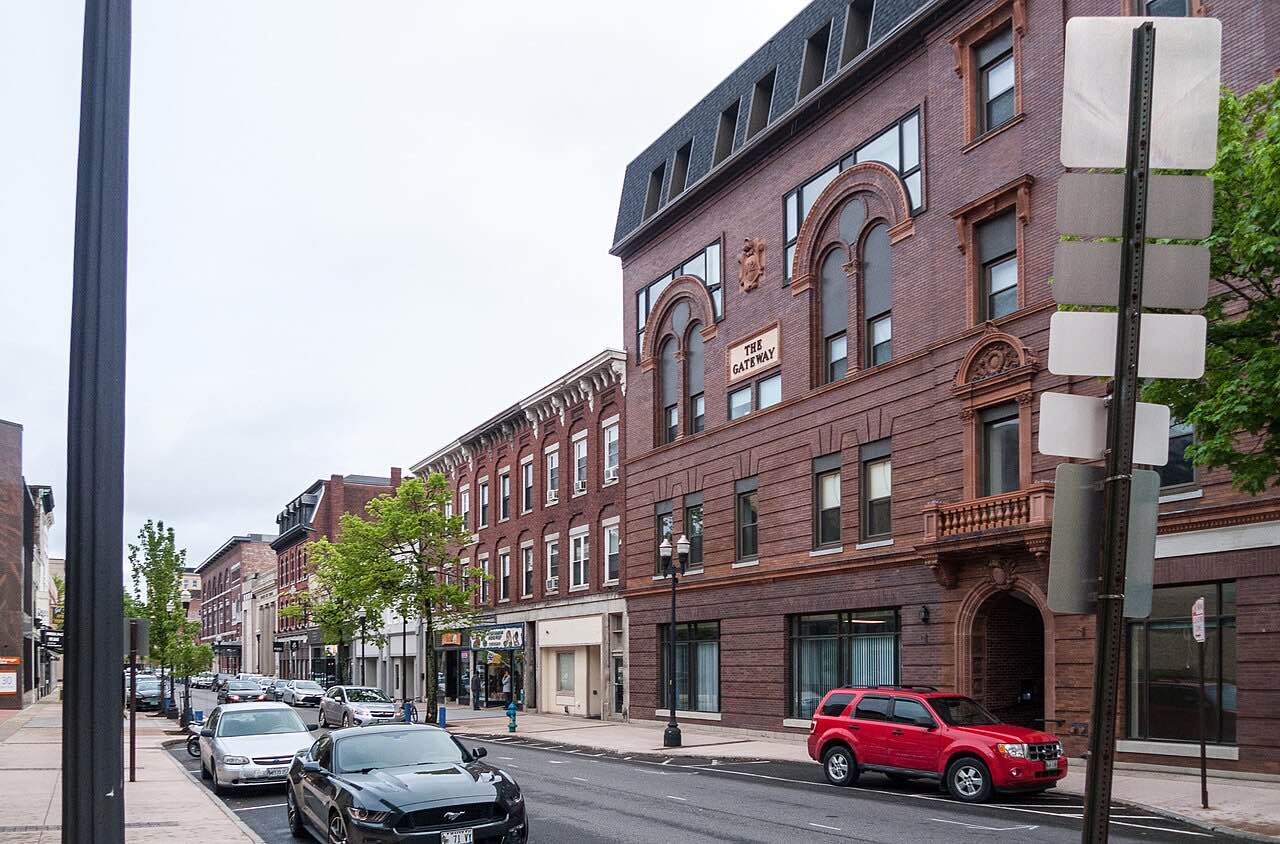
On a Saturday afternoon on Lisbon Street, the smell of cardamom tea drifts out of a storefront where the sign still reads like a relic of the old mill economy. Inside, the shelves hold bulk frankincense, prayer rugs, mango juice, soccer jerseys, and halal meat cut to order. Twenty-five years ago this same block was so empty that people called the heart of downtown “the combat zone.” Today it is one of the busiest streets in Lewiston, and most of the shopkeepers came here from Somalia.
The story of the Somalis in Lewiston is, more than anything, a story about a dying place that refused to die. A French-Canadian mill town that had been shedding people for thirty years became, almost by accident, the unlikeliest immigrant gateway in New England.
Lewiston: The Place
Lewiston sits on the east bank of the Androscoggin River in southern Maine, about 35 miles north of Portland and directly across the water from its twin city, Auburn. It is Maine’s second-largest city, built on a grid of red-brick textile mills and the canals that once powered them. The downtown housing stock is dense for Maine: rows of three- and four-story wood-frame tenements and apartment blocks, originally built for mill families, that by 2000 were cheap and half-empty. That cheap, plentiful housing would turn out to matter enormously.
How Lewiston Became a Somali City
Before the Somalis
Lewiston was a company town long before it was anything else. Benjamin Bates founded the Bates Manufacturing Company in 1850, and within a decade his mills were running tens of thousands of spindles and pulling workers off the surrounding farms. The labor that built the city came mostly from Quebec and New Brunswick: French-Canadian families who crossed the border for mill wages and stayed for generations, leaving a Catholic, French-speaking imprint still visible in the names on the churches and the gravestones. You can read that earlier migration in our piece on the French-Canadians of Lewiston.
Then the work left. Starting in the 1950s, the textile industry moved south to cheaper, non-union labor, and the mills closed one by one. Bates slowed production through the 1990s and shut its looms for good in 2001, the same year a very different chapter was about to begin. The population had been falling since 1970, jobs had vanished, and the families who could leave had left. Lewiston in the late 1990s was a town with a beautiful brick skeleton and not enough people to fill it.
The Somalis Arrive
The first Somali families did not arrive from Mogadishu. They came from Portland, Maine, about 40 miles south, where federal refugees had been resettled but where affordable apartments were scarce. In February 2001 a handful of Somali households drove north, found whole buildings of cheap, safe housing, and sent word back. This was secondary migration: refugees who had already spent years in the United States, in Atlanta, in Clarkston, Georgia, and in other cities, relocating on their own with no resettlement agency steering them.
Word of mouth did the rest. City assistance records show 443 Somali newcomers applied for aid for the first time in 2001. By June 2002 the Somali population was estimated at around 1,000, and by early 2003 more than 1,400 had arrived. They were drawn by the same things every time: low rents, low crime, decent schools, and the safety of raising children in a quiet place.
That rapid growth strained a city budget already stretched thin, and in October 2002 Mayor Laurier “Larry” Raymond wrote an open letter to Somali elders. He asked them to discourage further relocation, warning that the arrivals were maxing out the city’s resources and that the trend “cannot continue without negative results for all.” The letter drew national attention and stung deeply, and it became the symbol many remember. It is part of the factual record. It is not the center of this story.
What happened next told Lewiston more about itself. On January 11, 2003, a small out-of-state white-supremacist group held a rally downtown. That same day, the newly formed Many and One Coalition organized a counter-gathering at Bates College’s Merrill Gymnasium. Roughly 32 people showed up for the hate rally. Several thousand, by most accounts around 4,000 to 5,000, packed the gym for Many and One, with hundreds more turned away at the doors. Maine’s governor came; the mayor did not. The day is still remembered locally as a turning point.
Lewiston at Its Peak
The community kept growing. Beginning in 2005, a distinct group arrived: Somali Bantu refugees, an ethnic minority from the Shabelle and Jubba river valleys of southern Somalia who had been recognized by the United States as a persecuted people and resettled directly from camps in Kenya. Close to 1,000 settled in Lewiston between 2004 and 2006. Many had been farmers for generations, and that knowledge would soon find new ground in Maine soil.
By the early 2010s, estimates put the Somali population of Lewiston near 5,000, with thousands more in Portland. Storefronts that had sat dark for years reopened as groceries, restaurants, money-transfer shops, and clothing stores. The first dedicated mosque, the Lewiston Auburn Islamic Center, opened in 2007 in a narrow downtown row house with entrances on Lisbon and Canal streets, used for daily prayer, weddings, and Quran instruction for children. A second mosque later opened on Bartlett Street. The decline had not just stopped. It had reversed.
The Change
The clearest proof came on a soccer pitch. In November 2015 the Lewiston High School Blue Devils, a roster drawn from half a dozen countries and anchored by Somali players, won the school’s first state soccer championship. They beat Scarborough 1-0 at Fitzpatrick Stadium in front of a crowd of around 4,500, finishing the season a perfect 18-0. The team’s rallying cry, “pamoja ndugu,” meaning “together brothers,” said almost everything. Coach Mike McGraw, a lifelong Lewiston man, had spent decades on the program. The journalist Amy Bass told the full story in her 2018 book One Goal, which Netflix later optioned.
The Landmarks of Somali Lewiston
Mogadishu Store, 240 Lisbon Street. Shukri Abasheikh has run this grocery, restaurant, and clothing shop since 2006, and it became a touchstone of the new downtown. The shelves carry bulk spices, mango and guava juice, and halal meat, and the camel meat moves faster than outsiders expect. For years it was as much a gathering place as a store, where a stop for tea could turn into a four-hour conversation.
Lewiston Auburn Islamic Center, Lisbon Street. Opened in 2007 in a three-story row house, this was the community’s first real mosque, with prayer rooms running the length of each floor. Beyond the five daily prayers it serves as a wedding hall and a dugsi, where children study the Quran. Its entrances on both Lisbon and Canal streets made it, quite literally, a building that faced the old downtown and the canals that once ran the mills.
Mashallah Store, downtown Lewiston. Founded in 2012, this Somali-owned shop stretched the model past groceries into electronics, housewares, phones, and gifts alongside the halal meat counter. Stores like it turned Lisbon Street back into a place where you could run your errands on foot, the way mill families once did.
Trinity Jubilee Center, Bates Street. Organized by Trinity Episcopal Church in 2001, just as the first Somali families arrived, the center grew into a soup kitchen, food pantry, day shelter, and refugee integration program rolled into one. In 2024 it served more than 37,000 meals, and it has since broken ground on a larger $5.1 million home on Bates Street. It is one of the threads that has tied old Lewiston and new Lewiston together for a quarter century.
New Roots Cooperative Farm. Four Somali Bantu farmers, Jabril Abdi, Seynab Ali, Mohamed Abukar, and Batula Ismail, started this cooperative after learning the ropes through a local new-American agriculture program beginning in 2006. They farmed leased land for years, sold at area markets, and in 2022 bought their own ground outright. The crops are grown with traditional Somali methods, and the harvest goes back into the same community that planted it.
Bates Mill, Canal Street. The vast brick mill complex that gave the city its shape closed its looms in 2001. It is the ghost at the center of this story, the reason the apartments were cheap and the downtown was empty when the Somalis came. Much of the complex has since been redeveloped into offices, restaurants, and event space, a reminder that the city is on at least its second life.
Where the Lewiston Somalis Came From
Almost all came by way of the refugee camps of eastern Kenya, especially the sprawling Dadaab complex, after fleeing the civil war that tore Somalia apart from 1991 onward. Many spent a decade or more in those camps before being resettled in American cities, then chose Lewiston for themselves in a second move. The ethnic Somalis came largely from urban centers and the country’s south; the Somali Bantu came specifically from the farming villages of the Shabelle and Jubba river valleys, a minority with its own history of persecution at home.
What pulled them to this particular mill town was never one big thing. It was rent a family could afford, streets safe enough for children, and, increasingly, the simple fact that people they knew were already there. That same pattern of one family drawing the next has repeated across the country, from the Somalis of Cedar-Riverside in Minneapolis to the Bhutanese who rebuilt a corner of Akron, Ohio.
Lewiston Today
Lewiston is growing again. The city’s population passed 38,000 in 2024 and is still climbing, a reversal no one would have predicted in 2000. The census counts more than 1,200 residents of Somali ancestry, though local estimates that include the second generation and Somali-born neighbors put the number closer to 3,000, within a wider immigrant population of roughly 6,000. In the public schools, nearly four in ten students are now multilingual learners, with Somali among the most common languages alongside Portuguese, Arabic, and French.
The change has reached city hall. In 2019, 23-year-old Safiya Khalid, who came to the United States as a refugee, became the first Somali American elected to the Lewiston City Council, winning her race decisively despite a wave of online harassment. Across the river region and the state, others have followed: Deqa Dhalac of South Portland became the first Somali American mayor in the country, then a state legislator. The children who learned English in Lewiston classrooms are now coaches, college staff, business owners, and elected officials.
None of this has been simple, and recent years have brought new fears, including immigration enforcement that has rattled the community. But walk down Lisbon Street on a busy afternoon and the larger truth is hard to miss. A town that was told to expect decline instead got a future, and a good part of that future arrived speaking Somali.
Frequently Asked Questions
Why did Somalis settle in Lewiston, Maine?
The first Somalis in Lewiston arrived from Portland, Maine, in 2001, drawn by cheap, plentiful apartments in a former mill town that had been losing people for decades. Low rents, low crime, and good schools made it a safe place to raise children, and as word spread, family and friends followed. It was classic secondary migration, with refugees relocating on their own rather than being placed by an agency.
Is Lewiston still a Somali community today?
Yes. The census records more than 1,200 residents of Somali ancestry, while local estimates including the second generation reach roughly 3,000, part of an immigrant population near 6,000 in a city of about 38,000. The Somalis in Lewiston now run businesses, lead nonprofits, coach sports, and serve in elected office.
What are the most famous Somali landmarks in Lewiston?
Lisbon Street is the heart of it, lined with Somali-owned shops like the Mogadishu Store, open since 2006, and Mashallah Store. The Lewiston Auburn Islamic Center, the community’s first mosque, opened nearby in 2007, and the Somali Bantu-led New Roots Cooperative Farm grows traditional crops on land it bought in 2022.
Where did the Lewiston Somalis come from?
Most fled Somalia’s civil war after 1991 and spent years in refugee camps in Kenya before being resettled in American cities, then chose Lewiston in a second move. Ethnic Somalis came largely from the country’s urban south, while Somali Bantu refugees, who began arriving in 2005, came from the farming villages of the Shabelle and Jubba river valleys.
When did Somalis first arrive in Lewiston?
The first Somali families arrived in February 2001, moving north from Portland. By June 2002 the population was about 1,000, and it kept growing for years afterward. The Somali Bantu, a distinct group, began arriving from Kenyan camps in 2005.
If your family’s story passed through a Maine mill town, a Kenyan refugee camp, or a Mogadishu neighborhood, those threads are worth following before they fade.