
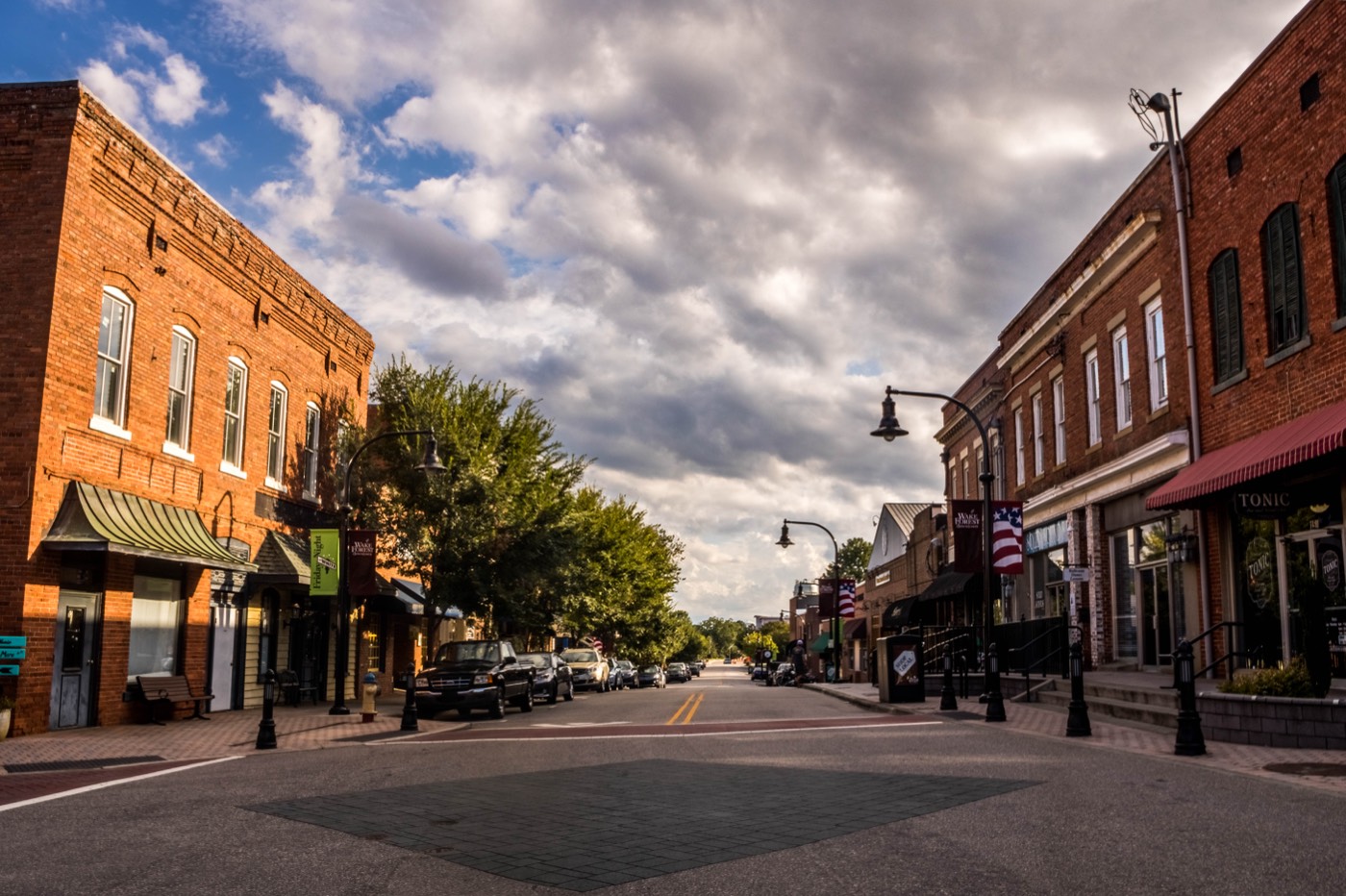
Drive north out of Raleigh on Capital Boulevard, past the warehouses and the new subdivisions, and the land softens into pecan groves and tobacco-barn country. Then the cul-de-sacs begin. This is Wake Forest, a town that grew nearly fivefold in a single generation, and somewhere in that surge of new arrivals are the Indians in Wake Forest, North Carolina: software engineers and pharmacists and physicians who came for the jobs in the Research Triangle and stayed for the schools, the quiet, and the room to raise a family.
The Place
Wake Forest sits in northeastern Wake County, about 18 miles north-northeast of downtown Raleigh. It began in 1832, when the North Carolina Baptist Convention bought Dr Calvin Jones’ 615-acre plantation for $2,000 and founded a college there.
For 122 years the town and the university shared a name and a campus. Then in 1956 Wake Forest University packed up and moved to Winston-Salem, taking the famous name with it and leaving the town to find a new identity.
It found one in the suburban boom. From a sleepy college town of a few thousand, Wake Forest has become one of the fastest-growing places in America, a leafy, prosperous Raleigh suburb of tree-lined streets, good schools, and a walkable old downtown along White Street.
How It Became Indian
The Indian presence in Wake Forest is not a story that begins downtown. It begins about half an hour to the south, in the Research Triangle, and it works its way north one family at a time.
The Triangle pulls them in
Research Triangle Park, anchored between Raleigh, Durham and Chapel Hill, is the largest research park in North America. Its tenants include IBM, Cisco, BASF and Syngenta, and for decades it has drawn engineers and scientists from around the world.
India supplied a great many of them. North Carolina has long ranked among the top states for H-1B visa approvals, and the skilled-worker pipeline into the Triangle’s technology and life-sciences firms ran heavily through Indian universities and Indian software companies.
The first wave of Indian families settled close to the work, in the Indian community in Cary and in Morrisville and Apex, the suburbs that ring the Park to the west and south. Those towns became the heart of the Triangle’s Indian life, with temples, grocers and restaurants clustered within a few miles of one another.
Moving north for room to grow
As those families put down roots and had children, many began looking for more space than the apartments and townhouses near the Park could offer. Wake Forest, on the far side of Raleigh, offered exactly that: larger lots, newer subdivisions, and a school system with a strong reputation. It was the same calculation that took other Indian families to Apex on the south side of the Triangle, and that Pakistani families made in choosing Cary next door.
The town’s growth figures tell the story of the opportunity. Wake Forest had 12,526 residents in 2000. By the 2020 census it had reached 47,601, and estimates since have pushed it past 52,000, a roughly fourfold increase in two decades.
That explosion of new housing was filled by newcomers from everywhere, and a steady share of them were Indian. They did not arrive as a single founding group settling a single street. They arrived as individual households choosing a good house in a good district, and over time those households added up.
A community that commutes to its roots
What makes the Indian community of Wake Forest distinct is that much of its cultural infrastructure still lies elsewhere. The big temples, the largest grocers and the most established restaurants remain in Cary and Morrisville, a 30 to 40 minute drive away.
So Wake Forest’s Indian families learned to commute to their heritage. A weekend might mean driving south for a temple darshan and a run to an Indian supermarket, then home again to the quiet streets near Joyner Park. The town is where they live; the western Triangle is where, for years, the community gathered.
That is beginning to change. As the numbers have grown, Indian restaurants have opened on Wake Forest’s own South Main Street, and the town government itself has started to host Indian cultural events. The community is no longer only commuting to its roots. It is starting to plant them locally.
The town throws a Diwali festival
The clearest sign of that shift came when the Town of Wake Forest’s Parks, Recreation and Cultural Resources department added a Diwali Festival to its official events calendar.
The festival is held at E. Carroll Joyner Park and is free and open to everyone, with music, dance performances, arts and crafts, henna artists and food trucks serving Indian food. It is a small thing on the surface, an afternoon in a park. But a Festival of Lights organised by the town hall is a public acknowledgement that Indian families are now part of the civic fabric, not visitors to it.
The Landmarks
Sri Venkateswara Temple of North Carolina, 121 Balaji Place, Cary. Reported to be the largest Hindu temple in North America, with an 87-foot gateway tower, the temple serves roughly 21,000 Hindu worshippers across the Triangle. For many Wake Forest families it is the spiritual anchor of the region, worth the drive south for a major puja or festival.
Hindu Society of North Carolina, 309 Aviation Parkway, Morrisville. Founded in 1986, this is the Triangle’s other large temple, and it is deliberately eclectic. Its founders chose their deities by questionnaire, setting aside regional worship styles so that Hindus from every part of India could feel at home under one roof.
Curry House, 2101 South Main Street, Wake Forest. One of the Indian restaurants that brought the cuisine into the town itself rather than the western suburbs. Regulars praise its tandoori, and for local families it means a curry dinner no longer requires a half-hour drive across the county.
Lazeez, 1318 South Main Street, Wake Forest. A North Indian and Punjabi kitchen on the same stretch of South Main, with a butter chicken that draws steady praise. Its presence, alongside Curry House, marks South Main Street as the closest thing Wake Forest has to an emerging Indian dining row.
Bombay Central, 1910 Falls Valley Drive, North Raleigh. An Indian grocery and cafe whose owners, the Patels, opened this branch to serve customers across the northern Triangle, drawing shoppers from Wake Forest and beyond. For families on the north side of Raleigh it cut the grocery pilgrimage to Morrisville considerably.
Apna Bazar, Davis Drive, Morrisville. One of the established full-size Indian supermarkets that anchors the western Triangle’s grocery scene, the destination for a proper monthly shop of lentils, spices, sweets and fresh produce. Wake Forest families fold a stop here into a wider weekend swing through the Cary-Morrisville corridor.
E. Carroll Joyner Park, 701 Harris Road, Wake Forest. A 117-acre park of restored farm buildings, a Depression-era pecan grove and a lawn amphitheatre, donated to the town in 2009. It is the green heart of Wake Forest and, since the festival began, the place where the town’s Diwali is celebrated.
Where They Came From
The Indians who settled around the Triangle, and then in Wake Forest, came overwhelmingly through the skilled-migration channels that fed the technology and pharmaceutical industries. That shaped where in India they originated.
The largest streams tended to come from the southern and western states that produce the most engineers and IT professionals: Andhra Pradesh and Telangana, Tamil Nadu, Karnataka, Maharashtra and Gujarat. These are the regions whose graduates filled the software firms and contract houses that staffed Research Triangle Park.
That origin profile explains the shape of the community’s institutions. The temples lean toward South Indian traditions in part because so many of the early Triangle families were Telugu and Tamil. The grocers stock the dosa batter and the curry leaves and the tamarind that those kitchens require.
It is a professional-class migration, knit together by workplaces, universities and visa categories rather than by a single ancestral village. People who would never have met in India became neighbours in North Carolina because they answered the same job postings. The same pattern repeats wherever Indian engineers cluster, from Gilbert, Arizona to Celina, Texas.
Wake Forest Today
Wake Forest in 2026 is a town still absorbing its own growth. Cranes and graded lots remain a common sight, and the school district keeps building to keep up. The Indian families here are woven into that ordinary suburban life: in the carpool lines at Heritage High School, in the youth sports leagues, in the new-build neighbourhoods north of town.
The community remains, in some ways, a satellite of the larger Indian Triangle to the south. For the grandest temple festivals and the deepest grocery aisles, Wake Forest families still point their cars toward Cary and Morrisville. The centre of gravity has not moved north.
But the local foundations are thickening. Two Indian restaurants now sit on South Main Street where there were none, and the town hall hosts a Diwali festival in its flagship park. These are the early markers of a community that is starting to be visible at home, not only at work and at worship across the county.
It is a particular kind of American story: not an old enclave with a century of history, but a brand-new one being built in real time, in subdivisions that did not exist when these families’ parents were children. The Indians in Wake Forest are writing their chapter as the town itself is still being built around them.
Frequently Asked Questions
Is there a large Indian community in Wake Forest, North Carolina?
Wake Forest has a growing Indian community, though it is smaller and newer than the long-established Indian populations in nearby Cary and Morrisville. The Indians in Wake Forest, North Carolina are largely professional families who work in the Research Triangle and chose the town for its housing and schools.
Why did Indian families move to Wake Forest?
Most came for jobs in Research Triangle Park’s technology and life-sciences companies, then moved north to Wake Forest for larger homes, newer subdivisions and a strong school system. It is a classic suburban migration, with families trading apartments near the office for houses with room to grow.
Where is the nearest Hindu temple to Wake Forest?
The two largest temples are in the western Triangle: the Sri Venkateswara Temple at 121 Balaji Place in Cary, reported to be the largest Hindu temple in North America, and the Hindu Society of North Carolina at 309 Aviation Parkway in Morrisville. Many Wake Forest families drive about 30 to 40 minutes for major festivals and worship.
Are there Indian restaurants in Wake Forest?
Yes. Curry House at 2101 South Main Street and Lazeez at 1318 South Main Street both serve North Indian cuisine within the town itself, so families no longer have to drive across the county for a curry dinner.
Does Wake Forest celebrate Diwali?
Yes. The Town of Wake Forest’s Parks, Recreation and Cultural Resources department hosts an annual Diwali Festival at E. Carroll Joyner Park, with music, dance, arts and crafts, henna artists and Indian food. The free event is a public sign that Indian families are now part of the town’s civic life.
Where in India did the Triangle’s Indian community come from?
Because the migration ran through technology and pharmaceutical jobs, most families trace to the engineering-rich southern and western states: Andhra Pradesh and Telangana, Tamil Nadu, Karnataka, Maharashtra and Gujarat. That origin profile shows up in the region’s South Indian temples and grocery aisles.
If your family’s story passed through Wake Forest, or any of the places Indians have made home in America, Atlas of Home can trace that journey. From an engineering campus in Hyderabad or Chennai to a research park near Raleigh, to a house on a new street north of the city, to wherever you are now.