
On a Saturday morning on East Chatham Street, the parking lot at Patel Brothers fills with families pushing carts of toor dal, curry leaves and Telugu-language newspapers, while a few miles north the tallest Hindu temple tower in North America rises above a Cary cul-de-sac. The Indians in Cary, North Carolina did not arrive looking for a neighbourhood. They came for the jobs, then built the rest around them.
The Place
Cary sits in western Wake County, wedged between Raleigh, Durham and the Research Triangle Park, the sprawling research campus that opened in 1959 and quietly rewired the region’s economy. For most of its life it was a dry railroad town of a few thousand people, incorporated in 1871 by Allison Francis “Frank” Page, who named it after an Ohio prohibitionist. The creation of the Research Triangle Park in 1959 changed everything.
Then the laboratories and software companies came, and Cary stopped being small. Its population doubled in the 1970s and again in the 1980s and 1990s. Today it is one of the most affluent towns in the state, with a median household income well above $100,000, far higher than the Wake County or North Carolina averages.
It is also, increasingly, an Indian town. Roughly one in five Cary residents is Asian, and people of Indian origin make up the largest single slice of that. Cary shares this story with its neighbour just to the north, where the Indians in Morrisville, North Carolina form an even denser concentration around the same research park.
How It Became Indian
Cary’s Indian story is inseparable from the labs and office parks that surround it. The community did not cluster around a port or a factory gate. It assembled, household by household, around a payroll.
The lab that started it
In 1976, two North Carolina State University researchers, James Goodnight and John Sall, incorporated a statistical software project as SAS Institute. They kept it in Cary, near the Research Triangle Park and within reach of NC State, Duke and the University of North Carolina at Chapel Hill.
SAS became one of the largest privately held software companies in the world, and analytics was exactly the kind of work that drew Indian graduate students and engineers. The Triangle’s universities turned out talent; SAS, IBM and the wider Research Triangle Park hired it. A good share of that talent was Indian, and a good share of those Indians chose to live in Cary.
The H-1B decades
The community grew fastest in the 1990s and 2000s, on the back of the technology boom and the H-1B visa programme that brought hundreds of thousands of Indian software professionals to the United States. The Triangle, with its research park, its universities and its low cost of living relative to Silicon Valley, was a natural landing place for engineers who might otherwise have joined the Indians in Cupertino, California.
Engineers arrived young, often single or newly married, on contracts with consultancies and product companies. They rented apartments along the Maynard Road loop, then bought houses as families grew. Word travelled back to Hyderabad, Chennai and Bangalore: the Triangle had jobs, good schools and a temple already going up.
The schools as a magnet
What kept families in Cary rather than passing through was the Wake County school system, consistently among the strongest in the state. For Indian parents weighing where to settle, the calculation was simple: top public schools, short commutes to the research park, and other Indian families already on the street.
By the 2010s the community had reached a size where it could ask the school system to recognise its calendar. Hindu parents launched petitions to have Diwali observed as a school holiday in Wake County, arguing that their children should not have to choose between the most important festival of the year and a day of classes.
Two languages, two waves
The community is not monolithic. A large South Indian contingent, Telugu speakers from Andhra Pradesh and Telangana and Tamil speakers from Tamil Nadu, dominated the technology wave, and it is their numbers that justified a dedicated South Indian temple. Alongside them came North Indian Gujarati, Punjabi and Hindi-speaking families, many of them in business and medicine as well as software.
The split shows up in the grocery aisles and the temple calendars. It shows up, too, in the radio: the Triangle supports its own Indian radio programming, and Cary anchors much of the audience. It is a different pattern from the older, denser enclaves like the Indians in Edison, New Jersey or the Indians in Jackson Heights, Queens, where shopfronts came before the suburbs.
The Landmarks
Sri Venkateswara Temple of North Carolina, 21 Balaji Place. Consecrated in May 2009 after a couple bought 2.8 acres of land on what is now Balaji Place, this South Indian style temple serves the estimated 21,000 Hindus of the Triangle. Its Rajagopuram, the soaring entrance tower inaugurated in October 2022, stands 87 feet tall and is the tallest such temple tower in North America, built by artisans brought from India. The temple’s record-setting gopuram drew worshippers from across the Southeast at its 2022 unveiling.
Hindu Society of North Carolina (Hindu Bhavan), 309 Aviation Parkway, Morrisville. The mother temple of the Triangle, organised in 1976 by about twenty Hindu families who first met in basements and rented halls. They opened the Hindu Bhavan in Morrisville in December 1986 and added a social hall in 2001. It remains the ecumenical, pan-Indian heart of the community just over the Cary line.
Patel Brothers, 802 East Chatham Street. The anchor of Cary’s desi grocery strip and part of the national chain that has tracked Indian settlement across America. On weekends the aisles of lentils, spices and fresh produce fill with families stocking up for the week, the unofficial town square of Indian Cary.
The East Chatham Street grocery strip. Beyond Patel Brothers, East Chatham Street has gathered a cluster of South Asian shops and eateries, including halal butchers and grocers such as New SuperGrocery, selling goat, lamb, frozen subcontinental fish and rice by the sack. The street functions as the everyday Indian high street that the temples are the spiritual counterpart to.
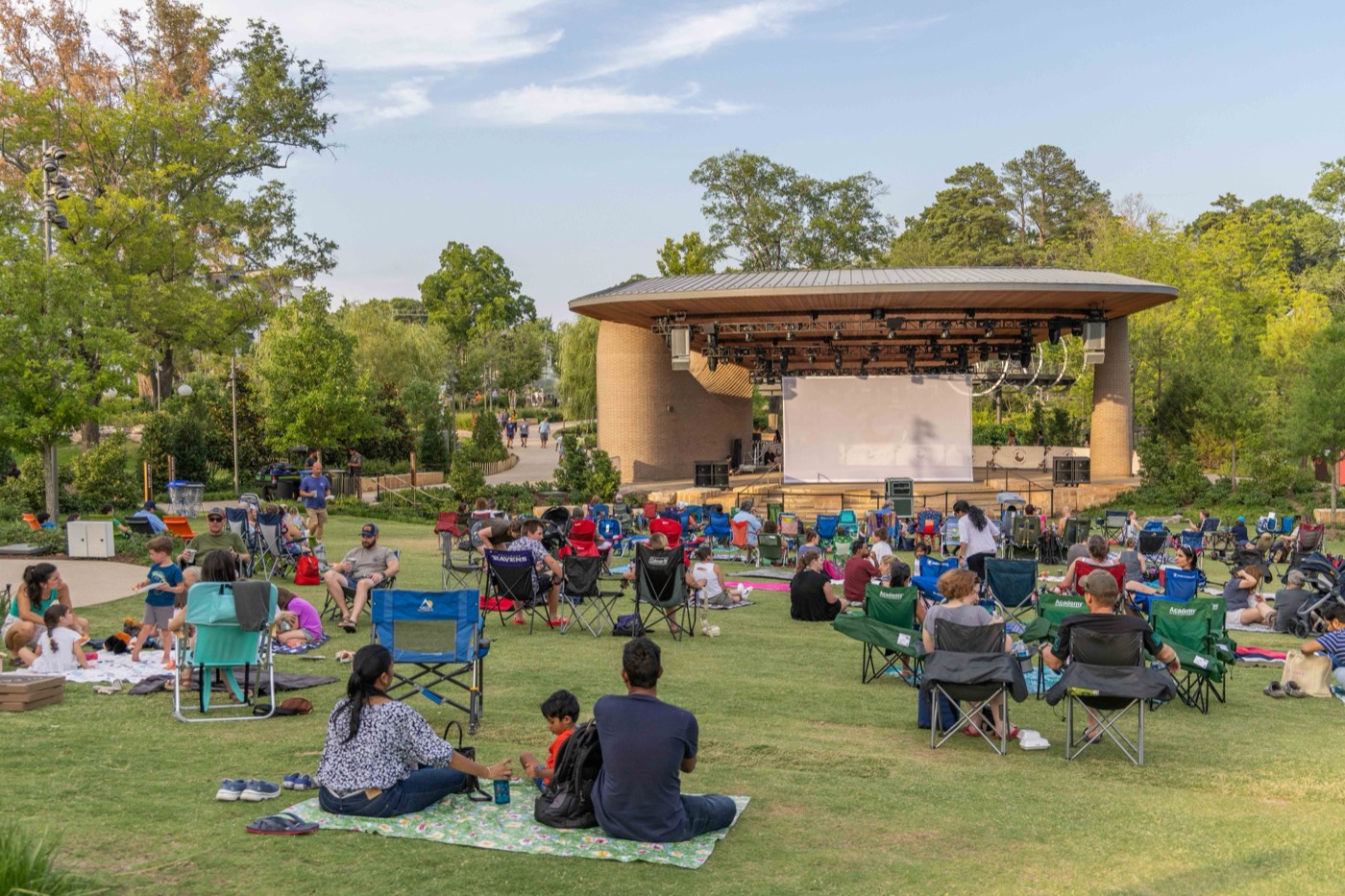
Koka Booth Amphitheatre, 8003 Regency Parkway. Each autumn this outdoor venue hosts Hum Sub Diwali, the festival once known simply as Cary Diwali. It draws close to 14,000 people from across the Southeast for a long day of food stalls, classical and film music, dance and children’s activities, with local mayors often pulled on stage.
The Maynard Road apartments. The loop of garden apartments and townhomes around Maynard Road has long been the first address for newly arrived engineers and graduate students, a soft landing of short leases and Indian neighbours before families buy houses deeper into Cary’s subdivisions.
SAS Institute campus, 100 SAS Campus Drive. The wooded headquarters of the analytics company that, more than any single institution, gave Cary its modern shape and drew the first wave of Indian engineers to the town. It remains one of the area’s signature employers.
Where They Came From
The heaviest flows trace to South India. Telugu speakers from Hyderabad and the wider Andhra Pradesh and Telangana region, long a feeder for the American IT industry, form one of the largest groups, with Tamil families from Chennai and Tamil Nadu close behind.
These were not refugees or labourers. They were graduate students and software professionals, drawn by the Research Triangle Park, the universities and the H-1B pipeline that channelled Indian engineering talent into American technology firms from the 1990s onward.
North India came too. Gujarati, Punjabi and Hindi-speaking families settled alongside the southern majority, some in software, others in business, medicine and the franchises, from grocery to motels, that Indian families have built across the American South, much as they did in the Mahatma Gandhi District in Houston.
Cary Today
Indian Cary is comfortable in a way that earlier American immigrant enclaves rarely were at this stage. There is no tenement chapter in this story, no garment-district hardship. The community arrived educated, employed and able to buy into one of the most expensive towns in the state more or less on landing.
That prosperity is visible in the institutions it has built in a single generation: an 87-foot temple tower, a Diwali festival that fills an amphitheatre, a grocery strip on Chatham Street, a school-calendar campaign carried out through petitions rather than protest. Cricket leagues play through the warm months, and Hindi is now spoken in a large share of Triangle households.
The open question is the one every affluent immigrant suburb faces. The first generation came for jobs and stayed for schools. Whether their children, raised in Cary’s subdivisions and bound for colleges across the country, return to anchor the community or scatter to other tech hubs will decide whether Indian Cary deepens or simply disperses. For now, the temple tower is the tallest thing for miles, and the parking lot at Patel Brothers is full.
Frequently Asked Questions
How many Indians live in Cary, North Carolina?
People of Indian origin are the largest component of Cary’s Asian population, which is roughly one fifth of the town. Cary, along with neighbouring Morrisville, holds one of the densest concentrations of Indian residents in North Carolina, a state with around 130,000 Indian Americans.
Why did so many Indians settle in Cary?
The Indians in Cary, North Carolina came overwhelmingly for technology work tied to the Research Triangle Park, SAS Institute and the area’s universities. The H-1B visa wave of the 1990s and 2000s brought engineers and software professionals, and Wake County’s strong public schools kept their families in town.
What is the tallest Hindu temple tower in North America?
The Rajagopuram, or entrance tower, of the Sri Venkateswara Temple of North Carolina at 21 Balaji Place in Cary stands 87 feet tall. Inaugurated in October 2022 and built by artisans from India, it is the tallest temple tower of its kind in North America.
Where do Indians shop for groceries in Cary?
East Chatham Street is the heart of Indian grocery shopping in Cary. Patel Brothers at 802 East Chatham Street anchors the strip, joined by South Asian and halal grocers such as New SuperGrocery selling spices, lentils, rice and subcontinental meats and fish.
When is the Diwali festival in Cary?
Hum Sub Diwali, long known as Cary Diwali, is held each autumn at the Koka Booth Amphitheatre. It draws close to 14,000 people from across the Southeast for food, music, dance and children’s activities, making it one of the largest Diwali celebrations in the region.
What languages do Indians in Cary speak?
South Indian languages are prominent: Telugu, from Andhra Pradesh and Telangana, and Tamil, from Tamil Nadu, both common among the technology wave. Hindi, Gujarati and Punjabi are widely spoken too, and Hindi is now heard in a large share of Triangle-area households.
If your family’s story passed through Cary, or any of the places Indians have made home in America, Atlas of Home can trace that journey. From a graduate department in Hyderabad to an office park off Cary Parkway, to wherever you are now.