
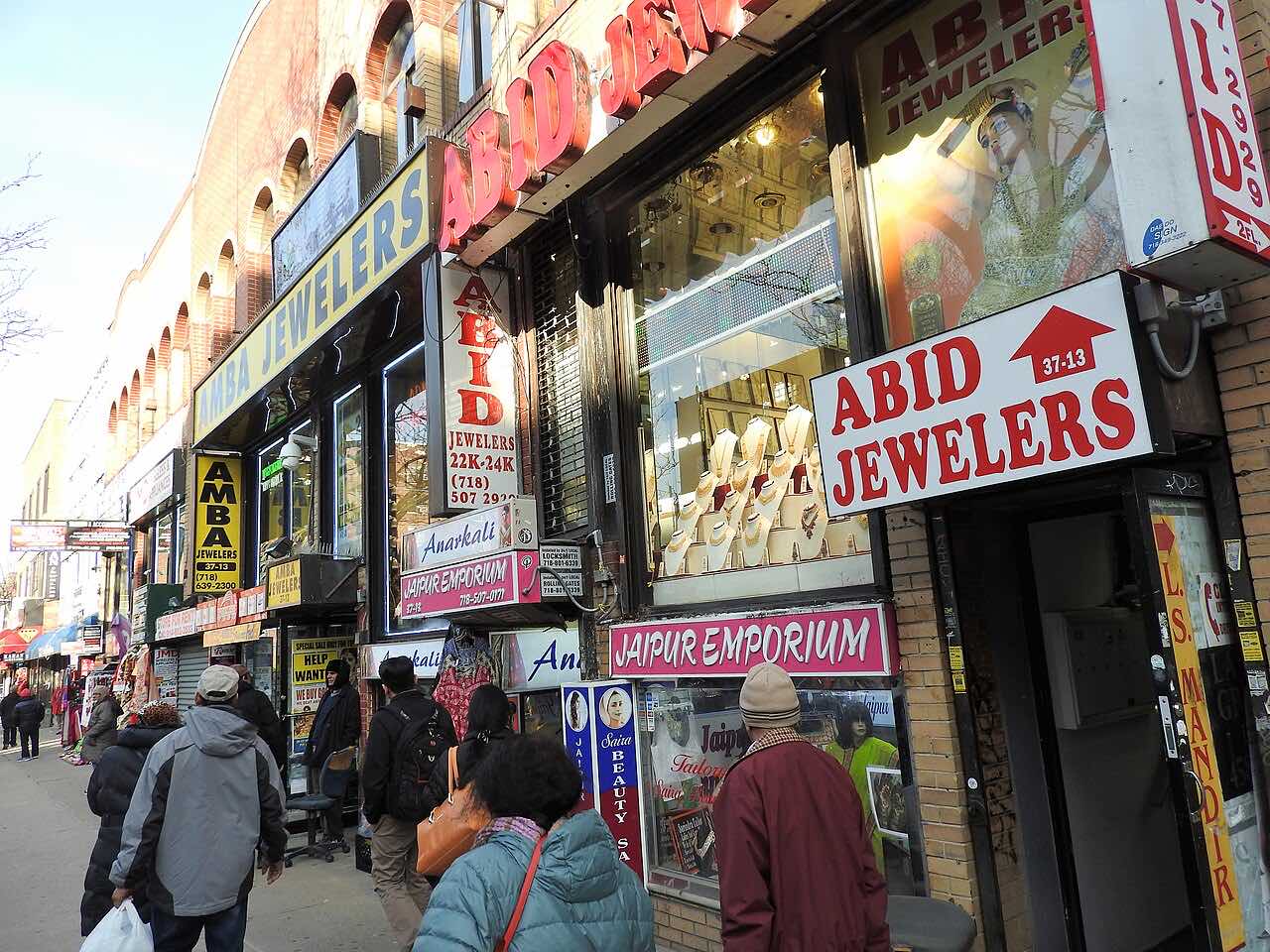
The first thing you notice is the gold. On 74th Street in Jackson Heights, the jewelry windows run nearly the length of the block, each one stacked with 22-karat necklaces and bangles that catch the afternoon light and throw it back onto the sidewalk. Signs in pink and saffron stack three deep above the storefronts. The Indians in Jackson Heights built this stretch into the sari-and-gold capital of the East Coast, and even now, decades on, the windows still glow the same way.
Step off the elevated 7 train at Roosevelt Avenue and the air changes. There is the smell of cumin and frying dough, the sound of Bollywood playback drifting from a phone shop, the rustle of shoppers comparing silk by the bolt. This is the story of how a planned suburb built to keep certain people out became the unlikely heart of Indian New York.
Jackson Heights: The Place
Jackson Heights sits in north-central Queens, threaded by the elevated 7 line and the E, F, M, and R trains that meet beneath Roosevelt Avenue. The neighborhood is built around blocks of garden co-ops, brick apartment buildings wrapped around private interior lawns that most passersby never see. Roosevelt Avenue runs loud and commercial beneath the tracks, while the side streets stay quieter and green. It is one of the most densely diverse square miles in the United States.
How Jackson Heights Became Little India
Before the Indians
Jackson Heights was invented, not grown. The Queensboro Corporation, led by Edward MacDougall, began buying farmland here in the 1910s and laid out one of America’s first garden-apartment communities, complete with shared gardens, co-op ownership, and strict design covenants. Laurel Court, finished in 1918, is often called the country’s first garden-city apartment building.
It was sold as an escape for white Manhattanites, and the welcome was deliberately narrow. The early developers barred Black and Jewish buyers through custom and restrictive covenants, advertising a “restricted” residential enclave for white Anglo-Saxon Protestants. By 1930 the population had jumped from a few thousand to more than 44,000. Courts struck down racial covenants in 1948, but exclusion lingered until the Fair Housing Act of 1968. The neighborhood that would become Little India started out as a place engineered to keep outsiders away.
The Indians Arrive
The door opened in Washington. The Immigration and Nationality Act of 1965 scrapped the old national-origin quotas and replaced them with a system favoring professional skills and family reunification. For the first time, Indian doctors, engineers, and scientists could come in real numbers, and they did. Many landed first in Manhattan or nearby Elmhurst, then looked to Jackson Heights, where the great subway junction at Roosevelt Avenue put the whole city within reach.
The retail story is usually traced to one shop. The electronics store Sam & Raj, opened in the 1970s by merchants remembered as Subhash Kapadia and Nitin Vora, became a legend across the Indian community. It sold the 220-volt appliances and gadgets that newcomers wanted to ship home, and it gave the block a reason to become a destination. Indian families across the metro area knew the name long before they knew the street.
Other stores followed fast. India Sari Palace opened its doors at 3707 74th Street and grew into the largest sari house on the strip, its bolts of silk and chiffon drawing brides from three states. Then came the chain that anchored everything. Patel Brothers, founded in 1974 by the Gujarati brothers Mafat and Tulsi Patel on Chicago’s Indian stretch of Devon Avenue, opened a 74th Street branch that became the East Coast pantry for Indian cooks, its aisles stacked with lentils, spices, and produce no American supermarket carried.
74th Street at Its Peak
This is where chain migration did its quiet work. One family’s shop drew a cousin’s wholesaler, who drew a friend’s restaurant, who drew the relatives who staffed them all. A jeweler from Gujarat would sponsor a brother, who opened a sweet shop, who knew a tailor looking for a storefront. The block thickened year by year until almost every door between Roosevelt Avenue and 37th Avenue belonged to a South Asian business.
By 1980 the majority of that block was Indian-owned, and by 1990 there were roughly 74 Indian businesses in Jackson Heights. Restaurants made the neighborhood famous beyond its own community. Jackson Diner opened in 1980 as an ordinary Greek-American luncheonette at the corner; when Gian Singh took it over a few years later and began folding in the Punjabi recipes of his childhood, he kept the old name, and “Jackson Diner” became shorthand in Manhattan for a pilgrimage worth making.
The jewelers turned 74th Street into something unique in America. More than thirty gold shops clustered along a single block and the adjoining 37th Road, their windows a wall of yellow 22-karat work for weddings and festivals. In 1992 Mayor David Dinkins came to a Diwali celebration and officially christened the strip “Little India.” Not everyone celebrated; some longtime white residents resented the label and a few shouted at the mayor that the neighborhood was still theirs. The name stuck anyway.
The Change
Success carried the community outward. As the doctors and engineers of the 1965 wave prospered, they bought houses where the apartments of Jackson Heights could not compete, drifting east along Hillside Avenue toward Floral Park, Glen Oaks, and Bellerose, and across the river to the Indian suburbs of Edison, New Jersey. The shops on 74th Street stayed put, but the customers increasingly drove in rather than lived around the corner.
The blocks kept filling, just with new arrivals. Through the late 1990s and 2000s, Bangladeshi, Pakistani, Nepali, and Tibetan immigrants moved in and opened their own storefronts, spreading the South Asian corridor onto 72nd and 73rd Streets. Bengali signage appeared beside the Hindi; momo shops opened around the corner from the dosa houses. The Tibetan community that took root here is a story of its own, told in our piece on the Tibetans of Jackson Heights.
The Landmarks of Little India
India Sari Palace, 3707 74th Street. Still trading after decades on the block, this is the grande dame of the sari trade in Queens. Generations of brides have come for the wall-to-wall silks and the in-house tailoring, and the shop remains one of the surest places to feel what 74th Street meant at its height.
Patel Brothers, 37-27 74th Street. The New York outpost of the Gujarati grocery empire founded in Chicago in 1974 is the pantry that fed the neighborhood. For Indian families across the region it has long been the default stop for everything from curry leaves to thirty kinds of dal, and it still pulls shoppers in from far beyond Queens.
Jackson Diner, 37-47 74th Street. Born in 1980 as a Greek-American diner and reborn under Punjabi ownership soon after, it kept its incongruous name and became the restaurant that put Little India on the map for Manhattan food lovers. Its weekend buffet was for years a rite of passage for anyone discovering Indian food in New York.
Butala Emporium, 37-46 74th Street. A dense, almost museum-like bazaar of puja supplies, statues, instruments, and books in a dozen subcontinental languages, open since the late 1980s. Its founder, Bhadra Butala, a Gujarat-born steward of the community who died in late 2025, built it into one of the most enduring institutions on the street.
Sam & Raj, formerly 37-08 74th Street. The electronics shop that started it all is now a ghost landmark, long closed, but for a generation of immigrants it was the first reason to ride the 7 train to Jackson Heights. It sold the appliances that newcomers shipped to relatives in India and, in doing so, taught a whole community where to find home.
Eagle Theater, 73-07 37th Road. The Art Deco house opened in 1938 as the Earle, and from the mid-1990s it ran the latest Bollywood releases for packed weekend crowds. It went dark around 2009 and reopened in 2012 as a food court and grocery, the marquee gone but the building still anchoring the corner.
The gold jewelry row, 74th Street and 37th Road. Not a single shop but a block-long wall of more than thirty jewelers, their windows banked with 22-karat necklaces, bangles, and bridal sets. It is the largest concentration of Indian gold in the eastern United States, and the image most people carry away from Little India.
Where the Jackson Heights Indians Came From
The community that built 74th Street was never from one place. Gujaratis from the towns and villages of western India were central to the retail story, the same merchant networks behind Patel Brothers and many of the grocers and jewelers. Punjabis from the north brought the wheat-and-tandoor cooking that made Jackson Diner famous, part of the same broad Punjabi migration that built farm towns like Yuba City in California. South Indians from Tamil Nadu, Kerala, and Andhra opened the vegetarian and dosa houses that drew a different crowd.
What pulled them to this particular corner was less any single region than the logic of the 1965 law and the city itself. Professionals came first under the new skills-based visas, then sponsored the relatives who staffed the shops. The unmatched subway junction at Roosevelt Avenue, cheap commercial rents in a neighborhood past its first prime, and the simple gravity of an existing Indian crowd did the rest. Once the gold and the saris were here, everyone in the metro area knew where to come.
Jackson Heights Today
74th Street is still the place you go for Indian gold and a wedding sari, but it is no longer mainly an Indian neighborhood to live in. The shops endure while the residents have largely dispersed to the suburbs of Queens, Long Island, and New Jersey, returning on weekends to buy what they cannot get closer to home. The block now reads as a pan-South Asian high street, Bangladeshi and Nepali and Tibetan as much as Indian.
That layering is the neighborhood’s nature, not its decline. The same blocks that once turned over from white Protestant to Indian have kept turning, and the Indian imprint remains the deepest, written in the jewelers’ windows and the smell of the spice shops. On Diwali the merchants still light the street and thousands come, the way they have for thirty years.
The Indians in Jackson Heights wrote a chapter that other communities are now adding to. The gold still glows on 74th Street, and as long as it does, this corner of Queens will stay the address Indian New York calls its own.
Frequently Asked Questions
Why did Indians settle in Jackson Heights?
The Indians in Jackson Heights came after the 1965 Immigration Act opened the United States to skilled migrants, drawing doctors and engineers to New York. The neighborhood’s major subway junction at Roosevelt Avenue and its affordable commercial rents made 74th Street an ideal place to open shops, and chain migration did the rest.
Is Jackson Heights still Little India?
74th Street is still widely known as Little India and remains the center of Indian retail in the New York region, especially for gold jewelry and saris. The Indians in Jackson Heights have largely moved to the suburbs, so the blocks are now shared with Bangladeshi, Pakistani, Nepali, and Tibetan neighbors, but the Indian imprint is still the strongest.
What are the famous shops and landmarks in Little India?
The best-known names include India Sari Palace, the grocery chain Patel Brothers, and Jackson Diner, which put the neighborhood’s food on the map. The block-long row of 22-karat gold jewelers is the signature sight, and ghosts like the Sam & Raj electronics store and the Eagle Theater Bollywood cinema live on in memory.
Where in India did the Jackson Heights community come from?
They came from across the country rather than a single region. Gujaratis from western India drove much of the retail trade, Punjabis from the north shaped the restaurant scene, and South Indians from Tamil Nadu, Kerala, and Andhra Pradesh opened the vegetarian houses.
When did Indians first arrive in Jackson Heights?
Indian families began arriving after the 1965 Immigration Act, and the commercial heart took shape in the 1970s with the electronics store Sam & Raj and the first sari and grocery shops. By 1980 most of the 74th Street block between Roosevelt and 37th Avenues was Indian-owned, and Mayor Dinkins officially named it Little India in 1992.
Every neighborhood like this one is really a collection of family stories: a grandfather who sold appliances on 74th Street, a mother who bought her wedding sari in one of those windows. Those threads are worth keeping.