
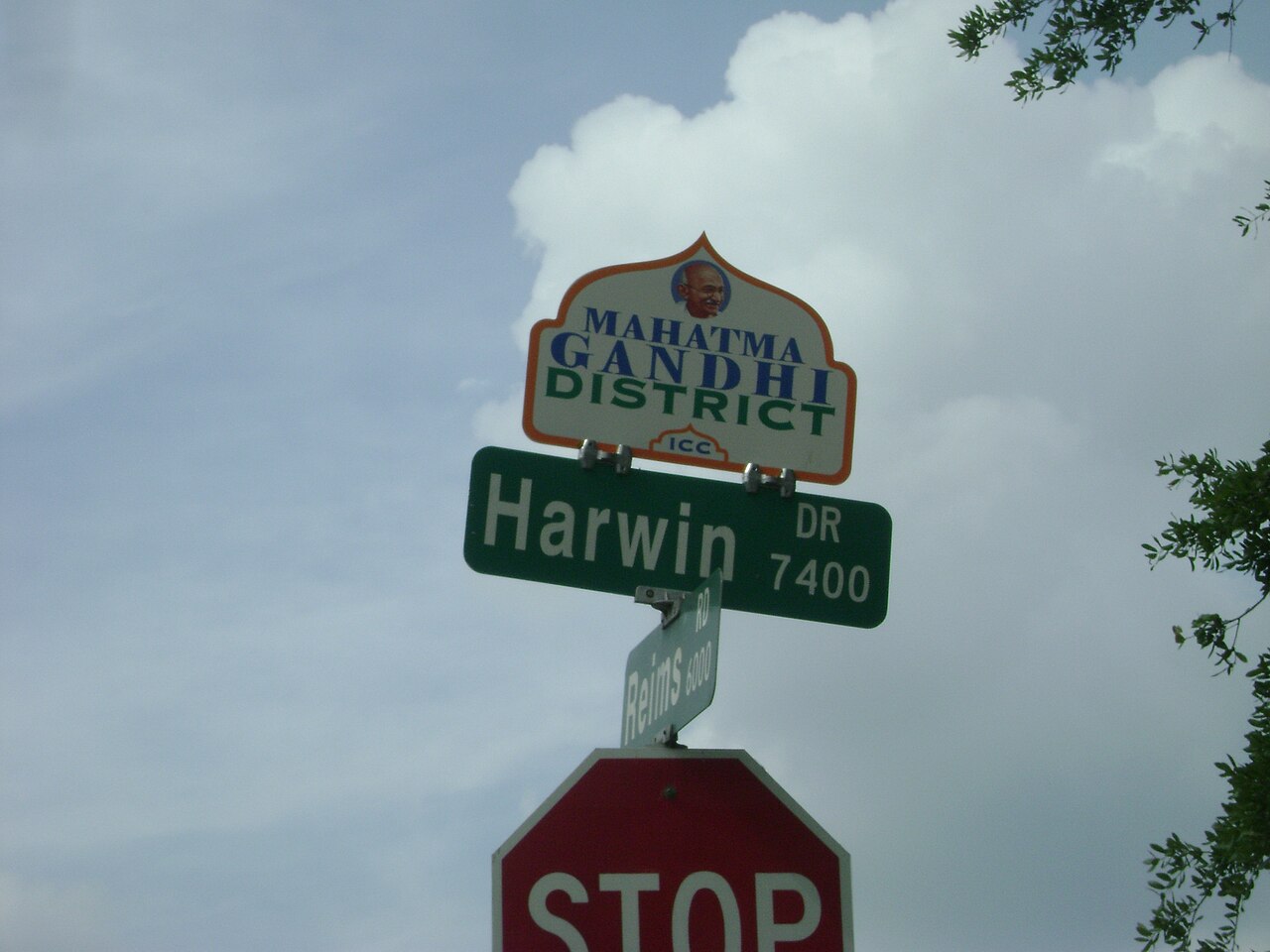
Locals just call it Hillcroft. You will not find “Little India” on any city map, but turn off the Southwest Freeway in southwest Houston and the strip malls start speaking a different language. Marigold garlands hang in grocery doorways, gold catches the Texas sun behind jewellers’ glass, and the smell of frying samosas drifts across the parking lots. This is the largest concentration of Indians in the Mahatma Gandhi District, Houston, the commercial heart of one of the biggest Indian communities in the United States.
Hillcroft Avenue: The Place
The district runs along Hillcroft Avenue in the Gulfton area of southwest Houston, bordered by U.S. Highway 59, the Southwest Freeway, to the south and the Westpark Tollway to the north. Many residents still call the area “Harwin” after the cross street, Harwin Drive, where the shopping centres pile up.
There is nothing quaint about the architecture. This is flat, car-bound Houston: low-rise strip malls, vast surface lots, and signage stacked three tenants high. The drama is inside the shops, not the streetscape, and that is exactly how the community built it.
How Hillcroft Became Indian
Before the Indians
Gulfton was not built for an Indian enclave. In the 1960s and 1970s it was a sprawl of new garden apartment complexes thrown up for young, mobile professionals drawn to Houston’s oil boom. When the oil bust hit in the early 1980s, vacancy soared and rents dropped through the floor.
That cheap, central, freeway-fed real estate is what made the corridor available. Storefronts along Hillcroft sat empty and affordable, waiting for someone with a plan.
The Indians Arrive
Indians had been coming to Houston for years before they had a high street to call their own. The Immigration and Nationality Act of 1965 scrapped the old national-origin quotas and opened the door to skilled migrants, and Houston had exactly the jobs they trained for.
The oil boom of the 1970s pulled Indian engineers and chemists to firms like Humble Oil and Shell. The Texas Medical Center hired Indian doctors and researchers by the hundred, and NASA’s Johnson Space Center recruited scientists from India, some of whom had arrived under the original H-1 visa for distinguished professionals. These were professional families with degrees, savings, and a growing hunger for the food and clothing of home.
The retail anchor came in 1983, when Rupa Vyas moved her Indian American grocery, Jay Stores, from Rice Village out to the Hillcroft area. In 1985 a veteran restaurateur named Joginder “Yogi” Gahunia, who had run eateries in the United Kingdom and Ohio before chasing Houston’s warmer weather, opened Raja Sweets, widely cited as the city’s first dedicated Indian sweet shop.
Gahunia did not build alone. He banded together with fellow immigrants Aku Patel, who ran the jewellers Karat 22, and Ramesh Lulla of the clothing boutique Sari Sapne. Three businesses, side by side, became a critical mass.
Hillcroft at Its Peak
Through the 1990s and 2000s the corridor filled in fast. Each new arrival made the next one easier: a grocer needed a spice supplier, a sari shop drew a tailor, a sweet shop pulled a restaurant next door. Chain migration worked through commerce as much as through family, with relatives flown over to staff the registers and kitchens.
By the late 2000s a single weekend errand on Hillcroft could mean diamonds and twenty-two-carat gold for a wedding, a bolt of silk for the sari to wear to it, the mithai to hand out after, and a Bollywood DVD for the drive home. The same density that powers Indian commercial strips like the one along Devon Avenue in Chicago took root in the Texas heat. You can read how that older enclave formed in the story of the Indians on Devon Avenue in Chicago.
By 2011 Raja Sweets reported that a quarter of its customers were not Indian. The district had become a destination for all of Houston, not just a service strip for one community.
The Change
Success bought mobility, and mobility moved people out. As Indian families prospered, many bought houses in the suburbs, above all in Sugar Land and the rest of Fort Bend County to the southwest. Sugar Land, nicknamed “Desitown” by some residents, is now well over a tenth Indian.
So the homes scattered while the shops stayed put. The same arc of professional families seeding a commercial core and then spreading into the suburbs shaped the Indian community in Edison, New Jersey. Hillcroft did not decline. It simply became the place you drive to rather than the place you live.
The Landmarks of Indian Hillcroft
Raja Sweets, Hillcroft Avenue. Opened in 1985 by Yogi Gahunia, it is the longest-running Indian restaurant in Texas and the business most often called the founding stone of the district. Gahunia died in 2002, but the Gahunia family still runs it, and its trays of fresh mithai sell out every Diwali.
Jay Stores. Rupa Vyas relocated this Indian American grocery to the Hillcroft area in 1983, arguably the first retail seed of the whole corridor. It put spices, lentils, and staples within reach of Houston’s growing Indian households years before the area had a name.
Karat 22 Jewelers. Founded by Aku Patel, one of Gahunia’s original neighbours, it set the template for the gold counters that now line the strip. Twenty-two-carat gold for weddings remains a cornerstone of the district’s economy.
Sari Sapne. Ramesh Lulla’s clothing boutique completed the founding trio. Decades on, it is still run by the founding family and still dresses Houston families for their weddings and festivals.
India Grocers. Opened within a few years of Jay Stores by Yatin Patel, a Zambian-born ethnic Indian, it grew into one of the corridor’s busiest supermarkets and a reminder that the diaspora reaching Houston travelled by way of East Africa as well as India.
The India Culture Center. Based in the district, the ICC has long been the community’s civic spine. Its members were the ones who, in 2009, agreed to pay roughly $10,000 for the street signage that would give the area an official name.
The Mahatma Gandhi statue, McGovern Centennial Gardens, Hermann Park. Not on Hillcroft but its spiritual counterpart across town, this bronze by the celebrated sculptor Ram V. Sutar was gifted by India and dedicated on October 2, 2004, the anniversary of Gandhi’s birth. It is why the district carries the name it does.
The naming was not automatic. City rules required signatures from a supermajority of commercial property owners, and organisers had to win over non-South Asian merchants who were wary of any move to rename Hillcroft Avenue itself. When the signs went up on January 16, 2010, Mayor Annise Parker stood alongside Sanjiv Arora, the Consul General of India, and declared the day “Mahatma Gandhi District Day,” a milestone documented in the area’s Wikipedia history. Pakistani-owned businesses share the same corridor, a sign that South Asian Houston has always been more layered than any single label.
Where the Hillcroft Indians Came From
Houston’s Indian population is not from one place. Gujarati entrepreneurs are widely credited with building the businesses of the Mahatma Gandhi District, and Gujaratis remain so visible that genetic researchers have studied “Gujarati Indians in Houston” as a defined population. Punjabi families added their own restaurants and gold counters along the way.
The later waves came from the south. Telugu families from Andhra Pradesh and Telangana, and Tamil families from the southeast, flowed into Houston’s tech and engineering jobs, while Malayali nurses from Kerala helped staff its hospitals. Some Indian arrivals, like grocer Yatin Patel, came by way of East Africa, part of a twice-migrated diaspora that left India generations earlier. For a southern California parallel built by similar Gujarati enterprise, see the story of the Indians of Artesia, California.
Hillcroft Today
The district is busy and unmistakably alive. Houston added nearly 200,000 residents in 2024 alone, much of it through international migration, and that keeps demand high for the groceries, gold, and silk that Hillcroft has always sold. There has been no dramatic redevelopment, just steady, business-led evolution.
The founders are still here in spirit and often in fact. Raja Sweets, Karat 22, and Sari Sapne remain in the hands of their founding families, among the oldest South Asian businesses in the city. They share the corridor now with a wider Houston, the same mixing that defines neighbouring immigrant stories like the Nigerian community in Houston.
Most of the community sleeps in Sugar Land and Katy now, not Gulfton. But on a Saturday, when the lots fill and the trays of mithai go out the door, Hillcroft is still where Indian Houston comes home.
Frequently Asked Questions
Why did Indians settle along Hillcroft in Houston?
Indian professionals came to Houston after 1965 for jobs in oil, the Texas Medical Center, and NASA, and they needed a place to buy the food and clothing of home. Cheap, central storefronts along Hillcroft Avenue, left vacant by the early-1980s oil bust, gave the first Indian grocers and restaurateurs an affordable foothold. That cluster grew into the Indians in the Mahatma Gandhi District, Houston.
Is the Mahatma Gandhi District still Indian today?
Yes, it remains the commercial heart of Indian Houston, with founding businesses like Raja Sweets, Karat 22, and Sari Sapne still run by their original families. Many Indian residents have moved out to suburbs such as Sugar Land, so the district is now more a shopping and dining destination than a residential enclave. Pakistani-owned businesses also share the same Hillcroft corridor.
What are the most famous Indian landmarks in the Mahatma Gandhi District?
Raja Sweets, opened in 1985 and the longest-running Indian restaurant in Texas, is the most cited landmark. Karat 22 Jewelers and the Sari Sapne boutique complete the founding trio, while the India Culture Center anchors the community’s civic life. The Mahatma Gandhi statue in Hermann Park gives the district its name.
Where in India did the Hillcroft community come from?
Gujarati families are credited with building most of the district’s businesses, alongside Punjabis. Later waves brought Telugu and Tamil professionals from southern India into Houston’s tech and engineering jobs, plus Malayali nurses from Kerala. Some Indian families also arrived by way of East Africa, a twice-migrated diaspora.
When did Indians first arrive in the Mahatma Gandhi District?
Indian professionals were already in Houston through the 1960s and 1970s, but the retail district began in 1983 when Rupa Vyas moved her Jay Stores grocery to the Hillcroft area. Raja Sweets followed in 1985, and the corridor was officially named the Mahatma Gandhi District on January 16, 2010.
If your family’s story passed through Hillcroft, or any of the places Indians made home across America, Atlas of Home can help you trace that journey. From a village in Gujarat or a city in Telangana, to the strip malls of southwest Houston, to wherever you stand now. Explore your story →