
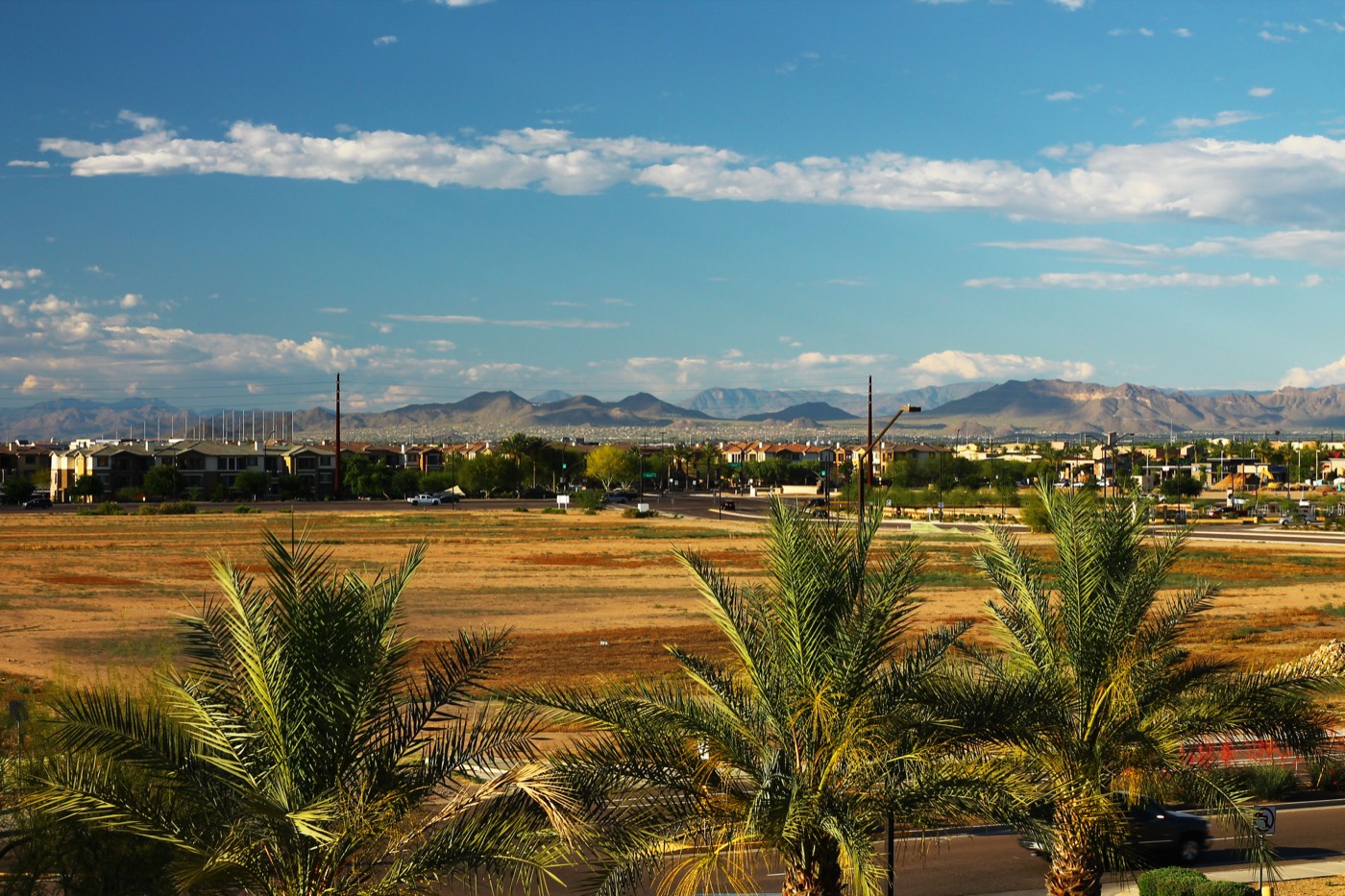
On a Thursday evening on West Warner Road, the parking lot of a strip-mall temple fills with families fresh from work at semiconductor fabs and hospital wards. Inside, bhajans rise over the hum of air conditioning. The Indians in Gilbert, Arizona have built a quiet, prosperous life in a town that was selling hay within living memory, and the desert suburb has come to feel, for thousands of them, like a place worth calling home.
The Place
Gilbert sits about 22 miles southeast of Phoenix, in the sprawl of Maricopa County known as the East Valley. It incorporated in 1920 as a railway siding on land owned by a farmer named William “Bobby” Gilbert, and for decades it was farm country, known as the “Hay Capital of the World” into the late 1920s.
The transformation came late and fast. In 1980 fewer than 6,000 people lived here. By 2026 the population had passed 291,000, making Gilbert the fourth-largest city in Arizona.
It is also affluent and family-heavy. The median household income runs around $122,000, three-quarters of households are families, and the schools draw national rankings. For an engineer relocating from Hyderabad or Pune, the appeal is legible at a glance.
How It Became Indian
The hay town that became a tech corridor
To understand why Indian families landed in Gilbert, you have to look just west, to Chandler. Intel built its first Arizona plant there in the early 1980s, and its Ocotillo campus eventually grew into an operation employing roughly 12,000 people. Microchip Technology put its headquarters in Chandler. NXP and a cluster of other chipmakers followed.
Semiconductor work is global work, and it runs heavily on skilled-visa hiring. The H-1B pipeline that feeds American chip fabs draws disproportionately from India’s engineering schools. As Intel and its neighbours expanded through the 1990s and 2000s, they imported a workforce, and that workforce needed somewhere to live.
Chandler filled first. Gilbert, the next town over and still mostly raw desert and farmland in the 1990s, offered new construction, big lots, and a clean slate.
The schools did the rest
If chips brought the parents, schools kept the families. Gilbert’s reputation for top-rated public education became a recruiting tool in its own right. Gilbert Classical Academy has ranked among the highest-performing high schools in Arizona, placing inside the top 20 in the state and the top few hundred nationally. Higley High School, Perry High in neighbouring Chandler Unified, and a roster of A-rated districts gave Indian parents exactly what they prize: measurable academic results.
For a community where education is treated as the family’s central project, that mattered enormously. A house in a strong Gilbert school zone was not just real estate. It was an investment in the next generation’s trajectory.
This is the same logic that has shaped Indian settlement in suburbs across the country, from Indian families in Fishers, Indiana to the Indian community in Chesterfield, Missouri. The pattern is consistent: affluent, low-crime, high-scoring suburbs near a major employer.
From renters to homeowners to a community
The earliest arrivals in the 1990s and 2000s were often single engineers or young couples renting apartments along the Chandler-Gilbert border. As careers matured and green cards came through, they bought houses, and the pattern repeated through chain migration: a brother followed, then parents arrived on long visits, then friends from the same university heard the pitch and made the move.
Healthcare deepened the base. As the East Valley grew, so did its hospital systems, and Indian physicians, anaesthesiologists, and pharmacists settled alongside the engineers. The result was a community that was not only large but professionally dense: doctors and chip designers living on the same cul-de-sacs.
By the 2020s, Asian residents made up roughly six to seven percent of Gilbert’s population, a meaningful share of a city approaching 300,000, and a large portion of that figure is Indian.
The Landmarks
Sai Dhyan Mandir, 1430 W Warner Road, Suite 152. This Shirdi Sai Baba temple is the closest thing Gilbert has to a dedicated Indian spiritual hub. It runs daily darshan and gathers crowds on Thursdays for Abhishekam at 6:45 PM and bhajans at 7:15 PM. Tucked into a Warner Road suite, it is unglamorous from the kerb and central to community life inside.
Tap N Tikka, 25 E Ray Road. An Indian restaurant near the Gilbert and Ray Road corner, it is one of the East Valley spots families lean on for a weeknight order of biryani or a tray of food for a house full of weekend guests. Its location on the Chandler-Gilbert seam is itself a map of where the community lives.
Patel Brothers, 1315 S Arizona Avenue, Chandler. The grocery anchor for the whole East Valley Indian community sits just over the line in Chandler. Part of the national Patel Brothers chain, it stocks the spices, lentils, fresh produce, and frozen staples that make a kitchen Indian, and it functions as a weekend social institution as much as a store.
Maha Ganapati Temple of Arizona, 51293 W Teel Road, Maricopa. The largest Hindu temple in the state, built to Agama specifications, it serves devotees across the Phoenix metro including Gilbert. Families make the drive for major festivals and milestone pujas the local strip-mall shrines cannot fully accommodate.
BAPS Shri Swaminarayan Mandir, 3620 N Black Canyon Highway, Phoenix. The Phoenix-area BAPS Swaminarayan congregation gives the region’s Gujarati families a spiritual and social home. For Gilbert’s Swaminarayan households, it is the anchor for organised worship and the youth and cultural programming that comes with it.
Gilbert Classical Academy, Gilbert. Less a landmark than a magnet, this top-ranked public school is part of why so many Indian families chose Gilbert in the first place. Among parents in the community, an acceptance here is talked about the way a promotion is.
The Gilbert Heritage District, around Gilbert Road and Page Avenue. The walkable old downtown, marked by its restored water tower, is where second-generation Indian-American teenagers and their parents fold into the broader life of the town: farmers’ markets, restaurants, weekend strolls. It is where the community is least distinguishable from its neighbours, which is its own kind of arrival.
Where They Came From
Gilbert’s Indian community draws heavily from the country’s engineering and medical heartlands, which is to say from the south and west. Telugu-speaking families from Hyderabad and the broader Andhra Pradesh and Telangana region are a large presence, reflecting that city’s status as a global IT and chip-design hub.
Tamil families from Chennai, Gujaratis whose presence is visible in the Swaminarayan congregations, and engineers from Pune, Bengaluru, and the northern technical universities round out the picture. It is a community defined less by a single home region than by a shared professional path: an engineering or medical degree, a skilled visa, and a job in the desert.
That professional selection is what gives the community its character. These are not, by and large, the chain-migrant working families of the older Indian diaspora. They are credentialled professionals who arrived already prosperous, a profile they share with the Indian community in McLean, Virginia and Indian families in Waxhaw, North Carolina.
Gilbert Today
Today the Indian presence in Gilbert is woven into the ordinary fabric of an affluent Arizona suburb rather than concentrated in a single visible enclave. There is no Little India here, no street of saree shops. The community lives in master-planned neighbourhoods, sends its children to A-rated schools, and reaches for its temples and grocers across the porous border with Chandler.
That dispersal is partly a function of how new it all is. Gilbert went from farm town to city of nearly 300,000 in a single generation, and the Indian families who arrived did so as the suburb was still being built. They are not layered onto an old neighbourhood. They are part of the original fabric of the new one, much as other newcomers have reshaped the Phoenix metro from the Russian community in Scottsdale to the Jewish families of Scottsdale.
The community’s institutions are still maturing. Worship often happens in strip-mall suites or requires a drive to Maricopa or Phoenix. The largest temples sit outside Gilbert proper. But the demand is plainly there, in the Thursday-evening parking lots and the weekend queues at Patel Brothers, and in a desert metro that keeps drawing chip plants and the engineers who run them, the trajectory points only one way.
Gilbert is not a place Indians fled to. It is a place they were recruited to, chose deliberately, and stayed in because the schools were good and the life was comfortable. That is a quieter story than the classic immigrant arrival, and in its own way a more telling one about where the diaspora is heading.
Frequently Asked Questions
How many Indians live in Gilbert, Arizona?
Gilbert does not publish a precise Indian-only count, but Asian residents make up roughly six to seven percent of the city’s population of about 291,000, and Indians are a large share of that group. The Indians in Gilbert, Arizona number in the thousands, concentrated among tech and medical professional families.
Why did so many Indian families settle in Gilbert?
The main draw is the East Valley’s semiconductor industry, anchored by Intel’s large campus in neighbouring Chandler, which hires heavily through skilled-worker visas that draw on Indian engineering talent. Gilbert’s top-rated schools, new housing, and high household incomes then made it a natural place for those families to put down roots.
Is there a Hindu temple in Gilbert, Arizona?
Yes. Sai Dhyan Mandir, a Shirdi Sai Baba temple at 1430 W Warner Road, serves the local community with daily darshan and Thursday-evening worship. For larger occasions, Gilbert families also travel to the Maha Ganapati Temple in Maricopa and the BAPS Swaminarayan Mandir in Phoenix.
Where do Indians in Gilbert shop for groceries and food?
The main Indian grocery anchor for the area is Patel Brothers, just over the line in Chandler at 1315 S Arizona Avenue. Indian restaurants such as Tap N Tikka on Ray Road serve the community across the Gilbert-Chandler border, which is where much of the population lives.
What is the connection between Gilbert and the tech industry?
The East Valley, including Gilbert, Chandler, and Mesa, has become a major technology corridor, home to Intel’s Ocotillo campus, Microchip Technology’s headquarters, and other chipmakers. This concentration of semiconductor work is the primary reason the Indians in Gilbert, Arizona settled here, since the industry recruits engineers globally.
Are Gilbert’s schools good for Indian families?
Gilbert is known for strong public schools, which is a major reason the community chose it. Gilbert Classical Academy ranks among the top high schools in Arizona, and Gilbert Public Schools and Higley Unified have both earned A district ratings, making the town highly attractive to education-focused Indian families.
If your family’s story passed through Gilbert, or any of the places Indians have made home in America, Atlas of Home can trace that journey. From the engineering campuses of Hyderabad and the temples of Gujarat, to a Thursday-evening bhajan on Warner Road, to wherever you are now.