
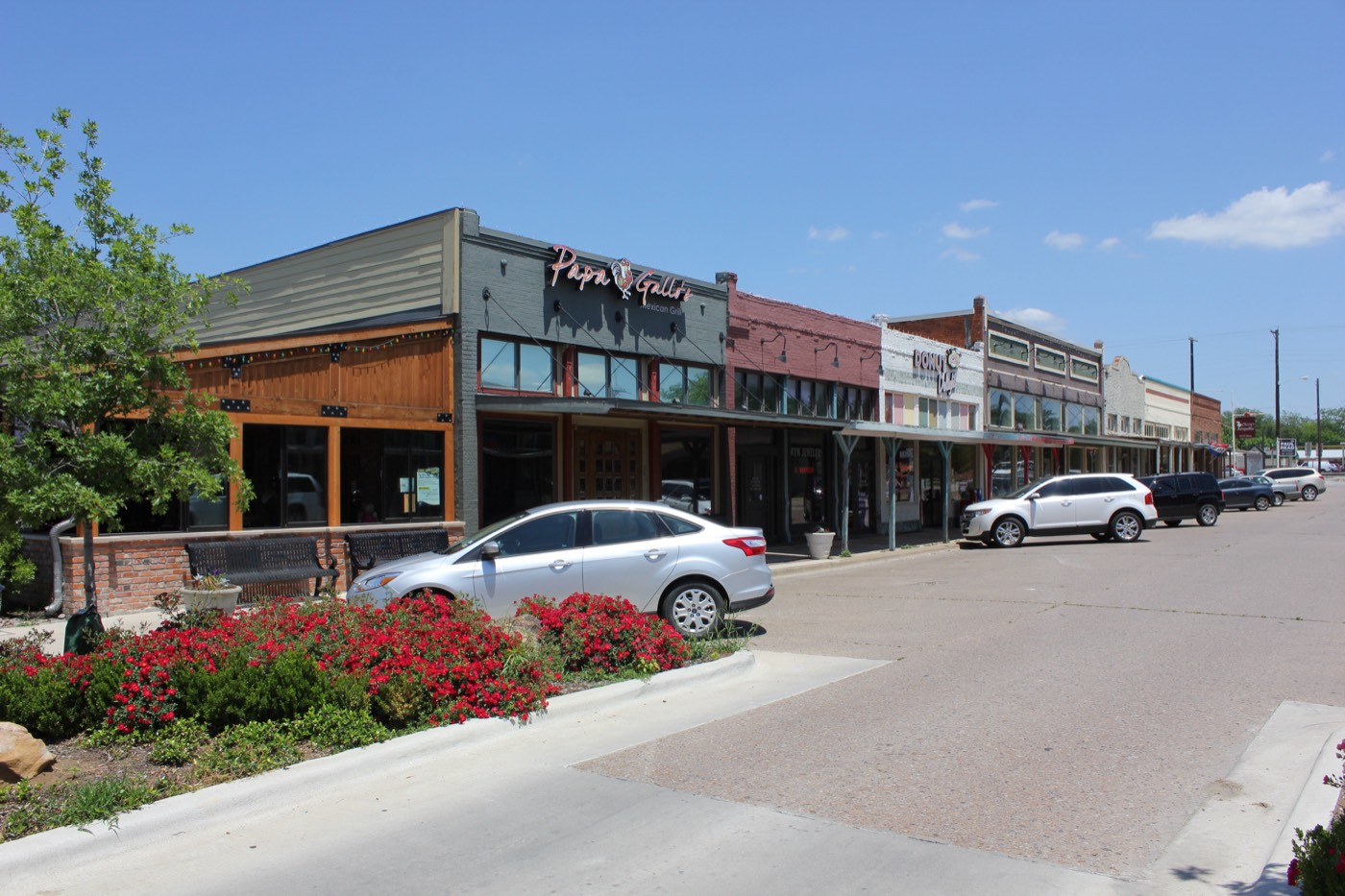
For most of its life, Celina was a cotton town with a brick square and a Friday-night football religion. Then, in the span of a single decade, it became something its founders could never have pictured: one of the fastest-growing places in America, and home to a fast-rising community of Indians in Celina, Texas, drawn north by new houses, top-rated schools, and the gravitational pull of the Collin County tech corridor.
The Place
Celina sits in the far north of Collin County, about an hour’s drive above downtown Dallas, where the metroplex finally thins into open prairie. Until recently it was best known for its high school football and its compact downtown Square, a ring of early-1900s brick storefronts built around the old railroad town.
That quiet did not last. Between July 2024 and July 2025 the U.S. Census Bureau named Celina the fastest-growing city in the country, with the population climbing 24.6 per cent in a single year to 64,427 residents. It had been the fourth-fastest the year before, part of a wider Collin County building boom.
The numbers behind that headline are hard to absorb. At the 2020 census Celina had 16,739 people. Five years later it had grown roughly fourfold, a 285 per cent increase, as subdivisions marched across what had been corn and cattle land.
How It Became Indian
Celina’s Indian story is not an old one. For a town founded in the nineteenth century, it is almost brand new, written almost entirely inside the last decade. To understand it, you have to start one county-line south.
The Frisco engine
The Dallas suburbs of Frisco and Plano spent the 2000s and 2010s becoming one of the largest Indian-American population centres in the United States, fuelled by corporate relocations, the Sam Rayburn Tollway technology corridor, and a steady stream of H-1B engineers.
In Frisco alone, the Indian share of the population grew from roughly 6 per cent in the early 2010s to around 20 per cent a decade later, making Indians the second-largest group in the city after white residents. As those families put down roots, they ran into the oldest suburban problem of all: they wanted more house, more land, and newer schools than an increasingly expensive Frisco could offer.
So they looked north. Past Prosper, to the next ring of construction. To Celina.
Houses, schools, and a county on fire
What pulled Indian families to Celina was the same arithmetic pulling everyone else, only sharpened. New master-planned communities offered large, modern homes at prices that still looked reasonable against Frisco and Plano. The median household income in Celina reached $170,894 in 2024, a figure that says a great deal about who was buying.
Schools mattered just as much. Most of Celina lies in the Celina Independent School District, while its southern edge falls inside the highly regarded Prosper ISD. Among Indian-American parents in particular, a strong school district is rarely a nice-to-have. It is the whole reason for the move.
The wider county was booming in parallel. Collin County recorded the largest percentage jump in Indian residents of any large county in America, climbing to an average of more than 116,000 in the five years through 2024, up from about 70,000 in the preceding five-year stretch. Celina caught that wave at exactly the right moment.
From single-digit to second-largest
The demographic shift shows up plainly in the data. Celina’s Asian population was effectively zero at the 2000 census, just 0.11 per cent. By 2020 it had reached 3.41 per cent, and the most recent American Community Survey estimates put the Asian share at roughly 11.9 per cent, around 3,200 residents and the largest minority group in the city.
Indians make up the great majority of that Asian count, the same pattern seen across Frisco, Prosper, and the rest of north Collin County. In a town that tripled in size, an Indian community materialised almost from scratch.
The 2026 wobble
That growth has not been frictionless. As of 2026, tighter federal scrutiny of H-1B visas, combined with technology-sector layoffs, has cooled the very pipeline that built Celina’s Indian community. Bloomberg reported that South Asian buyers, who once accounted for as much as 70 per cent of one major north-Dallas home builder’s sales, had fallen below 30 per cent in a single year.
It is a reminder that this community, more than most, is tied to immigration policy and the fortunes of the tech industry. The houses are permanent. The certainty is not.
The Landmarks
Karya Siddhi Hanuman Temple, 12030 Independence Parkway, Frisco. The spiritual anchor for Celina’s Hindu families sits a short drive south, just inside Frisco. Founded in 2015 by the spiritual leader Ganapathi Sachchidananda, the 34,000-square-foot temple drew international attention within a week of opening when it hosted a Guinness World Record for the longest continuous chanting of the Hanuman Chalisa, more than 24 hours. Its 72-foot Raja Gopuram tower, completed in 2019, is a landmark visible from the highway.
Desi District, 400 West Frontier Parkway, Celina. A clear sign that the community had reached critical mass inside Celina itself. Opening in January 2026, Desi District combines an Indian restaurant, a grocery store, and a meat market under one roof, serving dishes such as chili paneer and dal tadka. For Celina families, it means no longer driving to Frisco for a bag of curry leaves or a Sunday dosa.
Hareli Fresh Market, Celina. Part of a small chain expanding across Frisco, Prosper, and Celina in 2025, Hareli stocks Indian, broader Asian, Hispanic, and Middle Eastern groceries. Its arrival in the area tracks the migration almost street by street, following the families north as they buy.
Chowrastha, Highway 380 at FM 1385, Prosper. A South Indian and Hyderabadi favourite just over the line, Chowrastha serves Irani chai, dum biryani, live chaat, and dosa to a catchment that explicitly includes Celina, Prosper, Aubrey, and Little Elm. On weekends the queue is a fair census of the surrounding subdivisions.
Mustang Lakes, Celina. A master-planned community straddling the Celina and Prosper line, built around eight lakes, more than 60 acres of open space, and a 12,000-square-foot clubhouse. It is exactly the kind of amenity-heavy, schools-adjacent development that drew young Indian professional families out of the older suburbs.
Light Farms, Celina. One of Celina’s largest master plans, built on a farm-and-hometown theme with an on-site market and restaurant and a wide range of lot sizes. Its mix of starter-sized lots and larger home sites made it a natural first landing pad for buyers moving up from Frisco apartments and townhouses.
The Downtown Square, Celina. The historic heart of the old town, a ring of brick storefronts that resident J. Fred Smith helped rebuild in 1910 after the railroad pulled the town a mile north. Today it hosts boutiques, restaurants, and seasonal festivals, a piece of nineteenth-century Texas now ringed by twenty-first-century newcomers.
Where They Came From
Celina’s Indian families did not, for the most part, arrive from India. They arrived from Frisco, Plano, and Irving, the established Indian centres of the metroplex, in a classic case of suburban leapfrogging. The deeper origins, though, are easy to read in the temples and the menus.
The strong showing of South Indian and Telugu-leaning businesses, from dosa-and-biryani kitchens to the Hanuman-centred temple culture, reflects the heavy representation of engineers from Andhra Pradesh, Telangana, Tamil Nadu, and Karnataka who staff the region’s technology firms. Gujarati, Punjabi, and North Indian families are well represented too, as they are across the wider Dallas-Fort Worth Indian community served by umbrella groups like the India Association of North Texas, founded in 1962.
This is the same migration that built the Indian presence in other booming suburbs, from the Indians in Frisco, Texas just to the south, to the Indian community in McKinney, Texas to the east. It echoes the chain migration seen far beyond Texas, in places like the Indians of Fishers, Indiana, Chesterfield, Missouri, Waxhaw, North Carolina, and McLean, Virginia: an engineer arrives, buys a house near a good school, and three families follow.
Celina Today
Celina in 2026 is a town living through two stories at once. The old story is still visible on the Square, where the brick buildings, the Bobcats, and the small-town festivals remain. The new story is everywhere else, in subdivision after subdivision rising from the prairie, in the H-E-B and the new schools, and in the steady appearance of Indian grocers and restaurants where there were none.
For Indian families, it is a place still being built around them, with the rough edges that implies. Some amenities that have long existed in Frisco are only now arriving, which is why the January 2026 opening of Desi District inside Celina itself felt like a milestone rather than just another store.
And there is genuine uncertainty in the air. The same H-1B and tech-sector pressures that slowed home sales in 2026 hang over a community that grew on the assumption of continued arrival. Whether Celina’s Indian population keeps climbing or settles into a plateau, the imprint is already permanent. A cotton town that spent a century as a footnote has, in ten short years, become one of the newest centres of Indian-American suburban life in the country.
Frequently Asked Questions
How large is the Indian community in Celina, Texas?
Celina’s Asian population, of which Indians are the large majority, was around 11.9 per cent in recent American Community Survey estimates, roughly 3,200 residents and the city’s largest minority group. Given that Celina’s total population reached 64,427 in 2025 and is still climbing fast, the absolute number of Indians in Celina, Texas is rising quickly year on year.
Why did so many Indian families move to Celina?
Most arrived from nearby Frisco, Plano, and Irving in search of newer, larger homes at more reachable prices and access to highly rated schools in Celina ISD and Prosper ISD. The wider boom in Collin County’s technology sector, which drew many Indian engineers, made Celina the next logical step north.
Is there a Hindu temple near Celina?
The nearest major temple is the Karya Siddhi Hanuman Temple at 12030 Independence Parkway in Frisco, founded in 2015 and known for its 72-foot Raja Gopuram tower and a Guinness World Record for continuous Hanuman Chalisa chanting. Several other temples serve the broader north Collin County area.
Where can you find Indian food and groceries in Celina?
Desi District, opening in January 2026 at 400 West Frontier Parkway, combines an Indian restaurant, grocery, and meat market inside Celina. Hareli Fresh Market has been expanding into Celina, and Chowrastha on Highway 380 in nearby Prosper serves biryani, dosa, and chaat to the surrounding communities.
How fast is Celina actually growing?
The U.S. Census Bureau named Celina the fastest-growing city in the United States between July 2024 and July 2025, with a 24.6 per cent jump to 64,427 residents. Since the 2020 census, when it had 16,739 people, the city has grown roughly 285 per cent.
Is the Indian community in Celina still growing in 2026?
Growth has slowed in 2026 as tighter H-1B visa scrutiny and technology-sector layoffs cooled home buying among South Asian families, who had made up a large share of new-home sales. The established community remains, but its future expansion is closely tied to immigration policy and the tech economy.
If your family’s story passed through Celina, or any of the places Indians have made home in America, Atlas of Home can trace that journey. From the engineering campuses of Andhra Pradesh and Telangana, to a new house on the Celina prairie, to wherever you are now.