
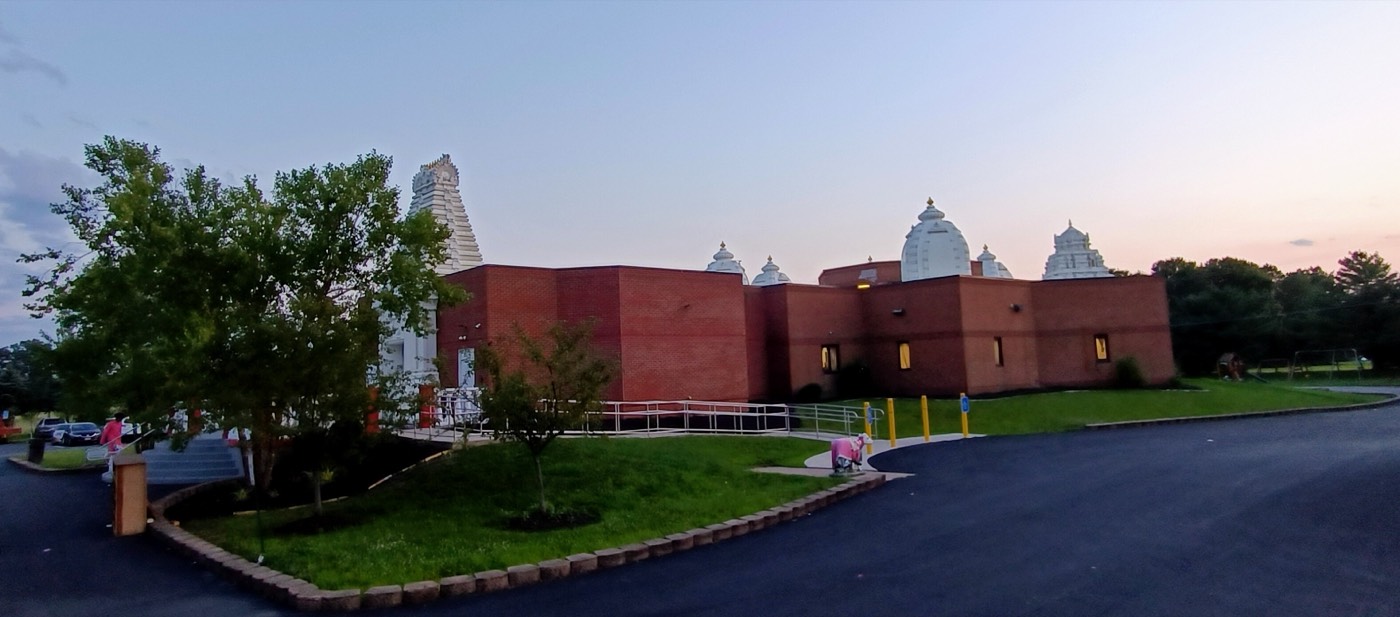
Drive north out of Columbus along the Olentangy, past the golf-course subdivisions and the brick entrance signs, and you arrive in Powell, a town of roughly fifteen thousand where the median household income runs near six figures and almost one resident in seven is Asian. The Indians in Powell did not stumble into this corner of Delaware County. They chose it, deliberately, for the schools, the quiet, and a temple on Hyatts Road that has anchored Hindu life in central Ohio for three decades.
The Place
Powell sits about fourteen miles north of downtown Columbus, tucked between the Scioto and Olentangy rivers in southern Delaware County. The first settlers arrived in 1801, and the crossroads went by Middlebury and then Hall’s Corner before taking the name of a judge who approved its post office in 1857.
For most of its history it was farmland. Then, in the late 1980s, it had a population of 378. Within two decades it passed 6,000, and the 2020 census counted 14,163. The growth came on the back of golf-course developments, good roads, and the Olentangy Local School District, which the state has rated among its very best.
Today it is one of the most affluent suburbs in the Columbus metro, and one of the most visibly South Asian. The 2020 census put Powell at roughly 12 percent Asian, a share that has kept climbing.
How It Became Indian
The Indian story in Powell is really the story of Indian Columbus, and Indian Columbus begins not with a developer but with a living room.
A living room in the 1970s
In 1975 a Columbus resident named Manu Bhatt began hosting weekly devotional singing at his home. The gatherings grew past a hundred people. By the early 1980s the group had organised into a formal study circle, incorporated as the Vedanta Society of Central Ohio, and started renting church halls for lectures that drew hundreds.
In 1985 they founded the Bharatiya Temple Society of Central Ohio, bought a house at 3903 Westerville Road in Columbus, renovated it, and installed the deities. On 6 December 1985 it was inaugurated as the Bharatiya Hindu Temple. The community had a home, but it was already outgrowing it.
Twenty-two acres in Powell
In 1991 the society did something ambitious for a young immigrant congregation. It bought 22 acres of land out in Powell, then still mostly rural. Construction began in 1993, and on 9 and 10 July 1994 the new temple at 3671 Hyatts Road was consecrated and opened to the public.
The choice mattered. The temple did not follow the Indian community to Powell. In many ways it led them there, planting a permanent landmark in a township that was about to explode in size.
Shashi Patel’s design was unusual on purpose. Rather than dedicate the building to a single deity, as most temples in India do, the society built an octagonal hall housing six shrines in a circle, so that worshippers from across India’s regions and traditions could each find their god under one roof. The east-facing entrance carries a gopuram, and the grounds were laid out with a yagna altar, a pond, and room to grow.
The professionals arrive
The people who filled the new subdivisions through the 1990s and 2000s were, in large part, the engineers, doctors, and IT specialists Columbus was hiring by the thousand. Major employers like Nationwide, Cardinal Health, and JPMorgan Chase built large technology teams, and a great many of those workers came from India on H-1B visas or as green-card holders.
Central Ohio households of South and Central Asian origin earn the highest median income of any foreign-born group in the city. That economic profile mapped neatly onto Powell: the school district, the new construction, and the safety drew exactly the families who could afford it. It is the same calculus that built Indian suburbs from Mason in south-west Ohio to Troy, Michigan: follow the engineering jobs, then buy where the schools are best.
By the 2010s the wider Columbus region was home to an estimated 30,000 to 40,000 people of Indian descent, with Telugu, Tamil, Gujarati, Hindi, Marathi, and Punjabi all spoken across the suburbs. Powell, with Dublin just to its south, became one of the densest pockets of that population.
From newcomers to neighbours
What began as visa workers waiting on green cards has matured into something settled. Children who started at Olentangy schools have graduated and come back. Families that rented now own. The temple that once renovated a house on Westerville Road now sits on a 30-acre campus with three community halls, a library, and classrooms full of weekend students learning Sanskrit shlokas and Bharatanatyam.
For the story of how this same migration shaped the suburb directly to the south, see our companion piece on the Indians in Dublin, Ohio, whose Sawmill Road corridor Powell families share for groceries and dinner.
The Landmarks
Bharatiya Hindu Temple, 3671 Hyatts Road. The spiritual heart of Indian Powell and the largest Hindu temple in the Columbus metro, with roughly 2,000 members. Architect Shashi Patel designed the octagonal brick structure to blend North Indian Nagara and South Indian Dravidian styles, with six shrines, each crowned by its own shikhara, housing Ganesha, Durga, Krishna, Shiva, Venkateshwara, and Rama.
Bharatiya Hindu Temple historical marker, Hyatts Road. In 2003 the Ohio Historical Society installed a marker at the temple, a quiet acknowledgement that a Hindu congregation founded by a handful of families in the 1970s had become part of the official record of the state.
Patel Brothers, 6600 Sawmill Road, Columbus. The national South Asian grocery chain anchors the Sawmill corridor that Powell and Dublin families treat as their pantry. Aisles of atta, dal, frozen parathas, and fresh curry leaves make the weekly shop feel like a market back home.
India Grocers, 5843 Sawmill Road, Dublin. A short drive south, this long-running independent grocer and gift shop stocks the spices, sweets, and pooja supplies that the big chains sometimes miss, and serves as a noticeboard for community events.
Doaba Indian Restaurant, 230 West Olentangy Street, Powell. One of the few full Indian kitchens inside Powell’s own old town centre rather than on the Sawmill strip, serving North Indian and Punjabi plates a short walk from the original 1850s crossroads.
Olentangy Liberty High School, 3584 Home Road, Powell. Opened in 2003 and consistently ranked among Ohio’s best, Liberty is the reason many Indian families chose Powell at all. Its science fairs, robotics teams, and spelling competitions are full of the children of the engineers who settled here.
Columbus Zoo and Aquarium, Powell. Powell’s most famous address is the zoo on Riverside Drive, a weekend fixture for families across the suburb. It is not an Indian institution, but it is part of the shared geography of growing up in Powell, the place every family’s photographs eventually include.
Where They Came From
Powell’s Indian families do not trace to a single state or language. The Columbus migration drew broadly, and the suburb reflects it: Telugu and Tamil speakers from the south, Gujaratis and Marathis from the west, Punjabis and Hindi speakers from the north.
The thread that ties them is occupational rather than regional. These were people educated as engineers, physicians, and computer scientists, recruited into the technology and insurance economy that Nationwide, Cardinal Health, Chase, and a growing roster of chip and cloud firms built in central Ohio.
That mix is why the temple was deliberately built in an octagon to honour several gods rather than one, and why community groups like the Telugu Association of Central Ohio and Columbus Tamil Sangam, founded in 1995, sit alongside one another. Powell is a meeting point for many Indias at once.
Powell Today
On a Saturday morning the temple car park on Hyatts Road fills early. Families arrive for archana, weekend language and dance classes run in the halls, and the kitchen turns out prasad for whoever stays. In October the same campus glows for Diwali, the single largest gathering on the calendar.
The rest of Indian Powell happens quietly, woven into ordinary suburban life. Cricket matches turn up on park fields in summer. The Sawmill Road grocers stay busy on weekends. Restaurants like Doaba sit in the old town centre, and newer Indian kitchens keep arriving as the population grows.
It is not a Devon Avenue or a Jackson Heights, and it is not the long-established Indian downtown of Edison, New Jersey, no dense commercial strip of saree shops and sweet houses. Powell’s Indian community is suburban by design: large houses, top schools, a temple on acreage, and a corridor of shops a few minutes’ drive away. For families who came for exactly that, it is the point, not a compromise.
The next generation is now the test of whether it lasts. Children raised in Powell’s subdivisions, fluent in both Telugu prayers and Friday-night high-school football, are starting to decide whether to stay in central Ohio or scatter to the coasts. Many are staying. With Intel and other technology investment reshaping the region’s economy, the engineering jobs that first drew their parents are multiplying, and the temple on Hyatts Road keeps adding classes for a third generation that will grow up calling Powell home.
Frequently Asked Questions
How many Indians live in Powell, Ohio?
The 2020 census put Powell at roughly 12 percent Asian, a large share of which is of Indian origin, out of a total population of about 14,163. The wider Columbus metro is home to an estimated 30,000 to 40,000 people of Indian descent, and Powell is one of its densest suburban pockets.
Why did so many Indians settle in Powell?
The Indians in Powell were drawn primarily by the Olentangy Local School District, one of Ohio’s top-rated, alongside new housing, low crime, and proximity to the Bharatiya Hindu Temple. Many work as engineers, doctors, and IT professionals for Columbus employers such as Nationwide, Cardinal Health, and JPMorgan Chase.
What is the Bharatiya Hindu Temple?
It is the largest Hindu temple in the Columbus metropolitan area, located at 3671 Hyatts Road in Powell. Founded by a community that began with home devotional gatherings in 1975, the temple on its current site was consecrated in July 1994 and serves roughly 2,000 members.
Where do Indians in Powell shop for groceries?
Most head to the Sawmill Road corridor on the Powell and Dublin border, where Patel Brothers at 6600 Sawmill Road and India Grocers at 5843 Sawmill Road stock South Asian staples, spices, sweets, and pooja supplies.
Is Powell related to Dublin, Ohio for the Indian community?
Yes. Powell and neighbouring Dublin together form the heart of the Indian community in north-west Columbus, sharing the Sawmill Road shops, restaurants, and cultural organisations. Many families consider them a single corridor.
What festivals do Indians in Powell celebrate?
Diwali, the festival of lights, is the largest annual celebration, hosted on the Bharatiya Hindu Temple campus each autumn. The temple also marks the major Hindu festivals through the year and runs weekend classes in Indian languages, music, and dance.
If your family’s story passed through Powell, or any of the places Indians have made home in America, Atlas of Home can trace that journey. From a village in Andhra or a town in Gujarat, to a house off Home Road and a temple on Hyatts, to wherever you are now.