
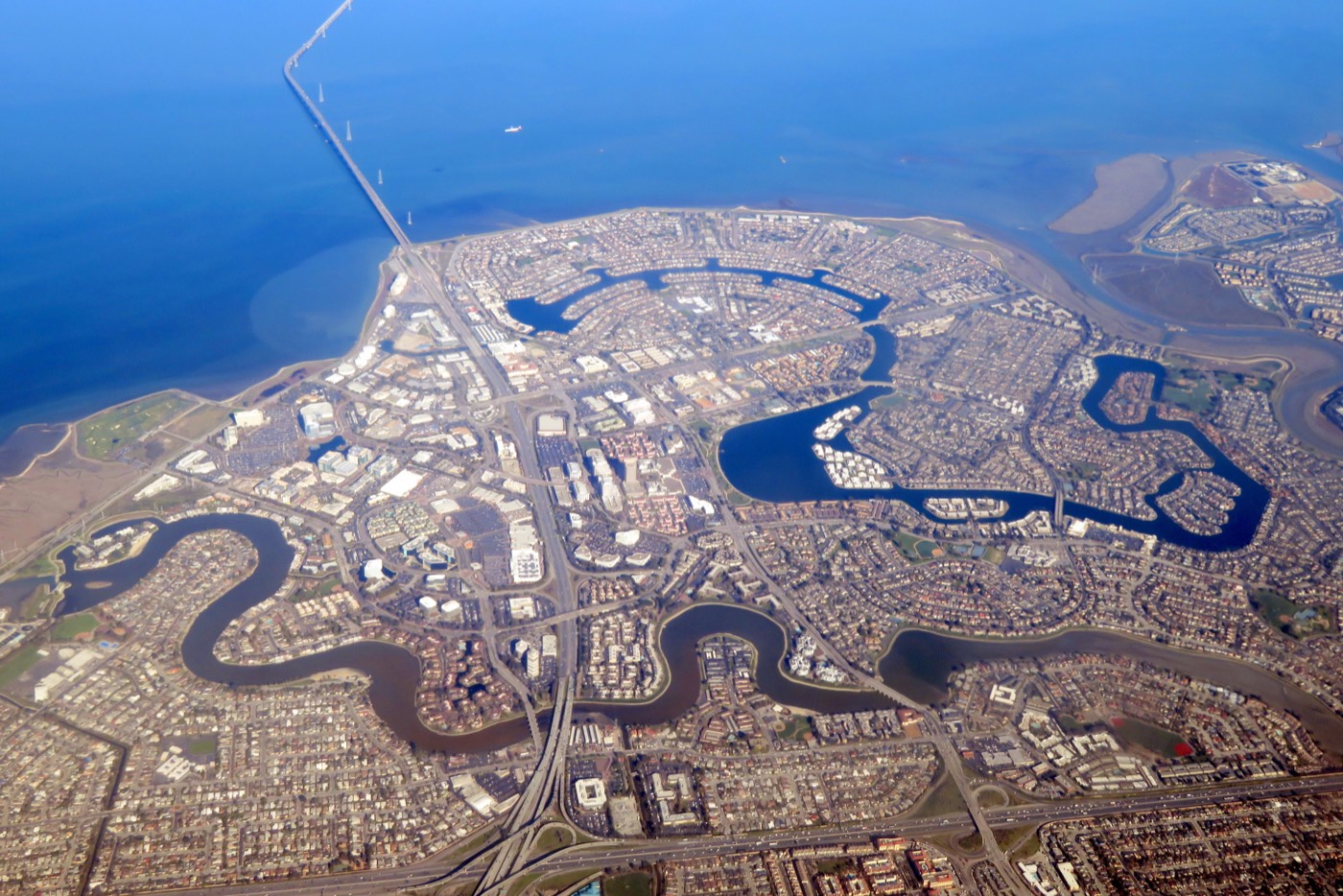
On a Saturday morning along the lagoon, the kayaks slide out past the levee and the joggers loop the boardwalk, and somewhere off Edgewater Boulevard a family is loading a trolley with atta, toor dal and a box of warm samosas. The Indians in Foster City did not arrive to a historic enclave with a name and a past. They arrived to a city that had been engineered out of bay mud barely a generation earlier, and over three decades they helped fill it. Today, in a town built on reclaimed salt flats, more than half the residents are Asian, and the Indian share has grown from a rounding error to one of the largest threads in the weave.
The Place
Foster City sits on the San Francisco Peninsula in San Mateo County, on what used to be Brewer’s Island, a tract of bay marsh and salt evaporation ponds. It is a planned community in the most literal sense: every lagoon, levee and cul-de-sac was drawn before a single home was built.
Water makes up most of the city’s footprint, and the central feature is an engineered lagoon system of more than 200 acres, designed first for drainage and then embraced as recreation. The result is a town of waterfront homes, sailboats and a continuous shoreline path.
It is also, by almost any measure, affluent. The median household income reached about 201,000 dollars in 2024, roughly double the California figure, and the typical home now trades well above a million. That combination, calm water, top schools and proximity to the heart of Silicon Valley, is exactly what drew the families this story is about.
How It Became Indian
To understand the Indians in Foster City you have to start with the city itself, because there was almost nothing here before 1960. The land belonged to the Leslie Salt Company and the Schilling estate, a flat expanse of evaporation ponds at the edge of the bay.
A city conjured from salt flats
In 1958 a retired developer named T. Jack Foster took a 200,000 dollar option on Brewer’s Island and set out to build an entirely new town. Ground broke on reclamation in August 1961, and because the fill had to be compacted before anything could be built, three years passed before the first houses were ready.
The first family moved in during March 1964. By the end of that year roughly 200 families had arrived, and by 1966 the population had reached 5,000. The community incorporated as a city on 27 April 1971. None of this is ancient history. There are residents alive today who remember the island as empty mudflats.
The first wave: engineers and the H-1B decade
The earliest Indian residents were a scattering of engineers and physicians who came in the 1970s and 1980s, the professionals admitted under the immigration reforms of 1965 that favoured skilled workers. In 1990 they were barely visible in the numbers: people of Asian Indian origin made up about one per cent of Foster City.
What changed was the technology boom on the Peninsula, and the visa system that fuelled it. Through the 1990s and 2000s, the H-1B programme brought a steady stream of Indian software engineers to the Bay Area, and many of them landed first as renters in the apartment complexes that ring Foster City’s lagoons.
From renters to homeowners
The pattern was consistent. A young engineer would take an apartment near the water, marvel at the schools, and then, once the job and the green card felt secure, buy a house a few streets over. The Asian share of the city climbed from 22 per cent in 1990 to 42 per cent by 2008, and the Indian portion specifically rose from that lone per cent in 1990 to about 8.6 per cent by 2008.
By the 2020 census the city was 53.5 per cent Asian, a majority. The growth was not driven by any single neighbourhood or builder courting Indian buyers. It was driven by what economists call a self-reinforcing amenity: each family that settled made the next family’s decision easier, because the grocery, the tutoring centre and the temple drive were all a little closer.
Why this town and not another
Foster City offered three things at once that mattered enormously to Indian tech families. It sat almost exactly halfway between San Francisco and the south-bay campuses, a defensible commute in either direction. Its schools, run by the San Mateo-Foster City School District, posted some of the strongest test scores on the Peninsula. And its waterfront calm felt safe in a way that suited families raising young children far from extended kin.
The arrival of major employers sealed it. Gilead Sciences, the biotechnology giant, grew into the city’s largest employer with thousands of staff. Visa built its headquarters complex here. Zoox, the autonomous-vehicle company, set up nearby. For an Indian engineer or researcher, the chance to live and work within the same few square miles, beside the water, with elite public schools, was close to ideal.
The Landmarks
India Cash & Carry, 750 Alma Lane, Unit 115. The community’s working pantry. Shoppers come for fresh produce, sacks of rice and atta, a wall of spices and a hot-food corner turning out samosas and ready meals. On weekends it functions as an informal noticeboard, where families swap leads on housing, tutors and weekend cricket.
Tabla Indian Restaurant, 939A Edgewater Boulevard. Tucked into the Edgewater Place shopping centre, Tabla is the neighbourhood’s reliable table for North Indian curries and tandoor. It sits in a row of Asian eateries that tells the city’s story in signage, a Korean barbecue, a Chinese kitchen and an Indian dining room sharing one car park.
Edgewater Place Shopping Centre, 901 to 999 Edgewater Boulevard. More than a strip mall, this is the everyday crossroads of immigrant Foster City. Its tenants skew unmistakably Asian, and the recent arrival of the Japanese grocer Osaka Marketplace only deepened the centre’s role as a pan-Asian larder for the Peninsula.
Leo J. Ryan Memorial Park. The city’s waterfront park, with its amphitheatre, lawns and gazebo on the lagoon, is where the Indian community goes public. Each spring its meadow hosts a free Holi celebration, organised by Bay Area South Asian Indians, that draws thousands to throw colour beside the water.
Brewer Island Elementary School. Named for the marsh the city replaced, Brewer Island is among the highest-ranked elementary schools in California, with roughly 82 per cent of pupils proficient in maths and 87 per cent in reading. For many Indian parents the school’s reputation was the single deciding factor in the move.
Bowditch Middle School. The city’s middle school carries pupils on from those elementary years, ranking among the strongest in the state. Its weekend and after-school hours fill with the maths leagues, coding clubs and music lessons that shape the rhythm of an Indian-American childhood here.
Bridgepointe Shopping Centre. Just over the city line in San Mateo, anchored by Target and Home Depot, Bridgepointe is the practical errand-run that bookends the more cultural shopping along Edgewater. It is where the lagoon-side life meets the ordinary business of furnishing a first American home.
Where They Came From
The Indians in Foster City are, overwhelmingly, a story of the post-1990 technology migration, and that shapes their origins. The largest streams trace to the software hubs of southern and western India, the engineering colleges of Andhra Pradesh and Telangana, the IT corridors of Karnataka and Tamil Nadu, and the technical schools of Maharashtra and Gujarat.
These were not chain migrations of village kin in the old sense. They were credential migrations: graduates of the Indian Institutes of Technology and regional engineering universities who followed jobs rather than relatives, then sponsored parents and siblings once they were settled.
The result is a community that is linguistically plural, Telugu, Tamil, Hindi, Kannada, Gujarati and Marathi all spoken at the same school gate, but socially cohesive, bound by a shared arc through the same universities, the same visa queue and the same handful of Peninsula employers.
Foster City Today
Foster City today is a majority-Asian city where the Indian presence is woven into ordinary life rather than fenced into an enclave. There is no single Indian district. Instead there is an Indian grocery in one centre, an Indian restaurant in another, a Holi festival in the park each spring and a steady current of South Asian families along the boardwalk every evening.
The pressures are real and worth naming honestly. Home prices well above a million dollars have made the city hard to enter for the next wave of young engineers, who increasingly rent rather than buy or look to less expensive towns inland. And Foster City’s defining feature, its low elevation behind levees, makes sea-level rise a genuine long-term worry that the city is spending heavily to address.
Yet for the families already here, the bargain still holds. The schools remain excellent, the commute remains manageable, the water remains calm. A town that was salt flats within living memory has become, for thousands of Indian Americans, simply home, the place where their children learned to ride bikes along a lagoon their grandparents could never have imagined. For a fuller picture of the city’s design and history, the Wikipedia entry on Foster City traces the engineering of Brewer’s Island in detail.
The Indian community here echoes patterns seen across the Bay Area’s affluent suburbs, from the engineers who settled among the Indians in Livermore, California to the families who built lives beside the Israelis in Palo Alto, California. It also rhymes with the suburban Indian heartlands forming far from the coasts, among the Indians in Gilbert, Arizona, the Indians in Celina, Texas, the Indians in Milton, Georgia and the Indians in Stone Ridge, Virginia. Closer to home, Foster City shares its lagoons and its larders with the equally established Chinese in Foster City, California, and with the Filipinos in Carson, California further south.
Frequently Asked Questions
How large is the Indian community in Foster City, California?
People of Asian Indian origin grew from about one per cent of Foster City in 1990 to roughly 8.6 per cent by 2008, part of an Asian population that reached 53.5 per cent of the city’s roughly 33,800 residents by the 2020 census. The Indians in Foster City are now one of the city’s largest communities.
Why did so many Indian families settle in Foster City?
Foster City offered a rare combination: a central Peninsula location halfway between San Francisco and Silicon Valley, top-ranked public schools, and waterfront calm. Major employers such as Gilead Sciences and Visa drew Indian engineers and researchers who could live, work and raise children within a few square miles.
Where do Indians in Foster City shop and eat?
India Cash & Carry at 750 Alma Lane is the community’s main grocery, while Tabla Indian Restaurant at 939A Edgewater Boulevard anchors the dining scene inside the Edgewater Place shopping centre. The nearby Bridgepointe centre in San Mateo handles everyday errands.
Is there an Indian festival in Foster City?
Yes. Each spring Leo J. Ryan Memorial Park hosts a free Holi celebration organised by Bay Area South Asian Indians, drawing thousands of people to throw coloured powder beside the lagoon. It has become one of the most widely attended Holi events in Northern California.
What is Foster City and why is it considered affluent?
Foster City is a planned community built in the 1960s on reclaimed bay land at Brewer’s Island and incorporated in 1971. Its median household income reached about 201,000 dollars in 2024, roughly double the state figure, driven by Silicon Valley salaries and a stock of waterfront homes.
How good are the schools that attract Indian families to Foster City?
The San Mateo-Foster City School District ranks among the strongest on the Peninsula. Brewer Island Elementary posts about 82 per cent maths proficiency and 87 per cent reading proficiency, and Bowditch Middle School ranks among the top middle schools in California, a major draw for the Indians in Foster City.
If your family’s story passed through Foster City, or any of the places Indians have made home in America, Atlas of Home can trace that journey. From an engineering college in Hyderabad or Chennai to a lagoon-side house on Brewer’s Island, to wherever you are now.