
There is a stretch of Foster City Boulevard where the parking lot of a Chinese supermarket fills before nine on a Saturday morning, families wheeling carts of bok choy and live crab back to German sedans under a flat Peninsula sky. The Chinese in Foster City did not inherit an old quarter or a historic Chinatown. They arrived in a city younger than many of them, a place pumped up out of the bay floor barely sixty years ago, and made it one of the most Chinese suburbs in America.
The Place
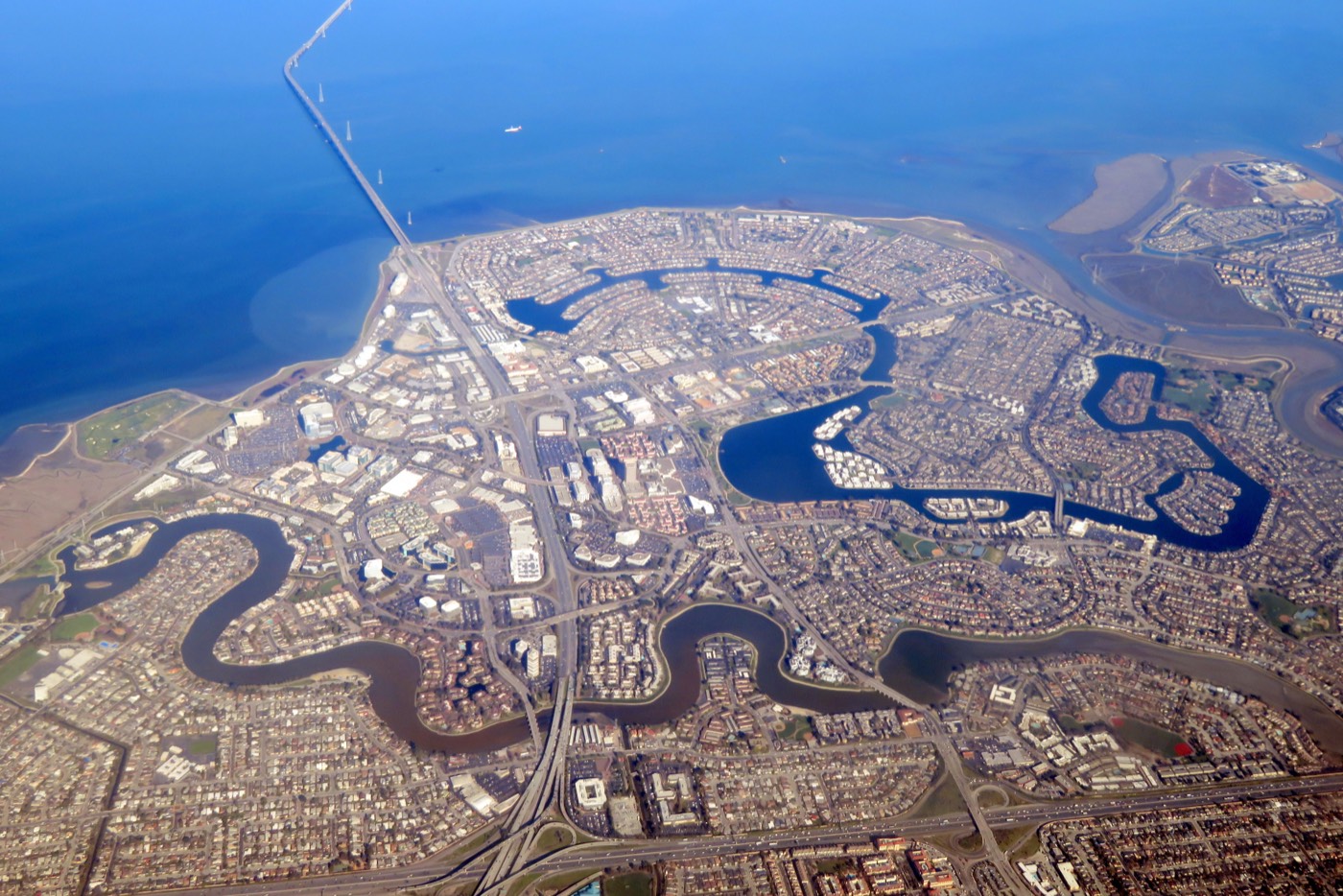
Foster City sits on the eastern edge of San Mateo County, on the San Francisco Peninsula, roughly halfway between San Francisco and Silicon Valley. It is a flat grid of lagoons and cul-de-sacs hugging the western shore of San Francisco Bay, threaded by canals that put a strip of water behind a startling number of back gardens.
Almost none of it is natural ground. The land was once Brewer’s Island, a dairy pasture below the tideline, and the city you see today was dredged, pumped, and engineered into existence. That artificiality is the point: Foster City was planned from a blank sheet, and the people who came filled it with their own intentions.
Today the median household income runs near $199,000, and the schools are among the most sought-after in the county. For a certain kind of arriving family, that combination reads as a single word: home.
How It Became Chinese
An island built from the bay
In 1958 a real estate developer named T. Jack Foster took an option on Brewer’s Island, a low-lying expanse in San Mateo County that had been used as a dairy farm since the nineteenth century. With Bay Area financier Richard Grant, Foster set out to build an entire city from scratch.
For six years, dredges ran around the clock, pumping sand up from the floor of San Francisco Bay. More than fourteen million cubic yards of material were laid down before the first house went up. By 1962, Foster had sunk millions of his own dollars into raising a habitable plain above the tide. The first families moved in around 1964, and the new city incorporated on 27 April 1971.
It was, from the beginning, a planned community: conceived whole, laid out for a particular life of good schools, quiet streets, and water views. That blank-slate quality mattered. There were no entrenched neighbourhoods to break into, no older population guarding the doors. Whoever could afford a house belonged.
The first wave
Chinese families were present early. As far back as the 1970 census, residents of Chinese descent already made up around five percent of the small new town, drawn by the same things drawing everyone: new houses, open enrolment in a fresh school district, an easy reach to jobs up and down the Peninsula.
These were not, for the most part, the descendants of San Francisco’s old Chinatown. They were engineers, doctors, and accountants, many of them educated in the United States or arriving with professional degrees, looking for a suburb that asked nothing of them but the mortgage.
The tech and biotech decades
The transformation accelerated as the Peninsula’s economy did. In 1987 a young biopharmaceutical company called Gilead Sciences was founded, and it grew into Foster City’s anchor employer, today the largest in town with thousands of staff working on antiviral medicine. The payments giant Visa established a major campus here as well, and later the autonomous-vehicle firm Zoox.
That mix, biotech and finance and software, drew exactly the workforce that was reshaping Chinese migration to America: technically trained, often holding advanced degrees, frequently sponsored on professional work visas before settling into green cards and citizenship. A chemist at Gilead, a risk analyst at Visa, an engineer commuting south to a Silicon Valley campus: any of them could buy in Foster City, and many did.
Between 1990 and the late 2000s the Chinese share of the city climbed steadily, from roughly eleven percent in 1990 to nearly seventeen percent by 2008. The broader Asian population grew alongside it, and by the 2020 census Asian residents made up 53.5 percent of Foster City, a clear majority of a city of around 33,800 people.
Mainland and Taiwan, side by side
The community that formed was never a single thing. Earlier arrivals included many Taiwanese families, part of the broad mid-century migration of students and professionals from Taiwan to the American West. Later decades brought a surge of newcomers from mainland China as China’s own economy opened and its graduates fanned out into global technology and science.
In Foster City these strands settled together, more by income and profession than by origin. A Taiwanese family that arrived in the 1980s and a mainland family that arrived in the 2010s might share a school district, a supermarket, and a weekend Mandarin class, their children indistinguishable in the same robotics club.
The school engine
If one force compounded all the others, it was schools. Foster City’s children attend the well-regarded San Mateo-Foster City Elementary School District, with high schoolers feeding into the San Mateo Union High School District. Campuses like Brewer Island Elementary and Bowditch Middle School rank among the strongest in the state, and Bowditch has been named a California Distinguished School.
For Chinese families weighing where to put down roots on the Peninsula, that reputation acted as a magnet, just as it has in Cupertino and Palo Alto to the south. A good house in a good district is the asset many immigrant parents prize above all others, and Foster City offered both within commuting distance of the jobs.
The Landmarks
99 Ranch Market, 1070 Foster City Boulevard. The pan-Asian supermarket chain’s Foster City branch is the closest thing the community has to a town square. Its aisles of fresh greens, live seafood tanks, and Taiwanese snacks pull shoppers from across the mid-Peninsula, and its food court turns a grocery run into lunch.
Tai Wu Restaurant, Foster City Boulevard. Tucked into the plaza beside the big Chinese grocery, Tai Wu is the kind of fast, unfussy Cantonese-leaning kitchen where a family can eat well for very little. It is a neighbourhood fixture rather than a destination, which is exactly why locals keep it close.
Joy Restaurant, Beach Park Plaza. Known also as 5 Joy, this strip-mall room just south of the San Mateo Bridge approach serves Taiwanese home cooking with Shanghainese and Shanxi dishes alongside. For Taiwanese families in particular it is a taste of the food they grew up with, plated without ceremony.
Brewer Island Elementary School, Foster City. Named for the dairy island the city was built upon, Brewer Island ranks among the top elementary schools in California. For many Chinese families it is the practical reason a particular street was worth the premium.
Bowditch Middle School, Foster City. A California Distinguished School and one of the highest-rated middle schools in the area, Bowditch is where the district’s reputation is made or unmade in the eyes of arriving parents. Its strong test scores are quoted in family WeChat groups the way home prices once were.
The Foster City lagoons and Leo J. Ryan Park. The city’s central lagoon and waterfront park host community gatherings and the summer fireworks, and on warm weekends the paddleboats and shoreline paths fill with the same families who shop the Chinese markets by morning. It is where the planned city’s promise of water-and-quiet is most visibly enjoyed.
Gilead Sciences headquarters, Lakeside Drive. The biotech campus that grew from a 1987 start-up into Foster City’s largest employer is, for many residents, the reason they live here at all. Its laboratories and offices employ a workforce in which Chinese scientists and analysts are heavily represented.
Where They Came From
The Chinese of Foster City trace back to two broad currents. One runs from Taiwan, carrying the students and professionals who came west across the second half of the twentieth century and often settled first elsewhere on the Peninsula before moving in. The other runs from mainland China, especially the coastal cities and university towns that supplied so many of the engineers and scientists who arrived from the 1990s onward.
What united them was rarely a home village and almost always a profession. They came as graduate students, as sponsored employees of technology and pharmaceutical firms, as skilled workers who converted visas into permanent residence. Foster City was seldom anyone’s port of entry; it was the place a family arrived at once it had succeeded.
That sets it apart from a chain-migration enclave built around a single county of origin. The link here was the Peninsula economy itself, and the shared conviction that a house in a top school district was the surest investment a striving family could make.
Foster City Today
Foster City today is a quietly multilingual place where more than half the residents are Asian and Chinese families form one of its largest groups. The signs of that are everyday rather than spectacular: a 99 Ranch run folded into the weekend, weekend Mandarin and music lessons, a SAT-prep culture as serious as anywhere in the country, parents trading notes on Bowditch and Brewer Island.
It is also a community shaped by money and by stillness. Home values here run high even by Peninsula standards, and the lagoon streets are calm to the point of hush. That can make integration feel less like a struggle and more like a default, the city having been built without an older order to push against. The result is a place that is genuinely Chinese-American without ever announcing itself with an arch or a gate.
The relationship with neighbouring San Mateo and with Millbrae up the line keeps the everyday infrastructure close: larger Chinese commercial strips, restaurants, and services are a short drive away, so Foster City can stay residential while still being deeply connected to the wider Peninsula Chinese world that stretches down through Fremont across the bay. For families who came to America with a plan, this engineered city on the water turned out to be a remarkably good place to carry it out.
Frequently Asked Questions
How many Chinese people live in Foster City?
Foster City has a population of roughly 32,000 to 34,000, of whom about 53 to 54 percent are Asian. The Chinese in Foster City form one of the largest single groups within that majority, with their share of the city rising from around five percent in 1970 to nearly seventeen percent by the late 2000s.
Why did so many Chinese families move to Foster City?
The main draws were jobs and schools. Major employers like Gilead Sciences and Visa created demand for exactly the technically trained workforce that drove Chinese professional migration, while the highly rated San Mateo-Foster City and San Mateo Union school districts made the city especially attractive to families. Its central Peninsula location, halfway between San Francisco and Silicon Valley, sealed the appeal.
Is there a Chinatown in Foster City?
No. Unlike San Francisco, Foster City has no historic Chinatown, because the entire city was built on reclaimed bay land in the 1960s and 1970s. The Chinese in Foster City live throughout a planned residential grid rather than in a single quarter, with community life centred on supermarkets, restaurants, and schools.
Where do Foster City Chinese families shop and eat?
The 99 Ranch Market on Foster City Boulevard is the community hub for groceries, with restaurants like Tai Wu nearby and Taiwanese spots such as Joy in Beach Park Plaza. Larger Chinese commercial strips in neighbouring San Mateo and Millbrae are a short drive away.
Are Foster City’s Chinese residents from mainland China or Taiwan?
Both. Earlier waves included many Taiwanese professional families, while later decades brought a large number of newcomers from mainland China. In Foster City the two have settled together, bound more by shared professions and schools than by a common region of origin.
What are the schools like in Foster City?
They are among the strongest reasons families move there. Elementary children attend the San Mateo-Foster City district, with campuses such as Brewer Island Elementary ranking near the top in California, and Bowditch Middle School recognised as a California Distinguished School. High schoolers attend San Mateo Union High School District schools.
If your family’s story passed through Foster City, or any of the places Chinese families have made home in America, Atlas of Home can trace that journey. From a coastal city in China or a town in Taiwan to a house on the Foster City lagoons, to wherever you are now.