
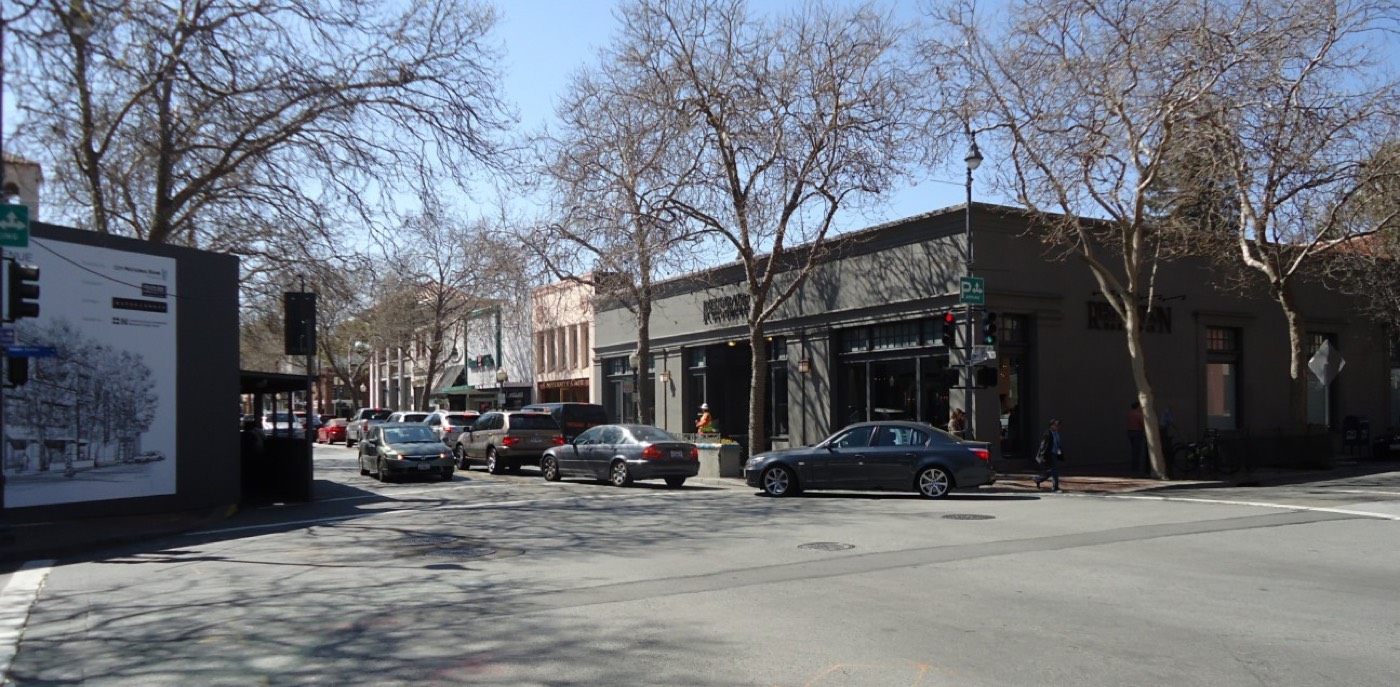
On a spring afternoon along University Avenue, the conversations drifting out of the coffee queues run in Mandarin as often as English: a Stanford postdoc comparing notes on a grant, a founder talking term sheets, a grandmother on the phone to Shanghai. The Chinese in Palo Alto are not a single wave but layers laid over more than a century, from the labourers who planted Stanford’s first palm trees to the engineers and investors who now help decide which startups get funded. Few American towns hold both ends of that story so plainly.
The Place
Palo Alto sits at the foot of the San Francisco Peninsula, wrapped around the western edge of Stanford University and threaded by Sand Hill Road, the short stretch that became shorthand for American venture capital. It is one of the most expensive places to live in the United States, a town of leafy streets, Eichler homes, and a downtown that empties of cars but never of ambition.
The city took its name from a coast redwood, El Palo Alto, the tall tree beside the creek where an early Spanish expedition camped. Today its 68,000 residents include some of the highest concentrations of engineers, academics, and founders anywhere on earth.
By the 2020 Census, Asian residents made up about 35 percent of Palo Alto, a share that has kept rising since. Chinese Americans, both long-settled and newly arrived, form one of the largest threads within that count.
How It Became Chinese
The Chinese presence in Palo Alto is older than the town itself. It begins not on University Avenue but in the soil of the Stanford estate, and it has renewed itself with each generation of newcomers drawn by the university and the industry that grew up around it.
The workers who built the campus
Before Palo Alto was incorporated in 1894, Leland Stanford ran a vast stock farm on the land that would become the university. Much of the physical labour was done by Chinese workers, between roughly a dozen and three hundred at any one time, who lived in quarters in what is now the Stanford Arboretum.
After construction of the campus began in 1885, these workers planted every palm tree along Palm Drive, dug and planted the Oval, and almost certainly laid out the gardens of the Main Quadrangle. The landscapes that visitors photograph today were shaped by their hands.
The labour quarters were occupied from the 1880s until 1925, when the last resident left and the buildings were torn down. For decades the story went largely untold. A Stanford archaeology project that began excavating the Arboretum Chinese Labor Quarters in 2017 has since recovered cups, plates, and animal bones from cooked meals, quiet evidence of lives lived in the shadow of the founding.
Students and scholars
The university that the labourers built slowly opened its classrooms to Chinese students. In 1896, Walter Ngon Fong became the first Chinese student to graduate from Stanford. Decades later, in the academic year of 1938 to 1939, Shau Wing Chan was appointed to teach Chinese language and literature, founding what would become Stanford’s programme in the subject.
For years the numbers stayed small. In 1958 there were just five students in first-year Chinese. By 1989 the university had to hire six additional lecturers to handle an enrolment in Chinese and Japanese that had simply exploded. The Stanford Area Chinese Club, founded in 1965 to share Chinese culture with Palo Alto, gave the growing community an early anchor off campus.
The engineers and the founders
The decisive shift came with the rise of Silicon Valley. As the semiconductor and then the software industries spread north and south of Stanford, the university’s graduate programmes filled with engineers and scientists from Taiwan and, later, mainland China. Many stayed, building careers at the companies clustered between Palo Alto, Mountain View, and Cupertino.
They came for graduate degrees and stayed for work; they came for work and sent for family. Some founded companies of their own. Others returned to Asia to start firms and kept a foot on the Peninsula. The migration was driven by education and by opportunity rather than by hardship, which gave the Palo Alto community a particular shape: affluent, highly credentialed, and tightly woven into the institutions of both Stanford and the tech economy. It is a profile shared with other Chinese enclaves built on professional migration, from the engineers of Bellevue, Washington to the older established families of Arcadia and Monterey Park in Southern California.
The newest arrivals
The most recent layer is the wave of researchers and founders working at the frontier of artificial intelligence. Chinese-born engineers have become some of the most sought-after people in the valley, and Palo Alto, sitting between Stanford’s labs and the venture firms on Sand Hill Road, is once again a natural landing point. A new generation arrives each year, repeating a pattern more than a century old.
The Landmarks
The Arboretum Chinese Labor Quarters, Stanford University Arboretum. The site where Chinese workers lived from the 1880s to 1925 is now the focus of a community-based archaeology project. It is the oldest physical marker of Chinese life in the area, hidden in plain sight near the campus most people pass through without a second thought.
Palm Drive and the Main Quad, Stanford University. The ceremonial entrance to Stanford, its palms planted by Chinese labourers, runs straight to the sandstone arches of the Main Quadrangle. Generations of Chinese students have walked it since Walter Ngon Fong first did in the 1890s.
Ohlone Elementary School, 950 Amarillo Avenue. Home to Palo Alto’s Mandarin immersion programme, begun as a pilot in 2008 with two kindergarten classes and forty children. A Stanford study later found its fourth and fifth graders reaching a fluency comparable to high schoolers in AP Mandarin, and the district expanded the programme into middle school.
Jing Jing Gourmet, 443 Emerson Street. A Szechuan and Hunan restaurant that opened in 1986 and fed downtown Palo Alto for thirty-eight years before closing in 2024. Its wontons in chilli oil and crispy dry-shredded beef were a fixture for an entire generation of families and students.
Kirin Restaurant, Castro Street, Mountain View. A Cantonese mainstay just south of Palo Alto with more than forty years of history, recently renovated. Its dim sum, the shrimp dumplings and shumai in particular, has long drawn Palo Alto families to the busy Chinese restaurant row on Castro Street.
99 Ranch Market, on the South Bay’s Chinese grocery circuit. The pan-Asian supermarket chain anchors the everyday grocery life of the area’s Chinese households, stocking the produce, sauces, and frozen dumplings that downtown’s boutique markets do not. It is where the week’s cooking actually begins.
Mandarin Roots, West Palo Alto. A family-owned restaurant known for homestyle Hunanese cooking with adjustable spice and locally sourced produce, a quieter, newer counterpoint to the old downtown stalwarts and a sign that the food culture keeps renewing itself.
Where They Came From
Palo Alto’s Chinese community traces to two main origins. The earlier engineering wave drew heavily from Taiwan, as graduates of its universities came to Stanford and the surrounding tech firms through the 1970s, 1980s, and 1990s.
The later and now larger wave comes from mainland China, especially its big coastal cities and university towns, arriving for graduate study and research and staying for careers in software, hardware, and increasingly artificial intelligence.
What unites them is selection by education. This is migration routed through admissions offices and job offers rather than through chain migration from a single village, which is why the community skews toward scientists, engineers, academics, and founders, and why ties back to both Taipei and the mainland remain so close.
Palo Alto Today
Today the Chinese presence in Palo Alto is woven through the institutions that define the town. It shows up in the Mandarin spoken in the playground at Ohlone, in the families filling the Saturday morning tutoring centres, and in the names on the doors of the startups that line University Avenue and the venture firms on Sand Hill Road.
It is a community shaped by money and by pressure. Palo Alto’s schools rank among the best in California, and the competition within them, much of it among the children of immigrant engineers, is famously intense. Housing costs push many families to nearby Mountain View, Cupertino, and Sunnyvale, so the lived community spreads well beyond the city line even when the workday centres on Palo Alto.
The old downtown landmarks are not permanent. Jing Jing’s closure in 2024, after nearly four decades, was a reminder that rising rents and changing habits reshape even the most beloved fixtures. Yet each year brings a fresh cohort of students and engineers, and the cycle that began with workers planting palm trees on a stock farm continues, quieter but unbroken, more than a hundred and thirty years on.
Frequently Asked Questions
How many Chinese people live in Palo Alto?
The Census does not publish a precise standalone figure for Palo Alto’s Chinese population, but Asian residents made up about 35 percent of the city’s roughly 68,000 people at the 2020 Census, a share that has continued to rise. Chinese Americans, both long-settled and newly arrived, form one of the largest groups within that total.
Why are there so many Chinese in Palo Alto?
The Chinese in Palo Alto are drawn overwhelmingly by Stanford University and the surrounding technology industry. Graduate study, research positions, and engineering and founder roles in Silicon Valley have pulled successive waves from Taiwan and mainland China to the city and the towns around it.
What is the history of Chinese workers at Stanford?
Chinese labourers worked the Stanford stock farm from the 1880s, living in quarters in what is now the Arboretum until 1925. They planted the palms along Palm Drive, dug the Oval, and helped lay out the Main Quadrangle gardens, shaping the campus landscape that endures today.
Is there a Mandarin school in Palo Alto?
Yes. Ohlone Elementary School runs a Mandarin dual-immersion programme that began as a pilot in 2008 and now teaches English-speaking and native Mandarin-speaking children together. A Stanford study found its older elementary students reaching fluency comparable to AP-level high schoolers, prompting expansion into middle school.
Where do Chinese families in Palo Alto shop and eat?
Everyday grocery shopping often happens at pan-Asian supermarkets such as 99 Ranch Market, while dining ranges from Castro Street’s long-running Cantonese restaurants in nearby Mountain View, like Kirin, to homestyle spots such as Mandarin Roots in West Palo Alto.
Did Chinese immigrants in Palo Alto come from a single region?
No. The earlier engineering wave drew heavily from Taiwan, while the larger recent wave comes from mainland China’s coastal cities and university towns. Because the Chinese in Palo Alto migrated mainly through education and work rather than chain migration, the community is unusually diverse in origin and heavily professional.
If your family’s story passed through Palo Alto, or any of the places Chinese families have made home in America, Atlas of Home can trace that journey. From the university towns of Taiwan and the coastal cities of China, to a kitchen near University Avenue, to wherever you are now.