
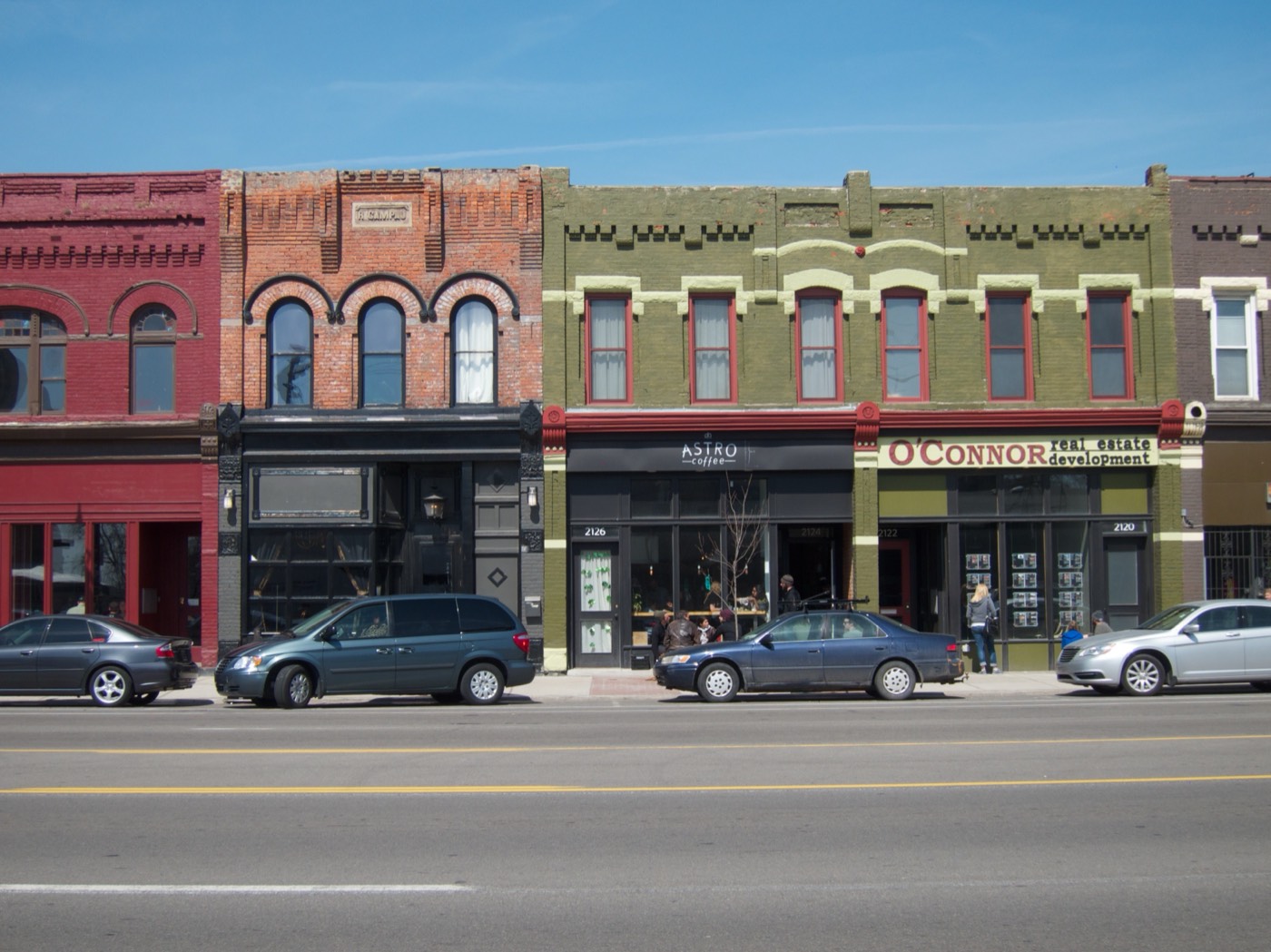
Walk west from downtown Detroit, past the off-ramps and the new glass, and the city suddenly softens into brick. Narrow workers’ cottages, pastel facades, deep front porches. This is Corktown, and it is the oldest surviving neighbourhood in the city. The Irish in Corktown built it, named it after the county most of them had fled, and left their fingerprints on every church bell and parade banner that still defines the place today.
The Place
Corktown sits directly west of Detroit’s downtown core, a compact grid bounded by Interstate 75 to the north, the John C. Lodge Freeway to the east, Bagley and Porter streets to the south, and Rosa Parks Boulevard, the old 12th Street, to the west. It is small enough to cross on foot in twenty minutes.
It is also Detroit’s oldest neighbourhood, though it is only about half as old as the city itself. The houses here predate the car factories that made Detroit famous, and many still stand: Federal-style rowhouses, modest cottages, the occasional Victorian with decorative cornices.
The streets once ran straight down to the Detroit River. The freeways severed that connection, but the bones of the nineteenth-century neighbourhood survived, which is why the whole district was placed on the National Register of Historic Places on 31 July 1978.
How It Became Irish
The story of the Irish in Corktown begins in the 1830s, before the famine ships, before the railroads, when Detroit was still a frontier town on the edge of the American interior. The Detroit Historical Society traces the neighbourhood’s roots to those first arrivals.
The first arrivals, 1830s
Irish immigrants began settling the area west of downtown in the 1830s. They came in modest numbers at first, labourers and craftsmen looking for work along the river and the new commercial streets. They clustered together, as immigrant communities do, in the cheaper land beyond the city’s original boundaries.
By the time the neighbourhood had a recognisable shape, it had a recognisable accent too. The newcomers were overwhelmingly from County Cork in the south of Ireland, and the name attached itself almost inevitably. Corktown. The county brought to Michigan.
The famine and the flood, 1840s and 1850s
Then came the Great Famine. The potato blight that devastated Ireland through the 1840s drove more than a million people across the Atlantic, and a steady share of them turned up in Detroit. By the middle of the nineteenth century, the Irish were the single largest group of newcomers arriving in the city.
They poured into the streets west of downtown. By the early 1850s, half the residents of the 8th Ward, the ward that contained Corktown, were of Irish descent. The neighbourhood became, in effect, a small piece of Munster transplanted to the Great Lakes.
The cottages they built
These were not wealthy people. The homes they put up reflected it. Some of the earliest surviving units, built around 1849, measured roughly 560 square feet, a single room downstairs with a sleeping loft tucked above.
They built rowhouses and detached cottages in the Federal style that was fashionable at the time, plain and sturdy. Many of those structures still line Bagley, Porter and Labrosse streets, which is precisely why the neighbourhood reads today as a rare survival rather than a reconstruction.
The church at the centre
An Irish Catholic neighbourhood needed an Irish Catholic parish, and Corktown got one early. Most Holy Trinity was founded in 1834 as the first English-speaking Catholic parish in Detroit, established specifically to serve the Irish.
The parish moved to the corner of Sixth and Porter streets in 1849. Construction of the present church began in the mid-1850s and was completed in 1866. It became the heart of the neighbourhood, the place where the Irish in Corktown were baptised, married and buried, and where they gathered each March to honour their patron saint.
Dispersal and arrival, after the Civil War
Success scattered them. As Detroit boomed into an industrial centre and the Irish grew more established and more prosperous, families began moving out of Corktown and across the wider city. The neighbourhood did not empty so much as change hands.
German immigrants had started making inroads by the time of the Civil War. In the early twentieth century, Maltese and Mexican newcomers moved into the same older housing the Irish had built. Corktown became a layered place, but its name and its founding identity stayed stubbornly Irish.
The Landmarks
Most Holy Trinity Catholic Church, 1050 Porter Street. The spiritual anchor of Irish Corktown, founded in 1834 and completed in its present Gothic Revival form in 1866. It is the second-oldest Catholic church in Detroit and the first built for an English-speaking congregation. Restored after a 1985 fire, it still hosts the neighbourhood’s St Patrick’s celebrations, the “Sharin’ o’ the Green,” a tradition stretching back generations.
St Patrick Senior Center, 58 Parsons Street. The building’s roots reach back to 1862, when St Patrick Parish was organised in response to the stream of Irish Catholics arriving in Detroit. The former church now serves the neighbourhood’s older residents, and the annual Corktown Races 5K run and walk raises funds to support it.
Gaelic League Irish American Club, 2068 Michigan Avenue. Founded in Detroit on 9 December 1920, the Gaelic League bought its Corktown headquarters from the Ford Motor Company in 1951 and added an annex three years later. It sits on Michigan Avenue at Wabash Street and remains an active hub for Irish music, dance and culture in the city.
Michigan Central Station, 2001 15th Street. The 18-storey Beaux-Arts depot opened in 1913 and carried passengers until 1988, after which it stood abandoned and became a symbol of Detroit’s decline. Ford Motor Company bought it in 2018 for ninety million dollars and reopened it on 6 June 2024 as the centrepiece of a thirty-acre technology campus, the most dramatic turn in Corktown’s modern story.
The corner of Michigan and Trumbull. For most of a century this was Tiger Stadium, the home of Detroit baseball, nicknamed simply “The Corner.” The stadium was demolished in 2009, but the site at Michigan Avenue and Trumbull Street is preserved as a ballfield, and on game days the Irish bars along the avenue still fill.
Nemo’s, 1384 Michigan Avenue. Opened in 1965 by brothers Pat and Tim Springstead, Nemo’s is a nineteenth-century building a block from the old stadium and one of Detroit’s most enduring baseball bars. It has outlasted the ballpark it once served and remains a fixture of the Michigan Avenue corridor.
The Corktown Historic District. Not a single building but the neighbourhood itself, listed on the National Register on 31 July 1978. The designation protects the surviving streetscape of cottages and rowhouses along Bagley, Porter and the surrounding streets, the physical record of the Irish who built it.
Where They Came From
The clue is in the name. The overwhelming majority of Detroit’s Irish came from County Cork, in the province of Munster on Ireland’s southern coast, which is why the neighbourhood was christened Corktown rather than something more generic.
Cork was a port county, and the city of Cork was one of the great emigration harbours of the famine era. For families pushed off the land by blight and rent, the road out often ran through Cork harbour and across the Atlantic to North America. Detroit, sitting on the route between the eastern seaboard and the opening interior, caught a steady flow of them.
The chain held the way these chains always do. One family established itself, sent word and sometimes passage money home, and drew the next across. A neighbourhood named for a single county is the most honest demographic record a city can keep. You can read the same chain elsewhere in Irish America, in the parishes and millyards of the Irish in Lawrence, Massachusetts, the Irish in Worcester, Massachusetts, the Irish in Albany, New York and the Irish in New Haven, Connecticut, where the same Munster surnames recur. Their arrival reshaped Michigan as surely as the later Dutch settlement of Grand Rapids and Zeeland reshaped the western half of the state.
Corktown Today
Corktown today is one of the most talked-about neighbourhoods in Detroit, and the reason is mostly that train station. Michigan Central Station, abandoned for thirty-six years, reopened in June 2024 as a mobility and technology campus anchored by Ford. Property values, restaurants and new construction have followed.
The Irish demographic majority is long gone, dispersed across the metro region more than a century ago. What survives is institutional and ceremonial rather than residential. The parish still rings. The Gaelic League still pours.
And every March the neighbourhood remembers exactly what it is. The Detroit St Patrick’s Parade, run by the United Irish Societies and held annually since 1958, marches down Michigan Avenue through the heart of Corktown, drawing crowds estimated between eighty and a hundred thousand. For one Sunday a year, the county that named the neighbourhood comes back to claim it. The Irish in Corktown no longer live here in numbers, but they never really left.
Frequently Asked Questions
Why is it called Corktown?
The neighbourhood is named after County Cork in Ireland, because the great majority of the Irish immigrants who settled the area in the 1830s, 1840s and 1850s came from that county. As the Irish became the largest group of newcomers to Detroit, the name stuck and has endured ever since.
When did the Irish settle in Corktown?
The Irish in Corktown first arrived in the 1830s, with the largest wave coming during and after the Great Famine of the 1840s. By the early 1850s, roughly half the residents of the 8th Ward, which contained Corktown, were of Irish descent.
Is Corktown really Detroit’s oldest neighbourhood?
Yes. Corktown is the oldest surviving neighbourhood in Detroit, with many homes dating to the mid- to late-nineteenth century. It was added to the National Register of Historic Places on 31 July 1978, which helped protect its original streetscape.
What is Most Holy Trinity Church?
Most Holy Trinity is the historic Catholic parish at the centre of Irish Corktown, founded in 1834 as Detroit’s first English-speaking Catholic parish, built to serve the Irish. The present church was completed in 1866 and still hosts the neighbourhood’s St Patrick’s Day celebrations.
Are there still Irish people in Corktown today?
The Irish majority dispersed across Detroit more than a century ago as families grew more prosperous, and Corktown later became home to German, Maltese and Mexican communities. What remains of the Irish in Corktown is institutional, including Most Holy Trinity parish, the Gaelic League Irish American Club, and the annual St Patrick’s parade.
What happened to Michigan Central Station?
The Beaux-Arts depot opened in 1913, closed to passengers in 1988, and stood abandoned for decades as a symbol of Detroit’s decline. Ford Motor Company bought it in 2018 and reopened it on 6 June 2024 as the centrepiece of a thirty-acre technology campus in Corktown.
If your family’s story passed through Corktown, or any of the places Irish people have made home in America, Atlas of Home can trace that journey. From the emigrant harbour at Cork to the cottages of Porter Street, to wherever you are now.