
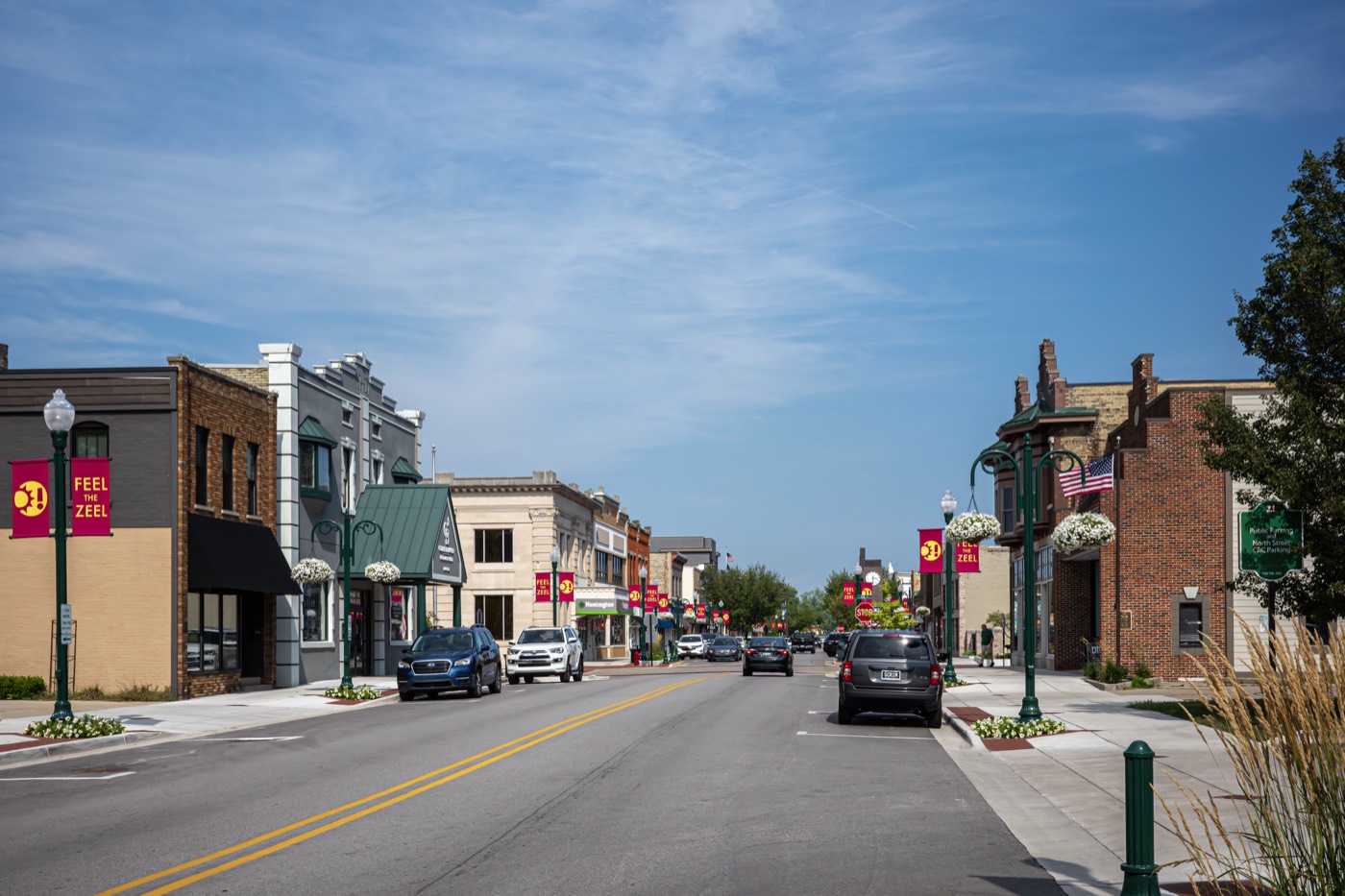
Drive five miles east of Holland, past the tulip beds and the lakeshore traffic, and the road quiets into a town that has been keeping its own counsel since 1847. The Dutch in Zeeland, Michigan did not arrive as scattered immigrants chasing work. They came as a congregation, an entire church that boarded three ships together and rebuilt itself, intact, in the Ottawa County forest. Almost two centuries on, the steeples still set the skyline and the bakery still sells banket by the pound.
The Place
Zeeland sits in Ottawa County, about 24 miles southwest of Grand Rapids and a short hop from its larger and louder neighbour, Holland. The 2020 census counted 5,719 people inside the city limits, with thousands more in the surrounding charter township.
It is a compact place, barely three square miles, built on slightly higher ground than the marshy land around it. The downtown runs along Main Avenue in a tidy grid of brick storefronts, with a three-faced Howard Miller clock keeping time above Splash Pad Park.
The city motto, painted on water towers and printed on T-shirts, is “Feel the Zeel.” It is the kind of slogan a town only adopts when it is comfortable being a little earnest, and Zeeland has always been comfortable being itself.
How It Became Dutch
Zeeland is Dutch in a way few American towns can claim, because its Dutchness arrived all at once, fully formed, as a religious community rather than a trickle of job-seekers. To understand the place you have to start in the Netherlands, in the early 1840s, on the islands of the province of Zeeland.
The Afscheiding and the reasons to leave
In 1834 a movement called the Afscheiding, the Secession, split the Dutch Reformed Church. A group of believers broke away from the state-affiliated church, objecting to what they saw as creeping liberalism and government control of religious life.
These Afgescheidenen, the seceded ones, faced fines, harassment and social marginalisation. In the province of Zeeland, on the island of Zuid-Beveland and around the town of Goes, a minister named Cornelius Vander Meulen led one of these dissenting congregations.
Religious pressure was only half the story. The 1840s were lean years across the Dutch countryside, with poor harvests and few prospects for ordinary farming families. For Vander Meulen’s congregation, faith and hunger pointed in the same direction: out.
Jannes van de Luyster sells everything
The migration had a financier, and his name was Jannes van de Luyster. A wealthy landowner from the Zeeland countryside, he sold his Dutch holdings and used the money to advance funds so that poorer members of the congregation could pay off their debts and buy passage across the Atlantic.
It was an extraordinary act. Van de Luyster did not just lead the group; he underwrote it. Roughly 77 families committed to the journey, and the whole enterprise was organised around a single congregation moving together rather than a loose stream of opportunists.
Historians have noted that, apart from the Pilgrims of Plymouth, this was one of the very few times a settled American community was founded by an organised church arriving as a body. The comparison is not idle local pride. It is the literal structure of how Zeeland came to be.
Three ships, one summer
The crossing happened in stages over the summer of 1847. Van de Luyster arrived first, on 27 June. A second party, the Steketee group, followed on 4 July. Vander Meulen’s own group landed on 1 August. In all, about 457 settlers made the voyage.
They pushed inland to a forested tract of roughly 16,000 acres in Ottawa County, land that had until recently been Odawa country. They named their new home Zeeland, after the province they had left behind, and they got to work.
The church before the houses
The first building they raised was not a home or a mill. It was a church. A log meeting house went up at the centre of the settlement, and the congregation that had organised itself back in Goes simply continued its life on American soil.
That congregation became the First Reformed Church of Zeeland, and it predates the town itself. Vander Meulen served as the first pastor, offering, in the words of the historical marker on the site, “both hope and courage for the first twelve long and strenuous years.”
In 1866 the log church was replaced by a wood-frame building on a fieldstone foundation, patterned on the church in Axel, back in the Netherlands. Dutch remained the language of worship for decades. The congregation only discontinued the use of Dutch in services in May 1943, nearly a century after the founders had stepped off the boats.
From farm colony to factory town
Zeeland was platted in 1849 and a school district organised the following year. Within a generation it had a sawmill, a wagon factory, blacksmith shops, grocers and a post office. It incorporated as a village in 1875 and became a city in 1907.
By the turn of the twentieth century, the same Dutch instinct for careful craft that built the churches was building furniture. Four furniture factories operated in town by 1907, and from that base grew the companies that would make Zeeland’s name far beyond Ottawa County.
The Landmarks
First Reformed Church of Zeeland, 148 East Central Avenue. This is the institution that came over on the boats. Organised in the Netherlands before the town existed, it raised the colony’s first log church and still gathers a congregation today. A 1976 state historical marker on the property tells the story of Vander Meulen and the founding families.
Dekker Huis / Zeeland Historical Museum, 37 East Main Avenue. Housed in an 1876 Dekker family home, the museum holds a recreated 1920s bank and grocery store, a barn and an interurban station. Run by the Zeeland Historical Society, it is the place the town keeps its own memory, from Dutch immigrant trunks to early factory tools.
Zeeland Bakery, 130 East Main Avenue. A Dutch bakery turning out doughnuts, pastries and cookies since 1954, with a lived-in counter and a crowd that knows the routine. This is where you find banket, the almond-paste pastry that travelled over with the founders, sold alongside Midwest classics like the maple long john.
The Howard Miller clock, 100 East Main Avenue. A three-faced clock sculpture from the Howard Miller Clock Company towers above the entrance to Splash Pad Park. It is a fitting downtown landmark for a town that, for nearly a century, was one of the world’s great clockmakers.
DeBruyn Seed Company, 101 East Washington Avenue. A long-running Zeeland seed business, a reminder that beneath the furniture factories the town’s roots ran into farm soil. Generations of Ottawa County gardeners have bought their stock here.
Public Restaurant, 131 East Main Street. A downtown anchor known for handcrafted, seasonally changing comfort food, it became a point of local pride when it returned to Zeeland after a stint elsewhere. It anchors the Main Avenue dining scene that grew up alongside the historic storefronts.
Splash Pad Park, downtown Main Avenue. The green heart of downtown, where Pumpkinfest and the rest of the town’s festival calendar gather each year. The volunteer-built decorations that fill the surrounding streets each autumn are one of the clearest expressions of Zeeland’s communal, congregation-rooted character.
Where They Came From
The founders of Zeeland did not come from across the Netherlands. They came overwhelmingly from one province, Zeeland, and within it from the island of Zuid-Beveland and the area around the town of Goes.
This was chain migration in its purest form: a single minister, Vander Meulen, leading the congregation he had served at home directly to a tract of Michigan forest. Where Drenthe and Gelderland sent their own seceded congregations to nearby Michigan settlements, the Bevelanders sent theirs here.
The result is a town named not for a country but for a single Dutch province, settled by people who in many cases had been neighbours and fellow worshippers before they ever boarded a ship. That density of shared origin is why Zeeland’s Dutch identity held so tightly for so long.
The same secession that built Zeeland also built its larger neighbour. You can trace the parallel story in the Dutch in Holland, Michigan, founded the same year by the same wave of Afgescheidenen under a different minister, Albertus van Raalte.
The Zeeland pattern repeated itself across the American interior as Dutch Reformed colonies sent out daughter settlements. The same instinct that planted a church before a house shaped the Dutch in Pella, Iowa and, a generation later, the Dutch in Orange City, Iowa. Further west, the Dutch in Lynden, Washington carried the same Reformed faith to the Pacific Northwest. For the wider story, the Zeeland, Michigan entry on Wikipedia traces the town from its log church to its furniture factories.
Zeeland Today
Zeeland today is a prosperous small city that has never quite let go of its origins. The Reformed churches still anchor the streets, the bakery still sells banket, and the surrounding township has grown to more than 12,000 people as the wider Holland-Zeeland area thrives.
Its industry is global. Herman Miller, the office-furniture giant descended from those early furniture factories, Gentex with its automotive mirrors, Mead Johnson and Plascore all keep substantial operations in and around town. The Dutch craft tradition turned into one of the most productive manufacturing corridors in west Michigan.
But the story is not all upward. In July 2025 the Howard Miller Company announced it would shut its Zeeland plant at 860 East Main Avenue after nearly 100 years, citing tariffs and a slumping furniture market, with all 133 local jobs to be lost as it winds down into 2026. The world’s great grandfather-clock maker, founded in Zeeland in 1926 by Herman Miller’s son Howard, is ending its run in the town that raised it.
That loss is real, and Zeelanders feel it. Yet the town that built itself around a church rather than a factory has weathered change before. The festivals still fill Main Avenue, the historical society still keeps the Dekker Huis open, and the descendants of those 457 settlers still call this corner of Michigan home.
Frequently Asked Questions
Why are there so many Dutch people in Zeeland, Michigan?
The Dutch in Zeeland, Michigan descend from an entire Reformed congregation that emigrated together from the province of Zeeland in the Netherlands in 1847. They came as an organised church seeking religious freedom and economic opportunity, and named their settlement after the province they had left.
When was Zeeland, Michigan founded?
Zeeland was settled in 1847 by roughly 457 Dutch immigrants who crossed the Atlantic in three ships that summer. The town was platted in 1849, incorporated as a village in 1875, and became a city in 1907.
Who founded Zeeland, Michigan?
The migration was financed by Jannes van de Luyster, a wealthy Dutch landowner who sold his holdings to fund the journey, and led spiritually by the Reverend Cornelius Vander Meulen. Vander Meulen had been a Secessionist pastor near Goes, on the island of Zuid-Beveland.
What is there to do in Zeeland related to Dutch heritage?
Visitors can tour the Dekker Huis / Zeeland Historical Museum at 37 East Main Avenue, see the historic First Reformed Church, and buy traditional Dutch banket at Zeeland Bakery on Main Avenue. The downtown also hosts a busy calendar of community festivals such as Pumpkinfest.
How is Zeeland different from Holland, Michigan?
Both towns were founded in 1847 by Dutch Afgescheidenen, but by different congregations under different ministers. Holland, led by Albertus van Raalte, grew into a larger city, while Zeeland, led by Vander Meulen, remained a smaller, tightly knit town just to the east.
Is Zeeland, Michigan still a Dutch town?
Yes, in character it remains strongly Dutch and Reformed. The Dutch in Zeeland, Michigan still fill numerous Reformed churches, the local bakery still sells Dutch pastries, and the town’s name, architecture and festivals continue to reflect its 1847 origins.
If your family’s story passed through Zeeland, or any of the places Dutch families have made home in America, Atlas of Home can trace that journey. From a congregation boarding three ships at Goes in the summer of 1847, to a clock keeping time over Main Avenue, to wherever you are now.