
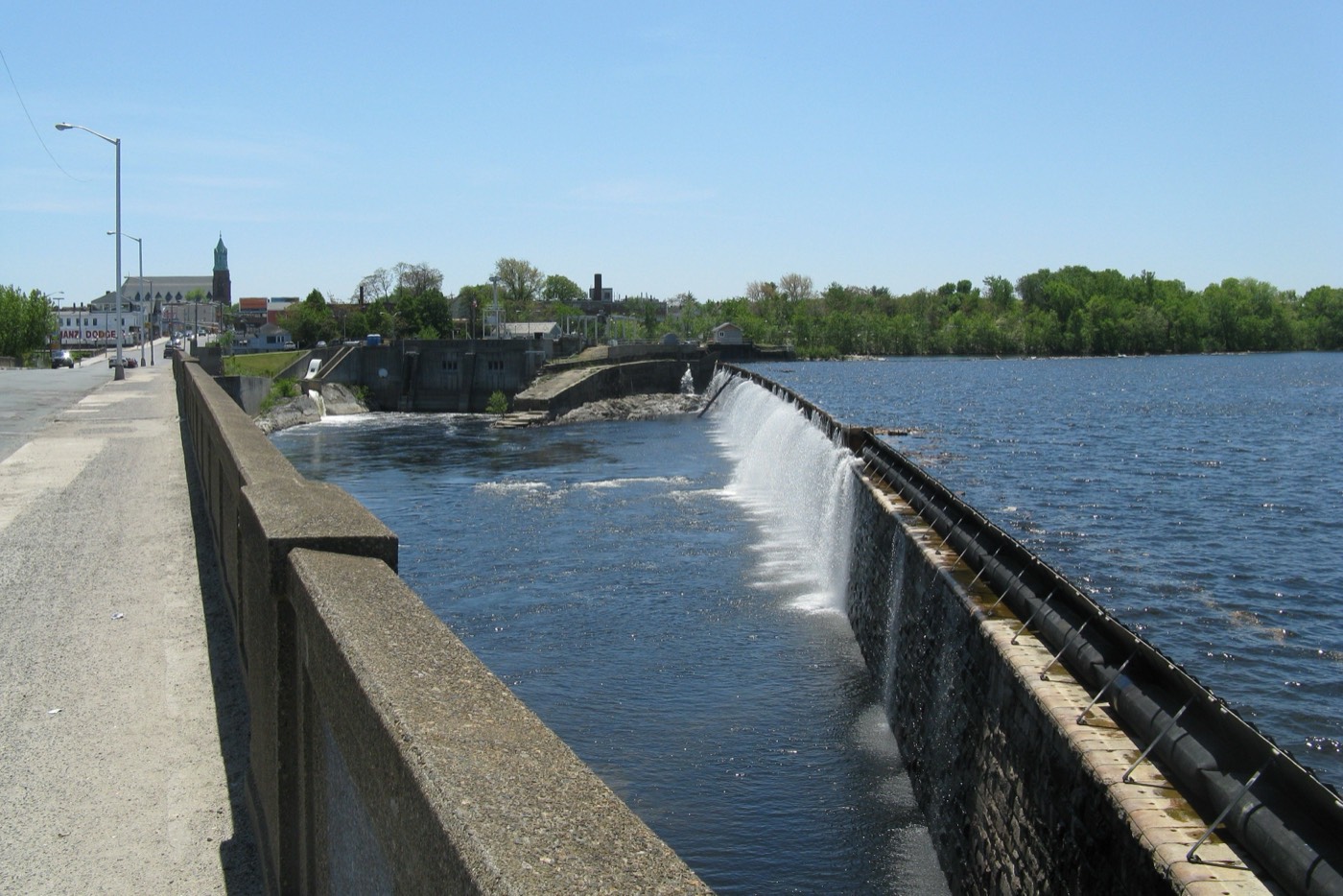
Before there was a city, there was a dam, and before the dam there were the men who dug it. The story of the Irish in Lawrence, Massachusetts begins in the mud of the Merrimack in the summer of 1845, when Irish labourers, many only recently off famine ships, began hauling granite into the current to build the largest masonry dam in America. They built the foundation of a city they were not always welcome in. Then they stayed, and made it theirs.
The Place
Lawrence sits on the Merrimack River in Essex County, roughly twenty-five miles north of Boston and a short way downstream from Lowell. It is a flat, compact, intensely built city, laid out on a grid of brick mills and triple-decker tenements that rise toward Tower Hill in the west and Prospect Hill in the east.
It was a planned city, conjured almost from nothing by Boston capital in the 1840s to spin and weave cloth on a scale the world had not yet seen. At its peak in 1920 it held 94,270 people; today it is home to around 89,000, one of the most densely populated and, for most of its history, most foreign-born places in New England.
How It Became Irish
The dam and the dig (1845 to 1848)
The Essex Company was incorporated on 16 April 1845, a syndicate of Boston merchants led by Abbott Lawrence who meant to harness the Merrimack and outdo Lowell. On 1 August 1845 they began excavating for the Great Stone Dam.
The work was brutal and the workforce was largely Irish, many of them labourers with experience of canal and dam building. The danger was constant: men drowned, fell, or were crushed, and death on the job was common. The dam, finished in 1848, ran nearly a thousand feet across the river and powered everything that followed.
The men who built it were not given lodgings in the new town. They were housed in crowded shanties on land rented from the Essex Company across the river, wooden and sod-lined cabins on the flats, and settled the so-called Plains above Haverhill Street near the dam they had raised.
Famine and the first wave
The timing was no accident. Lawrence was incorporated as a town in 1847, at the very height of the Great Famine, and the Irish arriving to dig and then to mill were often the same people fleeing starvation at home. Within less than twenty years of the town’s founding, nearly 5,000 of its residents had been born in Ireland.
They clustered, as poor newcomers do, in the cheapest wards: the city’s second and third wards and the riverside slum below the better streets. They lived in mill boarding houses and in the shanties on the Plains, and took the hardest, lowest-paid work in the new textile city.
Building the parishes
Faith came almost as fast as the famine ships. The first Mass in the new town of Lawrence was said in 1845 in the home of Michael Murphy at 7 Newton Street in South Lawrence. The first Catholic church, Immaculate Conception, opened as a small wooden building in 1846 and was replaced by a larger structure in 1854.
In 1848, Father James O’Donnell of the Augustinians established St. Mary Parish at the request of the Bishop of Boston. The Irish dead were the first laid in the new Catholic ground: Immaculate Conception Cemetery dates from 1847 and St. Mary’s from 1848.
As the Irish spread south of the river, they raised a parish of their own. St. Patrick’s began in 1869 as a mission of Immaculate Conception, its first Mass said on Christmas Day 1869 and the church dedicated to St. Patrick on 17 March 1870. It became independent in 1872, completed its upper church on 17 June 1894, and opened St. Patrick School in 1906 under the Sisters of Charity of Halifax.
Nativism and the long climb
Acceptance did not come with the parishes. The Irish faced both religious strain within and hostility without, and in the 1850s the Whigs turned anti-Irish feeling into an organised anti-immigration movement, part of the wider nativist surge across Massachusetts that decade.
Yet by 1890 the Irish had become the single largest immigrant group in the city. Of 28,577 foreign-born residents counted that year, 7,058 had been born in Ireland, roughly a quarter of the foreign-born population, ahead of 6,999 French Canadians and 5,131 English. The men who had arrived with nothing but a shovel now ran shops, sat on the police force, filled the pews, and held ward seats.
The mills and the strike
The Pacific Mills, incorporated in 1853, were the largest works of their kind in the world, and the Irish worked them alongside every other nationality pouring into Lawrence, which had become a byword for the immigrant mill town with dozens of languages on the loom floors.
When the great Bread and Roses strike broke out in 1912, more than 20,000 workers walked out after the mills cut pay to match a legislated reduction in hours. The strikers, German, Syrian, Irish, Italian, Jewish, Belgian and Portuguese, held out through two bitter winter months and won raises of up to twenty per cent when the strike ended on 14 March 1912. By then the Irish were as likely to be foremen and union men as they were at the bottom of the line.
The Landmarks
Great Stone Dam, on the Merrimack at the heart of the city. This is the Irish landmark in Lawrence, even if no plaque says so plainly. Begun on 1 August 1845 and finished in 1848, it was largely the work of Irish hands, and the city literally rests on what they built. It still spans the river below downtown, a low grey wall of granite under a constant sheet of falling water.
St. Mary of the Assumption / St. Mary-Immaculate Conception, in the Common district. Born from Father O’Donnell’s 1848 parish and the city’s first church of 1846, this is the mother church of Catholic Lawrence and of its Irish founders. Over time it merged with Immaculate Conception and broadened its mission to serve the city’s later, largely Hispanic, Catholics, carrying more than a century and a half of immigrant faith.
St. Patrick Parish, 114 South Broadway, South Lawrence. Dedicated on 17 March 1870, this was the Irish parish south of the river, its green steeple a fixture of the South Lawrence skyline. It was for generations a haven for the Irish community, and today its corner shares the block with a Vietnamese noodle shop and a Dominican restaurant. Mass is now offered in English, Vietnamese and Spanish, a single congregation reflecting a century of newcomers.
The Plains, above Haverhill Street in North Lawrence. This was the first Irish ground in the city, the flats where canal and dam workers threw up wooden, sod-lined shanties in the 1840s rather than the planned streets of the company town. Nothing of the shanties survives, but the name has long marked where Irish Lawrence first took root.
St. Mary’s Cemetery, South Lawrence. Consecrated in 1848 alongside Immaculate Conception Cemetery of 1847, these were the first Catholic burying grounds in the city, and the Irish were the first laid in them. To walk the older sections is to read the names off the famine ships and the dam crews in granite.
Lawrence History Center, 6 Essex Street. Housed in the former Essex Company complex of 1882 to 1883, the very firm that hired the Irish to build the dam, the centre was founded in 1978 as the Immigrant City Archives by Eartha Dengler. Its forty thousand photographs, church records and oral histories are where the Irish story of Lawrence is kept, alongside every community that followed.
The Claddagh Pub, 399 Canal Street. Opened on 29 January 1992 beside the Merrimack in downtown Lawrence, the Claddagh was for three decades the city’s best-known Irish pub, a riverside room of pints and live music. It has since closed, but for a generation it was where Irish Lawrence still gathered.
Where They Came From
The Lawrence Irish were, overwhelmingly, famine and post-famine emigrants. The men who dug the dam in 1845 and the families who filled the wards in the following two decades left Ireland in the years when the potato failed and the country emptied, the same exodus that built Irish Boston, Irish Lowell and Irish Holyoke.
They came as the poorest of the early arrivals, which is why they took the canal work and millhand jobs no one else would, and settled first in shanties and riverside slums rather than the company’s planned streets. What they shared was Catholicism, English, and a willingness to do the dangerous founding labour of an industrial city in exchange for a foothold in it.
You can trace the same Irish current up and down the Merrimack Valley. The story of the Irish in Lowell runs a few miles upstream, while the mill-town parishes of the Irish in Holyoke and the Irish in Worcester tell almost the same tale on different rivers. The same famine generation that filled the Lawrence wards also settled the suburbs south of Boston, among them the Irish in Braintree.
Lawrence Today
Lawrence is no longer an Irish city, and has not been for a long time. The mills that drew the Irish drew the French Canadians, Italians and Syrians after them, and in the last half-century the city has become overwhelmingly Latino, home to one of the largest Dominican communities in New England. The triple-deckers the Irish once filled now house newer arrivals, and St. Patrick’s preaches in Spanish and Vietnamese.
What remains is structural rather than visible on the street. The Irish built the dam the whole city runs on, founded its first Catholic parishes and cemeteries, and broke its earliest nativist resistance, so that later immigrants had a Catholic, working-class, mill-town Lawrence to arrive into. That inheritance did not leave when the Irish surnames thinned out.
The traces are findable if you look. The green steeple of St. Patrick’s still stands over South Broadway, the famine-era dead still lie in St. Mary’s ground, the Great Stone Dam still holds back the Merrimack, and the Lawrence History Center keeps the records of the people who raised all three. Lawrence remains, as it was built to be, an immigrant city, and the Irish were simply the first to make it one.
Frequently Asked Questions
When did the Irish first come to Lawrence, Massachusetts?
The Irish arrived with the founding of the city itself. Irish labourers began digging the canals and building the Great Stone Dam in 1845, and famine-era families settled in the new town through the late 1840s and 1850s. Within twenty years of Lawrence’s 1847 incorporation, nearly 5,000 residents had been born in Ireland.
Why did the Irish in Lawrence settle where they did?
As the poorest early arrivals, the Irish in Lawrence took the cheapest housing they could find. They lived in mill boarding houses and in sod-lined shanties on the Plains above Haverhill Street, and clustered in the city’s second and third wards and in the riverside slum below the better streets, rather than in the company’s planned avenues.
What churches did the Irish build in Lawrence?
The Irish founded Lawrence’s Catholic church life. Immaculate Conception opened in 1846, St. Mary Parish was established in 1848, and St. Patrick’s in South Lawrence was dedicated on St. Patrick’s Day, 17 March 1870. St. Mary’s and Immaculate Conception cemeteries, where the Irish were first buried, date from 1847 and 1848.
Did the Irish in Lawrence really build the Great Stone Dam?
Largely, yes. The Essex Company began the dam in 1845 and finished it in 1848, and the workforce was heavily Irish, many of them experienced canal and dam builders. The work was dangerous and frequently fatal, and the dam they raised still powers the layout of the entire city.
Are there still Irish in Lawrence today?
Far fewer than there once were. Lawrence is now a predominantly Latino city, home to a large Dominican community, and the old Irish parish of St. Patrick’s now offers Mass in Spanish and Vietnamese. The Irish legacy survives mainly in the dam, the parishes, the cemeteries and the city’s records rather than in a present-day neighbourhood.
Where can I research Irish family history in Lawrence?
The Lawrence History Center at 6 Essex Street, founded in 1978 as the Immigrant City Archives, holds church records, more than forty thousand photographs and hundreds of oral histories documenting the city’s immigrant families. Parish and cemetery records from St. Mary’s and St. Patrick’s are also key sources for tracing Irish Lawrence ancestry.
If your family’s story passed through Lawrence, or any of the places the Irish have made home in America, Atlas of Home can trace that journey. From a shanty on the Plains and a shovel on the Great Stone Dam, to a pew at St. Patrick’s, to wherever you are now.