
On 6 April 1822, a former dock worker named Hugh Cummiskey led thirty Irishmen on a thirty mile walk along the Middlesex Canal, out of Charlestown and up to a half built city on the Merrimack River. They came looking for work, and they found it digging the canals that would turn Lowell into the cradle of American industry. Two centuries later, the Irish in Lowell remain the single largest ancestry group in the city, woven into its parishes, its parkways and its pubs.
The Place
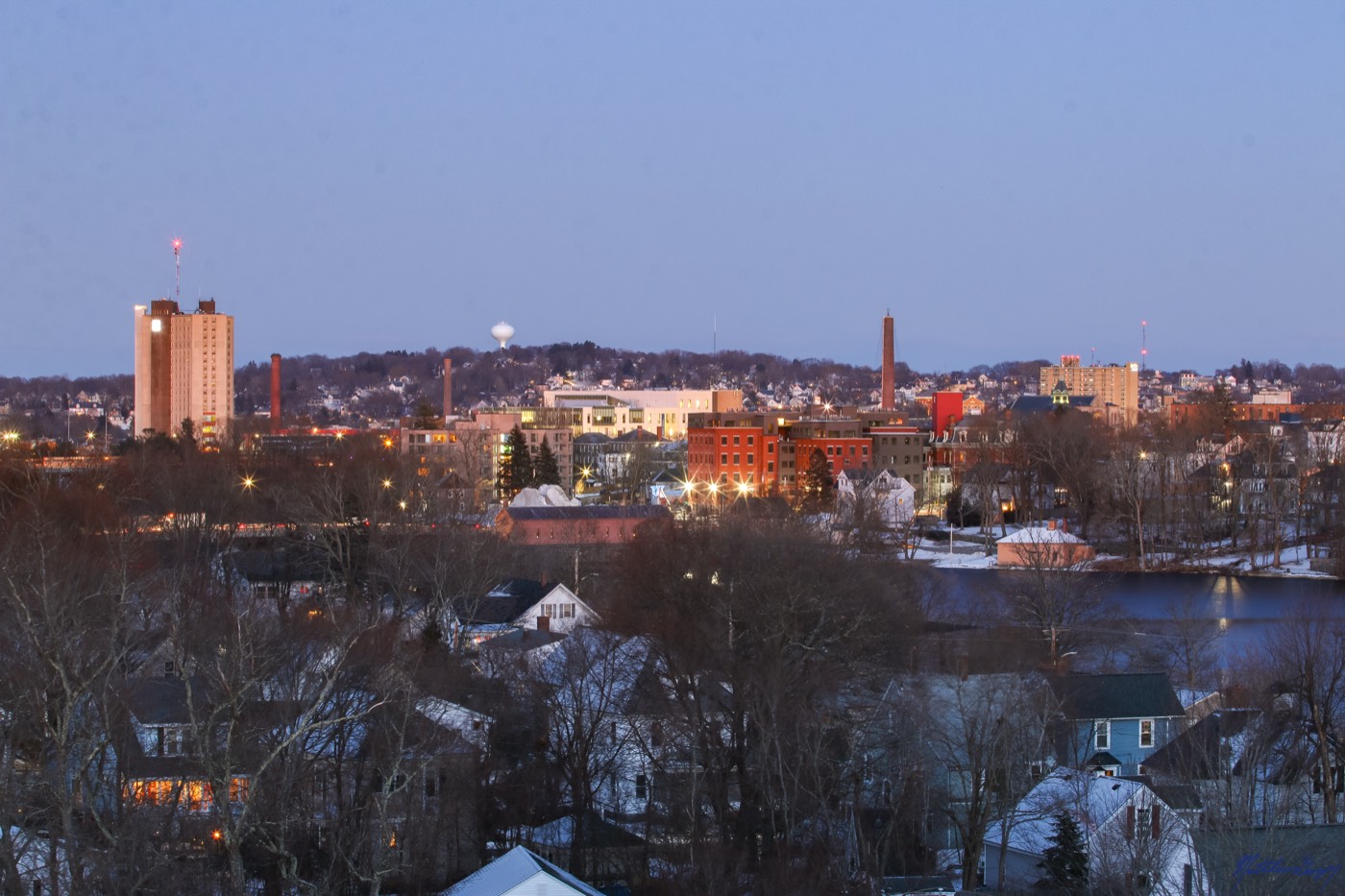
Lowell sits at the meeting of the Merrimack and Concord rivers in the Merrimack Valley, about thirty miles north west of Boston. It was conceived in the 1820s as a planned industrial town, named for the merchant Francis Cabot Lowell, and built around a network of power canals that drove the largest textile mills in the country.
The city today is home to roughly 122,000 people, and it remains one of the most diverse in Massachusetts. Its red brick mill blocks now house museums, lofts and a national historical park, but the bones of the place are still the canals and the boarding houses that the Irish were brought in to build.
How It Became Irish
The story of the Irish in Lowell does not begin with the famine. It begins a generation earlier, with the men who dug the ditches before the looms ever turned.
The Paddy Camps
When the Boston Associates set out to build Lowell, they needed labourers to excavate the Pawtucket and Merrimack canals that would power the mills. Kirk Boott, the mill corporation agent, turned to Hugh Cummiskey, an Irishman from County Tyrone who had arrived in Massachusetts in 1817.
Cummiskey brought thirty countrymen up from Charlestown in the spring of 1822. Boott received the men at Frye’s Tavern, handed them tools and some money for food, and set them to work rebuilding the Pawtucket Canal that same day.
Because the mill owners did not house these labourers as they housed the Yankee mill girls, the Irish built their own shelter on a patch of land south west of the town centre. The settlement of shanties and cabins became known as the Paddy Camps, and the ground itself came to be called the Acre.
A Church Before a Roof
By 1830 there were more than five hundred Irish workers and their families clustered in the Acre. The community organised itself quickly, and in 1831 it built St Patrick’s, the first Roman Catholic church in Lowell, a modest wooden structure raised to serve the canal men and their households.
Cummiskey himself was among those who helped establish the parish. He went on to serve as a constable, to take part in the Irish Benevolent Society, and to sit on the city’s Common Council in 1843 and 1844. He had walked in as a labourer and become a civic figure.
The Famine Years
The Great Hunger of the late 1840s changed everything. As blight ruined the potato crop and western Ireland emptied, the number of Irish in Lowell grew sharply, with the destitute and the desperate joining the established community in the Acre.
The newcomers steadily reshaped the mill workforce. The genteel image of the New England mill girl gave way to a harder reality of immigrant labour, and by 1860 a majority of Lowell’s mill workers were foreign born. The Irish moved from digging the canals to tending the looms the canals powered.
From the Acre Outward
As the nineteenth century wore on, the Irish became less a labouring underclass and more a part of Lowell’s civic fabric. They filled the police force and the fire companies, ran for office, and built more parishes as the community spread beyond the original acre of land.
The arc reached a kind of summit in 1859, when William Henry O’Connell was born in Lowell to John and Bridget O’Connell, Irish immigrants. He would become Archbishop of Boston and then a cardinal, the most celebrated son the Lowell Irish ever produced.
The Landmarks
St Patrick’s Church, 282 Suffolk Street. The first Catholic church in Lowell, founded in 1831 to serve the Paddy Camps. The present Gothic Revival granite church, designed by the noted ecclesiastical architect Patrick C. Keely, opened in 1854 with room for some two thousand worshippers. It stands on the eastern edge of the Acre and was added to the National Register of Historic Places in the 1980s.
St Patrick’s Cemetery, Lowell. Opened in 1832 as the Catholic Burial Ground and later renamed for the parish it served, this is the resting place of generations of the Acre’s Irish. It holds the graves of the canal men and famine refugees who never lived to see the community they founded prosper.
The An Gorta Mor memorial, behind St Patrick’s Church. A Celtic cross and plaque placed in April 2016 to honour the Irish victims of the Great Hunger of 1845 to 1849. Set in the shadow of the church the famine emigrants helped build, it ties the Acre directly to the catastrophe that filled it.
The Cardinal O’Connell monument, Cardinal O’Connell Parkway. A granite fountain and bust of Lowell’s most famous Irish son, unveiled on 17 November 1918 before a crowd of some thirty thousand people in front of City Hall. The fountain and bust were designed by Henry L. Rourke of Lowell.
The Irish monument and Celtic cross, near the O’Connell Parkway. A granite Celtic cross raised in 1977 to mark the 150th anniversary of Irish settlement in Lowell, with a companion plaque honouring the Irish of the city placed just yards from the cardinal’s statue. It is the community’s formal acknowledgement of where it came from.
The Old Court, 29 to 31 Central Street. An Irish pub and restaurant in downtown Lowell that opened in February 2001, serving shepherd’s pie and fish and chips alongside live music. It is the most prominent of the city’s Irish bars, a modern gathering place for a community whose social life once centred on the parish hall.
The Worthen House Cafe, Worthen Street. One of the oldest taverns in Lowell, long woven into the city’s Irish and working class life. It is the kind of corner pub that carried the social weight the Acre’s parishes could not, a place of pints and stories rather than candles and incense.
Where They Came From
The Irish who settled Lowell did not come from everywhere in Ireland in equal measure. Studies of the city’s nineteenth century arrivals found that the largest shares came from County Cork at around twenty per cent and County Kerry at around sixteen per cent, followed by Tyrone, Longford and Roscommon.
That pattern is no accident. Cork and Kerry in the south west, and the western counties generally, were among the regions the famine struck hardest, and they were the source of the heaviest emigration to industrial New England.
Hugh Cummiskey, the man who started it all, came from Tyrone in the north, and his presence helps explain that county’s outsized share. Early arrivals wrote home and sent passage money, and relatives followed kin to a place where a familiar name already had work. The chain ran from a handful of Ulster and Munster parishes straight to a single acre of Massachusetts.
Later waves, especially after renewed hardship in the west of Ireland between 1879 and 1881, drew more heavily from Connaught. Cheaper, faster steam passage made the crossing easier, and the chain migration that had built the Acre simply lengthened.
Lowell Today
The Irish are no longer the only story of the Acre, or of Lowell. The same neighbourhood that took in famine refugees now takes in Cambodian and Vietnamese families, and St Patrick’s parish offers Masses in Vietnamese and Khmer alongside its older congregations. The church the canal men built has become a church of the world’s newest arrivals.
Yet the Irish imprint has not faded. Irish ancestry remains the most commonly reported in the city, claimed by roughly sixteen per cent of residents, ahead of every other group. The names on the police roster, the parishes and the parkways still tell you who built much of this place.
On a spring evening you can stand behind St Patrick’s by the famine memorial, walk down to the Old Court for a pint, and pass the cardinal’s fountain on the way. The Acre is no longer an Irish ghetto, and that is its own kind of success. The community that began in a row of shanties has dissolved into the ordinary life of a working American city, which is exactly what its founders wanted.
For more on the Irish of Greater Boston, see our companion pieces on the Irish in Braintree and the Irish of Hyde Park, or follow the diaspora further afield to Irish Bay Ridge in Brooklyn and the Irish in Sauganash, Chicago. Lowell’s mill town story also rhymes with that of its neighbours, including the Greeks in Peabody and the Portuguese in Taunton, other immigrant communities the New England mills drew in. The fuller archive lives at the University of Massachusetts Lowell’s Erin to the Acre project and in the history of St Patrick’s Church.
Frequently Asked Questions
When did the Irish first settle in Lowell, Massachusetts?
The first Irish arrived in 1822, when Hugh Cummiskey led thirty labourers from Charlestown to dig Lowell’s canals. This was well before the famine emigration of the late 1840s, which greatly expanded the existing community. The Irish in Lowell are therefore among the oldest organised Irish communities in industrial New England.
What is the Acre in Lowell?
The Acre is the neighbourhood south west of downtown Lowell where the first Irish labourers built their shanty settlement, originally known as the Paddy Camps. It takes its name from the patch of land the early Irish occupied near the canals they were digging. Today it remains a gateway neighbourhood, now home to Cambodian and Vietnamese families as well as the descendants of the Irish.
Why did the Irish come to Lowell?
They came for work. Lowell’s mill corporations needed labourers to dig the power canals in the 1820s, and the Irish in Lowell were recruited specifically for that task. After the Great Hunger of the late 1840s, thousands more came as famine refugees and moved into the mills themselves.
Where in Ireland did Lowell’s Irish come from?
The largest shares came from County Cork and County Kerry in the south west, followed by Tyrone, Longford and Roscommon. These were among the regions hit hardest by the famine and the source of the heaviest emigration. Chain migration meant relatives followed kin from the same parishes to the same acre of Massachusetts.
What is St Patrick’s Church in Lowell?
St Patrick’s, at 282 Suffolk Street, was the first Catholic church in Lowell, founded in 1831 to serve the Irish canal workers. The present granite Gothic Revival building, designed by Patrick C. Keely, opened in 1854. It still stands on the edge of the Acre and now offers Masses in Vietnamese and Khmer alongside its traditional services.
Who was Cardinal O’Connell of Lowell?
William Henry O’Connell was born in Lowell in 1859 to Irish immigrant parents and rose to become Archbishop of Boston and a cardinal. He is the most celebrated figure the Lowell Irish produced. A granite fountain and bust in his honour stands on Cardinal O’Connell Parkway in front of City Hall, unveiled in 1918.
If your family’s story passed through Lowell, or any of the places Irish people have made home in America, Atlas of Home can trace that journey. From a parish in Cork or Tyrone to a shanty in the Acre, to wherever you are now.