
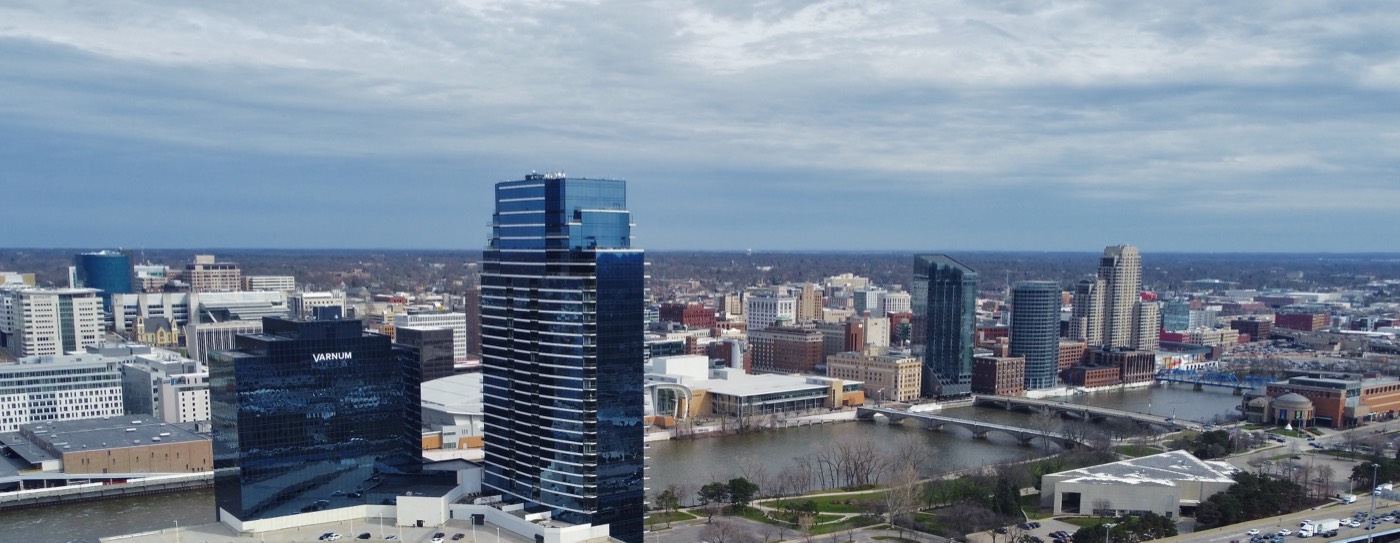
In Grand Rapids, the Dutch are not a footnote. They are the foundation. The Dutch in Grand Rapids built the churches, filled the furniture factories, founded the colleges, and lent their surnames to the arenas and gardens that now anchor the skyline. More than 150 years after the first families stepped off the riverboats, this remains the most Dutch big city in America, and it wears that inheritance plainly.
The Place
Grand Rapids sits on the Grand River in western Michigan, about 30 miles inland from Lake Michigan, the second-largest city in the state after Detroit. It grew rich in the nineteenth century on hardwood and craftsmanship, earning the nickname Furniture City when its factories supplied parlours across the nation.
Today it is a regional capital of medicine, higher education and philanthropy, its downtown lined with institutions bearing the names DeVos, Van Andel and Meijer. Drive its streets and the Dutch presence is constant: Reformed and Christian Reformed churches on corner after corner, Calvinist colleges, bakeries selling banket, and family farms in the surrounding townships still tilled by people named Lubbers, Sietsema and Versluis.
How It Became Dutch
The story begins not in Grand Rapids itself but a short distance to the west. In 1846 and 1847, Dutch settlers fleeing religious persecution and economic hardship in the Netherlands followed the Reverend Albertus Van Raalte to found a colony they named Holland, on the shore of Lake Michigan. From that seed colony, families fanned out across western Michigan, and many followed the river inland to the growing town of Grand Rapids.
The First Families, 1847 to 1857
Hiram H. Van Reede’s family are recorded as the first Dutch immigrants in Grand Rapids, arriving in 1847 and joining the existing First Reformed Church. Francis Van Driele followed in 1848, and others came after him, welcomed into the same congregation.
By the summer of 1849, the numbers justified a separate Dutch-speaking congregation, and Van Raalte organised Second Reformed Church as part of the Holland Classis. The community was small but growing fast, and it was bound together less by trade than by faith.
That faith soon fractured. In 1857, representatives of the Grand Rapids, Graafschap, Polkton, Vriesland and Noordeloos congregations organised the Classis of Michigan on 29 April. That date is remembered as the birth of the Christian Reformed denomination, a more orthodox split from the Reformed Church in America. The schism would shape Grand Rapids for a century, dividing families and neighbourhoods into the two great branches of Dutch Calvinism.
The Furniture City Years
What turned a religious settlement into a Dutch metropolis was wood. Grand Rapids became the furniture-making capital of the United States in the second half of the nineteenth century, and its factories needed hands.
The Dutch supplied them. At the turn of the twentieth century, when Dutch immigration peaked, nearly half of the roughly seven-thousand-strong labour force in the city’s chief industry was Dutch. They worked the benches at firms such as Berkey and Gay, Baker Furniture, Widdicomb and Hekman, and they lived in tight clusters of wood-frame houses near the plants.
The 1870 census already showed the shift. Of a city of 16,507 people, 2,944 had been born in the Netherlands, around 18 per cent of the population, and that figure counted only the foreign-born, not their American-born children. The Dutch were not one community among many. In whole districts they were the community.
The Strike of 1911
The Dutch dominance of the workforce produced one of the strangest labour episodes in American history. On 19 April 1911, more than 6,000 furniture workers walked off the job, demanding higher wages, a shorter day and the right to bargain collectively. Leaders including Garrit Verburg and John Timmer organised under the United Brotherhood of Carpenters and Joiners.
The majority of the strikers were Dutch members of the Christian Reformed Church, and that proved their undoing. On 9 August, seventeen Christian Reformed congregations in the city condemned union membership from the pulpit. Historians have called this the death blow. Within days the workers voted three to one to return, and the strike collapsed after 121 days. Many were blacklisted.
The episode revealed how completely church authority overlapped with civic and economic life. A theological objection raised on a Sunday could end a strike by the following week.
Building Institutions
The Dutch did not only labour. They built lasting institutions, above all schools. In 1876 the Christian Reformed Church founded what is now Calvin University, beginning with seven students on Spring Street to train ministers. In 1956 the college purchased the 390-acre Knollcrest Farm on the southeast edge of the city, and the modern campus rose there.
A parallel network of Christian day schools grew alongside it. Grand Rapids Christian High School opened in 1920, and the broader Grand Rapids Christian Schools system became one of the largest Reformed parochial systems in the country. Generations of Dutch-American children passed through these classrooms, keeping the language and the catechism alive long after the immigrant boats stopped coming.
The Postwar Dynasties
The twentieth century produced Dutch-American families whose fortunes still define the city. Richard DeVos, born in Grand Rapids in 1926, and Jay Van Andel, born there in 1924, met as boys at Grand Rapids Christian High School. Both attended Calvin College, both belonged to the Christian Reformed Church, and both credited their Dutch upbringing for the work ethic that built Amway, the direct-sales giant they founded in 1959.
Their names, and that of the Meijer family, now hang over downtown. Frederik Meijer, son of the Dutch immigrant Hendrik Meijer who opened his first store in 1934, gave the city its sculpture gardens. The Dutch story in Grand Rapids runs in an unbroken line from a riverbank congregation in 1849 to the boardrooms that fund the city today.
The Landmarks
Calvin University, 3201 Burton Street SE. Founded by the Christian Reformed Church in 1876 and moved to the wooded Knollcrest campus in the 1950s, Calvin remains the intellectual heart of Dutch Reformed America. Its theology, its art and its students still carry the imprint of the Netherlands across the wider culture.
Eastern Avenue Christian Reformed Church, 514 Eastern Avenue SE. Organised on 16 September 1879 with 86 members, it became the third Christian Reformed congregation in the city and a mother church to the southeast side’s Dutch neighbourhoods. Its parochial school helped pioneer the Reformed day-school movement here.
Frederik Meijer Gardens and Sculpture Park, 1000 East Beltline Avenue NE. Opened in 1995 and named for the son of Dutch immigrants, the 158-acre park pairs a tropical conservatory with one of the country’s finest sculpture collections. It is the most visited cultural attraction in the state, and a monument to a Dutch grocer’s fortune given back to the city.
Vander Veen’s The Dutch Store, 2755 28th Street SW, Wyoming. For over 80 years this family shop just south of Grand Rapids has imported directly from the Netherlands. Shelves of stroopwafels, hagelslag, speculoos and boxed banket, plus a deli of Dutch cheeses and cured meats, make it a pantry for the homesick and the curious alike.
Steenstra’s Royal Dutch Bakery, 3940 30th Street SW, Grandville. Family-owned since 1953, Steenstra’s bakes the almond-paste banket and seasonal krakelingen that define a Dutch-American Christmas in west Michigan. Generations have driven across town for its preservative-free loaves.
Van Andel Arena, 130 West Fulton Street. The downtown arena that opened in 1996 carries the name of Amway co-founder Jay Van Andel, grandson of Dutch immigrants. Like the nearby DeVos Place convention centre, it is a civic landmark named for the Calvinist business dynasties the Dutch community produced.
Heritage Hill and the southeast side. The historic streets between Madison and Fuller avenues once held the city’s spread-out Dutch pockets, distinct from the Polish West Side. Here the corner churches, both Reformed and Christian Reformed, still mark where the immigrant generation lived, worshipped and divided.
Where They Came From
The Grand Rapids Dutch traced their roots chiefly to the rural, devout provinces of the Netherlands: Zeeland, South Holland, Gelderland, Groningen and Friesland. Place names from the old country were stamped directly onto the new one, in nearby towns like Zeeland, Vriesland and Noordeloos.
The earliest arrivals were religious dissenters, members of the seceder movement that broke from the state-supported Dutch Reformed Church in the 1830s and 1840s and faced harassment for it. Van Raalte’s Holland colony was explicitly a refuge for such believers, and Grand Rapids inherited both their faith and their habit of splitting over doctrine.
Later waves, from the 1860s through the First World War, came for plainer reasons: farmland and factory wages. After the Second World War, Christian Reformed congregations sponsored a fresh cohort of Dutch immigrants and refugees, renewing ties to a homeland many of the older families had not seen in three generations.
The pattern echoed elsewhere in the Dutch Reformed diaspora. The same migration that filled Grand Rapids also built the Dutch community in Zeeland, Michigan just to the west, and carried families onward to Pella, Iowa and Orange City, Iowa on the prairie. A later branch reached the Pacific Northwest and founded the Dutch settlement at Lynden, Washington. Grand Rapids was the metropolis of that network, the city the smaller colonies looked to.
Grand Rapids Today
Dutch ancestry is still the single largest claimed in Grand Rapids, around 13 per cent of the city, ahead of German, Polish and Irish. The share has fallen from the days when a third of the metro area claimed Dutch blood, but no other ancestry has overtaken it, and the institutional footprint remains enormous.
The Christian Reformed Church of North America keeps its headquarters here, and the Reformed Church in America maintains a major office in the city. Calvin University, the Christian school system, the Reformed publishing houses and a dense lattice of charities still give the place a distinctly Calvinist civic character, even as the congregations themselves shrink and diversify.
Grand Rapids has become a more varied city, home to growing Latino, African American and refugee communities, and its downtown now reads as much corporate as Calvinist. But scratch the surface and the Dutch grain shows through: in the names on the buildings, the banket in the bakeries, and the steeples that still outnumber almost everything else. This is, by any measure, the capital of Dutch America. For more on the city’s heritage, see Experience Grand Rapids on Dutch history and Calvin University on Wikipedia.
Frequently Asked Questions
Why are there so many Dutch in Grand Rapids, Michigan?
The Dutch in Grand Rapids descend from religious dissenters who followed the Reverend Albertus Van Raalte to west Michigan in the 1840s, settling first at the colony of Holland and then moving inland. The growing furniture industry drew thousands more Dutch workers through the late 1800s, cementing the community.
What is the difference between the Reformed and Christian Reformed churches here?
Both descend from Dutch Calvinism. In 1857 a more orthodox group split from the Reformed Church in America to form the Christian Reformed Church, whose denomination was effectively born in Grand Rapids. For over a century the two branches divided Dutch families and neighbourhoods across the city.
How Dutch is Grand Rapids today?
Dutch remains the largest single ancestry claimed in Grand Rapids, roughly 13 per cent of residents, ahead of German and Polish. While the share has declined from its mid-century peak, the Dutch in Grand Rapids still define much of the city’s institutional and cultural life.
What role did the Dutch play in the Furniture City?
At the turn of the twentieth century, when Dutch immigration peaked, nearly half of the roughly 7,000 furniture workers in Grand Rapids were Dutch. They staffed firms like Berkey and Gay and Baker Furniture, and their Christian Reformed faith famously helped break the 1911 furniture strike.
Where can I find Dutch food in Grand Rapids?
Vander Veen’s The Dutch Store in Wyoming has imported Dutch groceries for over 80 years, stocking stroopwafels, hagelslag and banket. Steenstra’s Royal Dutch Bakery in Grandville, family-owned since 1953, bakes traditional banket and krakelingen, especially around the holidays.
Which famous families came from the Grand Rapids Dutch community?
Amway founders Richard DeVos and Jay Van Andel were both Grand Rapids Dutch, raised in the Christian Reformed Church and educated at Calvin College. The Meijer retail family, founded by Dutch immigrant Hendrik Meijer, gave the city the Frederik Meijer Gardens and Sculpture Park.
If your family’s story passed through Grand Rapids, or any of the places the Dutch have made home in America, Atlas of Home can trace that journey. From a seceder congregation in Zeeland or Gelderland, to a furniture bench on the Grand River, to wherever you are now.