
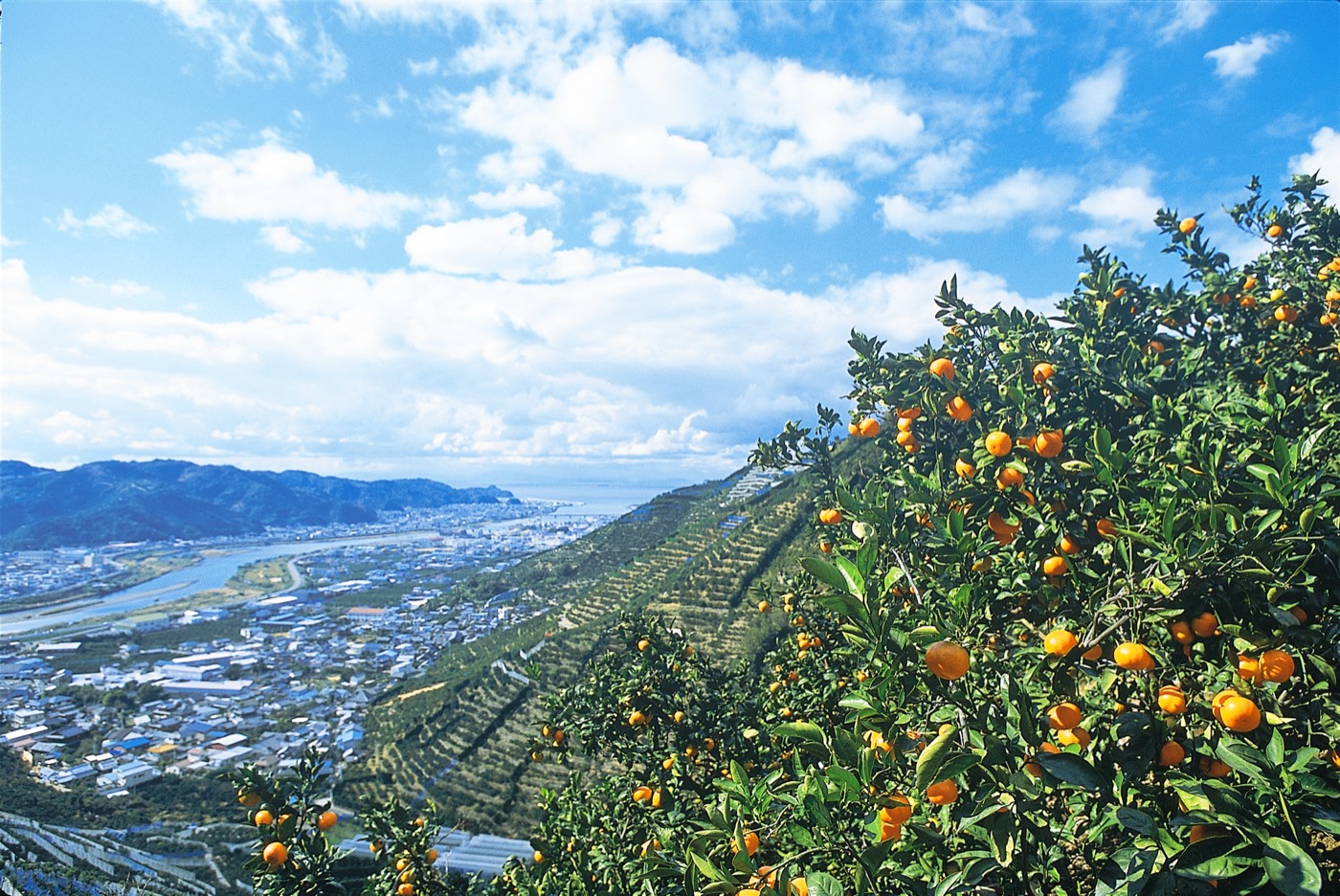
The Yamamoto surname means “the base of the mountain”, and it is one of the ten most common names in Japan. It is also one of the least clannish: it belongs to hundreds of unrelated families, each named after a different hill.
What Does the Surname Yamamoto Mean?
Yamamoto is written 山本 and means “the base of the mountain”, from yama (山), mountain, and moto (本), base, root or origin. It is a topographic name. It described where a family lived, not who they descended from.
The second character is the interesting one. 本 carries a bundle of related senses in Japanese: root, source, origin, the main or foundational thing. Attached to a landform it means the foot of it, the point where the slope meets ground people can actually live on.
So a Yamamoto household was the household at the bottom of the mountain, where the paddy fields end and the forest begins. That is a description, not a lineage, and it is the single most useful thing to understand about the name.
Where the Yamamoto Name Comes From
Yamamoto comes from Japan and is heavily concentrated in the west. It is the most common surname of all in ten prefectures: Toyama, Ishikawa, Fukui, Nara, Wakayama, Okayama, Hiroshima, Yamaguchi, Ehime and Kochi, spanning the Hokuriku coast, the Kansai interior, western Honshu and Shikoku.
The yama- family of names
Yamamoto sits inside a whole grammar of mountain names, each fixing a family at a different point on the same landform. Yamada (山田) is the mountain rice field. Yamaguchi (山口) is the mountain entrance, the mouth of the valley. Yamashita (山下) is below the mountain, Yamanaka (山中) is in among the mountains, Yamazaki (山崎) is the mountain cape where a ridge runs out into open ground, and Yamagata (山形) is the mountain’s shape.
Read together they are a map legend, each name pinning a household to a position relative to one specific local hill. Because they describe a landform rather than an ancestor, the same name arose independently in thousands of villages at once. Two Yamamoto families are not distant cousins who lost touch. They are two households that lived at the bottom of two different mountains, with no reason to expect any connection at all.
Why so many Japanese surnames are so young
Most Japanese families did not carry a registered surname until 1875, when the Heimin Myoji Hitsusho Gimurei compelled every commoner household to declare one. Our pages on the Tanaka surname and the Nakamura surname cover that law and its consequences in detail.
The short version: when millions of households had to produce a name in a hurry, most looked out of the door and described what they saw. Yamamoto was one of the obvious answers, everywhere in Japan at once, which is why it became so common so fast.
The older Yamamotos
Some Yamamoto lines are far older than 1875. Samurai families held surnames for centuries before commoners did, and Yamamoto Tsunetomo, the Saga retainer behind the Hagakure, was writing under the name in the early eighteenth century.
Where the name is densest
Wakayama is the heartland. Roughly two per cent of everyone in the prefecture is a Yamamoto, the highest share anywhere in Japan, on a peninsula of steep wooded ridges and narrow coastal flats where almost every settlement genuinely does sit at the base of a mountain.
Spelling Variants and Related Names
Yamamoto is unusually stable. The kanji 山本 are near universal, the reading is almost always yamamoto, and the Roman spelling barely varies.
The interesting relatives fall into two groups. The yama– names share the mountain: Yamada, Yamaguchi, Yamashita, Yamazaki (also spelled Yamasaki), Yamanaka, Yamauchi, Yamagishi, Yamagata, Yamane, Yamashiro, Yamamura and Yamaoka.
The -moto names share the structure, swapping the mountain for something else at whose base a family lived: Matsumoto (base of the pine), Hashimoto (base of the bridge), Sakamoto (base of the slope), Miyamoto (base of the shrine), Kishimoto (base of the bank), Morimoto (base of the wood), Fujimoto (base of the wisteria), Takemoto (base of the bamboo) and Enomoto (base of the hackberry).
Yamamoto is also a place name in its own right, including the town of Yamamoto in Miyagi and the former town of Yamamoto in Kagawa. Families from those places take the name from the settlement rather than directly from a hill.
The Yamamotos in America
Yamamotos arrived in America mainly between 1885 and 1924, in the Issei migration from western Japan to Hawaii and the Pacific coast. The prefectures that sent the most emigrants, Hiroshima, Yamaguchi, Wakayama and Okayama among them, are the same ones where Yamamoto is the commonest name of all, which is why the surname is so visible in Japanese American communities.
They came for plantation contracts in Hawaii, then for farm work, fishing and small business on the mainland. The 1924 Immigration Act closed the door, and the American Yamamoto story became the story of the Nisei, the American-born second generation.
Then came 1942. Executive Order 9066 removed around 120,000 people of Japanese ancestry from the West Coast, two thirds of them United States citizens, into inland camps. Families lost farms, businesses and homes they never recovered.
Yamamotos carried an extra weight through those years. The admiral who planned the attack on Pearl Harbor was named Yamamoto, and American families who had never met him, who were themselves imprisoned behind wire by their own government, spent the war answering for a surname.
That association outlived the war. In 2018 Palo Alto considered renaming a middle school for Fred Yamamoto, a local graduate who was incarcerated at Heart Mountain, volunteered for the 442nd Regimental Combat Team and was killed in action in France in October 1944. The proposal drew organised opposition over the surname alone, and the board chose other names.
After the camps closed, the communities rebuilt. Yamamotos returned to Little Tokyo in Los Angeles and put down deep roots in the South Bay, in Gardena and Torrance, which still hold two of the largest Japanese American populations in the country.
Later arrivals came differently, as engineers and researchers, settling around the tech corridors in Cupertino and Bellevue, Washington. Three waves, one name, and often no relation between them.
Notable People Named Yamamoto
Yamamoto Tsunetomo (1659 to 1719) was a samurai of the Saga domain whose recorded conversations became the Hagakure, the most quoted and most misread text on the samurai code.
Yamamoto Gonnohyoe (1852 to 1933) was an admiral and twice Prime Minister of Japan, in 1913 to 1914 and again in 1923 to 1924.
Isoroku Yamamoto (1884 to 1943) was born Takano Isoroku in Nagaoka, Niigata, and took the Yamamoto name only in 1916, through adoption into a samurai family that needed an heir. He studied at Harvard from 1919 to 1921 and served twice as naval attache in Washington, and those years left him convinced that Japan could not win a long war against American industry. He warned that he could promise six months or a year of success and nothing beyond it. He opposed war with the United States, then planned the attack on Pearl Harbor when the decision went against him. American fighters shot down his aircraft over Bougainville on 18 April 1943. (Read more at Wikipedia.)
Hisaye Yamamoto (1921 to 2011) was a Nisei short story writer imprisoned at Poston, Arizona, where she wrote for the camp newspaper. Her story “Seventeen Syllables” and the collection that took its name made her one of the first Japanese American writers to win national recognition. (See the Densho Encyclopedia.)
Yohji Yamamoto (born 1943) and Kansai Yamamoto (1944 to 2020) were unrelated designers who reshaped how the world dressed: Yohji through austere black tailoring out of Paris, Kansai through the costumes he built for David Bowie’s Ziggy Stardust.
Yoshinobu Yamamoto (born 1998), from Bizen in Okayama, pitched for the Orix Buffaloes before signing with the Los Angeles Dodgers in 2024.
How Common Is Yamamoto Today?
Yamamoto is the ninth most common surname in Japan and the 4,702nd most common in the United States, carried by 7,547 Americans at the 2010 Census.
| US rank (2010 Census) | #4702 |
|---|---|
| Americans with the name | 7,547 |
| Origin | Japanese (山本, “base of the mountain”) |
| Meaning | Topographic: the household at the foot of the mountain |
Of those American Yamamotos in 2010, 79.82 per cent identified as Asian or Pacific Islander, 10.52 per cent as two or more races, 5.68 per cent as white and 3.88 per cent as Hispanic. Those are self-identification proportions recorded on a census form, not measures of ancestry, and the double-digit multiracial share signals how thoroughly Japanese American families have intermarried since the war.
Frequently Asked Questions
What does the surname Yamamoto mean?
Yamamoto (山本) means “the base of the mountain”, from yama, mountain, and moto, base or origin. It is topographic, describing where a household stood rather than who it descended from.
Is Yamamoto Japanese or Chinese?
Yamamoto is Japanese. The characters 山本 exist in Chinese too, but the reading yamamoto is native Japanese and the surname is not used in China or Korea.
Where does the Yamamoto family come from?
There is no single Yamamoto family. The name is commonest in western Japan and is the leading surname in ten prefectures, with Wakayama the densest at roughly two per cent of the population.
How common is the surname Yamamoto?
It is the ninth most common surname in Japan. In the United States it ranked 4,702nd at the 2010 Census, with 7,547 bearers.
Is there a Yamamoto family crest or coat of arms?
There is no coat of arms for the Yamamoto surname, and any site selling you one is selling a decoration rather than a lineage. In European heraldry arms belong to individuals and their direct descendants, never to everyone sharing a name. Japan has its own tradition of kamon, household crests, but those attach to particular households, and Yamamoto households used many different ones.
Are all Yamamotos related to Admiral Isoroku Yamamoto?
No, and neither was he by birth. He was born Takano Isoroku and only became a Yamamoto by adoption in 1916. Beyond that, the surname arose independently in thousands of villages, so sharing it implies no relation at all.
If your family carries the Yamamoto name, its route from a mountain foot in western Japan to America is traceable. Atlas of Home can follow it from the prefecture your Issei ancestors left to wherever your family landed, and to wherever you are now.