
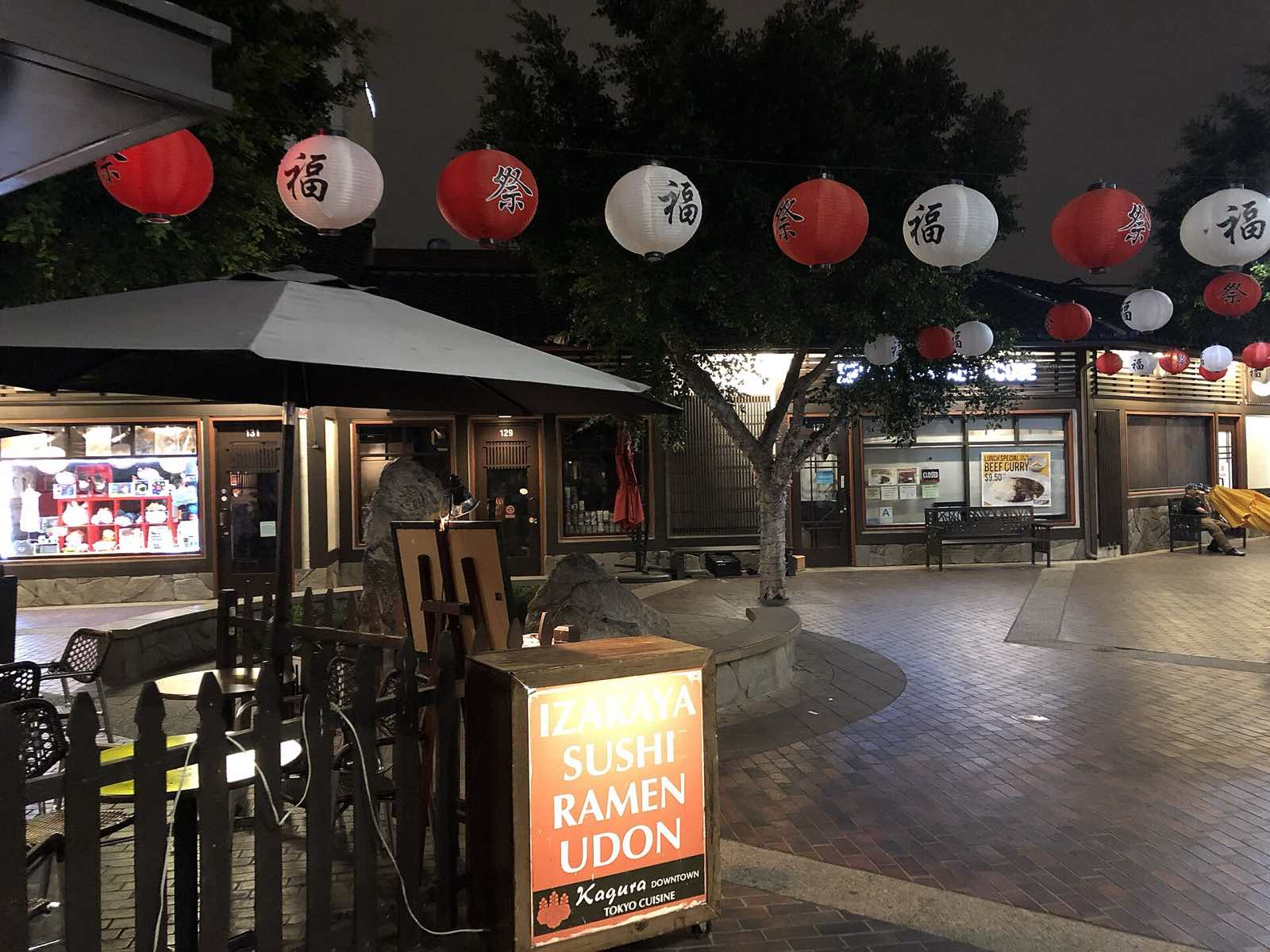
The smell hits first. Sweet rice steaming behind a glass counter on First Street, where a confectioner is folding bean paste into mochi the same way his grandfather did in 1903. A few doors down, paper lanterns sway over a brick courtyard, and the curved tile roof of a fire tower catches the afternoon light. The Japanese in Little Tokyo built this block, and almost every storefront on it carries a story that runs through a sailor who jumped ship, a confectionery that outlasted a war, and a forced exile that emptied these streets in six days.
Here they raised the largest Japantown in the United States, then watched it taken from them, then came back and built it again. What survives is not a theme park. It is a working neighborhood that has refused, for more than a century, to disappear.
Little Tokyo: The Place
Little Tokyo sits in downtown Los Angeles, bounded roughly by Los Angeles Street to the west, Alameda Street to the east, Third Street to the south, and First Street to the north. It covers about five city blocks between City Hall and Skid Row, a short walk from Union Station. The Metro A and E Lines stop at the Little Tokyo/Arts District station, and the housing stock runs from early twentieth-century brick storefronts with apartments above to senior towers and newer mixed-use blocks built to keep longtime residents in place.
How Little Tokyo Became Japanese
Before the Japanese
In the early 1880s this corner of downtown was a racially mixed strip near the city’s commercial hub, dotted with fruit trees and vineyards on the edge of a young Los Angeles. Fewer than fifty Japanese lived in the entire town. The two blocks around First and Main were where newcomers of every background washed up, looking for cheap rooms and day labor.
The land itself was unremarkable. What made it Little Tokyo was who arrived next, and how quickly word traveled back across the Pacific that there was work in Southern California.
The Japanese Arrive
The usual founding date is 1884, and the usual founder is a former sailor and cook named Hamanosuke Shigeta. Known around town as Charlie Hama, he had jumped ship in San Diego, then the nearest harbor to Los Angeles, and made his way north. On East First Street he opened a small restaurant, the first Japanese-owned business in the city. He did well enough to sell out about two years later, in 1886.
Others followed the same path. In 1898 Sanjuro Mizuno opened the Santa Fe Boarding House, one of the first places a Japanese laborer could find a bed and a meal in his own language. The boarding houses mattered because most of the early arrivals were young single men, the Issei, the first generation, who had come to earn money and meant to go home.
They came in waves from a handful of prefectures in southern and western Japan. Hiroshima and Yamaguchi sent the most, followed by Kumamoto, Wakayama, and Fukuoka. The pattern was chain migration in its purest form: a man from a Hiroshima village would send for a brother, a cousin, a neighbor’s son, and within a few years half a hometown might be working the same stretch of railroad or the same produce stalls. People from the same prefecture formed kenjinkai, mutual-aid clubs that lent money, settled disputes, and buried the dead.
The 1906 San Francisco earthquake pushed another two to three thousand Japanese south into Los Angeles, and Little Tokyo thickened into a real district. The men worked the railroads and the farms, and many drifted into the produce trade. Vegetable stalls lined Central Avenue just south of the district, fed by Japanese truck farms across Southern California. Shops, barbers, bathhouses, and pool halls spread along First Street to serve a population that was no longer planning to leave.
Little Tokyo at Its Peak
By 1941 there were roughly 36,000 people of Japanese ancestry in Los Angeles County, the largest such community on the mainland, and Little Tokyo was its beating heart. The Nisei, the American-born second generation, were now coming of age, and the district had churches, temples, newspapers, doctors, dentists, and dry-goods stores all run in Japanese.
In 1903 a young man from Gifu named Seiichi Kito had opened a confectionery called Fugetsu-Do, selling mochi and manju to homesick immigrants. By the 1930s it was an institution. In 1934, with the district sagging through the Depression, the Nisei launched Nisei Week to draw younger crowds and new business back to First Street. Eiji Tanabe chaired that first festival in August 1934, and the following year a Nisei Week Queen, Alice Watanabe, was crowned. The ondo street dancing and cultural exhibits from those first years still run every summer.
It was a full life, lived in two languages, with one foot in Hiroshima and one in California. None of the people building it knew how little time it had left.
The Change
On February 19, 1942, ten weeks after Pearl Harbor, President Franklin Roosevelt signed Executive Order 9066. It let the military remove anyone it chose from the West Coast, and in practice it meant the forced incarceration of nearly everyone of Japanese ancestry, citizen and immigrant alike.
The orders reached Little Tokyo in the spring. Families were given about six days to dispose of homes, shops, and a lifetime of belongings, and to take only what they could carry. Businesses held fire sales. Cars sold for a few dollars. Pets were left with neighbors who promised to write.
The Nishi Hongwanji temple on First Street, the first Buddhist temple building in Los Angeles, became a collection point where families stored what they could not sell and were processed for removal. Then the buses came. Roughly nine in ten of the people sent to the Manzanar camp in the Owens Valley came from the Los Angeles area, and others went to Heart Mountain in Wyoming and to camps across six states. By that summer the streets of Little Tokyo were silent.
The neighborhood did not stay empty. Black workers were pouring into Los Angeles for wartime factory jobs, and racial housing covenants shut them out of most of the city. Little Tokyo was one of the few places open to them, and tens of thousands moved into the emptied apartments and storefronts. For three years the district was known as Bronzeville, a crowded, jumping center of Black Los Angeles where you could hear jazz late into the night and, by some accounts, catch Charlie Parker on stage.
When the camps closed in 1945, Japanese Americans were allowed back, returning to a neighborhood that was no longer only theirs and a city with almost no room. One official called the Los Angeles housing situation full of dynamite. Churches opened hostels for the returnees, among them the Evergreen Hostel in nearby Boyle Heights, which sheltered more than 750 people in its first months. For a while the two communities shared the same blocks in an uneasy, generous arrangement some called Little Bronze Tokyo, where a returning storekeeper named Kichi Uyeda reopened a five-and-dime and hired Black clerks. Slowly, family by family, the Japanese rebuilt their Little Tokyo.
The Landmarks of Little Tokyo
Fugetsu-Do, 315 East First Street. Seiichi Kito opened this confectionery in 1903, and three generations later it is the oldest Japanese American business in the country. The family shuttered it for the war years and reopened after returning from camp; today Seiichi’s grandson Brian Kito, who took over in 1980, still makes mochi and manju by hand a few feet from where it started.
Japanese American National Museum, 100 North Central Avenue. The museum’s original home is the former Nishi Hongwanji temple, built in 1925, the same building where families stored their belongings and were processed before incarceration. It opened as a museum on April 30, 1992, and in January 1999 added a soaring glass Pavilion designed by architect Gyo Obata. A place of exile became a place of memory.
Japanese Village Plaza, 335 East Second Street. The open-air plaza opened in 1978 as part of an effort to draw people back to the district, and its 55-foot yagura, a replica of a rural Japanese fire-lookout tower designed by David Hyun, became Little Tokyo’s signature image. The original wooden tower was rebuilt in metal in 2010 after termites had their way with it. A plaque at its base calls it a testimony to the Issei pioneers who first settled here.
Koyasan Buddhist Temple, 342 East First Street. Reverend Shutai Aoyama founded this Shingon mission in 1912 in a small storefront on Commercial Street, the first temple of its kind in the United States. It moved into its permanent home on First Street in 1940, two years before its congregation was scattered to the camps, and it gathered them back when the war ended.
Far East Cafe, 347 East First Street. Cousins of the Jeong family opened this Chinese restaurant in 1935, and for almost sixty years it was where Little Tokyo held its weddings, graduations, and funerals over plates of chop suey. The 1994 Northridge earthquake red-tagged the building; after a restoration that added affordable apartments upstairs, the ground floor reopened in the mid-2000s.
Higashi Honganji Buddhist Temple, 505 East Third Street. Tracing its Los Angeles roots to the early 1900s, this Jodo Shinshu temple anchors the southern edge of the district. Its curved entrance and tile roof are among the most photographed sights in Little Tokyo, a piece of old-country architecture standing a block from the downtown skyline.
First Street North. The block of First Street between San Pedro Street and Central Avenue is the last stretch of original Little Tokyo intact enough to read as a whole, with thirteen low brick storefronts from the first half of the twentieth century. It was named a National Historic Landmark district in 1995. Walk it slowly and you are walking the street Charlie Hama opened.
Where the Japanese Came From
The Issei of Little Tokyo did not come from all over Japan. They came overwhelmingly from a cluster of southern and western prefectures, with Hiroshima and Yamaguchi far in the lead, then Kumamoto, Wakayama, and Fukuoka. These were rural, often poor districts where land was scarce and families were large, and where emigration agents and returning migrants spread word of wages in Hawaii and California.
Once the first men from a given village had a foothold, the rest followed along family and hometown lines, which is why a single Hiroshima farming town could end up with dozens of sons in one Los Angeles neighborhood. The kenjinkai that organized social life in Little Tokyo were, in effect, those hometowns reassembled on First Street, complete with their loyalties, their dialects, and their obligations to look after one another.
Little Tokyo Today
Little Tokyo is now one of only three Japantowns left in the United States, alongside the historic Japantown of San Francisco and the one in San Jose. It sits among a downtown ring of immigrant enclaves that includes nearby Koreatown and Historic Filipinotown. It is busy in a way it has not been in years, lifted by anime tourism and by Dodgers fans chasing anything tied to Shohei Ohtani. On a weekend the plazas fill, the ramen lines spill onto the sidewalk, and the lanterns glow over the brick.
The pressure underneath is real. More than fifty longtime businesses have closed in roughly fifteen years as rents climbed, and in January 2024 the beloved Suehiro Cafe, open since 1972, was pushed out of its First Street home by an eviction and a rent that nearly doubled. The fight against displacement here is old. It runs back to the 1970s, when the city’s redevelopment agency tore through the district and a tenant group organized to keep mom-and-pop shops and elderly residents from being cleared out.
What is different now is who holds the deeds. Through Sustainable Little Tokyo and a community investment fund that raised a million dollars from more than a hundred small investors, residents have started buying the buildings themselves, and in 2026 Suehiro is coming home to a new development on First Street North. The neighborhood that was emptied in six days is, block by block, putting itself back into its own hands. The next chapter is being written by the people who refused to leave.
Frequently Asked Questions
Why did the Japanese settle in Little Tokyo?
The Japanese in Little Tokyo first gathered around East First Street in the 1880s because it was a cheap, racially mixed strip near downtown Los Angeles where new arrivals could find rooms and work. Once a former sailor opened the first Japanese restaurant there in 1884 and boarding houses followed, chain migration from a few Japanese prefectures filled the district. Proximity to railroad jobs and the downtown produce trade kept people there.
Is Little Tokyo still Japanese today?
Yes, though it has changed. Little Tokyo remains one of only three historic Japantowns in the United States and is still anchored by Japanese American temples, businesses, and institutions like the Japanese American National Museum. Rising rents and gentrification have closed many legacy shops, but community groups are now buying buildings to keep the neighborhood’s Japanese character intact.
What are the most famous landmarks in Little Tokyo?
The best-known sights are the Japanese Village Plaza with its 55-foot yagura fire tower, the Japanese American National Museum in the former Nishi Hongwanji temple, and Fugetsu-Do, the country’s oldest Japanese American business, founded in 1903. The Buddhist temples and the historic block of First Street North round out the essential stops.
Where in Japan did the people of Little Tokyo come from?
Most Issei immigrants came from a handful of southern and western Japanese prefectures, above all Hiroshima and Yamaguchi, followed by Kumamoto, Wakayama, and Fukuoka. These were largely rural farming regions, and migrants followed relatives and neighbors from the same hometowns, recreating those village ties in Los Angeles.
When did the Japanese first arrive in Little Tokyo?
The Japanese in Little Tokyo trace their origin to 1884, when Hamanosuke Shigeta, a former sailor known as Charlie Hama, opened the first Japanese-owned business on East First Street. The community grew steadily after the 1906 San Francisco earthquake pushed thousands of Japanese south, and it peaked just before the wartime incarceration of 1942.
If your family’s story passed through Little Tokyo, through a confectionery counter or a temple pew or a name on a hostel ledger, that history is worth tracing back to the prefecture it came from.