
The Nakamura surname means “middle village”, from the Japanese naka (中), centre, and mura (村), village. It began life as a place name, and Nakamura villages sit scattered the length of Japan.
What Does the Surname Nakamura Mean?
Nakamura (中村) means “middle village” or “central village”: naka 中, middle or centre, joined to mura 村, village. It is a toponymic name, taken from a place rather than from an ancestor, a trade or a nickname.
The sense is more precise than it looks in English. Where several hamlets sat along one valley, they were told apart by position, and the one in the middle was simply the middle village. The same logic produced Nishimura (west village), Kitamura (north village) and Shimomura (lower village).
So a Nakamura ancestor was not the head of a village. He lived in the one between the others.
Where the Nakamura Name Comes From
Nakamura families come from all over Japan rather than from a single homeland, because the name was taken from a nearby settlement and there were Nakamura settlements almost everywhere. Two Nakamura households are usually named after two different villages.
A name taken from the map
Nakamura is still an ordinary Japanese place name. Nakamura-ku is one of the sixteen wards of Nagoya, and Nakamura in Kōchi Prefecture was a city in its own right until 2005, when it merged with Nishitosa to form the modern city of Shimanto.
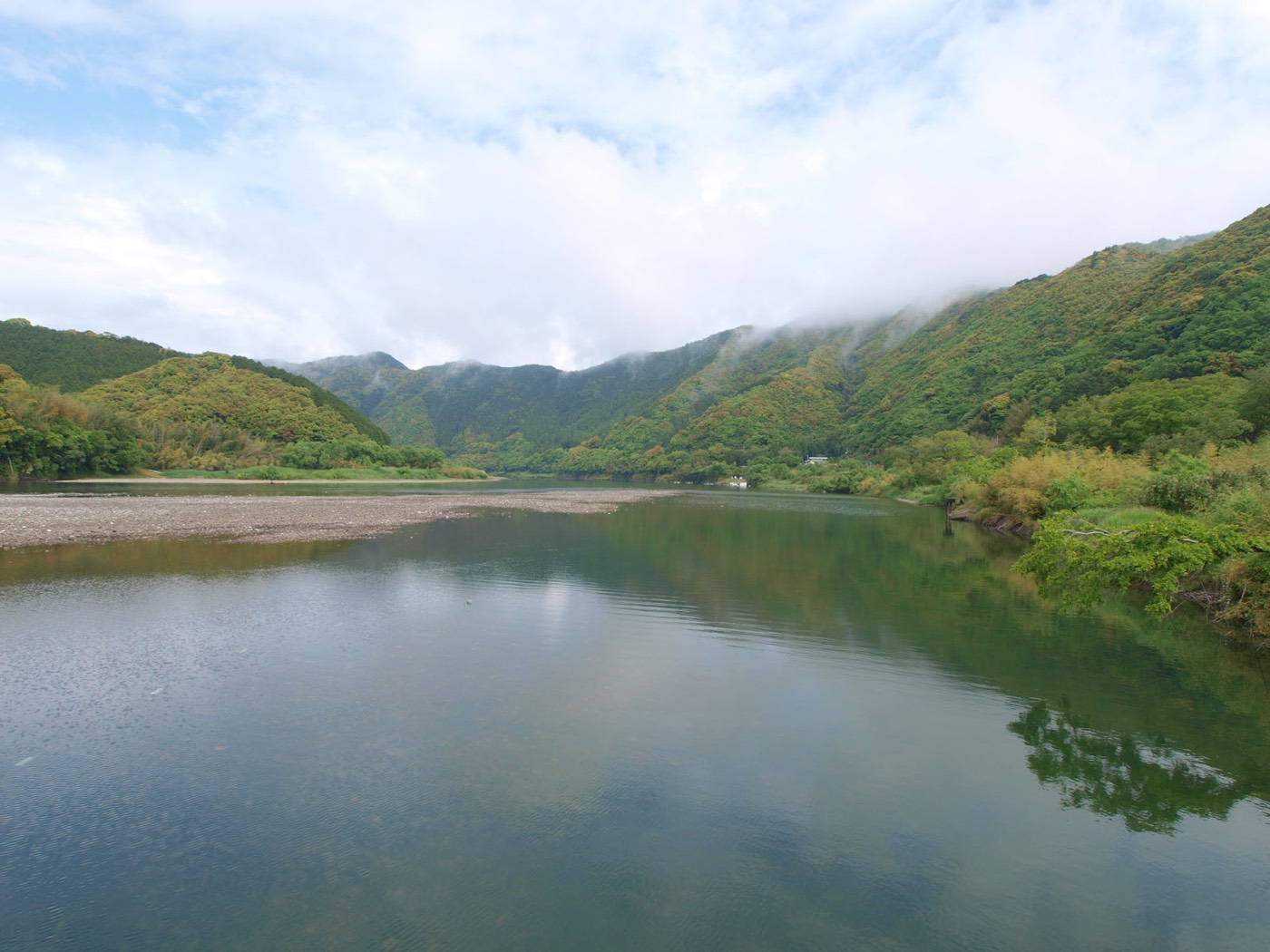
That Kōchi Nakamura has an unusually good story. After the Ōnin War the former imperial regent Ichijō Norifusa withdrew there and laid the town out on Kyoto’s grid, borrowing district names including Gion and Higashiyama. It is still the Little Kyoto of Tosa, and Nakamura Castle stands on Shiroyama hill above the Shimanto River.
Why the name is only about 150 years old
Most Japanese commoners carried no hereditary surname until the Meiji government made registration compulsory in 1875 under the Heimin Myōji Hitsushō Gimurei. We set out that law and its consequences in full on the Tanaka surname page, so it is worth reading alongside this one.
What matters for Nakamura is the choice it forced. Households given weeks to name themselves reached for what was nearest and least contentious, which was the ground under their feet. That is why the Japanese frequency tables read like a landscape survey: field, mountain, river, forest, village.
The village a Nakamura family named itself after may be six centuries old. The surname is generally a Meiji-era decision, taken in the 1870s by an ancestor often still named in the family register.
Nakamura as a name you are given: the kabuki houses
There is a second Nakamura that has nothing to do with villages. In kabuki, Nakamura is a professional name conferred on an actor, and it passes by succession and adoption rather than by blood.
Edo-period actors were commoners and could not hold surnames, so acting families used yagō, house or guild names borrowed from the merchant world. Naritaya belongs to the Ichikawa Danjūrō line, Otowaya to the Onoe Kikugorō line, and Nakamuraya to the line of Nakamura Kanzaburō. Audiences still shout the yagō, not the actor’s name, at the height of a dramatic pose.
Nakamura Kanzaburō I opened the Nakamura-za theatre in Edo on 21 November 1624, and his successors ran it for generations as zamoto, troupe head and manager. Eighteen holders of the name are recorded, ending with Kanzaburō XVIII, who died in 2012. The line continued by whatever means the century allowed: Kanzaburō IX arrived by adoption, Kanzaburō X as a merchant’s son-in-law, and Kanzaburō XIII, who moved the theatre to Tokyo in 1868, was the first Kanzaburō’s last direct descendant. Names change hands in public, at grand ceremonies called shūmei.
Nor is there one Nakamura house. Nakamura Kichiemon II (1944 to 2021), designated a Living National Treasure in 2011, carried the yagō Harimaya, and was legally adopted by his own grandfather, Kichiemon I, in order to inherit the name at all.
Spelling Variants and Related Names
Nakamura is written 中村 in almost every case, and unlike many Japanese surnames it has no competing kanji. Japanese names vary in their characters rather than their letters, so the variation worth knowing sits in the neighbouring names built from the same two blocks.
Take naka 中 and change the second element and you get Nakajima and Nakashima (middle island), Nakano (middle field), Nakagawa (middle river), Nakayama (middle mountain), Nakata and Nakada (middle rice field) and Nakahara (middle plain). Keep mura 村 and change the first and you get Kimura, Nishimura, Kitamura, Nomura, Matsumura, Tamura, Okamura and Uemura. Nakamura sits at the crossing point of the two largest families of Japanese surnames.
Romanisation gives no trouble either. Both syllables are short and unambiguous, so Nakamura appears in American ship manifests and census returns with almost none of the drift that afflicts Japanese names carrying long vowels, such as Satō. One warning for researchers: because Nakamura is still a place name, a ward name and a station name, record searches return a great deal of geography before they return any people.
The Nakamuras in America
Nakamuras reached the United States mainly between the mid 1880s and 1924, in the wave of Japanese labour migration to the Hawaiian sugar plantations and then to the Pacific coast. The name has been rooted in California ever since.
The first large movement began in 1885 under contract emigration to Hawaii, and turned towards the mainland in the 1890s through San Francisco and Seattle. The Gentlemen’s Agreement of 1907 and 1908 cut off new labourers but allowed families to reunite, which is why so many Issei households were formed by picture marriage. The Immigration Act of 1924 closed the door.
Their American-born children, the Nisei, grew up in farming districts and in the Japanese quarters of West Coast cities, among them Little Tokyo in Los Angeles and the market gardens that became Japanese Gardena.
Then came Executive Order 9066 in February 1942, under which roughly 120,000 people of Japanese ancestry were removed from the West Coast and held in incarceration camps. About two thirds were United States citizens. Nakamura families were among them, and many lost farms, shops and homes they never recovered. Congress apologised and made restitution only in 1988. The Densho Encyclopedia holds the documentary record of that period.
Postwar resettlement reshaped where the name is found. Families rebuilt in the South Bay of Los Angeles, in Torrance and later in Palos Verdes Estates. A quite separate, much later Nakamura presence grew on the Hudson River across from Manhattan, where corporate transfers from the 1970s onwards built Japanese communities in Fort Lee and Edgewater, New Jersey.
Notable People Named Nakamura
Nakamura Kanzaburō XVIII (1955 to 2012) was the last holder of the great kabuki name, an actor who took the form into television, advertising and open-air revivals of Edo-style playhouses before his death at 57.
Nakamura Kichiemon II (1944 to 2021) was one of the finest classical kabuki actors of his generation, celebrated for Benkei, and a Living National Treasure from 2011.
Shuji Nakamura (born 1954 in Ehime) invented the high-brightness blue light-emitting diode, the missing piece that made white LED lighting possible, and shared the 2014 Nobel Prize in Physics for it. He is now a Japanese-born American professor in California.
Tetsu Nakamura (1946 to 2019) was a physician who spent more than three decades in Afghanistan, eventually leaving medicine for irrigation engineering and building canals that turned desert around Jalalabad back into farmland. Made an honorary Afghan citizen, he was killed by gunmen on his way to a canal site in December 2019.
Robert A. Nakamura (1936 to 2025), born in Venice, California, was incarcerated as a child at Manzanar. He co-founded Visual Communications in 1970 and made the documentary Manzanar (1971), and is widely called the godfather of Asian American media.
Hikaru Nakamura (born 1987) is an American chess grandmaster and five-time United States champion, who at fifteen became the youngest American grandmaster to that date.
How Common Is Nakamura Today?
Nakamura is one of the ten most common surnames in Japan and the 4,633rd most common in the United States, where 7,658 people carried it at the 2010 Census. A 2008 study by Meiji Yasuda Life placed it seventh in Japan, with about 1,080,000 bearers.
Of those 7,658 Americans, 78.87 per cent identified as Asian or Pacific Islander in 2010, 11.2 per cent as two or more races, 6.48 per cent as white, 3.02 per cent as Hispanic, 0.22 per cent as American Indian or Alaska Native and 0.21 per cent as Black. Those are self-identification figures, not measures of ancestry, but the point stands: more than one American Nakamura in nine ticked more than one box, the mark of a community several generations deep in intermarriage.
| US rank (2010 Census) | #4,633 |
|---|---|
| Americans with the name | 7,658 |
| Origin | Japanese (中村) |
| Meaning | Middle village, from naka (centre) and mura (village) |
Frequently Asked Questions
What does the surname Nakamura mean?
Nakamura (中村) means middle village or central village, from naka, middle, and mura, village. It described a settlement sitting between others in the same valley or district, and was adopted as a family name from that place.
Is Nakamura Japanese or Chinese?
Nakamura is Japanese. The characters 中村 are Chinese in origin, as most kanji are, but the reading Nakamura is Japanese and the name is not used as a Chinese surname. In Mandarin the same characters read Zhongcun.
Where does the Nakamura family come from?
There is no single Nakamura homeland. The name was taken from a local village, and Nakamura villages existed across Japan, so different Nakamura lines began independently in different provinces. Distribution studies show it especially common in the west, including Yamaguchi, Mie and Nagasaki.
How common is the surname Nakamura?
Very common in Japan and moderately rare in the United States. It sits around seventh to eighth in Japan with roughly a million bearers, while the 2010 US Census recorded 7,658 Americans with the name, ranking it 4,633rd.
Is there a Nakamura family crest or coat of arms?
No, and be careful of anyone selling one. In heraldry arms are granted to individuals and pass to their direct descendants, never to everyone who happens to share a surname, so a “Nakamura family crest” is a decoration rather than a lineage. Japan does have family crests, called kamon, but a kamon belongs to a specific household line, not to a surname, and no single crest represents all Nakamuras.
Why are there so many Nakamura kabuki actors?
Because in kabuki the name is a professional inheritance, not a bloodline. Stage names pass at shūmei ceremonies to sons, adopted sons, sons-in-law and pupils, so an actor may become a Nakamura without being born one. The Kanzaburō line alone ran to eighteen generations.
If your family carries the Nakamura name, its route from Japan to America is traceable. Atlas of Home can follow it from the Meiji-era village register to the port, plantation or farming district where your family landed, and to wherever you are now.