
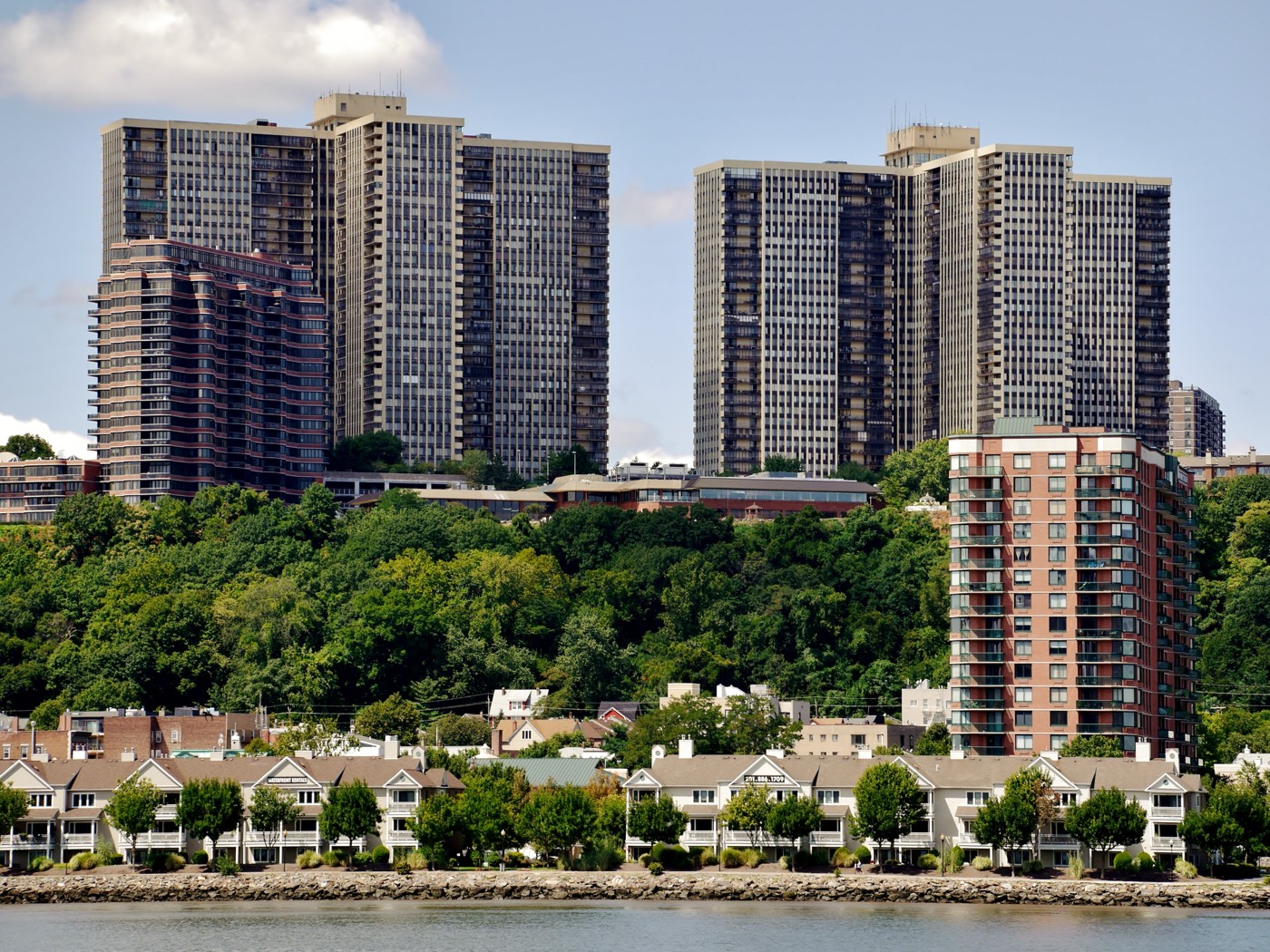
On a Saturday morning, the car park at 595 River Road fills with families speaking Japanese, the Manhattan skyline glittering across the water behind them. They have come, as Japanese in Edgewater have come for more than three decades, to a supermarket that is really a slice of home. Inside, the rice cookers hum, the bakery smells of melon pan, and the bookstore stocks the latest manga flown in from Tokyo. This narrow strip of New Jersey waterfront has quietly become the centre of Japanese life on the American East Coast.
The Place
Edgewater is a sliver of a borough, barely half a mile wide, pressed between the Palisades cliffs and the Hudson River in Bergen County. For most of the twentieth century it was a factory town: Ford built cars here, Alcoa rolled aluminium, and the American Can Company packed its tins along three miles of industrial shoreline.
When the factories closed in the late twentieth century, developers saw something the smokestacks had hidden. The view. From the Edgewater shore, the towers of Midtown Manhattan rise straight out of the water, close enough to count the windows.
The borough remade itself around that view. Glass condominium towers replaced the old plants, and the population climbed from roughly 4,000 in 1990 to 7,677 in 2000, then 11,513 in 2010, and 14,336 by 2020. The median family income reached $114,375 by the 2010 census, the affluence of people who commute to Manhattan and want to see it from their balcony, the kind of waterfront borough built on a single view.
How It Became Japanese
The Japanese came to Edgewater for the same reason everyone else did, and for one reason no one else had. The skyline meant Manhattan was minutes away. And in 1988, a single building gave the community a reason to stay.
The expatriate triangle
The story begins not in Edgewater but uphill, in Fort Lee, where Japanese corporate families had been settling since the 1970s. Japanese banks, trading houses and electronics firms posted executives to New York for three- or four-year tours, and those families needed somewhere close to Manhattan with good schools and other Japanese neighbours.
Fort Lee, sitting at the western foot of the George Washington Bridge, fit perfectly. By 2010 it held 1,302 Japanese residents, the largest concentration in New Jersey. Edgewater, just downhill along River Road, became the natural overflow as its waterfront towers rose.
Yaohan opens on the Hudson, 1988
In September 1988, the Japanese retail giant Yaohan opened its first East Coast location on the Edgewater waterfront. It was built explicitly for the families of Japanese executives living around Fort Lee, a full Japanese supermarket and mini-mall where homesick expatriates could buy the brands they knew.
Nothing like it existed on the East Coast. Where a Japanese family in most of America made do with a single aisle of imported goods, Edgewater offered an entire emporium: fresh fish cut for sashimi, a food court, a Japanese bookstore, household goods, all under one roof with the skyline framed in the windows.
From Yaohan to Mitsuwa
The store nearly did not survive its first decade. In September 1997, amid the Asian financial crisis and a collapse in the Japanese retail market, Yaohan declared bankruptcy under a debt of roughly $1.4 billion.
Rather than let the East Coast anchor close, former executives regrouped in 1998, acquired the American stores, and rebranded them as Mitsuwa Marketplace. The Edgewater store kept its address, its shoppers and its role. For the Japanese families on the waterfront, the name on the sign changed but the meaning did not.
A community that renews itself
What makes Edgewater unusual among Japanese American communities is that it never settled into a single generation. Many of the better-known Japanese neighbourhoods in America are descended from prewar immigrants, like the families who built the farms in the Japanese flower-growing town of Gardena or the merchants of San Jose’s historic Japantown.
Edgewater is different. Its Japanese population is constantly refreshed by new corporate postings, families who arrive for a few years and rotate home. The community is a revolving door of fresh arrivals from Tokyo and Osaka, which is why the supermarket shelves still read like a store in Japan rather than a nostalgic memory of one.
Naming the numbers
By the 2010 census, Japanese residents made up 4.9 percent of Edgewater, about 560 people, up from 3.22 percent a decade earlier. Combined with Fort Lee, the area held an estimated 2,500 Japanese Americans around 2011, the largest such cluster in the state.
Bergen County as a whole accounted for roughly 45 percent of all Japanese residents in New Jersey. The waterfront and the bluff above it had become, between them, the heart of Japanese New Jersey.
The Landmarks
Mitsuwa Marketplace, 595 River Road. The anchor of it all. Opened as Yaohan in 1988 and rebranded Mitsuwa in 1998, it is the largest Japanese shopping centre on the East Coast. Beyond the supermarket it holds a food court, a bookstore, household and cosmetics shops, and a wall of windows looking straight at Manhattan.
Hokkaido Ramen Santouka, inside Mitsuwa, 595 River Road. The ramen counter in the Mitsuwa food court draws lines on weekends from across the metro area. Its tonkotsu broth has a following far beyond the Japanese community, the kind of place where New Yorkers cross the river for lunch.
Books Kinokuniya, inside Mitsuwa, 595 River Road. The bookstore stocks Japanese-language novels, magazines, manga and stationery, a lifeline for families who want their children reading in their first language. For the expatriate parent it is where the homeland stays current rather than frozen.
Japanese American Society of New Jersey, 208 Main Street, Fort Lee. Just up the hill, the society serves as a cultural and language hub for the wider community, the institutional counterpart to the supermarket’s commercial gravity. It anchors the Japanese presence on the Fort Lee side of the triangle.
Japanese Weekend School of New Jersey, Fort Lee. With its office in Fort Lee, the weekend school keeps children of expatriate families on the Japanese curriculum during their American years, so they can re-enter schools back home without losing a step. Saturdays are for kanji and Japanese maths.
Independence Harbor, River Road, Edgewater. Built in 1989 on a pier reaching into the Hudson, this gated community of roughly 525 residences across some 25 acres is the kind of waterfront address that drew commuting families. From its grounds the skyline reads like a postcard.
The Mitsuwa summer festival, 595 River Road. Each summer the car park transforms for a matsuri, with bon odori circle dancing, taiko drumming and stalls selling takoyaki and okonomiyaki. For one evening the borough sounds and smells like a festival night in Japan.
Where They Came From
The Japanese of Edgewater and Fort Lee came overwhelmingly from urban Japan, the white-collar core of Tokyo, Yokohama, Osaka and the cities that feed Japan’s great corporations. These were not refugees or labourers but salaried families on assignment, sent by banks, trading houses and manufacturers to staff their New York operations.
That origin shapes everything about the community. Because most arrive on multi-year corporate postings, the population is unusually transient, weighted toward young families rather than retirees, and tightly bound to Manhattan’s financial district where the parent companies keep their American offices.
It also explains the demand that built Mitsuwa. A community of recent arrivals from urban Japan does not want an approximation of home cooking. It wants the actual brands, the actual fish, the actual bookstore, which is exactly what the waterfront supermarket was designed to supply.
Edgewater Today
Edgewater in the 2020s is denser and pricier than the factory town it replaced, a wall of glass towers along a riverwalk that runs unbroken toward the George Washington Bridge. The Japanese community remains woven through it, less a visible enclave than a steady presence in the schools, the restaurants and above all the supermarket on River Road.
The community is also broader than any single nationality now. Edgewater’s Asian population passed 35 percent in 2020, and the borough sits beside other strongly Asian towns, including the Korean community uphill in Fort Lee and, further out, the Indian neighbourhoods of Iselin. The Japanese share is smaller than it was at its peak, a reflection of shifting corporate postings as much as anything.
Yet the centre of gravity has not moved. As long as Japanese companies send families to New York, those families will find their way to 595 River Road, and the supermarket that was built for homesick expatriates in 1988 will keep doing the job it was built to do. It remains, in a way few American institutions can claim, a working piece of Japan on the Hudson.
Frequently Asked Questions
Why are there so many Japanese in Edgewater, New Jersey?
The Japanese in Edgewater are largely the families of corporate executives posted to New York by Japanese banks, trading houses and manufacturers. Edgewater offered Manhattan views, an easy commute over the George Washington Bridge, and from 1988 a full Japanese supermarket and mini-mall on the waterfront that made the area feel like home.
What is Mitsuwa Marketplace in Edgewater?
Mitsuwa Marketplace at 595 River Road is the largest Japanese shopping centre on the East Coast. It opened in 1988 as Yaohan and was rebranded Mitsuwa in 1998. Beyond a Japanese supermarket it holds a food court, a Japanese bookstore, and household and cosmetics shops, functioning as an informal cultural centre for the region.
How many Japanese people live in Edgewater?
At the 2010 census, Japanese residents made up about 4.9 percent of Edgewater, roughly 560 people, up from 3.22 percent in 2000. Combined with neighbouring Fort Lee, the area held an estimated 2,500 Japanese Americans around 2011, the largest such concentration in New Jersey.
Is the Japanese community in Edgewater connected to Fort Lee?
Yes. The Japanese in Edgewater and Fort Lee form a single community spread along River Road and the bluff above it. Fort Lee held the larger Japanese population at 1,302 in 2010, and institutions such as the Japanese American Society of New Jersey and the Japanese Weekend School are based there, while the Mitsuwa supermarket sits down the hill in Edgewater.
Where did Edgewater’s Japanese residents come from?
They came overwhelmingly from urban Japan, especially Tokyo, Yokohama and Osaka, sent on multi-year corporate assignments rather than as permanent immigrants. This is why the community is unusually transient and constantly refreshed by new arrivals, and why the local supermarket stocks current Japanese brands rather than nostalgic ones.
What was Yaohan and what happened to it?
Yaohan was a Japanese retail chain that opened the Edgewater store in 1988 as its first East Coast location. The parent company declared bankruptcy in 1997 during the Asian financial crisis. Former executives acquired the American stores in 1998 and rebranded them as Mitsuwa Marketplace, keeping the Edgewater location and its role intact.
If your family’s story passed through Edgewater, or any of the places Japanese families have made home in America, Atlas of Home can trace that journey. From the offices of Tokyo and Osaka to a supermarket on the Hudson, to wherever you are now.