
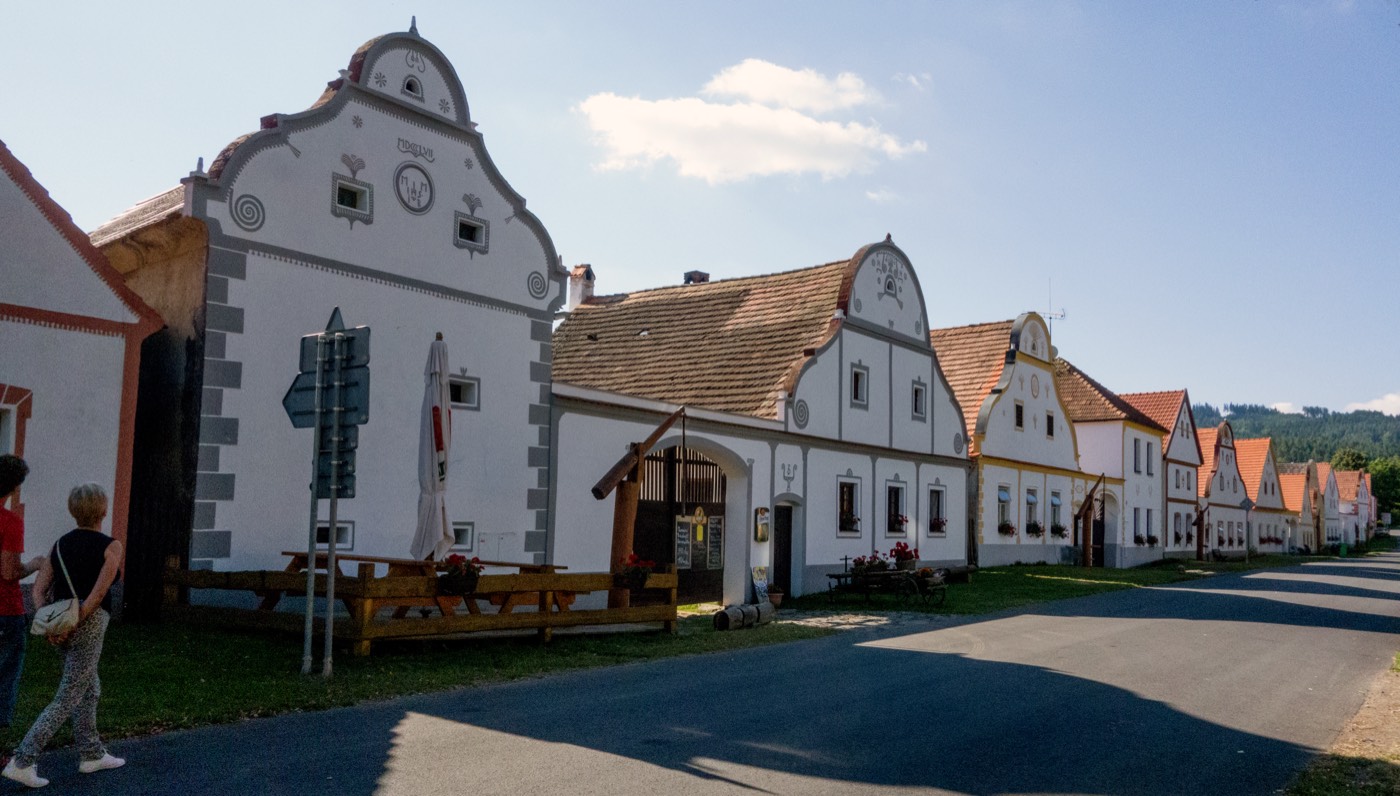
The Novotny surname means “the newcomer”, from the Czech word nový, “new”, and it belongs to Bohemia and Moravia. It is one of the three commonest family names in Czechia, and it is not the same name as Novak.
What Does the Surname Novotny Mean?
Novotny means “new” or “newly arrived”. Written Novotný in Czech, it was a byname for a person who had recently turned up in a village: a stranger with no local family, no inherited farm and no older name to be known by.
The root is the Slavic adjective nový, “new”, the same word that sits behind Novgorod and Nova Scotia’s Latin. From it Czech built the noun novota, “newness”, and from that family of words came the older adjective novotný, meaning new, fresh, recently made. Applied to a person, it meant the new one.
So it is a descriptive name, not a place name, not a trade and not a father’s name. That matters more than it sounds. Most European surnames tell you where a family belonged. This one tells you that a family did not.
Where the Novotny Name Comes From
Novotny comes from the Czech lands, Bohemia and Moravia, with a substantial Slovak population as well. It is usually ranked the third commonest surname in Czechia, behind Novák and Svoboda, and the feminine form Novotná alone accounts for roughly 25,700 people in the Czech population register.
There is no clan, no sept and no founding family. The name arose separately in village after village, wherever a community needed a word for the household that had not been there before. That independent, repeated origin is exactly why so many people carry it.
Why Novotny and Novak Are Not the Same Name
This is the thing worth getting right, because almost everyone assumes otherwise. Novák and Novotný both come from nový, and both mean roughly “the new one”, but they are two different words, and they became two different surnames.
Novák takes the root and adds the agent suffix -ák, producing a noun: “the new man”. Novotný takes the adjectival route through novota, producing a modifier: “the newly arrived”. One is a thing you are called, the other is a quality you are given.
They are not variants of one another. A Novotny family did not “become” a Novak family, or the reverse, and the two names were never interchangeable in Czech records. English offers a fair parallel in Newman and Newcome: same idea, same root, two entirely separate surnames with no shared ancestor.
If your family is Novotny, a Novak on the next farm was your neighbour, not your cousin.
What “Newcomer” Actually Meant in a Czech Village
A Bohemian village was not a loose collection of houses. It was a fixed set of inherited holdings, and families were known by the farm they had worked for generations. Standing came from land, and land came from ancestors.
The newcomer had neither. He was the man who married into a household, took over a holding left vacant by plague or debt, rented a cottage on the edge of the fields, or arrived to work for somebody else. He might prosper, but he began without the one thing the village measured people by.
That gives Novotný a social edge that dry etymology misses. It is the precise opposite of a habitational surname such as Dvořák, which fixed a family to a manor farm. Novotný recorded that a family had not been there long, and the name then stuck for centuries after the newness had worn off.
Spelling Variants and Related Names
The native forms are Novotný for a man and Novotná for a woman. In American records the accent disappears and the name settles as Novotny, with Novotney, Novotni and the German and Polish spelling Nowotny alongside it.
Czech surnames inflect for gender, so a single family arriving at Galveston could include a Novotný father and a Novotná mother and daughter. American clerks had no framework for this and flattened everyone to one form. Anyone tracing the family in Czech parish registers should search both spellings, because the women will not be filed under the men’s version.
The acute accent on the final y marks a long vowel, and it did not survive contact with American forms, typewriters and census takers. Most families lost it within a generation, which is why Novotný and Novotny are the same name in different countries rather than two names.
Nowotny, with a w, is the German and Polish rendering, common in Austrian Silesia, Upper Silesia and Vienna, where Czech-speaking families lived under German-language administration. Slovak keeps the Czech spelling exactly: Novotný, feminine Novotná.
Related but genuinely separate surnames from the same root include Novák, Nový (“new”) and the diminutive Nováček. None of them is a variant of Novotny. They are siblings, not aliases.
The Novotnys in America
Czech-speaking families arrived from the late 1840s onward, most heavily between 1870 and 1914, landing at Galveston, New Orleans, New York and Baltimore. They came for farmland and for escape from Habsburg conscription and rule, and unlike many migrations of the period they came as whole families intending to stay.
Texas took the earliest arrivals, with Bohemian settlement beginning in the 1840s and spreading across the blackland prairie. The Czech farming communities of West Texas grew from those first footholds, and Novotny remains a familiar name on their church rolls and cemetery stones.
Nebraska drew the largest concentration of all. Wilber, which still calls itself the Czech capital of the United States, and nearby Crete were built by Bohemian and Moravian homesteaders in the 1860s and 1870s. Iowa’s Czech Village in Cedar Rapids served the same role for families who stopped short of the plains.
Those who chose wages over land went to Chicago, which became the largest Czech city outside Europe. Pilsen on the Lower West Side was the first great Czech quarter, and as families moved up they pushed west into Cicero and Berwyn. Slovak Novotnýs more often followed the steel and oil work, including the refinery town of Whiting, Indiana.
Notable People Named Novotny
Antonín Novotný (1904 to 1975) led the Communist Party of Czechoslovakia from 1953 and served as president from 1957. A hardline Stalinist, he was forced out as party leader in January 1968 and replaced by Alexander Dubček, then removed from the presidency that March, immediately before the Prague Spring.
Jana Novotná (1968 to 2017), from Brno, won the Wimbledon singles title in 1998 after losing the final in 1993 and 1997. She reached world number two in singles and took 16 major titles in doubles and mixed doubles. She died of cancer at 49.
Helga Nowotny (born 1937), a Vienna-born sociologist of science, was a founding member of the European Research Council and its president from 2010 to 2013.
Tuva Novotny (born 1979) is a Swedish actress and film director, daughter of the Czech director David Novotný, with credits including Borg vs McEnroe and Annihilation.
Fritz Novotny (1903 to 1983) was an Austrian art historian whose studies of Cézanne shaped how the painter was read for a generation.
How Common Is Novotny Today?
Novotny ranked 5,270th in the 2010 United States Census, with 6,617 Americans carrying it. That makes it uncommon in America despite being one of the most ordinary surnames in its homeland, a gap explained by the modest scale of Czech migration next to Irish, German or Italian.
Of those bearers, 96.31 per cent identified themselves as white in 2010, with 1.65 per cent identifying as Hispanic. Those are self-identification proportions recorded on census forms, not a measure of anyone’s ancestry.
| US rank (2010 Census) | #5,270 |
|---|---|
| Americans with the name | 6,617 |
| Origin | Czech and Slovak |
| Meaning | “New”, “newly arrived”, the newcomer to a village |
In Czechia the picture reverses completely. There, Novotný and Novotná together are carried by tens of thousands of people, and the name functions much as Smith or Jones does in English, ordinary to the point of invisibility. Further reading is available at the Wikipedia entry for the surname and the Library of Congress chronology of Czechs in America.
Frequently Asked Questions
What does the surname Novotny mean?
Novotny means “new” or “newly arrived”, from the Czech adjective nový. It was given to someone who had recently settled in a village and had no established local family. The feminine form is Novotná.
Is Novotny Czech or Slovak?
Both, with Czech the larger share. The name is native to Bohemia and Moravia and is among the commonest surnames in Czechia, but it is equally at home in Slovakia, spelled identically. The Nowotny spelling reflects German and Polish usage in Silesia and Austria.
Where does the Novotny family come from?
There is no single Novotny family. The name arose independently in many Czech and Slovak villages, wherever a household arrived from elsewhere. Tracing your own line means finding the specific parish, usually in Bohemia or Moravia, rather than looking for a common ancestor.
How common is the surname Novotny?
In the United States it ranked 5,270th in the 2010 Census, with 6,617 bearers. In Czechia it is usually the third commonest surname of all, behind Novák and Svoboda.
Is there a Novotny family crest or coat of arms?
No. In every serious heraldic tradition, arms are granted to an individual and pass to that person’s direct descendants, never to everyone who happens to share a surname. There has never been a coat of arms belonging to all Novotnys. Sites offering to sell you one are selling a decoration, not a lineage, and it is worth knowing that before you frame it.
Are Novotny and Novak the same name?
No. They share the root nový, “new”, but they are separate words that became separate surnames, formed independently in different places. Novak uses a noun suffix and means “the new man”; Novotny is adjectival and means “newly arrived”. Sharing the root does not make two families related.
If your family carries the Novotny name, its route from Bohemia to America is traceable. Atlas of Home can follow it from the village that once called your ancestors the newcomers to wherever your family landed, and to wherever you are now.