
The Kim surname comes from Korea, where it is written with the character 金, meaning gold or metal. Roughly one Korean in five carries it. But Kim is not one family. It is dozens of separate lineages that happen to share a single syllable.
What Does the Surname Kim Mean?
Kim means gold. The name is written with the hanja 金, a character read geum in ordinary Korean words, where it means gold, metal or iron, but read gim when it stands as a family name.
That irregular reading is old and deliberate: Korean borrowed Chinese characters long before it had an alphabet, and the surname kept a pronunciation of its own.
The same character carries the Chinese surname Jin, romanised Kam in Cantonese and Chin in older spellings, so a Chinese Jin family and a Korean Kim family write, on paper, the same name. They are not related. The character travelled; the families did not. What it cannot tell you is which Kim you are. For that you need the bon-gwan.
Where the Kim Name Comes From
Kim comes from the southern half of the Korean peninsula, above all from two places: Gimhae in South Gyeongsang Province, and Gyeongju, the ancient capital of the kingdom of Silla. Nearly every Kim traces back to one seat or the other.
What a Bon-Gwan Is
A bon-gwan (본관) is an ancestral seat: the place a lineage says it came from, recorded alongside the surname and passed down the male line unchanged for centuries. It is the thing that makes Korean surnames legible.
Two Koreans both called Kim are, genealogically, strangers unless they share a bon-gwan. Ask a Korean grandparent about the family name and the answer is rarely “Kim”. It is “Gimhae Kim” or “Gyeongju Kim” or “Gwangsan Kim”, because the seat is the real identifier. The 2000 census recorded roughly 348 distinct Kim lineages.
The system had teeth. Article 809 of the Korean Civil Code forbade marriage between any two people sharing a surname and a bon-gwan, however many centuries lay between them and their common ancestor. Two Gimhae Kims who met at university could not legally marry, and thousands of couples raised children they could not register. On 16 July 1997 the Constitutional Court of Korea struck the provision down as an offence against human dignity, and the law was rewritten to bar only close relatives.
The Gimhae Kim: King Suro and Heo Hwang-ok
The Gimhae Kim are the largest Korean lineage of any surname, well over four million people. They trace descent from Suro, founding king of Geumgwan Gaya, a state on the Nakdong delta traditionally dated to the first century.
Suro’s queen, by tradition, was Heo Hwang-ok, said to have arrived by sea from a kingdom the chronicles call Ayuta. Two of their sons took their mother’s surname rather than their father’s, which is why the Gimhae Kim, the Gimhae Heo and the Incheon Yi have long regarded one another as a single kindred and avoided intermarriage.
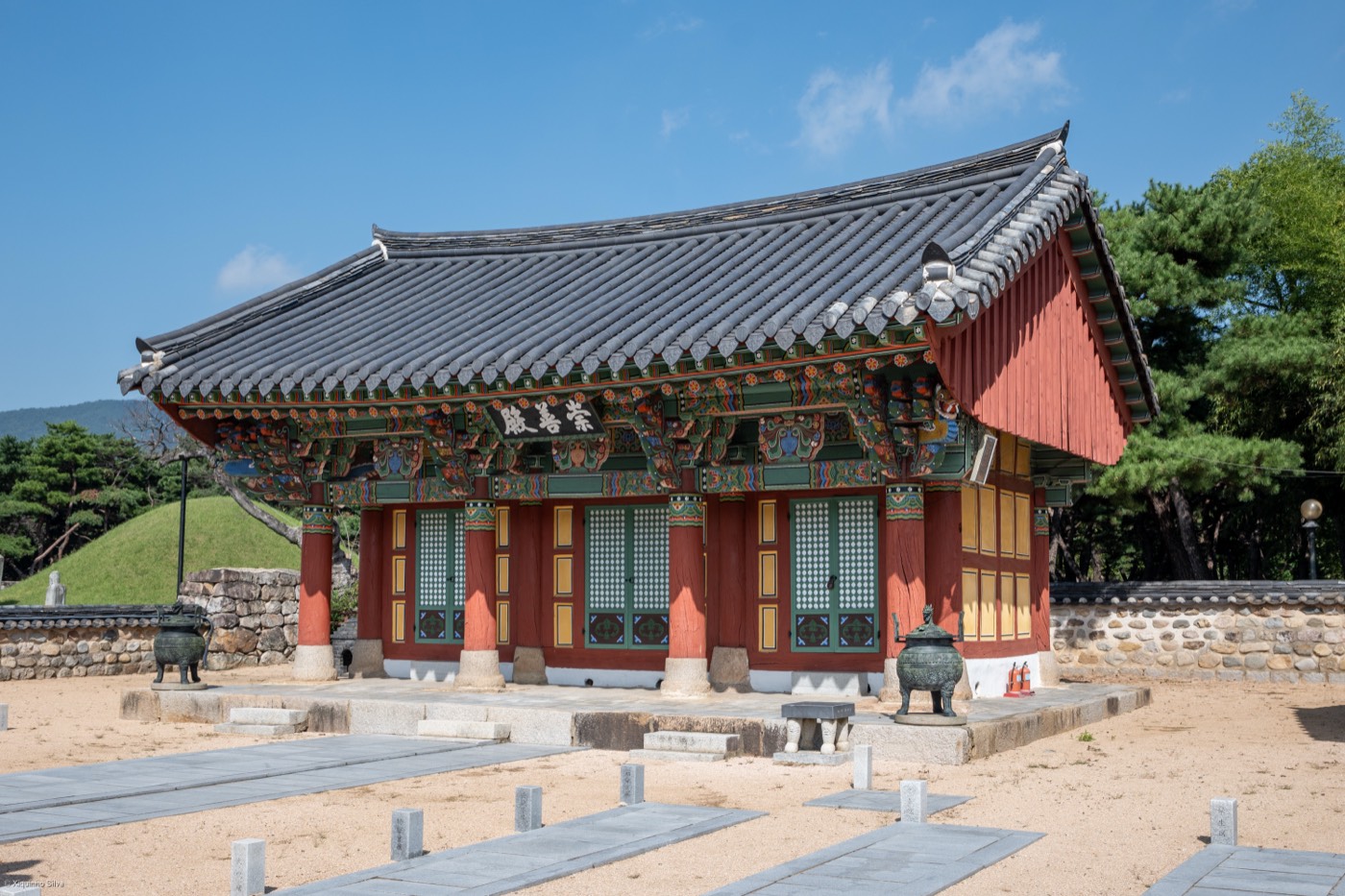
The clan’s great figure is Kim Yu-sin (595 to 673), counted as Suro’s twelfth-generation descendant, who led the armies of Silla in the campaigns that unified the Three Kingdoms. Suro’s tomb still stands in Gimhae, with a shrine hall beside the burial mound.
The Gyeongju Kim: Kim Alji and the Golden Box
The Gyeongju Kim, around 1.8 million strong, descend from Kim Alji, and their origin story is one of the most quoted in Korean literature. In the year 65, King Talhae of Silla heard a cockerel crowing in the forest west of his capital and sent his minister Hogong to investigate.
Hogong found a golden box hanging from a branch. Inside was an infant. The king adopted the child, named him Kim for the gold of the box, and renamed the wood Gyerim, the rooster forest, a name that later stood for the kingdom itself.
Alji never ruled, but his seventh-generation descendant took the throne as King Michu in 262, and from the reign of Naemul the Kim held the Silla crown almost without interruption for five hundred years. The grassy royal tumuli of central Gyeongju are, in large part, Kim graves.
How One Name Reached a Fifth of Korea
Dynastic prestige explains the beginning. It does not explain the scale, and the honest answer lies in the nineteenth century rather than the first.
For most of the Joseon period a great many Koreans, the enslaved and low-born in particular, had no surname at all. Surnames marked the yangban elite. As that order broke down, wealthy commoners bought their way into aristocratic genealogies, and the class system was dismantled by the reforms of 1894 to 1896. When a census law of 1909 required every Korean to register a surname, those without one chose names that carried standing. Kim, Yi and Pak were the names of kings, and now cover roughly 45 per cent of South Koreans.
Spelling Variants and Related Names
Kim, Gim and Ghim are the same Korean surname, 김, written three ways because Korea has used more than one system for putting its language into the Latin alphabet.
The McCune-Reischauer system, devised in 1939 and standard in English for most of the twentieth century, renders 김 as Kim. The Revised Romanization of Korean, adopted by South Korea in 2000 and now official for place names, renders it Gim. On paper Gim should have replaced Kim overnight.
It did not, for one plain reason: personal names were exempted. Koreans kept the spellings already on their passports, degrees and shopfronts, and almost nobody rewrites a surname the world already recognises. Kim survived because it was everywhere. Gim, Ghim and Kin together account for well under one per cent of bearers.
Related and adjacent forms:
- 김: the hangul spelling, identical for every Kim regardless of clan.
- 金: the hanja, still printed on genealogies, seals and formal documents.
- Gim and Ghim: Revised Romanization and older ad hoc variants.
- Kin: the Japanese reading of 金, used by some Korean families under colonial rule and by some Zainichi Koreans since.
- Jin, Kam, Chin: Chinese surnames written with the same character 金, unrelated by blood but identical on the page.
The Kims in America
Kims arrived in America in three waves: sugar plantation labourers in Hawaii from 1903, war brides, orphans and students after 1950, and the very large professional migration that followed the Immigration and Nationality Act of 1965.
The first shipload of 102 Korean labourers reached Honolulu on 13 January 1903, and around 7,300 followed within two years under contract to the Hawaiian Sugar Planters’ Association. Exclusion legislation shut the door in 1924 and it stayed shut for a generation. The post-1965 wave built Korean America as it exists now: urban, educated, family-driven, settling in dense and mutually supporting clusters that are still where you find them.
In New Jersey, the Bergen County towns along the Hudson palisades hold one of the highest Korean concentrations in the country. Korean families in Harrington Park and neighbouring Norwood came out of exactly this migration, drawn by the schools and by proximity to Manhattan’s Koreatown on 32nd Street.
West coast and sunbelt settlement followed the work. Orange County families put down roots in Anaheim Hills, engineers gathered around Microsoft and Boeing in Bellevue, Washington, and the newest concentration sits in the north Dallas suburbs, where Korean families in Frisco, Texas arrived largely in the past two decades.
The bon-gwan is what gets lost. It appears on no US birth certificate and no green card, and usually survives only in a grandparent’s memory or in a jokbo, the printed clan genealogy many families carried over. If an elder is still living, that is the question to ask.
Notable People Named Kim
Kim Yu-sin (595 to 673), of the Gimhae line, was the Silla general whose campaigns alongside King Muyeol unified the Three Kingdoms, and one of the most venerated figures in Korean history.
Kim Dae-jung (1925 to 2009) spent decades as a dissident under military rule, survived a kidnapping and a death sentence, and served as president of South Korea from 1998 to 2003. He received the Nobel Peace Prize in 2000.
Jim Yong Kim (born 1959), a physician born in Seoul and raised in Iowa, co-founded Partners In Health, led Dartmouth College, and served as president of the World Bank from 2012 to 2019.
Daniel Dae Kim (born 1968) was born in Busan and raised in Pennsylvania. Known for Lost and Hawaii Five-0, he is a leading advocate for Asian American representation in Hollywood.
Chloe Kim (born 2000), born in Long Beach, California to Korean immigrant parents, won the Olympic snowboard halfpipe at seventeen in 2018 and defended it in 2022, the first woman to take back-to-back gold in the event.
How Common Is Kim Today?
Kim is the 77th most common surname in the United States, carried by 262,352 Americans at the 2010 Census. In South Korea it is the most common name of all, held by about 21.5 per cent of the population.
| US rank (2010 Census) | #77 |
|---|---|
| Americans with the name | 262,352 |
| Origin | Korean (金, “gold” or “metal”, pronounced Kim in Korean. Borne by roughly a fifth of all Koreans.) |
| Meaning | Gold, from the hanja 金 |
The contrast is the interesting part. Kim has climbed fast on post-1965 migration yet still sits outside the American top fifty, while topping the list in both Koreas.
Frequently Asked Questions
What does the surname Kim mean?
Kim means gold. It is written with the hanja 金, meaning gold, metal or iron, read geum in everyday Korean but gim as a surname. The meaning is shared with the Chinese surname Jin, written with the identical character.
Is Kim Korean or Chinese?
Kim is Korean. The confusion comes from the character 金, borrowed from Chinese, which also spells the Chinese surname Jin, romanised Kam in Cantonese. A Kim and a Jin write the same character but belong to entirely separate lineages.
Where does the Kim family come from?
There is no single Kim family. Korean lineages are identified by their bon-gwan, and the two largest Kim seats are Gimhae in South Gyeongsang Province, from King Suro of Geumgwan Gaya, and Gyeongju, from Kim Alji of Silla. Roughly 348 distinct Kim lineages were recorded in 2000.
How common is the surname Kim?
Kim is the most common surname in Korea, borne by about 21.5 per cent of South Koreans, roughly one person in five. In the United States it ranked 77th at the 2010 Census with 262,352 bearers, and it has climbed steadily since 1965.
Is there a Kim family crest or coat of arms?
No, and be wary of anyone selling one. Korea had no European-style heraldic tradition: lineage was recorded in the jokbo, a printed genealogical register, not in painted arms. In traditions that do use heraldry, arms are granted to individuals and their direct descendants, never to everyone sharing a surname. A “Kim family crest” is a decoration invented for sale.
Why do so many Koreans have the surname Kim?
Because prestige names spread when the class system collapsed. Many Koreans had no surname before the late nineteenth century, and when the reforms of the 1890s and a census law of 1909 required everyone to register one, families overwhelmingly chose royal names. Kim, Yi and Pak now account for around 45 per cent of South Koreans.
If your family carries the Kim name, its route from Korea to America is traceable. Atlas of Home can follow it from the ancestral seat at Gimhae or Gyeongju to whichever port your family reached, and to wherever you are now.