
They called it K-Town. Not officially, at least not at first. But from the late 1970s onward, if you walked east off Sixth Avenue onto West 32nd Street, in the long shadow of the Empire State Building, you stepped out of Midtown and into Seoul. The smell of grilling galbi drifted down from second-floor windows, neon Hangul stacked itself five stories into the night sky, and the block stayed awake long after the rest of Manhattan had gone dark.
This is the story of the Koreans in Koreatown, Manhattan: a community that did not build a neighbourhood of houses, but a single vertical main street of Korean culture stacked floor on floor.
Koreatown, Manhattan: The Place
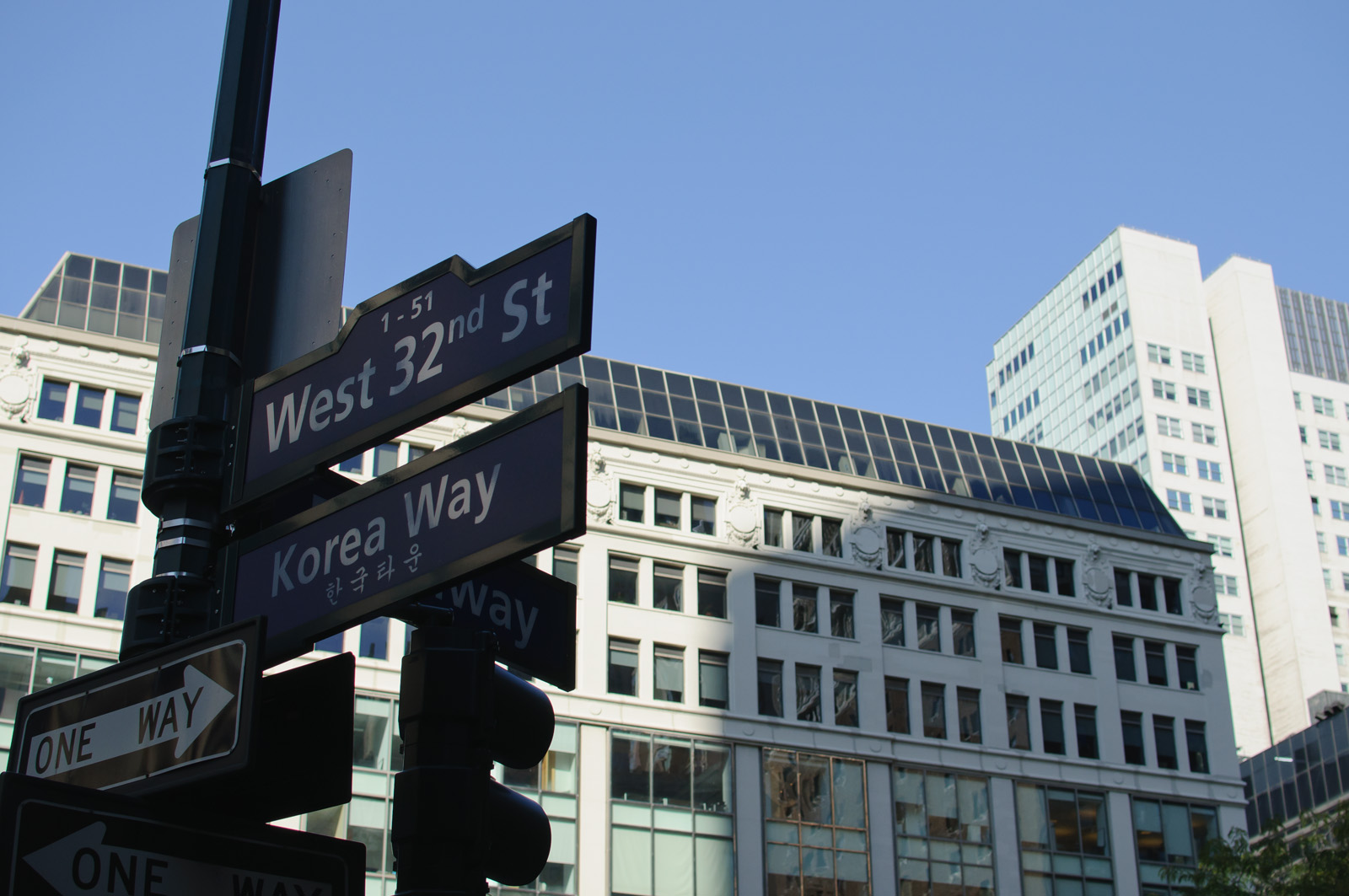
Koreatown sits in Midtown South, centred on 32nd Street between Fifth Avenue and Broadway, with Greeley Square at its eastern end. The heart of it, the block between Fifth and Sixth Avenues, was officially nicknamed Korea Way by the city, marked with bilingual street signs.
It is hemmed in by Herald Square, Macy’s, and the Empire State Building, served by nearly every subway line that funnels into 34th Street. Unlike most ethnic enclaves, this one is commercial, not residential. The Korean families who built it mostly live in Queens or New Jersey and commute in. What rises here is not housing but business, packed into older Garment District lofts that now hold restaurants, karaoke bars, and spas one above the other.
How Koreatown, Manhattan Became Korean
Before the Koreans
Before it was Korea Way, West 32nd Street was a tired fringe of the Garment District. The blocks around it had spent decades servicing the rag trade: wholesale showrooms, fabric importers, button and trimming suppliers, the loft buildings that fed the needle trades clustered to the north and west.
By the 1970s much of that industry was contracting. Rents on the block between Broadway and Fifth Avenue were soft, the storefronts were rundown, and the area had little reason to draw anyone after the workday ended. It was, in short, cheap and overlooked. That made it available.
The Koreans Arrive
The wave that built Koreatown began with the Immigration and Nationality Act of 1965, the Hart-Celler Act, which lifted the old quotas that had effectively barred Asian immigration. The numbers tell the story: the Korean population of the United States grew from around 11,000 in 1960 to roughly 290,000 by 1980. By 1976, immigration from Korea had reached the annual ceiling of 30,000.
Most of these newcomers in New York settled in Queens, especially Flushing, and turned to self-employment when professional jobs proved hard to find. They bought produce stores and dry cleaners from departing Jewish and Italian owners, and opened nail salons, groceries, and import firms.
Many of those importers and wholesalers worked out of the Korean business district that ran roughly from 24th to 34th Streets between Fifth and Sixth Avenues, dealing in wigs, handbags, costume jewellery, and dry goods. West 32nd Street sat right in the middle of it. The traders were already there all day. What they lacked was somewhere to eat, read, and gather.
The catalyst came at the very end of the 1970s. Koryo Books, devoted to Korean literature, opened on the block when there was almost no Korean presence on the street. Its founder had begun by bringing books over from Korea and lending them out of his home in Flushing before demand pushed him to open a Manhattan shop. Around the same time, a Korean restaurant arrived, with the New York Kom Tang Kalbi House dating its claim as the first of its kind to 1979.
Koreatown at Its Peak
Through the 1980s the cluster thickened fast. A bookstore and a handful of restaurants succeeded, and their success pulled in cosmetics shops, import-export firms, bakeries, and more eateries, revitalising the rundown block between Broadway and Fifth Avenue.
Two forces fed the growth at once. A steady stream of new arrivals from Korea kept demand high for familiar food, books, and goods, and the Garment District location delivered constant foot traffic from tourists and Midtown workers. Retailers imported Korean products for immigrants who missed the tastes and brands of home, and the same shelves slowly drew in curious outsiders.
Because land in Midtown is scarce and expensive, Koreatown did the only thing it could. It grew upward. Restaurants, karaoke rooms, bars, dessert cafes, and spas stacked themselves on multiple floors of the same buildings, so a single address could hold an entirely different world depending on which elevator button you pressed. In 1995 the city formalised what the street had already become, designating West 32nd Street as Korea Way with bilingual signage.
By then the block ran around the clock. Restaurants served at 3 a.m., karaoke lounges hid several floors above the pavement, and spas stayed open all night. It was a downtown Seoul transplanted onto one Manhattan block, and it never closed.
The Change
The biggest shift was not decline but discovery. The same vertical density that once served homesick immigrants became a draw for the whole city, and then the world. Korean barbecue, karaoke, and late-night dessert cafes turned into a mainstream night out.
The Hallyu wave, the global surge of K-pop, Korean drama, and K-beauty, accelerated everything. Stores that once sold mostly to Koreans found their customers were now tourists from around the globe. At Koryo Books, staff have said that the large majority of shoppers are now foreigners hunting K-pop albums and Korean language books.
Rents climbed with the attention. Wholesalers and old guard businesses thinned out as the block tilted toward restaurants, nightlife, and retail aimed at visitors. The Korean families who own and run these places still mostly live elsewhere, in the residential heartlands across the river and out in Queens, and commute in to keep the street alive.
The Landmarks of Korean Koreatown
Koryo Books, 35 West 32nd Street. One of the very first Korean stores on the street and a founding pillar of the neighbourhood, open since the late 1970s. It began as a private lending collection in Flushing and grew into the cultural anchor of Korea Way. Today it serves a global crowd of K-pop fans alongside its longtime readers.
New York Kom Tang Kalbi House, West 32nd Street. A barbecue restaurant that traces its opening to 1979 and stakes a claim as the first Korean restaurant on the block. Together with Koryo Books, it marks the genesis point of the entire enclave. Its long survival made it a touchstone for the community.
Kunjip, 9 West 32nd Street. An old guard institution on two floors with a famously long menu. For decades it has fed both Korean regulars and newcomers wandering in from the Empire State Building. It is the kind of around-the-clock kitchen that defined K-Town’s reputation.
Han Bat, 53 West 35th Street. Dating to 1990 and slightly off the main strip, Han Bat is a staple known for traditional home-style cooking: stews, banchan, pancakes, and several kinds of bibimbap. It is the spot regulars send you to when they want you to understand the food beyond the barbecue. A quieter pillar of the community’s everyday life.
Juvenex Spa, 25 West 32nd Street. A 24-hour Korean spa stacked above the street, open every day of the year. It is the clearest example of the vertical, round-the-clock culture that sets this Koreatown apart. People come at 4 a.m. as easily as 4 p.m.
Korea Way and Greeley Square. The block of 32nd Street between Fifth and Sixth Avenues, officially Korea Way since 1995, with Greeley Square anchoring its eastern end at Broadway. The bilingual street signs are the neighbourhood’s truest landmark, the moment the city put the community’s name on the map in two languages.
Where the Koreatown Koreans Came From
The people who built Koreatown came overwhelmingly in the post-1965 wave, after the Hart-Celler Act reopened the door. Many had roots in Seoul and the surrounding region of South Korea, often educated and urban, arriving with professional backgrounds that the American job market did not always recognise. Self-employment in retail, food, and import became the practical path forward.
This was a chain migration in the classic sense: each new arrival pulled in family and friends, who took jobs in the businesses already running before opening their own. The same families who anchored Manhattan’s commercial strip planted residential roots elsewhere, and the journey did not stop at 32nd Street. Korean communities branched out to Palisades Park and across Bergen County in New Jersey, to the Atlanta suburb of Duluth in Georgia, and to Annandale in Virginia, while the largest American Koreatown of all rose in Los Angeles. You can read about the residential heart of one of them in our portrait of the Koreans of Palisades Park, New Jersey.
Koreatown, Manhattan Today
Today Koreatown is busier and more international than it has ever been. The Korean population of Manhattan roughly doubled between 2000 and 2010 to about 20,000, and the block now sits at the centre of a New York metropolitan Korean American community numbering well over 200,000, one of the largest concentrations of ethnic Koreans anywhere outside Korea.
The street has changed character. K-pop merchandise shops, K-beauty flagships, and dessert cafes now share the block with the veteran barbecue houses. In February 2026 a major K-pop retailer opened an expanded flagship here, a sign of how thoroughly the Hallyu wave has reshaped the neighbourhood’s customers. The crowd is global, drawn by everything from skincare to soju.
What has not changed is the model. This is still a commercial Koreatown, a place people travel to rather than live in, with its real domestic life out in Flushing and across the Hudson. The residential and the commercial were always two halves of the same story, and the families still cross the river each day to keep the lights of Korea Way burning. The street that began with one bookstore and one barbecue house is now a vertical chapter of Korea that the whole world climbs.
Frequently Asked Questions
Why did Koreans settle in Koreatown, Manhattan?
The Koreans in Koreatown, Manhattan first concentrated on West 32nd Street because it sat in the middle of the Garment District, where many Korean importers and wholesalers already worked through the 1970s and 1980s. The block had cheap, rundown storefronts and constant foot traffic, so a bookstore and restaurants could thrive. The street became a daytime base that grew into a full commercial enclave.
Is Koreatown, Manhattan still Korean today?
Yes, Koreatown, Manhattan remains a Korean commercial enclave, though most of the families who own and run its businesses live in Queens or New Jersey rather than on the block itself. The street is busier and more international than ever thanks to the global popularity of Korean food, music, and beauty. Korean ownership and culture still define the neighbourhood.
What are the most famous Korean landmarks in Koreatown, Manhattan?
Korea Way, the block of West 32nd Street between Fifth and Sixth Avenues, is the central landmark, marked with bilingual street signs since 1995. Koryo Books and longtime restaurants such as Kunjip and Han Bat anchor the food and culture scene. The 24-hour Juvenex Spa captures the vertical, round-the-clock character of the area.
Where in Korea did the Koreatown community come from?
Most came from South Korea in the wave that followed the 1965 Immigration Act, with many from Seoul and its surrounding urban region. They were often well-educated professionals who turned to self-employment in retail, food, and importing after arriving in New York. Chain migration then drew in relatives and friends from the same areas.
When did Koreans first arrive in Koreatown, Manhattan?
Korean businesses began clustering on West 32nd Street in the late 1970s, when Koryo Books and an early barbecue restaurant opened on a then-overlooked Garment District block. The enclave thickened through the 1980s and the city designated Korea Way in 1995. The community’s larger arrival in New York followed the 1965 reform of immigration law.
If your family’s story passed through Koreatown, Manhattan, or any of the places Koreans made home, from Seoul to West 32nd Street to wherever you are now, Atlas of Home can help you trace that journey. Explore the residential side of the same migration in our pieces on the Koreans of Koreatown, Los Angeles, the Koreans of Annandale, Virginia, and the Koreans of Duluth, Georgia. You can also read the wider history on Wikipedia’s Koreatown, Manhattan page.