
On a Sunday morning in southeast Bellevue, the parking lot of a Korean Presbyterian church fills with hybrid sedans and crossovers carrying families home from worship, the children switching between English and Korean as easily as crossing a street. The Koreans in Bellevue, Washington are not the largest of the city’s Asian communities, but they are among its most settled: software engineers and project managers who chose this corner of the Seattle Eastside for the same reasons everyone does, the schools and the safety, and then quietly built a Sunday life of churches, tofu houses and grocery runs around it.
The Place
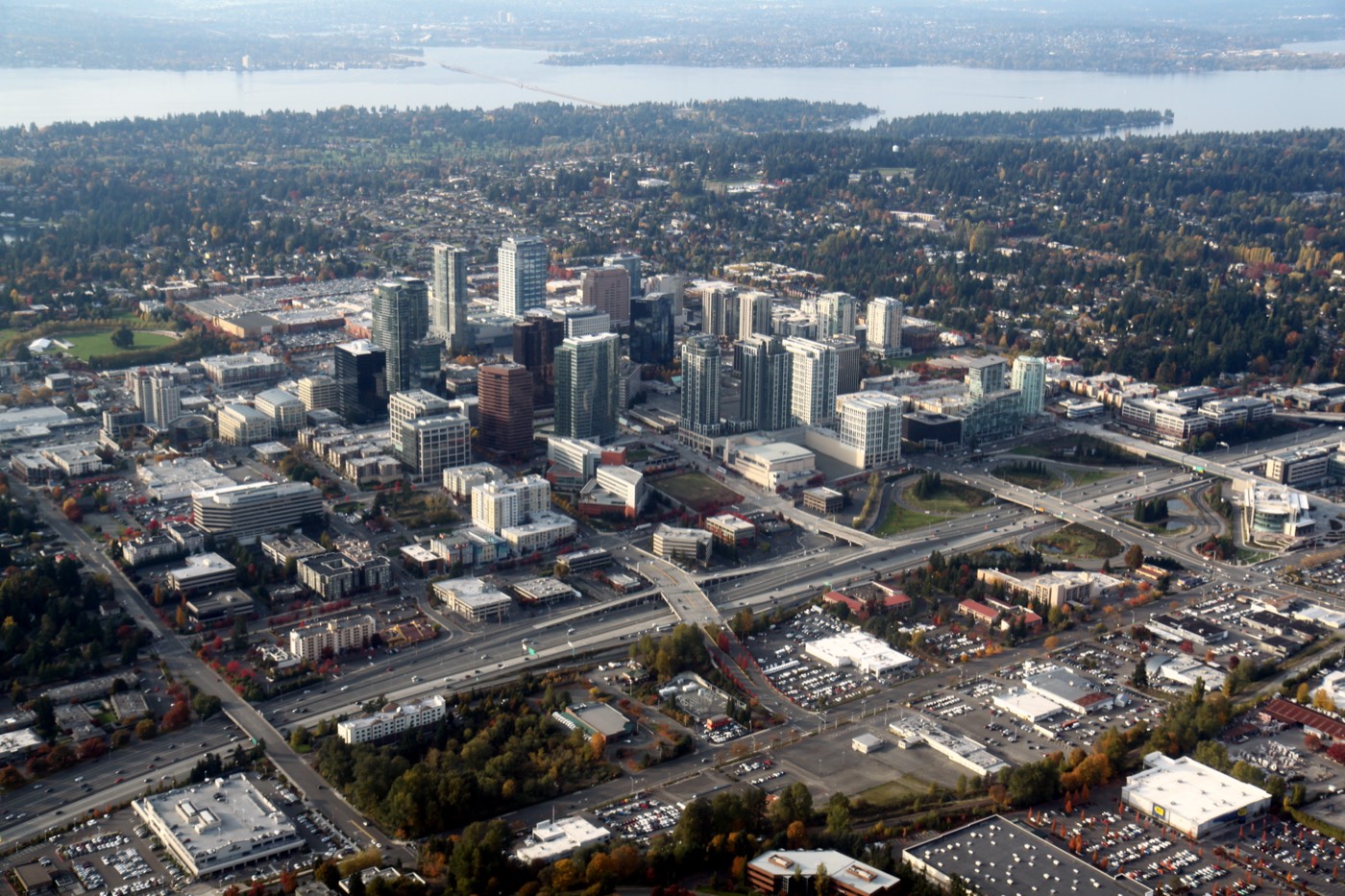
Bellevue sits directly across Lake Washington from Seattle, the anchor of the affluent suburban belt locals call the Eastside. It was first settled by European Americans in 1869 and incorporated as a small third-class city only in 1953, a sleepy place of orchards and strawberry farms for most of its early life.
The Evergreen Point Floating Bridge changed that in 1963, and the software boom of the 1990s finished the job. Today downtown Bellevue is a forest of glass towers, the second-largest city centre in Washington, home to Microsoft offices, Expedia and a workforce that is young, highly educated and overwhelmingly drawn to technology.
How It Became Korean
The Korean story in Bellevue is a quieter version of a story that played out all across the Eastside. It did not begin with a single neighbourhood or a founding business. It began with jobs.
The early Eastside, before the towers
Korean immigration to the Seattle area picked up after the 1965 Immigration and Nationality Act lifted the old national-origin quotas. The first sizeable wave settled where housing was cheapest and the bus lines ran, which in those decades meant south King County and north Seattle, not the leafy and still semi-rural Eastside.
For a long time the gravity of Korean Seattle pulled south and north rather than east. The two great poles of the region’s Korean life formed along a corridor that ran from the Korean community in Federal Way in the south up through Seattle to the Korean enclave in Lynnwood in the north, where rents were lower and the first Korean churches, restaurants and grocers took root.
The tech draw
What pulled Koreans across the lake to Bellevue was the same thing that pulled everyone else: the work. As Bellevue’s information-technology cluster grew through the 1990s and 2000s, it began attracting exactly the demographic Korean immigration had been producing, young, university-educated, and well paid.
A generation of Korean engineers, product managers and finance professionals, many of them educated in the United States or recruited directly from Seoul, found themselves working in Bellevue and Redmond. For families weighing where to put down roots, the Eastside offered a trade that was hard to refuse: a longer commute traded for what is consistently ranked the best public-school district in the state.
A stable, settled community
Unlike the explosive growth of Bellevue’s Chinese and Indian populations, the Korean community here has grown slowly and held steady. The city’s Korean and Japanese populations have been roughly stable since 2010, even as the number of Chinese residents in Bellevue climbed past 21,000.
By recent counts there are around 3,889 Korean residents in Bellevue, close to 1.5 percent of the population. The figure understates the community’s presence. Korean is the third most commonly spoken language at home in Bellevue, after English and Mandarin Chinese, a sign of how many of these households are first-generation and bilingual.
The broader picture confirms the trend. Across the Seattle-Tacoma-Bellevue metropolitan area, the Korean American population grew by roughly a quarter between 2010 and 2020, from about 54,000 to 67,000, with the Eastside taking a steadily larger share of that affluent, professional middle.
A church-centred life
If there is a single institution that organises Korean Bellevue, it is the church. For an immigrant community spread thinly across an expensive suburb, with no Koreatown to gather in, the Korean church functions as town square, language school and social safety net at once.
Southeast Bellevue, with its larger lots and quieter streets, holds a notable cluster of them: Presbyterian, Methodist and non-denominational congregations whose Sunday schedules run from early-morning prayer through Korean-language services to English-language youth groups for the second generation. For many families, the church is where the children first learn to read Korean and where the parents find the contacts that ease a new life in America.
That role matters more in a place like Bellevue than it would in a denser Korean enclave. Without a single neighbourhood to walk to, the congregation becomes the village. New arrivals learn which schools to aim for, which agents to call, which doctor speaks Korean, all in the lobby after a Sunday service. The church is the infrastructure that a Koreatown would otherwise provide.
The Landmarks
H Mart Bellevue, 100 108th Ave NE. The Korean supermarket giant’s downtown Bellevue store sits steps from the city’s office towers, the most convenient of the chain’s Pacific Northwest locations for the Eastside professional class. It is smaller than its sister stores, but its in-house deli turns out banchan and freshly made kimchi daily, and its arrival meant Eastside families no longer had to drive 40 minutes to shop.
Bellevue Korean Presbyterian Church (BKPC). One of the anchor Korean congregations of the Eastside, BKPC serves the area’s Korean families with Korean-language worship alongside English-language ministry for younger members. Like most Korean churches in the region, it does far more than Sunday service, acting as a hub for new arrivals finding their footing.
Korean Pilgrim Presbyterian Church, 6016 120th Ave SE. Tucked into a residential stretch of southeast Bellevue, this PC(USA) congregation is part of the dense network of Korean Christian life that gives the city’s community its shape. Its location reflects the broader settlement pattern, Korean institutional life clustering in the quieter, family-oriented southeast.
Bulgogi Korean BBQ, 15600 NE 8th St. Set inside Crossroads Bellevue, the international food-court mall on the city’s east side, Bulgogi is one of the most accessible Korean tables in town. Crossroads itself, with around 30 international restaurants under one roof, has long been the unofficial dining room of immigrant Bellevue.
Crossroads Bellevue, 15600 NE 8th St. More than a mall, Crossroads is the closest thing the eastern, more diverse half of Bellevue has to a community living room. Its food court and public chess tables draw a genuinely international crowd, and for Korean families on the east side it is a default weekend gathering place.
The Lynnwood and Federal Way H Mart corridor. The two largest Korean supermarkets in the region sit at opposite ends of the metro, in Lynnwood to the north and Federal Way to the south. For a serious Korean grocery run, with the widest selection of seafood, side dishes and imported goods, Bellevue families still make the pilgrimage to one of these older anchors of Korean Washington.
Where They Came From
Bellevue’s Koreans came overwhelmingly from South Korea’s cities, and disproportionately from Seoul and its surrounding Gyeonggi province, the heartland of the country’s educated professional class. This is migration of a particular kind: not refugees or labourers, but graduates and technologists moving along the same global circuits that carry talent into the software industry.
Many arrived first as students at American universities and stayed for work, while others were recruited directly into Eastside tech firms. The result is a community whose origin story is written less in a single home region than in a shared social class, the urban, university-educated South Korean professional who could have settled anywhere and chose the Eastside for its schools.
That selectiveness is why the community reads as it does: smaller than the Korean populations of the Lynnwood or Federal Way corridors, but anchored firmly in Bellevue’s affluent professional middle.
It also shapes how the community ages. Where older Korean immigration to America often centred on small businesses, the dry cleaners, the corner stores, the wig shops, Bellevue’s Koreans are salaried professionals whose children are pointed squarely at university. The second generation here is less likely to inherit a family business than a family expectation, and the schools are where that expectation gets met.
Bellevue Today
Korean Bellevue today is a community you have to know how to see. There is no neon-lit Koreatown, no single street of hangul signage. Its centre of gravity is dispersed across church car parks in the southeast, a downtown H Mart aisle, a Crossroads food-court table on a Saturday afternoon.
It also lives, more than almost anywhere, in the schools. Korean families came to Bellevue for the Bellevue School District, ranked the top district in Washington, and for magnet programmes like the International School. Those classrooms, full of the second generation, are where this community’s future is quietly being decided.
And it sits alongside, rather than inside, Bellevue’s other Asian communities. The city’s much larger Chinese and Indian populations, and its established Persian community, share the same towers, schools and grocery aisles. Korean Bellevue is a smaller, steadier thread in that weave: professional, church-centred, and content to build its life quietly around the things that brought it here.
Frequently Asked Questions
How many Koreans live in Bellevue, Washington?
Recent estimates put the number of Korean residents in Bellevue at around 3,889, close to 1.5 percent of the city. Koreans in Bellevue, Washington form a smaller community than the city’s Chinese or Indian populations, but Korean is still the third most spoken language at home in the city.
Why did Koreans settle in Bellevue rather than Seattle?
Most came for work and stayed for the schools. As Bellevue’s technology industry grew, it drew young, university-educated Korean professionals, who then chose to raise families in a city with the best-ranked public-school district in Washington.
Where do Korean families in Bellevue go to church?
Southeast Bellevue holds a cluster of Korean congregations, including Bellevue Korean Presbyterian Church and Korean Pilgrim Presbyterian Church. For Koreans in Bellevue, Washington, the church serves as a social and cultural centre as much as a place of worship.
Where can you buy Korean groceries in Bellevue?
H Mart operates a store in downtown Bellevue at 100 108th Ave NE. For a wider selection, many families drive to the larger H Mart stores in the Lynnwood and Federal Way corridor, two long-standing anchors of Korean life in the region.
Is there a Koreatown in Bellevue?
No. There is no concentrated Koreatown in Bellevue. The community is dispersed across the city, gathering instead around churches, the downtown H Mart and Korean restaurants at the Crossroads mall on the east side of town.
How does Bellevue’s Korean community compare to others on the Eastside?
It is one of several Korean communities in the broader Seattle metro, distinct from the larger, more concentrated populations along the Lynnwood and Federal Way corridor. Bellevue’s is defined by its affluence, its tech professionals and its church-centred social life.
If your family’s story passed through Bellevue, or any of the places Koreans have made home in America, Atlas of Home can trace that journey. From a flat in Seoul to a Sunday service in southeast Bellevue, to wherever you are now.