
On a wet Thursday morning at the North Bellevue Community Center, a circle of women settles into chairs for yoga, then drifts toward conversation in Hindi, Telugu, and Kannada. A few miles south, the parking lot at Crossroads fills with families heading for dosa and biryani. The Indians in Bellevue, Washington have built one of the densest and most prosperous South Asian communities on the West Coast, woven quietly into a city that, a generation ago, was still known mostly for strawberry farms and lakefront estates.
The Place
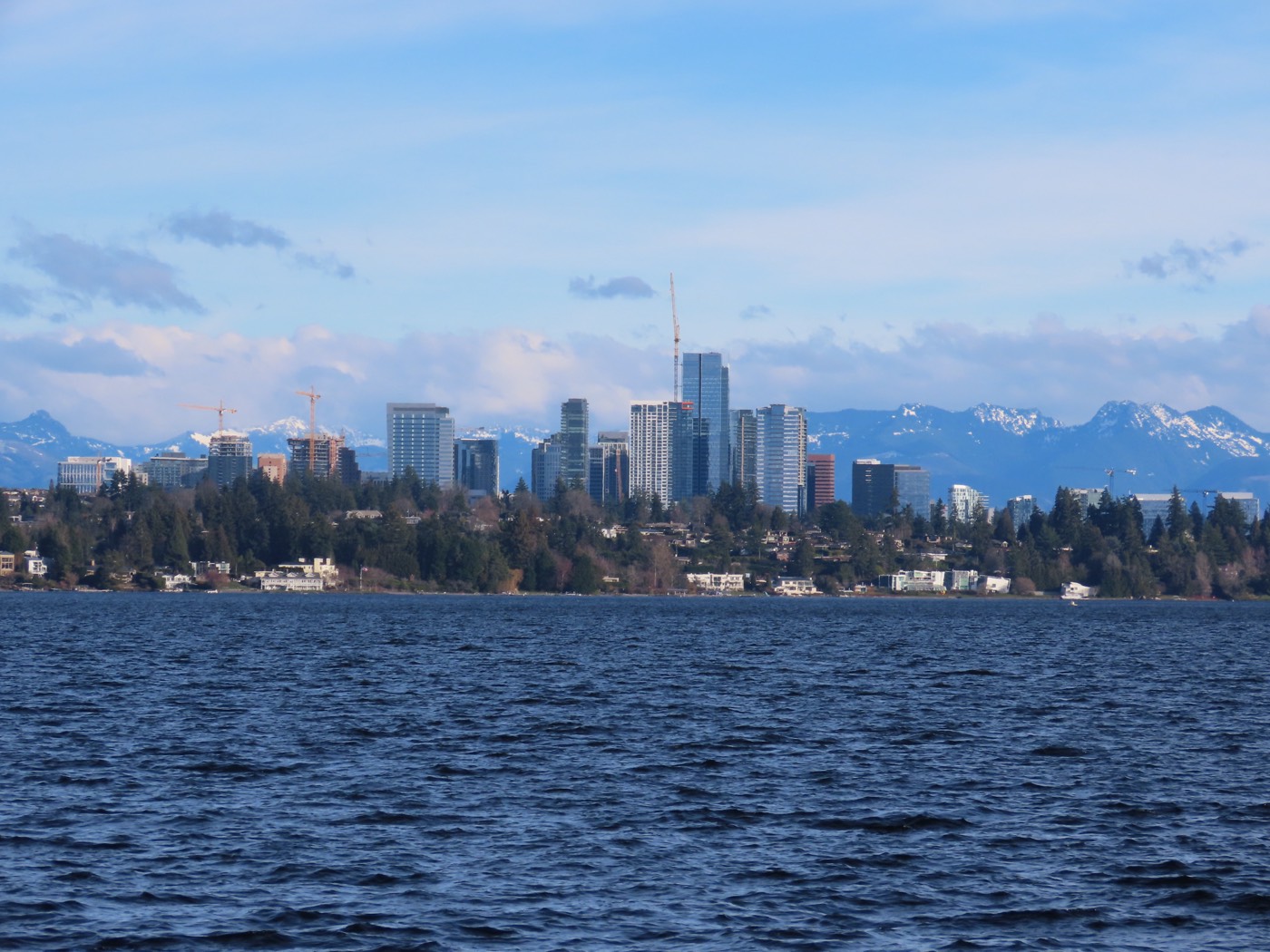
Bellevue sits on the eastern shore of Lake Washington, directly across the water from Seattle. For most of the twentieth century it was a bedroom suburb. Today it is the second-largest city centre in Washington state, a forest of glass towers wrapped around the headquarters and satellite offices of some of the most powerful technology companies on earth.
It is also one of the wealthiest mid-sized cities in the country, with a median household income of roughly 165,000 dollars. Nearly four in ten residents were born outside the United States, and the Asian share of the population has climbed from about 10 percent in 1990 to a plurality today.
That transformation has an accent. A great deal of it is Indian.
How It Became Indian
Orchards, estates, and a bridge
The first settlers crossed the lake in 1863, when Aaron and Ann Mercer staked a claim near what is now Mercer Slough. The hills were logged through the 1870s and 1880s, then planted with orchards, vegetable patches, and the berry farms that supplied fast-growing Seattle. For decades, much of that farming was done by Japanese American families, who gave Bellevue its early reputation as an agricultural town.
The lakeshore told a different story. Since the 1890s the Medina waterfront had been called the Gold Coast, a place where Seattle money bought farmland and built estates. The completion of the first floating bridge across Lake Washington in 1939 stitched the two worlds together and set the stage for everything that followed.
In 1946 the developer Kemper Freeman opened Bellevue Square on land where strawberries had grown a few seasons earlier. The city incorporated in 1953 with just 5,950 residents. It would not stay small for long.
The companies arrive
The high-tech boom reached downtown Bellevue in the 1990s, and the city stopped being a place people only slept in. By 2000 it had more jobs than residents. The arc bent decisively in the 2010s. Expedia, long a major Eastside employer, announced in 2015 that it was decamping for the Seattle waterfront.
Into that space stepped Amazon, which opened a Bellevue office in 2017 and grew it past 12,000 workers, becoming the city’s largest employer. Microsoft’s Bellevue workforce peaked near 9,300 in 2021 before the company pulled most of it back to its Redmond campus. T-Mobile runs its corporate headquarters from nearby Bellevue as well.
Each of those firms runs on engineers. And a striking share of those engineers came from India.
The numbers tell the story plainly. As recently as 1990, only about one Bellevue resident in ten was Asian. By the middle of the 2010s that figure had passed a third, and the foreign-born share had roughly tripled, from around 13 percent to nearly 40. The orchards had not just been paved over. The town’s whole population had been remade.
The H-1B generation
The modern Indian community in Bellevue is, overwhelmingly, a story of skilled migration. Through the late 1990s and the 2000s, the H-1B visa programme funnelled software developers, data engineers, and product managers from cities like Hyderabad, Bengaluru, Chennai, and Pune toward the Pacific Northwest.
Many arrived first as contractors or new graduates, sharing apartments near their offices. As careers matured and green cards came through, they bought homes, and they chose Bellevue and its neighbours for the same reason wealthy Seattle families once chose the Gold Coast: the schools.
The Bellevue School District has been ranked the best in Washington, and its high schools dominate the state’s top tier. The combination of high salaries, top-rated public schools, and a critical mass of fellow newcomers turned the Eastside into a self-reinforcing magnet. Each family that settled made the next family’s decision easier.
A community takes shape
By the 2010s the Indian presence was no longer a scattering of tech workers but a full community, with its own grocers, restaurants, temples, classical music and dance schools, and weekend cricket. Census figures count more than 21,000 Indian residents in Bellevue, roughly 15 percent of the city and the second-largest Indian population of any city in Washington, behind only Seattle.
That density is concentrated, but not uniform. The waterfront estates remain the preserve of older wealth. The Indian community clustered instead toward the more multicultural eastern neighbourhoods, above all around Crossroads, where mid-century apartments and townhomes offered a foothold and where the shopping centre had long welcomed immigrant tenants of every background.
With the families came the institutions. Indian grocers and restaurants opened along the eastern arterials. Carnatic and Hindustani music teachers, Bharatanatyam and Kathak academies, and weekend Telugu and Tamil classes filled community-centre rooms. On summer weekends, parks across the Eastside fill with cricket matches, the unofficial pastime of a generation that grew up watching the sport and refused to give it up after emigrating.
The Landmarks
Crossroads Shopping Center, 15600 NE 8th St. Less a mall than a living room for immigrant Bellevue, Crossroads gathers roughly thirty international restaurants around a public stage, a chess scene, and a weekly farmers market. For many Indian families it is the first place that felt familiar, and it remains where weekend errands and a thali lunch can share a single trip.
Mayuri Indian Cuisine, 15400 NE 20th St. Tucked into upper Bellevue near a Trader Joe’s, Mayuri has served North and South Indian cooking to the Eastside for years. The Mayuri name, attached to both restaurants and grocery operations across the region, is shorthand here for the moment when good Indian food stopped requiring a drive into Seattle.
Hindu Temple and Cultural Center, 3818 212th St SE, Bothell. The largest Hindu temple in the Pacific Northwest sits just north of Bellevue and draws worshippers from across the Eastside for daily puja, festival aartis, and weekend cultural programmes. For Bellevue families it is the closest thing to a regional spiritual anchor.
Redmond Hindu Temple and Cultural Center. Closer to home for many, this temple serves families across Redmond, Bellevue, Sammamish, Kirkland, Issaquah, and Bothell, part of a constellation of worship spaces that grew up alongside the tech corridor.
North Bellevue Community Center, 4063 148th Ave NE. Every Thursday the India Association of Western Washington runs programming here, from chair yoga and Bollywood fitness to a professional women’s network and a book club. It is where the community does its un-glamorous, essential work of simply staying in touch.
Bellevue Square, 575 Bellevue Square. Kemper Freeman’s 1946 shopping centre, now the heart of the upscale Bellevue Collection, hosts a Diwali celebration each autumn with dance, henna, and live performance at centre court, a sign of how thoroughly the festival of lights has entered the city’s mainstream calendar.
Where They Came From
The Indians of Bellevue did not arrive from a single village or region in the way some American diaspora neighbourhoods did. They came along the pipelines of the technology industry, which means they came disproportionately from India’s own software cities.
Hyderabad and the Telugu-speaking south are heavily represented, as are Bengaluru and Tamil Nadu, alongside Maharashtra, Delhi, and the broad Hindi-speaking belt. You hear the result at Crossroads on a Saturday: Telugu, Tamil, Kannada, Hindi, Marathi, and Gujarati, often inside the same family group.
What unites them is less geography than profession and aspiration: families that crossed an ocean on a work visa, bet on Bellevue’s classrooms, and stayed. Around Bellevue they sit within a wider Eastside lattice of Indian life that reaches into the Indian community in neighbouring Redmond, the families who settled across the plateau in Sammamish, and the households that put down roots in Bothell, near the region’s biggest temple.
Bellevue Today
Bellevue’s Indian community is, by almost any measure, thriving. Its members fill senior engineering and management roles across the Eastside’s tech firms, send their children to some of the best public schools in the country, and have built the cultural infrastructure, temples, grocers, dance academies, that a permanent community requires.
It is not without strain. Bellevue’s house prices are punishing, and much of the broader Eastside Indian population has spread to the more affordable plateaus of Sammamish, Issaquah, and Bothell, or south toward Renton, as families chase square footage. The H-1B system that built the community remains a source of anxiety, its green-card backlogs leaving even long-settled families in extended legal limbo.
Still, on a festival night, the trajectory is unmistakable. Diwali now lights up Bellevue Square, the temples overflow, and Crossroads hums in half a dozen Indian languages. A city that grew from orchards into a software capital has become, in the space of a single generation, one of the great Indian addresses in the American West.
Frequently Asked Questions
How many Indians live in Bellevue, Washington?
Census figures count more than 21,000 Indian residents in Bellevue, roughly 15 percent of the city’s population. That makes the Indians in Bellevue, Washington the second-largest Indian community in any Washington city, behind Seattle.
Why did so many Indian families move to Bellevue?
The pull was a combination of tech jobs and schools. Companies including Amazon, Microsoft, and T-Mobile drew thousands of Indian engineers to the Eastside on H-1B visas, and the top-ranked Bellevue School District convinced many of them to buy homes and stay.
Where is the centre of Indian life in Bellevue?
The Crossroads neighbourhood in eastern Bellevue, anchored by the multicultural Crossroads Shopping Center, has long been the community’s commercial and social hub, with Indian restaurants, grocers, and a steady weekend crowd.
Are there Hindu temples near Bellevue?
Yes. The Hindu Temple and Cultural Center in nearby Bothell is the largest Hindu temple in the Pacific Northwest, and the Redmond Hindu Temple and Cultural Center serves Bellevue families closer to home. Both draw worshippers from across the Eastside.
What regions of India do Bellevue’s Indians come from?
Because the community grew through the technology industry, it draws heavily from India’s software cities, especially Hyderabad, Bengaluru, Chennai, and Pune. Telugu, Tamil, Kannada, Hindi, Marathi, and Gujarati are all commonly heard.
How do Bellevue’s Indian schools rank?
Very high. The Bellevue School District has been named the best in Washington, and its high schools, including the International School, Newport, and Interlake, regularly rank among the top in the state, a major reason Indian families settle in Bellevue.
If your family’s story passed through Bellevue, or any of the places Indians have made home in America, Atlas of Home can trace that journey. From a software office in Hyderabad to a townhome near Crossroads, to wherever you are now.