
On a Sunday morning along 212th Street SE, the cars begin arriving before the doors open. Families in fresh kurtas, grandparents holding the hands of small children, software engineers who spent the week in glass towers across the lake: they come to the Hindu Temple and Cultural Center, the largest Hindu temple in the Pacific Northwest. The story of the Indians in Bothell, Washington runs straight through this building, and through the biotech labs and tech campuses that drew so many of them here in the first place.
The Place
Bothell sits at the northern edge of the Seattle metropolitan area, straddling the line between King and Snohomish counties about fifteen miles from downtown Seattle. It began as a logging town, incorporated in 1909, and stayed small and pastoral well into the 1980s.
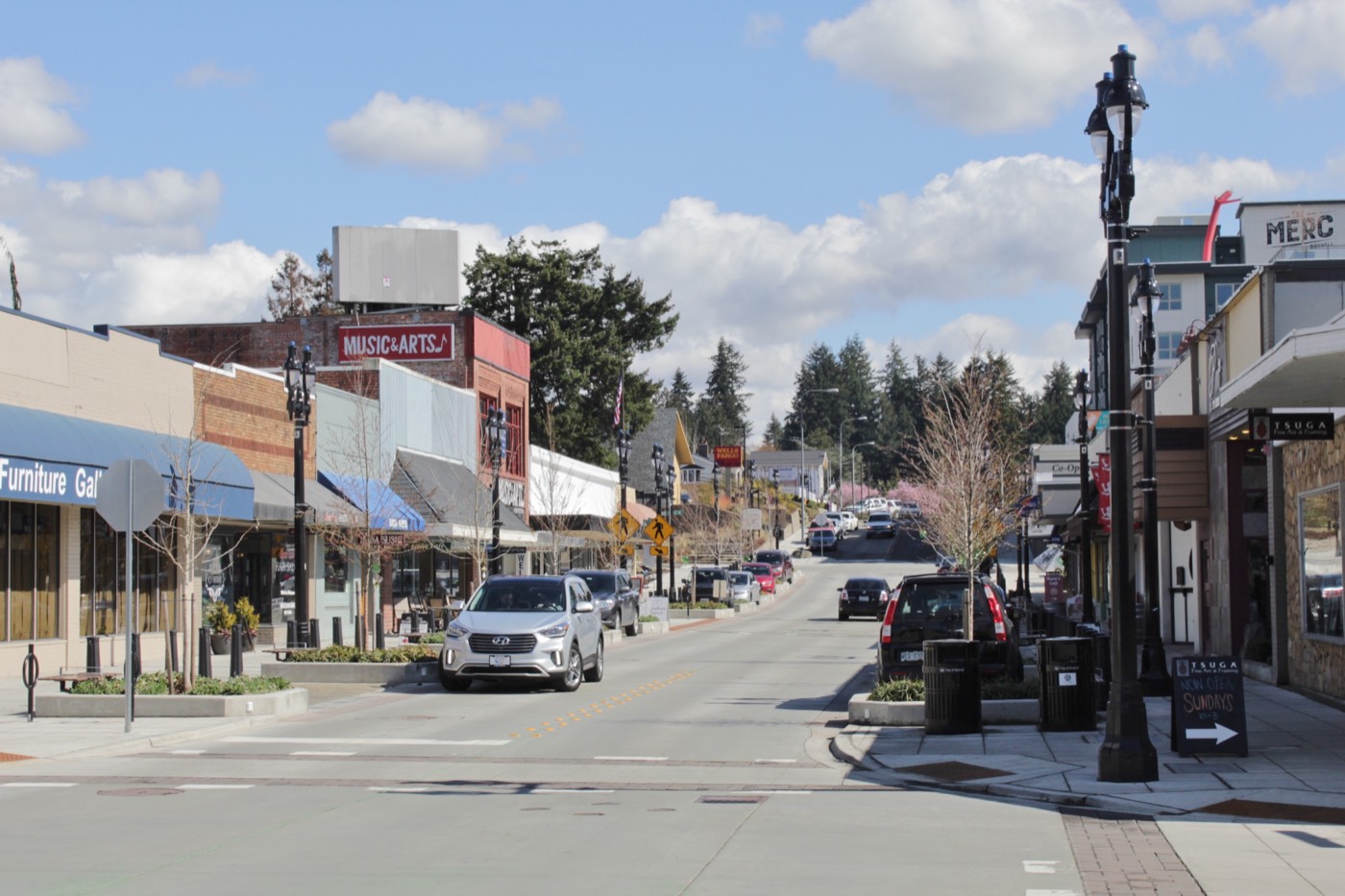
Then the business parks arrived. Canyon Park and the North Creek corridor filled with technology and biomedical firms, and in 1992 the city annexed nearly six square miles to its north, doubling in size almost overnight. Today it is a comfortable Eastside suburb of leafy cul-de-sacs, good schools, and a revived downtown along Main Street.
It is also, by the numbers, one of the more Indian places in the state. Roughly a third of Bothell’s Asian residents trace their roots to India, and the city’s Indian share sits well above the Washington and national averages.
How It Became Indian
Bothell did not set out to become a centre of Indian life. It became one the way most Eastside suburbs did: through work, schools, and the slow accumulation of people who told their friends back home where to come.
The labs that built a city
The first wave came for science. Beginning in 1984, development in Canyon Park and North Creek transformed sleepy Bothell into a regional employment centre, and biotechnology became its defining industry. Today the sector employs more than 25,000 people in and around the city, which has earned Bothell the nickname of the city that biotech built.
Seattle Genetics, founded in 1998 and later renamed Seagen, grew into the largest biotech company in the Seattle area with its headquarters in Bothell. Companies like it needed chemists, bioengineers, data scientists, and clinical researchers, and a great many of those roles were filled by Indian graduates of American universities and by skilled migrants on work visas.
This was the kind of work that suited the first arrivals. It rewarded advanced degrees, it paid well enough to buy a house, and it offered the stability that a young family far from home craves. A doctorate in chemistry or molecular biology from an Indian institute, polished at an American graduate school, was a passport into the Canyon Park labs. Word travelled fast through alumni networks, and one hire often became a small chain of them.
The lake and the campuses across it
The second and larger wave came for software. Bothell sits within commuting distance of Redmond and Bellevue, where Microsoft and, later, Amazon, Google, and a constellation of smaller firms built their campuses. As Indian engineers poured into the Eastside through the 1990s and 2000s, many looked north of the crowded Redmond and Bellevue housing markets and found Bothell.
The appeal was straightforward. Houses were newer and more spacious, the commute down Interstate 405 or across SR 522 was manageable, and the schools were excellent. For a young family arriving from Hyderabad or Chennai with a first tech salary, Bothell offered the suburban American life they had read about, within reach of the lab or the campus.
There was also room to grow. Where Redmond and Bellevue had largely filled in, Bothell still had new subdivisions going up across its annexed northern reaches, and the prices, by Eastside standards, were forgiving. A couple could buy their first house here, start a family, and trade up a few streets over without ever leaving the school district. That continuity is part of why so many who arrived for a single job offer are still here a decade or two later.
A community that organised itself
What turned a scattering of households into a community was institutions, and the Indians of Bothell built theirs early. The effort that became the Hindu Temple and Cultural Center began in the early 1980s, when there were far fewer Indian families in the region than there are today. The organisation was formally registered in 1989, purchased land in 1994, and completed the first phase of its temple in 2002, installing its deities in early 2003.
That early foundation mattered. As the tech and biotech waves swelled the population through the 2000s and 2010s, the temple was already there, ready to grow with them. Cultural societies, language schools, classical dance classes, and cricket clubs followed, knitting the newcomers into something that felt less like a commute and more like home.
The same pull that shaped Bothell shaped its neighbours. Just to the south and east, the towns of Sammamish and Bellevue drew their own large communities of engineers and their families, until the whole Eastside became one of the most concentrated centres of South Asian and East Asian life in the western United States.
The Landmarks
Hindu Temple and Cultural Center, 3818 212th St SE, Bothell. The largest Hindu temple in the Pacific Northwest and the spiritual anchor of the community. Begun in the early 1980s and registered in 1989, it completed its first worship hall in 2002 and has hosted three decades of festivals, weddings, pujas, and consecration rituals. On weekends the parking lot fills well before the doors open.
Mayuri International Foods, 7225 170th Ave NE, Redmond. A short drive south in Redmond Town Center, Mayuri is one of the anchor Indian grocers for Eastside families, its aisles stacked with lentils, spices, fresh produce, and frozen specialities from across the subcontinent. For many Bothell households it is the standing Saturday errand.
Mayuri Foods, Bothell. Mayuri also runs a Bothell location serving Indian cuisine, putting biryani, dosas, and curries within minutes of the temple. It is the kind of place where a tired engineer can pick up dinner that tastes like the food they grew up with.
Paradise Biryani, Bothell. A neighbourhood fixture for the Hyderabadi-style biryani that the region’s large Telugu population grew up on. On cricket-match weekends the takeaway orders pile up.
Canyon Park Business Center, Bothell. The cluster of labs and offices that gave the city its biotech identity, and a daily destination for the Indian scientists and engineers who helped build it. It is less a tourist landmark than a quiet engine of the community’s prosperity.
Northshore School District. Headquartered in Bothell, Northshore is consistently among the top public districts in Washington, with high schools such as North Creek, Inglemoor, and Woodinville ranking in the state’s upper tier. For Indian families, the quality of these schools is often the single biggest reason they chose Bothell over anywhere else.
Main Street, downtown Bothell. The revived historic core, with its restaurants, breweries, and farmers’ market, is where the city’s old logging-town bones meet its new suburban prosperity. On a summer evening you will hear half a dozen languages along its few blocks.
Where They Came From
The Indians of Bothell are overwhelmingly a post-1990s, skilled-migration community, and their origins reflect the industries that drew them. A large share come from the south, from the Telugu-speaking regions of Andhra Pradesh and Telangana around Hyderabad, and from Tamil Nadu and Karnataka, the heartlands of India’s own software industry.
Others arrived from the north and west, from Delhi, Punjab, Maharashtra, and Gujarat, often by way of an American graduate degree before a job offer in Redmond, Bellevue, or a Canyon Park lab. The common thread is education and the H-1B and student-visa pipelines that carried engineers and scientists from Indian campuses to the Pacific Northwest.
It is a profile shared by the great Indian tech suburbs elsewhere in the country, from Cupertino in Silicon Valley to Ashburn in northern Virginia. Bothell is the Pacific Northwest’s quieter, rainier version of the same story.
Bothell Today
Drive through North Creek or Canyon Park on a weekday and the Indian presence is unmistakable: in the lab parking lots, the school pickup lines, the grocery runs to Redmond. Diwali fills the temple and community halls each autumn, and weekend cricket matches dot the region’s parks through the long Northwest summer.
It is, for the most part, a prosperous and settled community. The families who arrived as young engineers two decades ago now have teenagers heading to the University of Washington, and a second generation that is thoroughly American while still turning up at the temple for the big festivals. The biotech industry has had its setbacks, including cancelled projects and corporate shake-ups, but it remains the city’s backbone.
The cultural calendar has thickened along with the population. The temple’s festival days draw crowds that spill into the cultural hall, and community groups across King and Snohomish counties run Diwali bazaars, classical music recitals, and dance showcases each year. Weekend cricket has become a fixture too, with teams of engineers and their children claiming the region’s fields through the dry months. Much of this is invisible to a passing visitor, organised through group chats and temple bulletins rather than storefronts, but it is the connective tissue of the community.
Bothell is not a place that announces itself. It has no famous Indian commercial strip the way some cities do, no single avenue of sari shops and sweet stalls. Its Indian life is spread across cul-de-sacs and labs and one very large temple, the unflashy texture of a community that came to work, raised its children well, and quietly made a logging town its own.
Frequently Asked Questions
How many Indians live in Bothell, Washington?
Bothell does not publish a precise count, but Indians make up roughly a third of the city’s Asian population, and the city’s Indian share is several times the national average. The Indians in Bothell, Washington are one of the larger South Asian communities in the Seattle metropolitan area.
Why did so many Indians settle in Bothell?
Two industries drew them: the biotech corridor in Canyon Park and North Creek, and the tech campuses of Redmond and Bellevue across the lake. Bothell offered newer, more affordable housing than Redmond, an easy commute, and one of the best public school districts in Washington.
Where is the Hindu temple in Bothell?
The Hindu Temple and Cultural Center is at 3818 212th St SE, Bothell. It is the largest Hindu temple in the Pacific Northwest, with roots going back to the early 1980s and a first worship hall completed in 2002.
Where do Indians in Bothell shop for groceries?
Many families shop at Mayuri International Foods in nearby Redmond Town Center, one of the main Indian grocers serving the Eastside, along with Mayuri’s Bothell location and other South Asian markets in the region.
What is Bothell’s connection to biotech?
Bothell is sometimes called the city that biotech built. Development in Canyon Park and North Creek since the 1980s turned it into a regional employment centre, and biotechnology now employs more than 25,000 people in the area, including many Indian scientists and engineers.
Which schools serve the Indian community in Bothell?
The Northshore School District, headquartered in Bothell, is among the top public districts in Washington. Its high schools, including North Creek, Inglemoor, and Woodinville, rank highly statewide, which is a major reason Indian families choose the city.
If your family’s story passed through Bothell, or any of the places Indians have made home in America, Atlas of Home can trace that journey. From a campus in Hyderabad or Chennai to a lab in Canyon Park and a Sunday at the temple on 212th Street, to wherever you are now.