
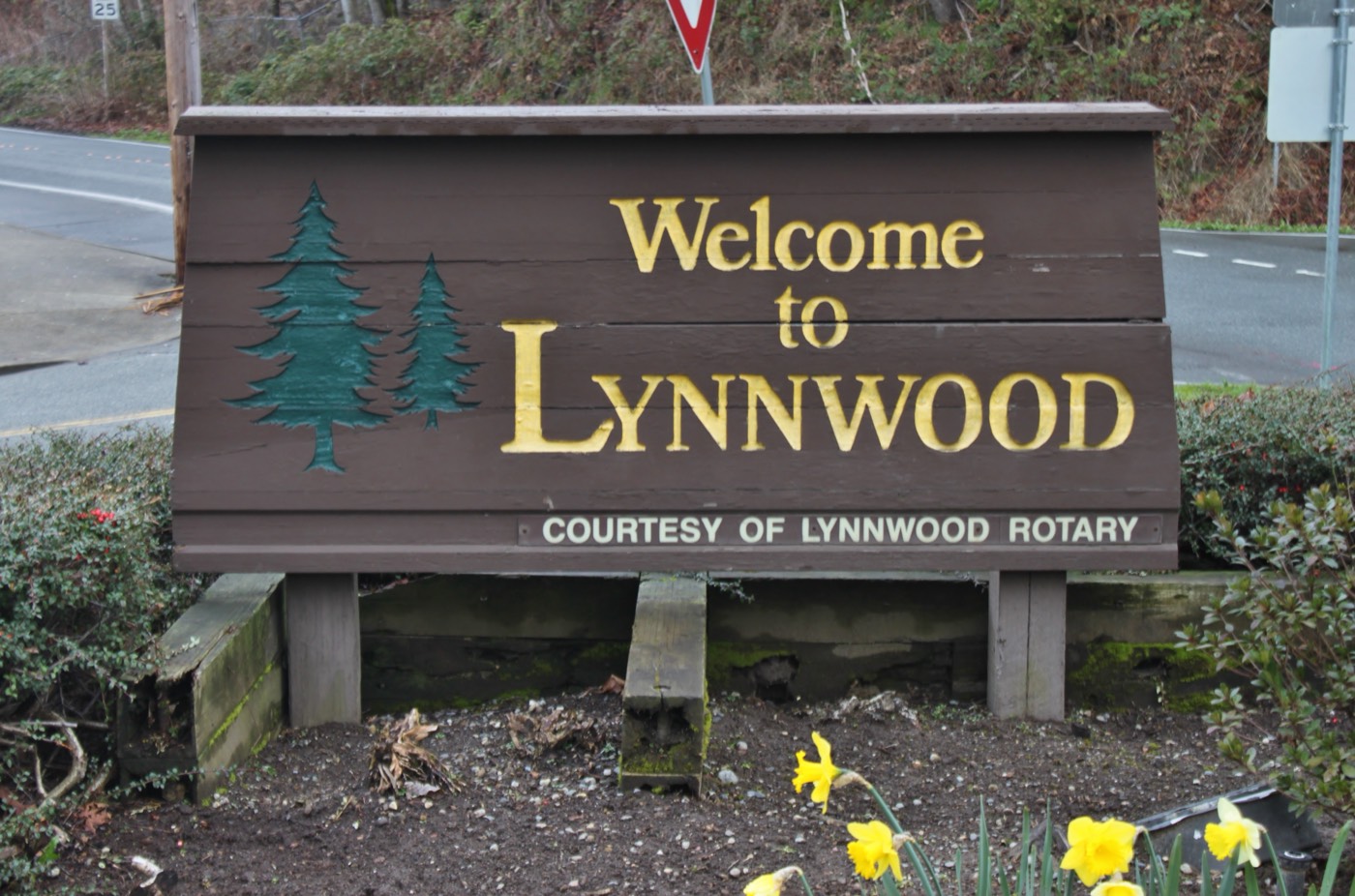
Drive north out of Seattle on Highway 99, past the auto dealerships and the scrap yards, and somewhere around 184th Street the signage starts to change. The Koreans in Lynnwood have built a quiet capital here, a stretch of strip malls where the menus, the supermarket aisles and the karaoke playlists all arrive first in Hangul. There is no grand gate, no banner across the road. There is just G Mart, a jimjilbang glowing at the kerb, and the steady traffic of families who came north for the schools and stayed for everything else.
The Place
Lynnwood sits in south Snohomish County, about fifteen miles north of downtown Seattle, where Interstate 5 and old Highway 99 run roughly parallel toward the Canadian border. It began as Alderwood Manor, a planned community the Puget Mill Company laid out in 1917 on five and ten acre plots. The name Lynnwood came later, in 1937, when a realtor named Karl O’Beirn platted land along Highway 99 and named it after his wife.
The city incorporated on 23 April 1959 with around 7,000 residents. The completion of Interstate 5 in 1965 and the opening of Alderwood Mall in 1979 turned a roadside settlement into one of the Puget Sound’s busiest retail hubs. By the 2020 census Lynnwood counted 38,568 people, and nearly one in five was Asian American.
How It Became Korean
The Korean story in Lynnwood is, at root, a story about Highway 99. The old federal route had been bypassed by the freeway and left with cheap commercial rents and long, low-slung buildings, exactly the kind of space a first-generation immigrant could afford to open a market or a restaurant in. From the 1970s onward, Korean and Vietnamese families began filling it.
The first arrivals, 1970s and 1980s
Korean migration to the Seattle suburbs followed a familiar national pattern, accelerating after the 1965 Immigration and Nationality Act lifted the old country quotas. Some of the earliest Korean residents of the region arrived through the military, as wives of American servicemen stationed at Fort Lewis to the south, a route that seeded Korean families across the Puget Sound long before the markets appeared. It is a quieter origin than the urban density of Koreatown in Los Angeles, but it set the same chain in motion.
Between 1970 and 1990, census records show, Lynnwood gained a large Asian American population, primarily Korean and Vietnamese. By 2000 Asian Americans made up roughly 14 percent of the city. The newcomers were drawn less by Lynnwood itself than by what surrounded it: affordable homes, a short commute to Seattle and Everett, and above all the Edmonds School District, consistently ranked among the strongest in the region. It is the same school-first calculus that drew Korean families to the larger southern hub at Federal Way.
The supermarkets that anchored it
What turned a scatter of households into a recognisable Korean district was groceries. A Korean supermarket is not only a place to buy food. It is a community square, a noticeboard, a food court and a first job all at once, and in Lynnwood and neighbouring Edmonds the markets did the work that a town centre might have done elsewhere.
Pal-Do World opened a 40,000 square foot international market on Highway 99 in north Lynnwood, run by Byung C. Park and Young Su Park, a couple who had run shops in South Bend, Indiana, and on New York’s Upper West Side before opening their first Pacific Northwest store in Tacoma in 1992. It was not a shop so much as a mini-mall, with a food court and a row of Asian businesses tucked inside.
A few miles up the highway in Edmonds, the Han family opened BooHan Plaza in April 2000. The family had begun in the 1970s making tofu and rice cakes out of a 500 square foot addition on their home before launching into retail. Hodori Market, in the Seoul Plaza complex on Highway 99, had been selling banchan and frozen Korean staples for nearly a decade by the early 2000s. The markets fed each other, and the corridor thickened.
The boom, and the doubling
The numbers caught up with the storefronts. Snohomish County’s Korean population more than doubled in a single decade, from 3,787 in 1990 to 7,654 in 2000. Shoreline, Lynnwood, Edmonds and Mukilteo all ranked among the top eight ZIP codes for Korean residents across King and Snohomish counties.
The growth was concentrated and competitive. By the per-capita measure, Mukilteo holds the highest concentration of Koreans in Washington state, Mill Creek the second, and north Lynnwood the third, a tight cluster of suburbs strung along the same school districts and the same highway. The pattern echoes the Asian suburban belt across Lake Washington, where the Chinese community in Bellevue grew along a similar logic of schools and proximity. The arrival of an H Mart, and its sister store G Mart, on the Lynnwood stretch of Highway 99 confirmed the corridor as the everyday centre of Korean life north of Seattle.
From a market row to a Koreatown
What started with groceries broadened into something fuller. Around the H Mart plaza and along the 99 corridor came the dessert cafes, the spas, the karaoke rooms and the Korean-language-only businesses that mark a community deep enough to serve itself. The professional and business families who had settled for the schools now had somewhere to spend a Friday night without leaving the neighbourhood.
The Korean institutions also crossed the city line into Edmonds, where the Korean Community Service Center opened to help newly arrived immigrants navigate language, paperwork and culture shock. The community that markets built had begun, by then, to build for itself.
The Landmarks
H Mart and G Mart, 17424 Highway 99. The anchor of Korean Lynnwood. G Mart sits in the H Mart family of stores, its shelves carrying more than a dozen kinds of dried chilli, walls of kimchi, sake and Korean exfoliating mitts. The plaza’s food court is where many newcomers eat their first Lynnwood meal.
Pal-Do World, Highway 99, north Lynnwood. The 40,000 square foot international market that helped anchor the corridor, built by Byung and Young Su Park after a journey through Indiana, New York and Tacoma. Inside is a small mall of Asian shops and a tofu-house food court.
Q Sauna and Spa, 17420 Highway 99. A full Korean jimjilbang on the highway, with temperature-graded saunas, plunge baths and the scrub-and-wrap rituals that draw families on weekends. Recent ownership poured money into the facilities, a sign of a community confident enough to invest.
Modoo Korean Restaurant, 18601 Highway 99 #100. A neighbourhood standby for bibimbap, seafood pancake, army stew and tofu casseroles, with vegan options that nod to a changing clientele. It keeps the kind of tight weekday hours that say it is cooking for regulars, not tourists.
LUMI Dessert Cafe, 4713 168th Street SW #101. Bingsu mountains of shaved ice, golden toast and egg waffles, the after-dinner ritual of the corridor’s younger crowd. On weekend nights it stays open late, the lights on long after the markets have shut.
Big Bang Karaoke, 18623 Highway 99. A 21-and-over noraebang with private rooms and a songbook in Korean, English, Japanese, Chinese, Vietnamese and Filipino, a fair map of who actually lives along Highway 99 now.
Korean Community Service Center, 22727 Highway 99, Edmonds. Just over the Lynnwood line, the nonprofit founded in 1983 by five Korean women to serve immigrants facing language, cultural and financial barriers. It remains the social safety net of the corridor’s Korean families.
Where They Came From
The families who filled Lynnwood’s Highway 99 came overwhelmingly from South Korea, and like most of the post-1965 Korean diaspora in America they came in waves shaped by education and opportunity. Many were urban and middle-class, leaving Seoul, Busan and the larger cities for a country that promised, above all, a different schooling for their children.
A thinner, earlier thread ran through the U.S. military. Korean women who married American servicemen at bases like Fort Lewis were among the first to settle the Puget Sound, and their presence helped make the region legible to the relatives and church networks who followed. By the time the markets opened on Highway 99, chain migration was doing the rest, one family sponsoring the next.
Lynnwood Today
The Korean corridor north of Seattle is no longer a secret. It runs from north Lynnwood up through Edmonds along the same Highway 99 that the freeway once left for dead, and on a weekend the H Mart car park fills with three generations at once: grandparents buying banchan, parents picking up tofu stew, teenagers heading for the dessert cafe.
It is also, increasingly, a shared space. The karaoke songbooks and food courts now speak Vietnamese, Chinese and Filipino as readily as Korean, a reminder that the corridor is a pan-Asian high street with a Korean heart. The wider story stretches down I-5 to the larger Korean centre at Federal Way, and the two communities trade customers, churches and family. It is a West Coast cousin to the dense Korean strip-mall corridors that Korean immigrants built elsewhere, from Los Angeles to Annandale, Virginia.
What holds Lynnwood’s Koreans in place is the same thing that first drew them: the schools, the markets, and the unglamorous certainty that everything a Korean family needs is within a few minutes of Highway 99. It is not a showpiece Koreatown. It is a working one, which is precisely why it has lasted.
Frequently Asked Questions
Where is the Korean community in Lynnwood, Washington?
The Koreans in Lynnwood are concentrated in north Lynnwood along the Highway 99 corridor, roughly between 168th and 196th Streets SW, and the community extends north across the city line into Edmonds. The H Mart and G Mart plaza on Highway 99 is its everyday centre.
How large is the Korean population around Lynnwood?
Snohomish County’s Korean population more than doubled from 3,787 in 1990 to 7,654 in 2000. By per-capita measure, north Lynnwood holds the third-highest concentration of Koreans in Washington state, behind neighbouring Mukilteo and Mill Creek.
Why did Koreans settle in Lynnwood?
Korean families came north for affordable homes, an easy commute to Seattle and Everett, and above all the highly rated Edmonds School District. Cheap commercial rents on the bypassed Highway 99 then made it possible to open the markets and restaurants that anchored the community.
Is there an H Mart in Lynnwood?
Yes. The H Mart and its sister store G Mart sit on Highway 99 in north Lynnwood and form the anchor of the area’s Koreatown, with a food court of Korean, Japanese, Chinese and Vietnamese vendors.
What Korean restaurants are in Lynnwood?
The corridor includes Modoo Korean Restaurant for bibimbap and tofu stews, the H Mart food court’s Korean stalls, LUMI Dessert Cafe for bingsu, and Big Bang Karaoke. Earlier landmarks like Pal-Do World’s tofu-house food court helped establish the scene.
How does Lynnwood’s Korean community relate to Federal Way?
Lynnwood and Federal Way are the two main Korean centres in the Seattle area, north and south of the city respectively. The communities trade customers, churches and family along Interstate 5, and many Korean institutions span both.
If your family’s story passed through Lynnwood, or any of the places Koreans have made home in America, Atlas of Home can trace that journey. From a city in South Korea to a strip mall on Highway 99, to wherever you are now.