
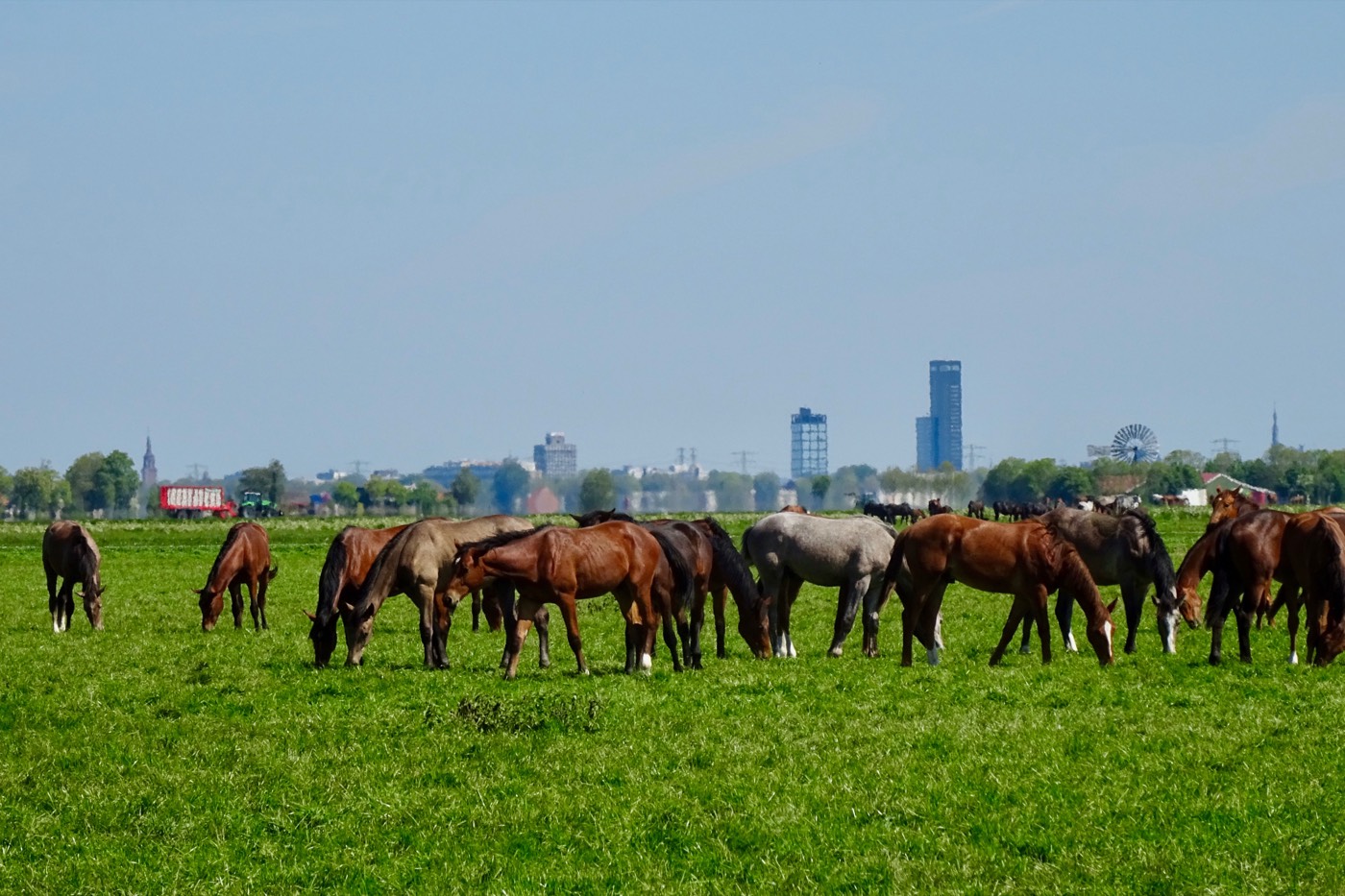
The DeVries surname is Dutch and means “the Frisian”, a name given to people from Friesland, the province along the northern coast of the Netherlands. It is one of the most common surnames in the Dutch-speaking world, and one of the most quietly literal.
What Does the Surname DeVries Mean?
DeVries means “the Frisian”. It joins the Dutch definite article de, meaning “the”, to Vries, an older spelling of Fries, the Dutch word for a person from Friesland. The name is an ethnic label, not a trade or a farmstead.
The older provincial spelling was Vriesland, which is why the surname kept the V long after the province settled on Friesland with an F. A DeVries was, at some point in the family’s past, simply the Frisian in the room.
That places it in a small class of Dutch surnames built from peoples and provinces rather than from fathers, jobs or fields. Den Hollander is the Hollander. De Zeeuw is the Zeelander. De Vries is the Frisian, and it outgrew both.
Where the DeVries Name Comes From
The DeVries name comes from Friesland in the northern Netherlands, and from the neighbouring provinces of Groningen, Drenthe and Overijssel where Frisian settlement ran deep. It is still densest in and around Friesland today.
Friesland and the Frisians
The Frisians are one of the older named peoples of the North Sea coast, recorded by Roman writers and long settled on salt marshes and artificial dwelling mounds, the terpen, raised above the tides.
Friesland is not simply a Dutch region with an accent. It has its own language, West Frisian, called Frysk by its speakers, a West Germanic tongue closer to English in its ancestry than Dutch is. Roughly 450,000 people speak it, and in 2013 the Dutch parliament confirmed Frisian as the country’s second official language. The province’s official name is now the Frisian one, Fryslân.
Why an Ethnonym Became a Surname
Names of this kind begin as descriptions rather than inheritances. A man who moved from the Frisian marshes to a market town in Holland or Groningen became, in local usage, Jan de Vries, and the tag stuck to his children.
Repeat that across four centuries of coastal trade and seasonal labour, and you get a name recurring in Dutch records from the sixteenth century onwards, held by families with no connection to one another.
The Registration of 1811
The second reason the name is everywhere is bureaucratic, and it has a precise date. On 18 August 1811, under French rule, a Napoleonic decree required every inhabitant of the Netherlands to hold a fixed hereditary surname and to register it. Municipalities kept name adoption registers, the registers van naamsaanneming, listing the head of the household, his children and often his grandchildren.
Most of the country was unaffected in substance, because hereditary surnames were already normal there. The northern provinces were the exception. In Friesland, Groningen, Drenthe and Overijssel many families still used patronymics, so a man was Sjoerd Jansz because his father was Jan, and his own son would be Jan Sjoerdsz in turn.
Those families now had to choose something permanent, and a great many Frisian households chose the plainest available truth about themselves. The Dutch government kept the requirement after the French left and, in 1825, ordered anyone still unregistered to comply.
This is why the name is both extremely common and, genealogically, unusually shallow in the north. For many DeVries families the surname is only about two centuries old, even though the family is far older, and the Frisian registers survive to show the moment of choosing.
Spelling Variants and Related Names
The main variants are de Vries, De Vries, DeVries, Devries, deVries and plain Vries, with De Vriese and De Vreese as the Flemish and Belgian forms. The differences are almost entirely about spacing and capitalisation rather than about different families.
In Dutch the de is a tussenvoegsel, a small linking particle sitting between the given name and the substantive part of the surname. Dutch convention writes it lower case when a first name comes before it, as in Jan de Vries, and capitalised when it stands alone, as in Mr De Vries. Dutch directories file the name under V, not D, because the particle is not treated as part of the name proper.
American clerks had no such rule. Faced with “de Vries” they closed the gap, capitalised the D and filed the result under D, producing DeVries and Devries as single inseparable words. Many immigrant families adopted that form themselves, and some dropped the particle entirely.
Related and cognate names include Fries and De Fries in Dutch, Friese and Friesen in German and Low German, and Vriesema and similar formations in the Frisian far north. If you are searching records, treat every one of these as the same name and search them all. Spelling was a clerk’s decision far more often than a family’s.
The DeVrieses in America
DeVrieses reached America in two distinct waves: a thin colonial trickle into New Netherland in the 1600s, and a far larger nineteenth century migration that began in 1847 and built Dutch farming towns across the Midwest and, later, the Pacific Northwest.
The colonial figure is David Pietersz de Vries, a mariner who backed the short-lived Zwaanendael settlement on Delaware Bay and then established patroonships on Staten Island in 1639 and at Tappan in 1640. Both were destroyed in the Dutch wars with the Lenape.
The wave that actually planted the name in American soil came two centuries later. A secession from the Dutch Reformed Church in 1834 left conservative congregations under pressure, and when the potato crop failed in 1845 and 1846 the pressure became departure. In 1847 the pastor Albertus van Raalte led his followers to western Michigan and founded the Dutch colony at Holland, Michigan, while Hendrik Scholte took another company to Pella, Iowa, in the same year.
From those two beachheads the settlement spread along family and church lines. Zeeland, Michigan was founded within months of Holland by a companion congregation, and the growing furniture city to the east drew Dutch labour for decades, building the Dutch community in Grand Rapids into one of the largest in the country.
Iowa’s Dutch belt pushed north-west a generation later, when land around Pella grew expensive and colonists founded Orange City in Sioux County in 1870, followed by nearby Sioux Center. Frisian families were well represented in these northern Iowa settlements, where dairying was familiar work.
The last leg ran west. Dutch and Frisian dairy farmers moved to the Nooksack valley in Washington State from the 1890s onwards, and the Dutch settlement at Lynden became the westernmost anchor of the network. If your DeVries line passes through Michigan, Iowa or Whatcom County, it is very likely part of this chain rather than of the colonial one.
Notable People Named DeVries
David Pietersz de Vries (c. 1593 to 1655) was a Dutch navigator and colonist in New Netherland. His Korte Historiael of 1655 is one of the fullest eyewitness accounts of the colony.
Hugo de Vries (1848 to 1935) was a Dutch botanist and a founder of genetics. In 1900 he was among the researchers who independently rediscovered Mendel’s laws of inheritance, and his work on the evening primrose produced the mutation theory.
Theun de Vries (1907 to 2005) was born in Veenwouden in Friesland and became one of the most translated Dutch writers of the twentieth century, known abroad for the resistance novel The Girl with the Red Hair.
Peter De Vries (1910 to 1993) was an American comic novelist raised in Chicago’s Dutch immigrant community. He edited Poetry magazine, then spent from 1944 to 1987 on the staff of The New Yorker.
Peter R. de Vries (1956 to 2021) was a Dutch investigative journalist whose crime reporting programme ran from 1995 to 2012. He was shot in Amsterdam on 6 July 2021 after leaving a television studio and died nine days later.
Nyck de Vries (born 1995) is a racing driver from Friesland, born near Sneek. He won the Formula 2 championship in 2019 and became the first Formula E world champion in the 2020 to 2021 season.
How Common Is DeVries Today?
DeVries ranks #2649 among American surnames in the 2010 US Census, with roughly 13,600 bearers. In the Netherlands the picture is entirely different: De Vries is the third most common surname in the country, behind only De Jong and Jansen, with more than 73,000 bearers recorded in 2007.
That gap is the story of the name in one line. In the Netherlands it is ordinary to the point of invisibility. In America it marks a family as Dutch on sight, and the count is split further across the variant spellings.
| US rank (2010 Census) | #2649 |
|---|---|
| Americans with the name | 13,600 |
| Origin | Dutch (Frisian) |
| Meaning | “The Frisian”, a person from Friesland |
Frequently Asked Questions
What does the surname DeVries mean?
DeVries means “the Frisian” in Dutch. It combines de, “the”, with Vries, an old spelling of Fries, a person from the province of Friesland. It is an ethnic byname rather than an occupational or patronymic surname.
Is DeVries Dutch or German?
DeVries is Dutch. The German and Low German equivalents of the same idea are Friese and Friesen, and the Flemish and Belgian forms are De Vriese and De Vreese. A DeVries family with German records most likely crossed from the Dutch north into East Frisia, which is historically Frisian ground.
Where does the DeVries family come from?
There is no single DeVries family. The name comes from Friesland and the neighbouring northern Dutch provinces of Groningen, Drenthe and Overijssel, and it was adopted independently by thousands of unrelated households. Your own line has to be traced through records, not through the name alone.
How common is the surname DeVries?
In the United States it ranks #2649 with about 13,600 bearers, and more again under variant spellings. In the Netherlands De Vries is the third most common surname of all, with over 73,000 bearers recorded in 2007.
Is there a DeVries family crest or coat of arms?
No. In almost every European heraldic tradition, arms are granted to an individual and pass to that person’s direct descendants, never to everyone sharing a surname. Since DeVries was adopted separately by thousands of unrelated families, a single crest for all of them is impossible. Sites selling a “DeVries family crest” are selling a decoration, not a lineage.
Why did so many Frisian families take the name de Vries in 1811?
Because until then most of them had no fixed surname at all. Friesland still used patronymics, so when the Napoleonic decree of 18 August 1811 forced every household to register a permanent family name, huge numbers of Frisians registered the simplest description of themselves. The Meertens Institute surname database still shows the result.
If your family carries the DeVries name, its route from Friesland to America is traceable. Atlas of Home can follow it from the terp villages and church books of the Frisian north to wherever your family landed, and to wherever you are now.