
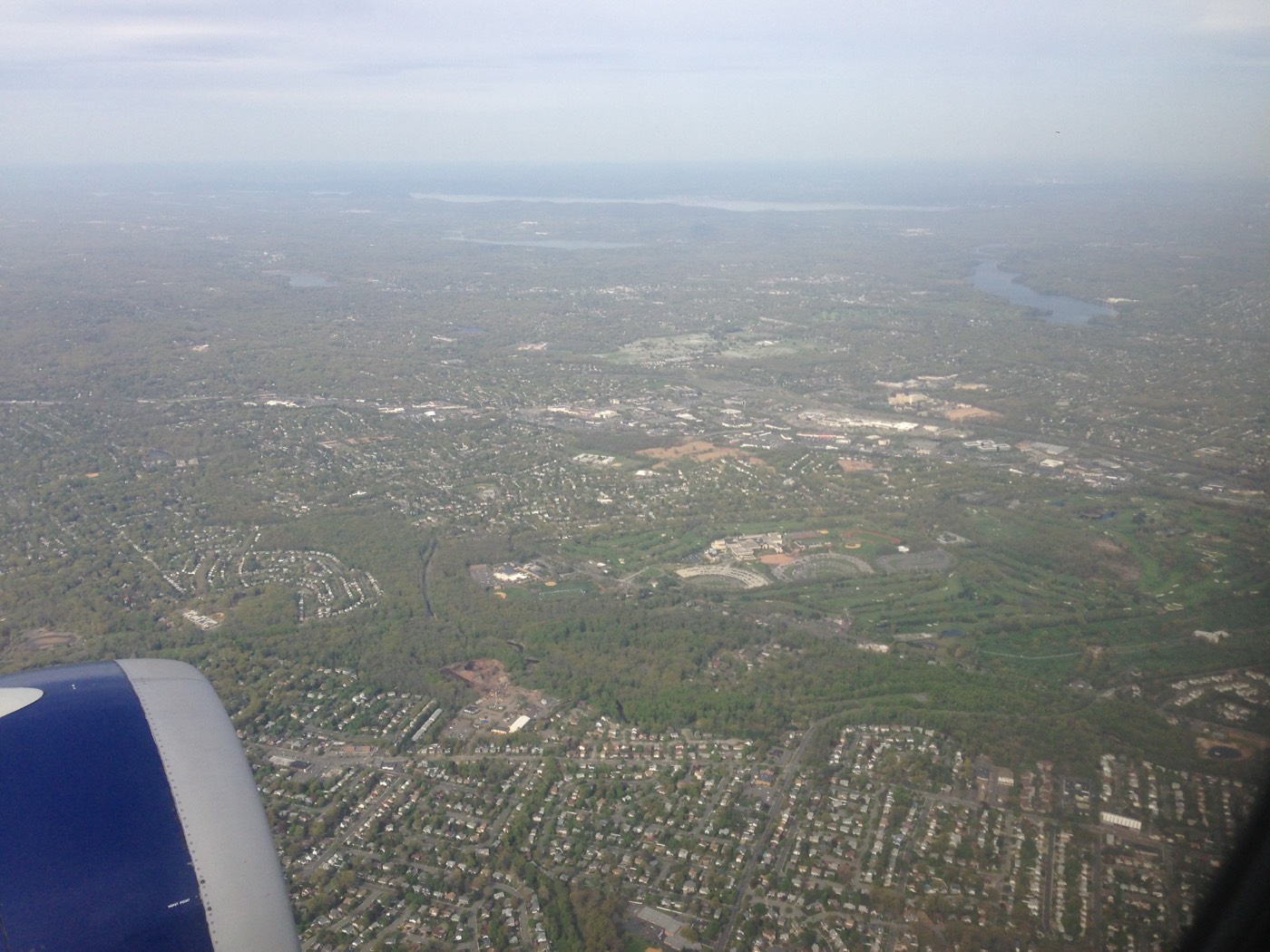
On a Saturday morning, the parking lot off Route 17 fills before nine. Families move through the doors of H Mart with empty carts and a weekend list, and within an hour the produce aisles fill with the sound of two languages braided together. This is the everyday rhythm of the Koreans in Paramus, New Jersey, a community that built a quiet, prosperous home in the busiest retail town in America.
The Place
Paramus sits in the heart of Bergen County, a few miles west of the George Washington Bridge and the Hudson River. The borough takes its name from the Lenape word Peremessing, often translated as land of abundant wild turkey, a reminder that this was farmland long before it was anything else.
It is now one of the largest shopping destinations in the country. The intersection of Routes 4 and 17 anchors a corridor of malls that generates more than six billion dollars in annual retail sales, more than any other ZIP code in the United States.
Yet behind the highways and the malls is a residential borough of roughly 26,700 people, leafy and orderly, with some of the most respected public schools in New Jersey. It is this second Paramus, the one of cul-de-sacs and classrooms, that drew Korean families here.
How It Became Korean
From turkey land to truck farms to malls
For most of its history Paramus was agricultural. By 1940 the borough counted only about 4,000 residents, and its farmers grew vegetables for the markets of nearby New York, work that helped earn New Jersey the nickname the Garden State.
The George Washington Bridge opened in 1931, and the widening of Routes 4 and 17 followed. By the 1950s, farmers and outside developers realised that shopping centres were more profitable than produce. Garden State Plaza and the Bergen Mall both opened in 1957, and Paramus was transformed into a retail capital almost overnight.
The borough incorporated in 1922 and grew steadily through the postwar decades. Its blue laws, among the most restrictive in the country, still close nearly all retail on Sundays, a deliberate civic choice to give residents one quiet day a week. That quietness, oddly, is part of what made the town liveable for families.
The Koreans cross the bridge
The Korean story in this corner of New Jersey began in earnest in the 1980s. As Korean immigration to the New York metropolitan area accelerated after the 1965 reform of American immigration law, the first arrivals concentrated in the city itself, in Flushing and in Manhattan’s Koreatown.
Then the wealthier and more established families began to move. They crossed the George Washington Bridge into Bergen County, drawn by safety, by reputable schools, and by a commute back to Manhattan that remained manageable.
The earliest and densest enclaves formed in the eastern towns nearest the Hudson. Palisades Park became one of the largest Korean enclaves outside Korea, its main avenue lined with restaurants, bakeries and noraebang. Neighbouring boroughs followed, each with its own character within the broader belt.
Paramus, the central node
Paramus sits slightly west of that riverfront core, in central Bergen County, and it attracted a particular kind of Korean household. These were professional families, often a generation removed from first arrival, who wanted larger houses, top schools and space, while staying within the orbit of the Korean institutions clustered to the east.
By the 2010 census, Korean Americans made up 6.9 percent of Paramus residents, the borough’s largest single ethnic minority. By 2020 the borough was 26.1 percent Asian. The numbers describe a steady, deliberate settlement rather than a sudden wave.
What sealed Paramus as a Korean centre in its own right arrived in 2018. On 27 April that year, the grocery chain H Mart opened a 25,000 square foot supermarket on Route 17, the first in the borough, in what one observer noted was the hometown of the company’s president, Stacey Kwon. A Korean supermarket on the busiest retail highway in America was a kind of declaration: this town was home now.
The store’s arrival changed the weekly geography of Korean Paramus. Where families had once driven east to Palisades Park or Ridgefield for groceries, they now had banchan, fresh tofu and Korean produce a few minutes from home. A supermarket is a small thing, but in an immigrant community it is also an anchor, a place where the language of childhood is spoken at the checkout and where the food of home stays within easy reach of the next generation.
That sense of being settled, rather than merely arrived, is the defining feature of the Korean presence here. Paramus was never an entry point. It was a destination, the place families moved to once the hard early years in the city were behind them.
The Landmarks
H Mart, 60 State Route 17 North. The anchor of Korean Paramus, this branch opened in April 2018 and quickly became a weekend gathering point for families across central Bergen County. At 25,000 square feet it is more compact than some of the chain’s suburban giants, but it sits at the symbolic centre of the retail corridor, banchan and fresh produce a short drive from any mall.
Hot Stone BBQ, 60 NJ-17, Paramus. Sharing the Route 17 address with H Mart, this Korean barbecue restaurant lets shoppers fold a meal of grilled galbi into the same trip as the weekly groceries. It is the kind of convenience that makes a corridor feel like a neighbourhood.
Seoul Galbi Korean BBQ, 123 Paramus Road. Set off the highways on Paramus Road, Seoul Galbi serves traditional Korean barbecue with the marinated meats, fresh vegetables and house sauces that regulars come back for. Tucked into a quieter stretch, it draws a steady local crowd rather than mall traffic.
Arcola Korean United Methodist Church, Paramus. Korean churches do far more than hold Sunday services in Bergen County: they run language schools, anchor social life and ease new arrivals into American routines. This Methodist congregation is one of the borough’s longstanding Korean houses of worship.
Korean Evangelical Church, 286 Paramus Road. Another of the borough’s Korean congregations, sitting on the same Paramus Road that threads through the residential heart of the town. For many families, the church calendar and the school calendar are the two clocks that order the week.
Westfield Garden State Plaza, 1 Garden State Plaza. The largest mall in New Jersey, opened in 1957, is not a Korean landmark in itself, but it is the gravitational centre of the town the community chose. Korean Paramus is inseparable from the retail giant on whose edges it settled.
Paramus High School, 99 East Century Road. A National Blue Ribbon school and a magnet for academically driven families, the borough’s high school is one of the quiet reasons Korean households moved here. In a community that prizes education, the schools are landmarks as surely as any storefront.
Where They Came From
The Koreans who settled in Paramus came overwhelmingly from South Korea, many by way of New York City. The chain of migration ran from Seoul and the country’s other cities to Flushing and Manhattan, and then across the George Washington Bridge into Bergen County as families found their footing.
The move to Paramus was usually a second or third step rather than a first landing. These were households that had already established businesses or professional careers in the metropolitan area and were trading the density of the city, or the bustle of the riverfront enclaves, for suburban schools and quiet streets.
What drew them was consistent across the whole Bergen belt: safety, schools and proximity to Manhattan. Paramus offered all three, plus something specific to itself, the chance to live among the best public schools in the region while remaining minutes from the Korean grocers, churches and restaurants that made daily life feel like home.
For parents, the calculation was often explicit. A strong school district in the United States is the surest investment in a child’s future, and Bergen County’s reputation travelled back across the Pacific. Families chose Paramus the way they might have chosen a good neighbourhood in Seoul, weighing test scores, commute and community before signing anything.
Paramus Today
Korean Paramus today is woven into an affluent, ordinary suburb rather than concentrated in a single visible district. With a median household income that has long sat above six figures, the borough is comfortably middle and upper middle class, and Korean families are a settled, established part of that prosperity.
The texture of the community shows up in specifics. It is the crowd at H Mart on a Saturday, the Korean churches whose parking lots fill on Sundays even as the blue laws keep the malls dark, the barbecue restaurants on Route 17 and Paramus Road, and the high achievers moving through Paramus High School.
It is also a community in conversation with its neighbours. Paramus belongs to a wider belt of Korean Bergen County that includes the Koreans in Leonia, the Koreans in Closter, the Koreans in Northvale, the Koreans in Old Tappan, the Koreans in Demarest and the Koreans in Cresskill. Together these towns form one of the densest Korean American regions in the country, with Paramus as its central retail and grocery hub.
For more on how this enclave took shape, the histories of Koreans in the New York metropolitan area and the borough of Paramus itself trace the larger story.
Frequently Asked Questions
How many Koreans live in Paramus, New Jersey?
At the 2010 census, Korean Americans made up 6.9 percent of Paramus residents, the borough’s largest single ethnic minority. By the 2020 census the borough of about 26,700 people was 26.1 percent Asian, and the Koreans in Paramus, New Jersey remain a substantial and established part of that population.
Why did Koreans settle in Paramus?
The Koreans in Paramus, New Jersey came largely from New York City, crossing the George Washington Bridge into Bergen County from the 1980s onward. They were drawn by safety, by some of the best public schools in the state, and by proximity to Manhattan and to the established Korean enclaves of eastern Bergen County.
Is there a Korean supermarket in Paramus?
Yes. H Mart opened a 25,000 square foot supermarket at 60 State Route 17 North on 27 April 2018, the chain’s first store in the borough. It has become a weekend gathering point for Korean families across central Bergen County.
What is Paramus known for?
Paramus is one of the largest shopping destinations in the United States, with the intersection of Routes 4 and 17 anchoring malls that generate more than six billion dollars in annual retail sales, the most of any ZIP code in the country. It is also known for restrictive blue laws that close most retail on Sundays.
How is Paramus connected to the wider Bergen County Koreatown?
Paramus sits in central Bergen County, slightly west of the riverfront enclaves such as Palisades Park, Fort Lee and Leonia that form the core of the region’s Korean belt. It functions as a retail and grocery hub for the surrounding Korean towns rather than as a single dense Korean district.
Are the Paramus schools good for Korean families?
Yes, and they are a major reason families moved here. Paramus High School is a National Blue Ribbon school, and the borough’s strong public schools have long attracted education-focused households, including many Korean American families.
If your family’s story passed through Paramus, or any of the places Koreans have made home in America, Atlas of Home can trace that journey. From Seoul and the streets of Flushing to the malls and quiet cul-de-sacs of central Bergen County, to wherever you are now.