
On a Sunday morning in Cresskill, the bells of a stone church mix with the smell of fresh perilla leaves carried home from a market two towns over. The Koreans in Cresskill, New Jersey did not arrive all at once, and they did not arrive first. They came up the hill from Fort Lee and Palisades Park, school district by school district, until a small Bergen County borough of barely two square miles counted nearly one in five residents as Korean American.
The Place
Cresskill sits in the Northern Valley, a band of leafy boroughs pressed between the Palisades cliffs and the Hackensack River in northern Bergen County. It is small, just 2.07 square miles, and it borders Alpine, Demarest, Tenafly, Dumont and Bergenfield. The name comes from the watercress that once grew in its streams, joined to “kill,” the old Dutch word for a creek.
The borough incorporated on 8 May 1894, carved out of Palisades Township. For most of the twentieth century it was a quiet commuter town of modest colonials and good schools. What it had, and still has, is a short drive to the George Washington Bridge and some of the most sought-after public education in the state.
How It Became Korean
To understand Cresskill, you have to start at the bottom of the hill.
The bridge and the first wave
Korean immigration to Bergen County began in earnest in the 1970s, after the 1965 Hart-Celler Act reopened the United States to Asian newcomers. The first arrivals settled close to New York City, in Fort Lee at the foot of the George Washington Bridge, and in the dense, affordable apartments of Palisades Park. The pull was simple. The towns were cheaper and safer than the city, and the bridge put Manhattan jobs within a half-hour reach.
By the 1980s those two boroughs had become the centre of gravity for Korean life in the New York metropolitan area. Palisades Park, a single square mile, would eventually become the most heavily Korean municipality in the country, with Koreans making up more than half its residents. Broad Avenue filled with Korean signage, twenty-four-hour restaurants and bakeries. For a generation of newcomers, it was the first address in America.
The climb up the valley
What happened next is the quieter story. As families established themselves, many looked north and west, up into the Northern Valley, in search of larger houses, more space and the schools that the region is known for. Cresskill, Tenafly, Closter and Demarest were the natural destinations.
This second move was not about finding a Korean enclave. It was about leaving the dense enclave behind for a single-family home and a top-ranked district, while staying close enough to drive back down to Broad Avenue for groceries and church. The same upward pull reshaped the cliffside borough of Englewood Cliffs, where Korean corporate families clustered around the headquarters that line the Palisades. Researchers who have studied the area, including Noriko Matsumoto in her book on East Asian immigration in the Bergen suburbs, describe exactly this pattern of upward, outward movement from the corridor towns into the valley.
You can see it in Cresskill’s census numbers. The borough was 27.6 percent Asian in 2010 and 31.3 percent by 2020. Korean Americans alone made up about 17.8 percent of the population in 2010, one of the higher shares of any town in the county that is not in the immediate Fort Lee orbit. The median household income, well above the state figure, marked it as one of the comfortable boroughs of the valley rather than a working entry point.
Why the schools sealed it
For many Korean families, the decision came down to one thing above all others: the classroom. Cresskill runs its own small pre-K through grade twelve district of roughly 1,679 students, anchored by the Edward H. Bryan and Merritt Memorial elementary schools and Cresskill Middle and High School.
The high school consistently posts SAT scores above state and national averages and ranks among the top fifty public high schools in New Jersey. Roughly thirty percent of its students are Asian. For parents who measured a town first by its district, a compact, high-performing borough with a strong AP programme was close to ideal.
So the migration compounded on itself. Each Korean family that moved up the valley and reported back on the schools made the next family’s decision easier. Real estate agents who spoke Korean, churches that ran weekend Korean language classes and a community centre a few minutes away in Tenafly all made the leap from the corridor feel less like a leap.
The Landmarks
Korean Community Center (KCC), 100 Grove Street, Tenafly. Just over the border in neighbouring Tenafly, the KCC is the institutional heart of Northern Valley Korean life. In 2015 the non-profit opened a modern three-storey, 21,000-square-foot building, with programmes spanning senior care, after-school classes, health services and civic advocacy. For Cresskill families it is the closest thing the valley has to a town square.
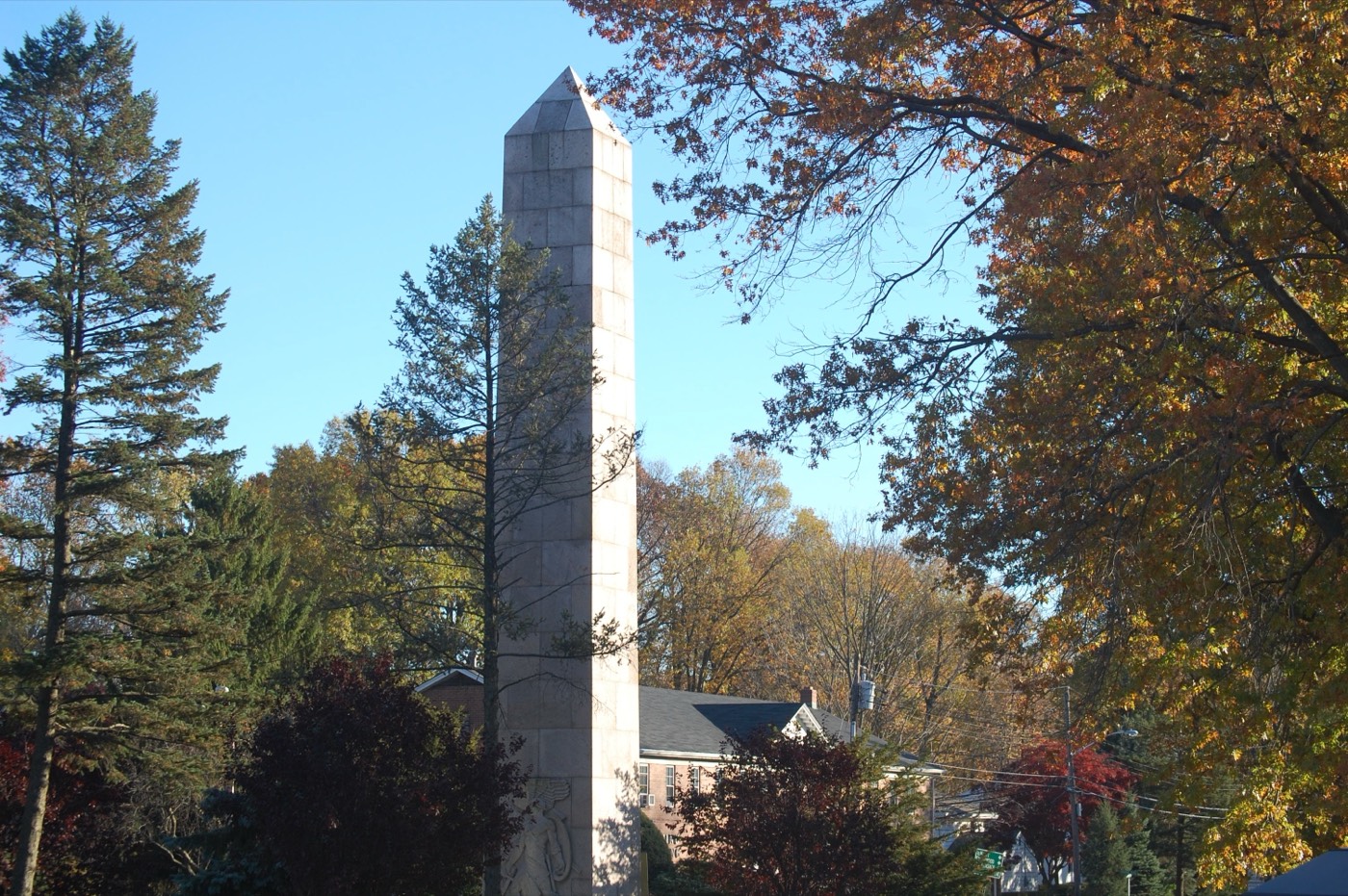
Camp Merritt Memorial Monument, Madison Avenue at Knickerbocker Road. A 66-foot granite obelisk, a near replica of the Washington Monument, marks the border of Cresskill and Dumont. It honours the soldiers who passed through the World War One embarkation camp that once stood here, where more than a million American troops staged before shipping out to Europe, and the 578 who died at the camp in the 1918 influenza epidemic. Dedicated in 1924, it is the borough’s oldest civic landmark, a fixed point that newer arrivals drive past every day, a reminder that this small town carried weight long before the Korean families came up the hill.
Korean Community Church of New Jersey, 147 Tenafly Road, Englewood. One of the older Korean Presbyterian congregations in the area, founded by fifteen members in 1972, it has long drawn worshippers from across the corridor and the valley, including Cresskill. Sunday services here are as much social anchor as religious gathering.
New Life Church of New Jersey, 283 Harrington Avenue, Closter. A Korean Presbyterian church in the next borough up, it is one of a cluster of Korean congregations that ring Cresskill on every side. For many families, church and school are the two institutions that organise the week.
H Mart, 1379 16th Street, Fort Lee. The Korean American supermarket giant, headquartered in nearby Lyndhurst, runs the grocery store that stocks Cresskill kitchens. A short drive back down toward the bridge brings families to aisles of banchan, fresh seafood and Korean produce. The chain began with a single shop in Queens in 1982 and now spans the country, but in Bergen County it remains a neighbourhood institution.
Cresskill Middle and High School, 1 Lincoln Drive. The borough’s combined upper school is, in many ways, the reason the Korean community took root here. Its reputation for academics and its high college-placement rate were the magnet that pulled families up from the corridor towns.
Cresskill Borough Hall, 67 Union Avenue. The municipal building on Union Avenue is the civic centre of a town that has had to learn to govern a fast-changing population, balancing longtime residents with newer Korean families who now sit on its boards and send their children through its schools.
Where They Came From
Most Korean families in Cresskill trace their American beginnings not to Korea directly but to the corridor towns a few miles south. The deeper origin, in Korea, is overwhelmingly the greater Seoul region, the source of the bulk of post-1965 Korean emigration to the New York area.
What set the Northern Valley families apart was often profession. The valley drew Korean professionals, business owners and corporate families, including managers posted to the New York offices of Korean conglomerates. These were households that arrived with means, or built them, and for whom a Cresskill address signalled arrival in the fullest sense.
The chain ran in two links, then, not one. From Seoul to Fort Lee and Palisades Park, and from there up the hill to Cresskill, Tenafly and Closter, each move a step further into the American suburb.
Cresskill Today
Cresskill today is a borough where roughly a third of residents are Asian and a substantial share are Korean American, woven into the ordinary life of a small town rather than concentrated in a single commercial strip. There is no Cresskill Koreatown. The Korean presence shows instead in the schools, the churches that surround the borough and the daily traffic toward H Mart and the KCC.
The community is not without its tensions. Across the Northern Valley, the rapid arrival of Korean families has sometimes strained relations with longtime residents over development, signage and the pressures of competitive schooling. Cresskill has navigated this more quietly than its neighbours, but the questions are familiar across the corridor.
What endures is the pattern that built the place. Cresskill is the town you move to once the first chapter, down by the bridge, is written. It is the second address, the one that means the schools, the house and the stake in a quiet American suburb. For thousands of Korean families, that is exactly what it has been.
Frequently Asked Questions
How many Koreans live in Cresskill, New Jersey?
Korean Americans made up about 17.8 percent of Cresskill’s population in 2010, and the borough was 31.3 percent Asian overall by the 2020 census, out of roughly 9,155 residents. That gives Cresskill one of the higher Korean shares of any Northern Valley town.
Why did Koreans move to Cresskill?
Most Koreans in Cresskill moved up from Fort Lee and Palisades Park in search of single-family homes and top-ranked schools, while staying close to the George Washington Bridge and the Korean businesses of the corridor. The strong Cresskill public school district was the central draw.
Is there a Koreatown in Cresskill?
No. Unlike Palisades Park, Cresskill has no Korean commercial strip. The Korean community there is residential and woven into the town, relying on nearby Tenafly, Englewood and Fort Lee for churches, the Korean Community Center and grocery shopping at H Mart.
What schools serve Cresskill?
Cresskill runs its own pre-K through grade twelve district of about 1,679 students, including the Edward H. Bryan and Merritt Memorial elementary schools and Cresskill Middle and High School. The high school ranks among the top fifty in New Jersey and is a major reason Korean families settled here.
Where do Cresskill’s Korean families shop and worship?
Many shop at the H Mart in Fort Lee and attend Korean Presbyterian churches that ring the borough, such as New Life Church in Closter and the Korean Community Church of New Jersey in Englewood. The Korean Community Center in Tenafly serves as a cultural and social hub.
How does Cresskill fit into Bergen County’s Korean corridor?
Bergen County holds more than 64,000 Korean residents, over half of New Jersey’s total. Cresskill sits at the upper, suburban end of the corridor that runs from heavily Korean Palisades Park and Fort Lee up through Tenafly and Closter, representing the move into spacious, school-focused suburbia.
If your family’s story passed through Cresskill, or any of the places Koreans have made home in America, Atlas of Home can trace that journey. From the apartments of Palisades Park to a colonial on a quiet Cresskill street near the best schools in the valley, to wherever you are now.