
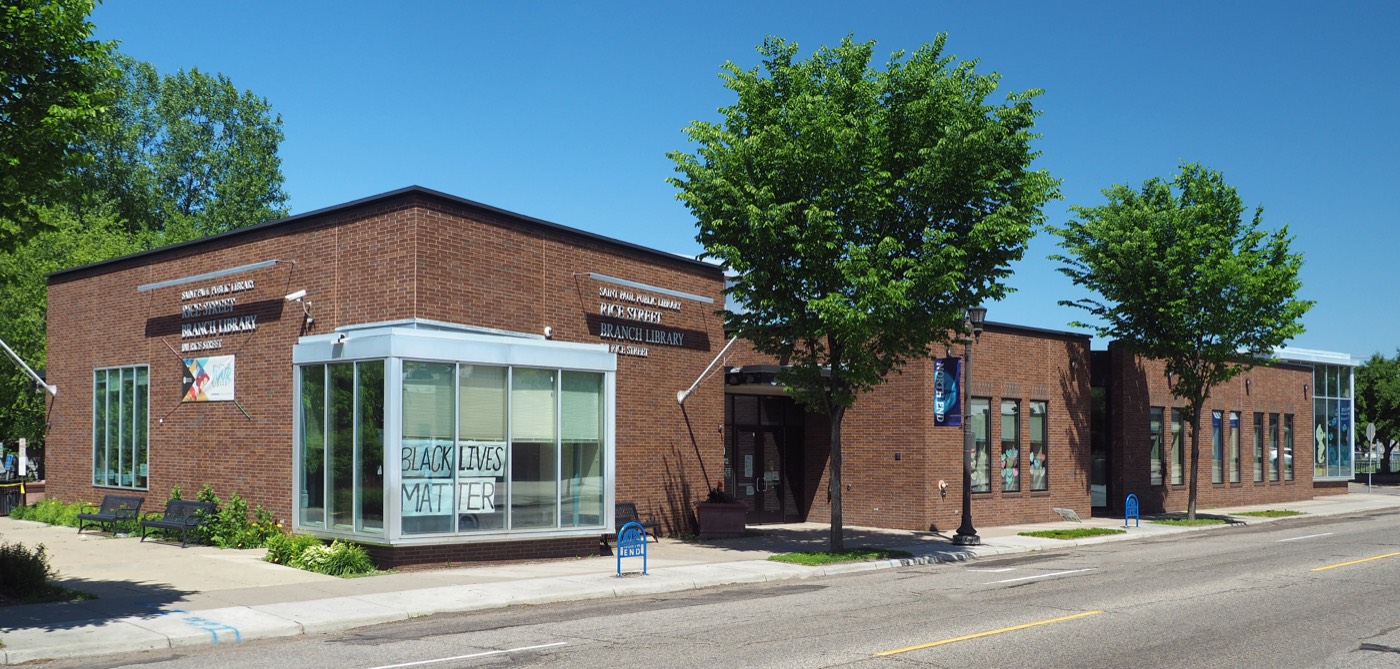
On a December morning on Rice Street, the queue outside a school gymnasium runs down the pavement in the cold, and inside there are drums, woven tunics in red and white, and a hall full of people keeping a calendar that has counted for more than twenty-seven centuries. This is Karen New Year, and the Karen in Saint Paul now form the largest community of their people anywhere in the United States. Almost all arrived after 2005, by way of a bamboo-and-thatch camp on the Thai border.
The Place
Saint Paul is the smaller and older of the Twin Cities, a river town of steep bluffs, Catholic spires and brick corner shops that never quite got the skyline its neighbour did. Its northern and eastern flanks are the working half: the North End along Rice Street, and the East Side spreading from Payne Avenue and Arcade Street towards Lake Phalen.
These were factory neighbourhoods. Hamm’s Brewery, 3M and Whirlpool employed people who walked to work, and Payne Avenue has been the East Side’s commercial spine since the 1930s. The plants closed between the 1980s and the 2000s and the storefronts emptied out.
What refilled them was arrivals. In 1980 the Payne-Phalen district was about 95 per cent white; by 2020 that share had fallen to roughly 30 per cent and a majority of residents were Asian. Rice Street and Arcade Street now carry signs in Karen script, a round alphabet descended from Burmese that most Americans have never seen.
How It Became Karen
A war older than the country that started it
The Karen are one of Burma’s largest ethnic minorities, hill and delta people with their own language, their own script and, since British colonisation, a substantial Christian minority alongside Buddhists and animists. They fought alongside the British in the Second World War and expected a state of their own when it ended. They did not get one.
Burma became independent in 1948, and by the end of that year the Karen were at war with the new government. That war has never properly finished. After the 1962 military coup the Karen language was banned from schools, so for sixty years Karen children learned to read their own alphabet in churches, in monasteries or in refugee camps, and never in a classroom the state would recognise.
The camps on the Thai border
From the 1980s onward, villages in the Karen hills were burned, mined and emptied. People walked east. Along the Thai side of the border a chain of nine camps grew up and then hardened into permanence: Mae La, Umpiem, Nu Po, Mae La Oon, Mae La Ma Luang, Ban Mai Nai Soi, Ban Mae Surin, Ban Don Yang and Tham Hin. As recently as 2015 they still held roughly 93,000 people, around 84 per cent of them Karen.
Mae La is the largest, a town of bamboo houses on stilts pressed against a limestone cliff in Tak Province, home to some 45,000 people. Children were born there, married there and had children of their own there. Nobody was permitted to work outside the fence.
The gate opens, 2006
In December 2006 the UN refugee agency put 43 per cent of Mae La’s registered population forward for resettlement, and the American doors opened wider than they had in years. Between October 2006 and August 2007 alone, roughly 12,800 Karen refugees were resettled in the United States, most of them out of Mae La.
Minnesota took an unusually large share. Its voluntary resettlement agencies actively promoted the state, and 667 refugees from Burma arrived in the grant year beginning October 2006. A handful of Karen families had come earlier, from about 2000, which mattered enormously: there were already people here who could meet a plane.
Why Saint Paul and not somewhere warmer
Minnesota was not chosen for the weather. It was chosen because the state had spent thirty years learning how to receive refugees from the highlands of Southeast Asia.
The Hmong who settled Saint Paul’s East Side from the 1970s had built the infrastructure without meaning to: interpreter networks, ESL classrooms, Southeast Asian grocers, landlords used to large households, clinics that knew what a rice-and-fish-paste diet looked like. Karen families arriving in 2006 walked into a city where that institutional work had already been done once.
Then came secondary migration, which the official figures always miss. Families placed in Texas, Georgia or upstate New York packed up and drove to Saint Paul because a cousin was here, because a church held services in Sgaw Karen, because someone said there was work. That is the single biggest reason the population outgrew the resettlement numbers.
Building the institutions
The community did not wait to be organised. The Karen Organization of Minnesota was founded by Karen refugees themselves, the first social services agency in the country established that way, and it now serves more than 2,000 people a year.
Churches multiplied fastest. Karen Baptist congregations opened across the city and its inner suburbs, and today the majority of members of Saint Paul’s Baptist congregations are Karen. Buddhist Karen founded their own societies and temples. More than two dozen Karen-owned businesses have opened since the first families arrived. In 2014 Ler Htoo graduated from the Saint Paul Police Academy and is believed to be the first police officer of Karen ethnicity anywhere in the United States.
The classroom the junta would not allow
The most remarkable thing the Karen have done in Saint Paul happened in a school district office. Parents began asking for Karen language classes in 2016. The request went nowhere, was revived in 2021, and in the autumn of 2023 Saint Paul Public Schools began teaching Karen at four high schools: Como Park, Harding, Humboldt and Washington Technology, with an online option district-wide.
District staff believe it is the first Karen language instruction ever offered by a public school system in the United States. Around 341 pupils enrolled in the first year. Middle schools followed, and Karen kindergarten classes started at Wellstone Elementary in 2024.
Karen is now the fifth most common home language among Minnesota’s public school pupils, spoken by roughly 4,700 students statewide, more than half of them in Saint Paul.
The Landmarks
Karen Organization of Minnesota, 2353 Rice Street, Suite 240, Roseville. The first social services agency in the country founded by Karen refugees from Burma, and still the largest Karen organisation in the United States. It sits at the northern end of the same Rice Street that runs down through the North End, which is no coincidence.
Karen Culture Organization of Minnesota, 1380 Jessie Street, Saint Paul. A modest building off the East Side’s industrial edge doing the work no grant asks for: the annual wrist-tying ceremony, the organising behind Karen New Year, and dance classes teaching Minnesota-born teenagers steps their grandmothers learned in a camp.
Washington Technology Magnet School, 1495 Rice Street. One of the four Saint Paul schools that began teaching Karen for credit in 2023, and the venue that has hosted the two-day Karen New Year celebration. For a people whose language was outlawed at home, a school gymnasium full of drums on a December weekend is not a small thing.
Kyaw Karen Market, 945 Rice Street. A neighbourhood grocery with a deli counter serving Burmese curries to people who came in for roselle leaves and fermented fish paste. It is the kind of shop that doubles as a noticeboard and a job centre.
Friends Cafe, 1711 Rice Street. Opened in 2014 by a group of Burmese friends and taken over in 2017 by the parents of a young woman who grew up in the trade. It serves the food of Myanmar to Karen, Karenni and Burmese customers, and increasingly to Minnesotans who heard the tea leaf salad was worth the drive.
Karen Marketplace and Restaurant, 1377 Arcade Street. Formerly the Original Karen Market, and one of the East Side’s genuine hidden rooms: a small shop of vegetables, frozen meats and household goods with a restaurant tucked in the back serving Burmese breakfast. Arcade Street is the quieter of the community’s two spines.
Emmanuel Karen Baptist Church, 400 Oxford Street North, Saint Paul. One of a cluster of Karen Baptist congregations across the city and its edges, including First Karen Baptist Church just over the line in Oakdale. Karen Baptist Christianity dates to nineteenth-century American missionaries in Burma, so these churches are not a new adaptation. They are the oldest thing the community brought with it.
Where They Came From
Almost every Karen family in Saint Paul can name a camp. Mae La is heard most often, with Umpiem, Nu Po, Mae La Oon and Tham Hin close behind. Before the camps came villages in Karen State and the eastern hills, and in the Irrawaddy delta, though the delta Karen and the hill Karen do not always share a dialect.
About seven in ten Karen refugees speak Sgaw Karen; a smaller share speaks Pwo Karen, and the two differ enough in pronunciation that a speaker of one may not follow the other. Sgaw is what you hear on Rice Street, and what Saint Paul Public Schools teaches.
Religion divides along old lines too. There are Baptist, Catholic, Buddhist and animist Karen, and in Saint Paul all of them live within a few miles of each other. Lineage is traced through the female line. Wrist-tying, in which a thread is bound around the wrist to keep the soul from wandering, is performed at Christmas, at Easter and at the Buddhist New Year alike, which tells you how this community holds its differences.
Beyond Ramsey County, where the great majority live, smaller Karen communities have taken root in Albert Lea, Austin, Marshall and Willmar, drawn by meatpacking work and cheaper housing.
Saint Paul Today
More than 20,000 Karen people now live in Minnesota, the largest concentration in the country, and Saint Paul holds the core of it. The city library system has published children’s books in Karen. The state produces hunting and fishing regulations and driver’s licence materials in the language. Small administrative facts, and together they mean something: a community no longer being processed, but counted.
It is not a finished story. The 2021 coup in Myanmar reopened the war the camps exist because of, and families here still send money to relatives who never got out. Two Saint Paul homeless encampments have had significant Hmong and Karen populations, a reminder that arriving early does not guarantee arriving safely.
Still, the arc is legible. The first families landed in a city that had done this before, and twenty-five years later there is a police officer, a school curriculum, two dozen businesses and a New Year celebration that fills a gymnasium on Rice Street. It helped that the Hmong of Maplewood and the East Side had built the road first, and that Saint Paul, long shaped by Mexican families on the West Side and by newer Indian communities in Woodbury and Eden Prairie, was already a place where arriving was ordinary.
Frequently Asked Questions
How many Karen people live in Saint Paul, Minnesota?
More than 20,000 Karen people live in Minnesota, the largest Karen population of any US state, and most are in Ramsey County with Saint Paul at the centre. The Karen in Saint Paul are widely described as the largest and fastest-growing Karen community in the country.
Why did Karen refugees settle in Saint Paul?
Minnesota’s resettlement agencies promoted the state during the large waves of 2006 and 2007, and the infrastructure built for Hmong refugees from the 1970s onwards made it workable. Secondary migration then multiplied the numbers as families placed in other states moved to join relatives.
Where are the Karen from?
The Karen are an ethnic group from Burma, now Myanmar, in armed conflict with the central government since 1948. Most Karen families in Saint Paul came via refugee camps on the Thailand-Burma border, above all Mae La in Tak Province, where some spent two decades or more.
Where is the Karen neighbourhood in Saint Paul?
There is no single Karen neighbourhood, but the community clusters along the Rice Street corridor through the North End and across the East Side around Arcade Street and Payne Avenue, plus the inner suburbs of Roseville, Maplewood and Oakdale.
Do Saint Paul schools teach the Karen language?
Yes. Saint Paul Public Schools began teaching Karen for credit in autumn 2023 at Como Park, Harding, Humboldt and Washington Technology, believed to be the first such programme in any US public school district. Karen kindergarten instruction started at Wellstone Elementary in 2024.
What religion are the Karen in Saint Paul?
Both Christian and Buddhist, with animist practice woven through both. Baptist Christianity reached the Karen through American missionaries in nineteenth-century Burma, and Karen members now make up the majority of Saint Paul’s Baptist congregations.
If your family’s story passed through Saint Paul, or any of the places the Karen have made home in America, Atlas of Home can trace that journey. From a bamboo house on stilts at Mae La to a shopfront on Rice Street, to wherever you are now.