
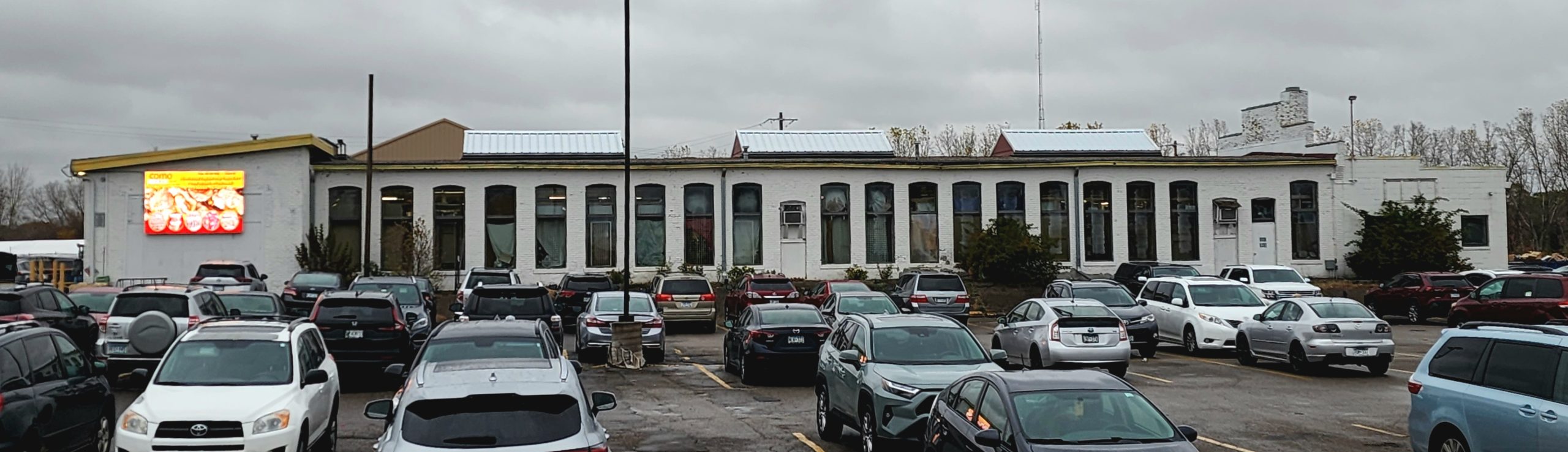
On a Saturday morning at 217 Como Avenue, the parking lot fills before the cold has burned off. Inside the East and West buildings of Hmongtown Marketplace, the air is thick with the smell of cilantro and pork sausage, lemongrass and bitter melon.
A woman in a stall lined with hanging silver jewellery is folding a paj ntaub story cloth, her thumb tracing a row of figures crossing the Mekong by raft. From a small speaker somewhere down the aisle, a recording of a qeej, the six-pipe bamboo mouth organ, plays a tune that everyone in the building seems to know and nobody is listening to. Outside, the St. Paul wind is doing what the St. Paul wind always does.
St. Paul, The Place
St. Paul is the older, quieter twin. It sits on the east bank of the Mississippi, a city of brick warehouses, river bluffs, and long winters that pin the sky low for half the year. The Hmong neighbourhoods cluster in two arcs: the Thomas-Dale district known locally as Frogtown, just west of the State Capitol, and the East Side, the broad working-class flank of the city that runs out toward the Bruce Vento Nature Sanctuary and the Johnson Parkway.
University Avenue ties the two together. The Green Line light rail runs down its middle now, past pho shops and Hmong herbalists and Vietnamese bakeries in the cultural district known as Little Mekong. The houses are mostly small frame Victorians and post-war bungalows, the kind of stock that was cheap enough in 1980 for a refugee family to rent and, eventually, to buy.
How St. Paul Became Hmong
Before the Hmong
Frogtown took its name, depending on which old-timer you ask, from the marshy ground that froze into ponds full of frogs each spring, or from the German Froschberg given by the first wave of settlers. Either way, the neighbourhood was built between roughly 1860 and 1900 by Germans, Poles, Czechs, Swedes, and Irish working the railroads and the meatpacking plants north of downtown.
St. Adalbert’s, the first Polish parish in the Twin Cities, was founded in Frogtown in 1881. Down the avenue, the soaring red-brick Church of St. Agnes went up between 1909 and 1912 to serve a German congregation. The East Side, where Hmong Village stands today, was a similar story: Swedes, Italians, and African American families who had moved up from the South sharing a grid of small wood houses and a few big factories.
By the 1970s much of that earlier population had aged out, moved to the suburbs, or both. The houses were tired. The rents were low. St. Paul was, by accident, a city with empty rooms.
The Hmong Arrive
On 5 May 1975 in Long Tieng, the secret CIA airbase in the highlands of northern Laos, General Vang Pao took the stars off his collar, dropped them on the prime minister’s desk, and walked out. For thirteen years he had led a Hmong army recruited and equipped by the Central Intelligence Agency to fight the Pathet Lao and to harass the North Vietnamese supply lines that ran through eastern Laos. Some twelve thousand Hmong soldiers had died in what was, on paper, a war that did not exist.
When the Pathet Lao took Vientiane that summer, the Hmong who had fought alongside the Americans were marked. Families walked for weeks through the highlands to the Mekong, then crossed by raft and inner tube into Thailand. The first arrivals were funnelled into refugee camps: Nam Phong, Ban Vinai, later Phanat Nikhom, and last of all the Buddhist monastery at Wat Tham Krabok.
The first Hmong family in Minnesota was Dang Her and his wife Shoua Moua, who landed on 5 November 1975. The U.S. State Department had given resettlement contracts to a small constellation of voluntary agencies, and Minnesota happened to be where Lutheran Social Service, Catholic Charities, Church World Service, and the American Red Cross all had strong field operations. Governor Wendell Anderson set up an Indochinese Resettlement Office in December 1975 to coordinate the work.
The agencies did not pick Frogtown for the Hmong. Frogtown picked itself. Once a few families had been placed there, more followed, sponsored across by relatives, then by clan brothers, then by clan brothers of clan brothers. The Refugee Act of 1980 unlocked larger waves. By the middle of the decade, certain census tracts west of the Capitol were tipping Hmong block by block.
St. Paul at Its Peak
By the late 1990s, Frogtown census tracts had passed a thousand Hmong residents each. The community had its own newspapers, its own radio programs on AM 690, its own grocery stores along University Avenue, its own clan associations meeting in basements and rented halls. The Hmong American Partnership, founded as a 501(c)(3) on Arcade Street on the East Side in August 1990, became the largest Hmong nonprofit in the country.
The Hmong Cultural Center opened in 1992 at 995 University Avenue West, the first of its kind in the Midwest, with a library, a Hmong 101 program for non-Hmong neighbours, and a small collection that would grow into a museum. Two years later, the Hmong New Year celebration moved into the Saint Paul RiverCentre downtown, where it now draws roughly forty thousand people a day across two days at the end of November.
In January 2002, the East Side sent Mee Moua to the Minnesota Senate in a special election, making her the first Hmong American elected to any state legislature in the country. She represented Senate District 67, which had the highest concentration of Hmong Americans of any district in the United States. She kept the seat through 2010.
The marketplace era began in March 2004, when Toua Xiong and his wife Nou Vang Xiong bought the old Shaw Stewart Lumber site at 217 Como Avenue, six acres of warehouses and yard just north of the Capitol. Toua had arrived in St. Paul in 1986 at seventeen years old, settled in Frogtown, and worked his way up. He opened the site as International Marketplace, renamed it Hmongtown Marketplace in 2009, and watched it become the cultural anchor of Hmong St. Paul.
The Change
The last wave arrived in 2004 and 2005, when the Thai government finally closed Wat Tham Krabok, the monastery camp that had sheltered the holdouts after Ban Vinai shut down in 1992. Roughly fifteen thousand Hmong were resettled to the United States in that final movement, the largest single share to Minnesota, California, and Wisconsin. Saint Paul Public Schools built Transitional Language Centers to absorb about a thousand newcomer Hmong children.
Hmong Village followed in November 2010, a second and even larger indoor market built on the East Side at 1001 Johnson Parkway, with more than 250 vendors, seventeen restaurants, and ten farmers stalls inside a single climate-controlled shell. By then the community was no longer young. The first generation was greying. The second was in college, in law school, in the State Legislature, in startups along the Green Line.
The Landmarks of Hmong St. Paul
Hmongtown Marketplace, 217 Como Avenue. Opened in 2004 on the old Shaw Stewart lumberyard, this is the cultural anchor: two big warehouses, an outdoor food court in summer, hundreds of stalls selling everything from sticky rice in banana leaves to silver wedding necklaces. The first Hmong-owned and operated marketplace in the United States.
Hmong Village, 1001 Johnson Parkway. The East Side’s answer to Hmongtown, opened in November 2010. Larger, glossier, all indoors. Locals argue about which is better the way Italians argue about red sauce.
Hmong Cultural Center, 995 University Avenue West. Founded in 1992 in the Little Mekong cultural district. A library, a museum, and the home of the Hmong 101 program, which has explained Hmong history to thousands of non-Hmong Minnesotans over three decades.
Hmong American Partnership headquarters, 1075 Arcade Street. Founded August 1990, now the largest Hmong nonprofit in the country, serving roughly seven thousand people a year across eighteen nationalities. The clearest expression of how the Hmong settlement here turned outward.
Saint Paul RiverCentre, 175 West Kellogg Boulevard. Site of the Minnesota Hmong New Year since 1994. Two days of pageant, qeej competitions, paj ntaub stalls, and the courtship ball-toss game called pov pob, drawing crowds approaching eighty thousand over the weekend.
Church of St. Agnes, 535 Thomas Avenue. A ghost landmark in a different sense: the Bavarian-baroque German Catholic church that anchored Frogtown when Frogtown was German is now ringed by Hmong-owned houses, its parish still active, the neighbourhood reshaped twice around it.
Hmong College Prep Academy. Founded by Dr. Christianna Mai-Choua Hang as a K-12 charter school in 2004, moved to its St. Paul campus in 2006. A Hmong-led school that sends graduates to the University of Minnesota every spring.
Where the St. Paul Hmong Came From
Almost all of the Hmong in St. Paul trace their families to the highlands of northern Laos: Xieng Khouang province, where the limestone karst of the Plain of Jars rises out of red-earth farmland, and Houaphanh, Luang Prabang, and Sayaboury along the Vietnamese and Thai borders. A smaller number came through China and Thailand directly.
The route from village to St. Paul went through camps. Nam Phong took the first soldiers in 1975. Ban Vinai held forty-two thousand people at its peak in 1986. Phanat Nikhom was the processing centre for resettlement. Wat Tham Krabok, the Buddhist monastery north of Bangkok, absorbed the holdouts and the latecomers until 2004.
The Hmong organise themselves through xeem, the patrilineal clans. There are eighteen recognised in Minnesota, and the Hmong 18 Council of Minnesota convenes their elders.
The names ring through any roll call of St. Paul: Yang, Vang, Lee, Xiong, Thao, Moua, Lor, Her or Hawj, Kue, Cha or Chang, Hang, Vue, Fang, Chao, Cheng, Chue, Khang, Kong. Clan members count themselves as kin, and Hmong tradition forbids marriage within a clan, which means clans braid into each other across the city the way streets do. You introduce yourself in St. Paul, and your last name tells half the room which uncle to call.
St. Paul Today
The Twin Cities metro now holds an estimated sixty-six thousand Hmong Minnesotans, and the Hmong Cultural Center has put the statewide figure above ninety-five thousand. Roughly thirty thousand live in St. Paul proper, still the largest urban Hmong community in the country. Fresno and Sacramento have higher state-level totals, but spread across farm valleys; St. Paul is where the streetscape is Hmong.
The second generation runs the place now. Foung Hawj sits in Mee Moua’s old Senate seat. Tou Xiong holds another. Susan Pha is a council member in Brooklyn Park. Hmong-owned restaurants like Union Hmong Kitchen and Vinai have made larb, papaya salad, and General Vang Pao’s chicken wings part of the regional vocabulary alongside walleye and tater-tot hotdish.
Hmong are not the only newer arrivals on the East Side anymore. Karen families from Burma, Somali families up from Minneapolis, Latino families along Payne Avenue: the neighbourhood is layered again.
The first generation, those who walked out of Long Tieng in 1975 or out of Wat Tham Krabok in 2004, are growing old in the houses they bought thirty and forty years ago. Some are returning to Laos for retirement, or for business. Many never will.
On the last Saturday in November, when the qeej players line up at the RiverCentre and the pov pob balls start arcing across the floor, the city forgets, for two days, that it is in Minnesota at all.
Frequently Asked Questions
Why did Hmong refugees settle in St. Paul?
The Hmong in St. Paul, Minnesota arrived because the United States resettled refugees through voluntary agencies, and Lutheran Social Service, Catholic Charities, and Church World Service all had strong operations in Minnesota when the first families arrived in November 1975. Once a few Hmong families were placed in Frogtown and on the East Side, chain migration through clan and family networks pulled tens of thousands more, and Minnesota’s public housing, jobs, and welcoming state Indochinese Resettlement Office cemented the city as a hub.
Is St. Paul still Hmong today?
Yes. Roughly thirty thousand Hmong live in St. Paul proper and around sixty-six thousand in the Twin Cities metro, still the largest urban Hmong community in the United States. Frogtown and the East Side remain the cultural cores, anchored by Hmongtown Marketplace, Hmong Village, the Hmong Cultural Center, and the annual Hmong New Year at the Saint Paul RiverCentre.
What are the most famous Hmong landmarks in St. Paul?
The two big indoor markets define the community: Hmongtown Marketplace at 217 Como Avenue, opened in 2004 by Toua and Nou Xiong, and Hmong Village at 1001 Johnson Parkway, opened in November 2010. Other anchors include the Hmong Cultural Center at 995 University Avenue West, the Hmong American Partnership at 1075 Arcade Street, and the Minnesota Hmong New Year celebration each November at the RiverCentre.
Where in Laos did the St. Paul Hmong come from?
The Hmong in St. Paul, Minnesota are overwhelmingly from the highland provinces of northern Laos: Xieng Khouang, Houaphanh, Luang Prabang, and Sayaboury. Most families came via Thai refugee camps including Ban Vinai, Phanat Nikhom, and the Wat Tham Krabok Buddhist monastery, the last of which closed in 2004 and 2005 and sent the final wave of Hmong refugees to St. Paul.
When did Hmong refugees first arrive in St. Paul?
The first Hmong family in Minnesota, Dang Her and his wife Shoua Moua, arrived on 5 November 1975, six months after the fall of Vientiane to the Pathet Lao. Larger waves followed after the Refugee Act of 1980, again in the late 1980s and early 1990s, and a final wave of about fifteen thousand from Wat Tham Krabok in 2004 and 2005.
If your family’s story passed through St. Paul, or anywhere along the Mekong before that, Atlas of Home can trace the journey. From the highland villages of Xieng Khouang to the camps at Ban Vinai and Wat Tham Krabok, to Frogtown and the East Side, to wherever you are reading this.