
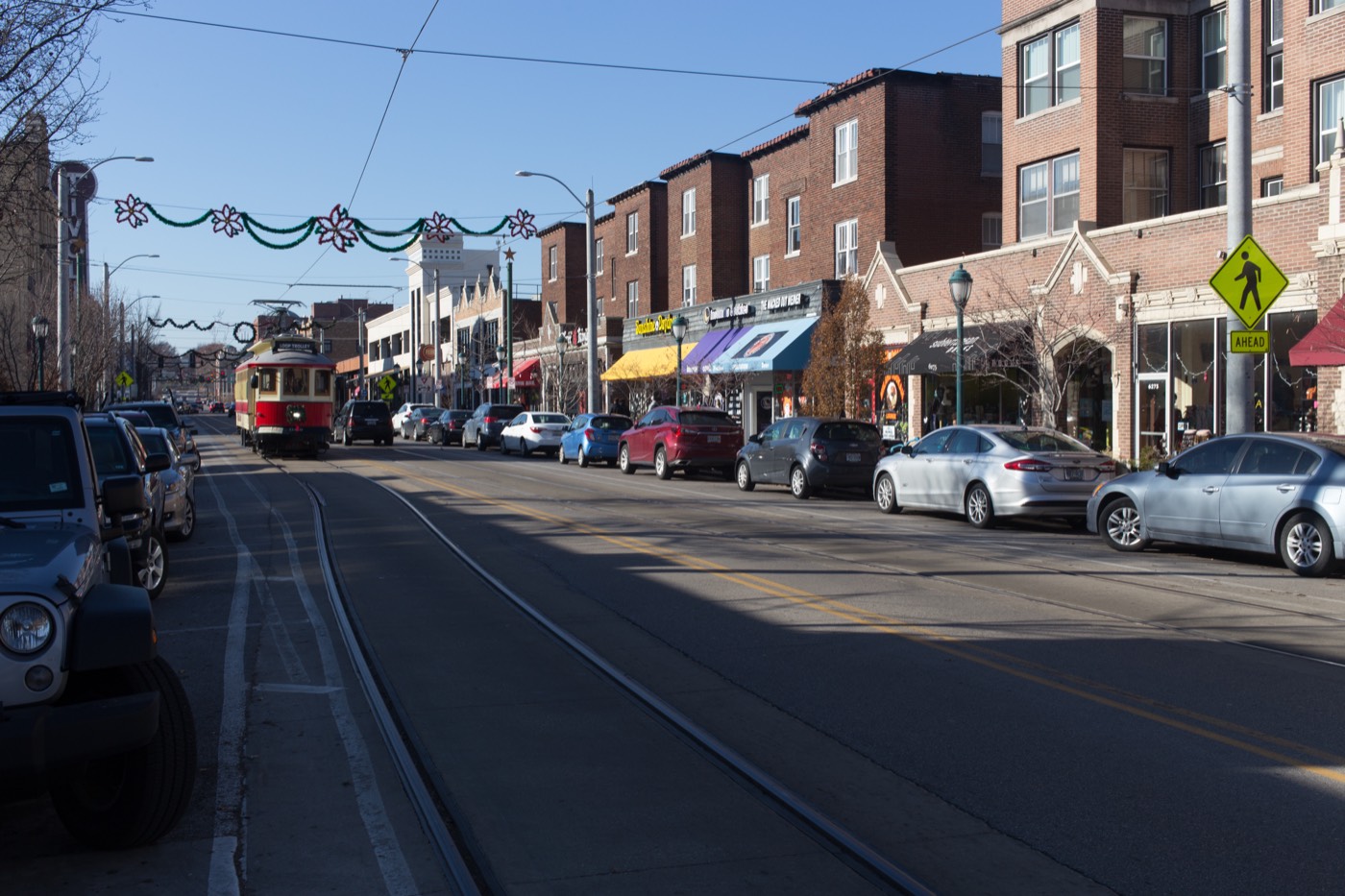
On a Saturday morning along Delmar Boulevard, you can still read the older St Louis in the quiet. The cars stay parked. Families walk to shul in the cool light, past the brick storefronts of the Loop, and for a few hours the street belongs to the Jews in University City, the people who turned a streetcar suburb into the centre of Orthodox life west of the Mississippi.
The Place
University City sits just west of the St Louis city limit, an inner-ring suburb in St Louis County named for its proximity to Washington University. The 2020 census counted 35,065 residents.
It was the invention of one man. The publisher Edward Gardner Lewis bought 85 acres in 1902, near the grounds of the coming World’s Fair, to house the headquarters of his Woman’s Magazine and to build a model city around it.
University City was formally incorporated in September 1906, with Lewis as its first mayor. He left behind an ornate octagonal City Hall, a 135-foot tower that began life as his Magazine Building, and a pair of stone lions guarding the entrance to University Heights. The grandeur was the bait. What filled the streets afterward was something Lewis never planned.
How It Became Jewish
The Jews of St Louis did not arrive in University City. They moved there, in stages, across half a century, always one neighbourhood further west than the year before.
The eastern beginnings
The first large wave came from Russia and the Pale of Settlement in the 1880s and 1890s. They settled densely in the near north side of the city, in neighbourhoods like Carr Square, which by the early 1900s held a thick lattice of Jewish bakeries, kosher butchers and small synagogues.
Even then, the community was already planting roots out west. In 1893, a group of Russian immigrants founded the Chesed Shel Emeth Cemetery in University City, established so that Jewish burial would be available to anyone regardless of means. The burial ground predated the great residential migration by half a century. The dead reached University City before the living.
The march west
As the immigrant generation prospered, it moved. Through the 1910s and 1920s the centre of Jewish St Louis shifted into the West End of the city. By the 1940s, as the population kept expanding westward, it crossed the line into University City and Clayton in St Louis County.
This was the classic American pattern of upward mobility read across a map. Each move was a step out of the immigrant quarter and into a leafier street, and University City, with its broad boulevards and solid brick houses, was exactly the kind of place a second-generation family aspired to.
Building in brick and concrete
When the congregations followed their members west, they built. The most remarkable result still stands at 524 Trinity Avenue, just off the Loop.
In 1950 Congregation B’nai Amoona commissioned the German modernist Erich Mendelsohn to design its new home. It was Mendelsohn’s first completed work in the United States, and many regard it as among his finest. The sanctuary is crowned by a sweeping parabolic roof of steel and reinforced concrete that cantilevers out over a glass wall, a piece of architecture that looks like motion frozen in stone.
The building’s later life tells the rest of the story. B’nai Amoona itself moved further west, and in 1986 developer Richard Baron and local leaders turned the synagogue into the Center of Contemporary Arts, known as COCA. The Mendelsohn building is now on the National Register of Historic Places, a former house of prayer reborn as a school for dancers and painters.
The Orthodox core takes hold
While Reform and Conservative congregations eventually drifted on toward Creve Coeur and Olivette, a distinct thing happened in University City. An Orthodox neighbourhood settled in and stayed, because Orthodox life depends on walking distance.
The community built an eruv, the ritual boundary that permits observant Jews to carry on Shabbat, encompassing the streets around Delmar Boulevard. Synagogues clustered inside it. Young Israel of St Louis sits in the heart of the eruv at 8101 Delmar Boulevard and maintains a mikvah used by the wider community. Agudas Israel of St Louis stands close by at 8202 Delmar.
The institutions multiplied around them. The Vaad Hoeir, the United Orthodox Jewish Community of St Louis, has anchored kosher certification and communal authority here for over eighty years. In 2019 the Epstein Hebrew Academy, the city’s first Orthodox Jewish day school, bought a new building in University City and moved in the following January, drawing young families even closer to the centre.
The Landmarks
Chesed Shel Emeth Cemetery, University City. Founded in 1893 by Russian immigrants, this is the oldest thread of Jewish University City, with roughly 22,500 plots and headstones carved in English, Hebrew and Yiddish. In February 2017 a vandal toppled 154 of them, an act that drew national attention and a wave of repair donations from neighbours of every faith. The man charged was later found to have acted out of drunken anger rather than antisemitism, but the community’s response had already become the real story.
The Mendelsohn Building (COCA), 524 Trinity Avenue. Built in 1950 as Congregation B’nai Amoona, this was Erich Mendelsohn’s first American commission, its parabolic concrete roof sweeping over the old sanctuary. Since 1986 it has housed the Center of Contemporary Arts. It is the single most beautiful object the Jewish migration left in University City.
Young Israel of St Louis, 8101 Delmar Boulevard. An Orthodox congregation sitting in the heart of the St Louis eruv, with a mikvah serving observant families across the area. Its members have long staffed the institutions that hold the neighbourhood together, from the Vaad Hoeir to the day school.
Agudas Israel of St Louis, 8202 Delmar Boulevard. Another Orthodox congregation a few doors along the same boulevard, part of the dense cluster of shuls that let families walk to prayer on Shabbat without crossing the eruv’s edge.
The Delmar Loop. The entertainment district that runs along Delmar Boulevard took its name from a turn-of-the-century streetcar that looped back toward downtown. By the 1960s the trolley was gone and the street had fallen into decline, until Joe Edwards opened Blueberry Hill at 6504 Delmar in 1972 and slowly revived it. Today the Loop is the seam where Jewish residential University City meets the wider city, and the American Planning Association has named it one of the great streets of America.
University City Hall, Delmar Boulevard at Princeton Avenue. The octagonal tower that began as Edward Gardner Lewis’s Magazine Building in 1903, flanked by the stone lions of the University Heights gateway. It is the civic face of the town the Jewish community made its own, and a reminder that the place was built as a dream of culture long before that dream took a particular shape.
Epstein Hebrew Academy, University City. The first Orthodox Jewish day school in St Louis, it consolidated the older talmud torahs and, in 2020, moved into a new University City home. Its presence keeps young observant families anchored to the neighbourhood, the surest sign that the community is not merely ageing in place.
Where They Came From
The deepest roots run back to the Russian Empire and the Pale of Settlement. The founders of Chesed Shel Emeth in 1893 were Russian immigrants, part of the great exodus that fled pogroms and poverty in the 1880s and 1890s and poured into the port cities and inland industrial towns of America.
They were largely Yiddish-speaking Eastern European Jews, traditional and Orthodox in their practice, which is why the institutions they eventually built in University City leaned that way. The cemetery’s headstones, carved in Hebrew and Yiddish as well as English, record the languages they carried across the Atlantic.
From the near north side of St Louis, they moved in their own internal migration: north city to the West End, the West End across the county line, and finally into the streets around Delmar. The origin was Eastern Europe. The geography of belonging was rewritten one suburb at a time.
University City Today
University City today is mixed and middle-class, no longer a place where any single group dominates. The 2020 census recorded a population that was roughly 49 per cent White, 37 per cent Black and 6.5 per cent Asian, a portrait of a genuinely shared inner suburb rather than an ethnic enclave.
The Jewish presence has thinned at its edges, as the broader community’s centre of gravity has shifted toward Creve Coeur and Olivette and the institutions of the further suburbs. Pratzel’s, the kosher bakery that had served St Louis since 1913, and Diamant’s kosher market both closed in 2011, the kind of quiet losses that mark a community in transition.
Yet the Orthodox core endures, precisely because it cannot easily leave. The eruv, the mikvah at Young Israel, the day school that moved in as recently as 2020: these tie observant families to walking distance of Delmar Boulevard in a way no amount of suburban pull can undo. On a Shabbat morning, the old pattern holds. The street still empties of cars, and fills with people walking to pray, the way it has for the better part of a century.
For families tracing the St Louis chapter of their story, University City is where so many threads meet: the immigrant cemetery of 1893, the Mendelsohn roof of 1950, the storefronts of the Loop, and the synagogues whose members never moved on. You can read other Jewish migrations that ran the same way, out from the immigrant quarter to the leafy suburb, in places like Creve Coeur, the next stop west for much of St Louis Jewry, and further afield in West Rogers Park in Chicago, Squirrel Hill in Pittsburgh, and the New York neighbourhoods of Forest Hills, Kew Gardens Hills and Midwood. The same arc, a continent over: the immigrant city, the long walk west, the shul you could reach on foot.
Frequently Asked Questions
When did Jews settle in University City, Missouri?
The earliest Jewish foothold was the Chesed Shel Emeth Cemetery, founded by Russian immigrants in 1893. The residential migration came later: by the 1940s the Jews of St Louis were moving west across the city line into University City and Clayton, settling the neighbourhood that survives today.
Why did the Jewish community move to University City?
The Jews in University City arrived through a steady westward migration from the older immigrant quarters of north St Louis, following the same path of upward mobility that drew many American Jewish families to leafier suburbs. University City’s broad boulevards and solid brick homes made it a natural destination as the community prospered through the 1930s and 1940s.
What is the most important Jewish landmark in University City?
Architecturally, it is the old Congregation B’nai Amoona synagogue at 524 Trinity Avenue, designed in 1950 by Erich Mendelsohn in his first American commission and now home to the Center of Contemporary Arts. Spiritually, the cluster of Orthodox synagogues along Delmar Boulevard, inside the St Louis eruv, remains the living heart of the community.
Is there still an Orthodox Jewish community in University City?
Yes. University City holds the Orthodox core of Jewish St Louis, bound together by an eruv along Delmar Boulevard, synagogues such as Young Israel and Agudas Israel, a mikvah, and the Epstein Hebrew Academy, which moved into University City in 2020. Observant families remain within walking distance of the shuls.
What happened at Chesed Shel Emeth Cemetery in 2017?
In February 2017 a vandal toppled 154 headstones at the cemetery, which dates to 1893. The act drew national attention amid a wave of threats against Jewish sites, and prompted an outpouring of donations and repair help from neighbours across the St Louis area.
What is the Delmar Loop’s connection to the Jewish community?
The Delmar Loop is the commercial spine running through University City, and the residential streets of the Jews in University City spread around it. The same boulevard carries Young Israel and Agudas Israel at its western end and Joe Edwards’s revived entertainment district, including Blueberry Hill, further east.
If your family’s story passed through University City, or any of the places Jews have made home in America, Atlas of Home can trace that journey. From the shtetls of the Russian Pale to a cemetery founded in 1893, to the synagogues along Delmar Boulevard, to wherever you are now.