
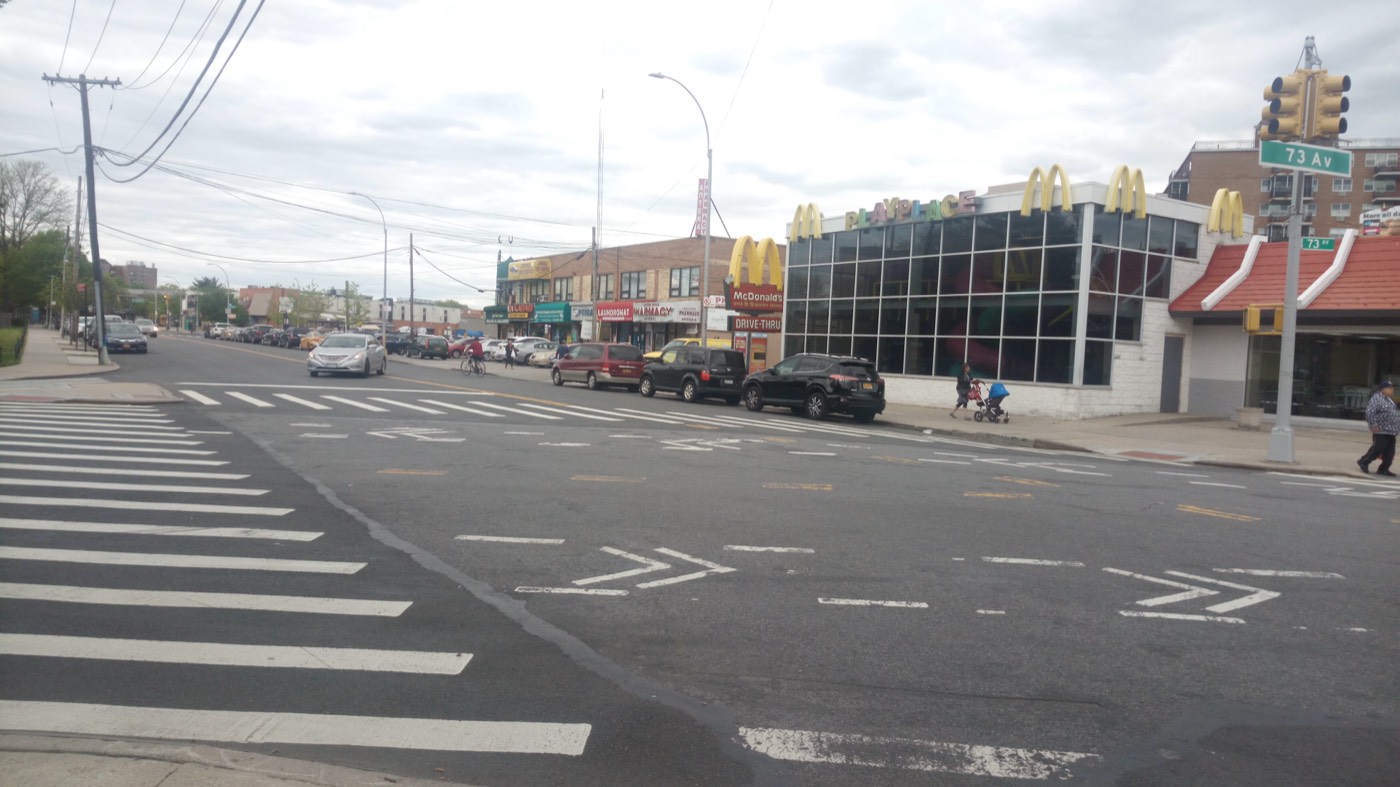
On a Friday afternoon, Main Street in Kew Gardens Hills empties before sundown. Shutters roll down over kosher bakeries and butchers, the bus traffic thins, and the Jews in Kew Gardens Hills walk home in their finest for Shabbat. It is one of the densest pockets of observant Jewish life anywhere in New York City, tucked into the geographic centre of Queens.
The Place
Kew Gardens Hills sits in central Queens, bounded by Flushing Meadows-Corona Park to the west, the Long Island Expressway to the north, Union Turnpike to the south, and Kissena and Parsons Boulevards to the east. Its ZIP code is 11367, and it covers roughly a single square mile.
The land was once farmland in the Town of Flushing, known in the early twentieth century as Queens Valley. By the 1920s the farms had given way to golf courses, and the area took its present name from the nearby Kew Gardens, itself christened after the Royal Botanic Gardens, Kew, in London.
Today it is a compact, walkable grid of brick apartment houses and single-family homes, threaded by an eruv and anchored by a commercial spine along Main Street. The neighbourhood is plural in a way few places are, home to the largest concentration of Afghans in the New York metropolitan area alongside its Jewish majority.
How It Became Jewish
Kew Gardens Hills did not begin as an Orthodox enclave. It became one slowly, family by family, congregation by congregation, across three quarters of a century.
The first institutions, 1941 to 1951
The neighbourhood’s Jewish story has a clear starting line. In 1941, the year Main Street was paved and bus routes began running, the Jewish Center of Kew Gardens Hills opened its doors. It remains the only traditional Conservative synagogue in the heart of the neighbourhood, and for years it stood as the community’s institutional anchor.
Orthodox life arrived a decade later. In 1950, Congregation Torath Emeth was formed, the first Orthodox shul in the area. The following year, in 1951, the Young Israel of Kew Gardens Hills was founded by fifteen families.
That same year, Rabbi Fabian Schonfeld assumed the pulpit at Young Israel, a post he would hold for six decades. He became, in effect, the architect of Orthodox Kew Gardens Hills, and one of the founders of the Vaad Harabonim of Queens, the kashrut authority whose VHQ symbol still certifies much of Main Street. The congregation he started with fifteen families now counts roughly 450.
The Brooklyn and Bronx migration, 1960s
Through the 1960s, Orthodox Jews from Brooklyn and the Bronx began arriving in numbers. They were drawn by something practical and specific: a growing density of kosher food stores and restaurants that made an observant life easier to lead than in many other corners of the city.
As the population thickened, so did the infrastructure of religious life. Yeshivas took root, among them Yeshivas Chofetz Chaim, Ohr Hachaim, and Yeshiva Kesser Torah. Day schools followed, including Yeshiva of Central Queens. Each new institution made the next family’s move a little easier.
By this point the neighbourhood had acquired the texture of a self-contained Orthodox world. An eruv was strung around its boundaries, allowing observant residents to carry on Shabbat, and dozens of synagogues, large and small, filled the side streets.
The Bukharian wave, 1970s to the present
The most consequential change came from much further away. Bukharian Jews, the ancient community of Central Asia from cities like Bukhara and Samarkand, began leaving the Soviet Union when emigration laws loosened in the early 1970s, and again by the thousands in the early 1990s as Islamic fundamentalism rose in newly independent Uzbekistan.
Most settled first in Forest Hills and Rego Park, neighbourhoods that earned the affectionate nickname “Queensistan.” By community estimates, some 70,000 Bukharian Jews now live within a ten-mile radius of Kew Gardens Hills.
Over the last decade and a half, younger Bukharian families have moved south and east into Kew Gardens Hills itself, drawn by lower housing prices and a more intensely observant, Sephardic-friendly environment for raising children. The shift is visible in the data: people who identify as Sephardi make up roughly a third of the Jewish population in the Kew Gardens Hills, Jamaica, and Fresh Meadows area, a figure that largely reflects the Bukharian presence.
The change has not been frictionless. As Bukharian institutions thrive, attendance at old-line Ashkenazi congregations like Young Israel has visibly thinned. Kehilat Sephardim, a Bukharian-led congregation, grew from around 50 members to roughly 600 over two decades, while the neighbourhood that once had three Conservative synagogues now retains only one.
The Landmarks
Young Israel of Kew Gardens Hills, 150-05 70th Road. Founded in 1951 by fifteen families and led for sixty years by Rabbi Fabian Schonfeld, this is the cornerstone of the neighbourhood’s Orthodox history. A nearby stretch of road was co-named “Rabbi Fabian Schonfeld Way” in his honour after his passing.
Jewish Center of Kew Gardens Hills, 71-25 Main Street. Established in 1941, it is the oldest Jewish institution in the neighbourhood and the only traditional Conservative synagogue at its centre. For a generation it was the gravitational point around which the rest of Jewish Kew Gardens Hills assembled.
Max & Mina’s Ice Cream, 71-26 Main Street. A beloved and famously inventive kosher ice cream parlour, known for unconventional flavours, sitting in the thick of the Main Street kosher corridor. It has become a small landmark of the neighbourhood’s food culture, drawing visitors from well beyond Queens.
Lander College for Men, 75-31 150th Street. A branch of Touro University, this Orthodox men’s college brought a yeshiva-and-degree model of higher education to the neighbourhood. Its presence helped cement Kew Gardens Hills as a centre of serious Torah study as well as residence.
Congregation Etz Chaim of Kew Gardens Hills, 147-19 73rd Avenue. One of the many Orthodox shuls woven through the residential streets, it also helps administer the local eruv that allows observant residents to carry on Shabbat. Its eruv signage marks part of the neighbourhood’s invisible religious boundary.
The Main Street kosher corridor. Along Main Street, kosher supermarkets, glatt kosher butchers, seforim and Judaica shops, and cholov yisroel dining options sit one after another, much of it certified by the Vaad Harabonim of Queens. On Fridays the whole strip winds down before sundown, a weekly rhythm that defines the place.
Kissena Boulevard shops. The eastern commercial edge mixes kosher establishments with the wider plurality of the neighbourhood, where kosher delis sit near Afghan bakeries and Israeli cafes. It is one of the most eclectic retail stretches in all of Queens.
Where They Came From
The Jews of Kew Gardens Hills arrived in distinct streams, and the neighbourhood today is the sum of all of them.
The founding generation came short distances, from Brooklyn and the Bronx, leaving older Jewish neighbourhoods in the 1950s and 1960s for a quieter, leafier Queens that already had the kosher infrastructure to support observant life. They were largely Ashkenazi, the descendants of earlier waves from Eastern and Central Europe.
The transforming generation came from much further. Bukharian Jews trace their roots to Central Asia, to the Silk Road cities of Bukhara and Samarkand in present-day Uzbekistan, where Jews had lived for well over a thousand years. Soviet emigration in the 1970s and the upheaval of the early 1990s pushed them west, first to Israel and then in great numbers to Queens.
The result is a community layered rather than uniform: Ashkenazi founders and Bukharian newcomers, with Israelis and other Sephardim threaded between them, all sharing the same square mile and the same Main Street.
Kew Gardens Hills Today
Kew Gardens Hills today is a neighbourhood in the middle of a generational handover. The Ashkenazi institutions that built it are quieter than they were, while Bukharian and Sephardic congregations fill with young families. It is, by most measures, growing more observant, not less, and tilted toward the young: nearly a quarter of people in Jewish households here are under eighteen.
The Jews of Kew Gardens Hills share their square mile generously. The neighbourhood holds the largest Afghan community in the New York region, along with Israelis, Chinese, Korean, Indian, and other residents, and the commercial streets reflect that mix. A kosher butcher and an Afghan bakery can be neighbours, and often are.
What endures is the weekly rhythm. The eruv still rings the neighbourhood, the yeshivas still fill each morning, and Main Street still goes quiet before every sunset on Friday. For a place that began as farmland called Queens Valley, it has become one of the most concentrated centres of Jewish life in America, and a quiet bridge between Eastern Europe, Central Asia, and Queens.
Those tracing similar journeys may find echoes in nearby communities, from the older Ashkenazi heartland of the Jews in Midwood, Brooklyn to the neighbouring Jewish community of Forest Hills, the Hasidic village of Kiryas Joel upstate, and the Jews of Passaic, New Jersey.
Frequently Asked Questions
Why do so many Jews live in Kew Gardens Hills?
The Jews in Kew Gardens Hills first came from Brooklyn and the Bronx in the 1950s and 1960s, drawn by an early density of kosher stores and an eruv that made observant life convenient. The community has grown ever since, layered later by a large Bukharian Jewish migration from Central Asia.
What is the Bukharian Jewish community in Kew Gardens Hills?
Bukharian Jews are an ancient community from Central Asian cities like Bukhara and Samarkand, in present-day Uzbekistan. They left the Soviet Union in waves from the 1970s onward, settling first in Forest Hills and Rego Park and, more recently, moving into Kew Gardens Hills, where they now form a large share of the Jewish population.
When did Orthodox Jewish life begin in Kew Gardens Hills?
Orthodox institutions took root in 1950 with Congregation Torath Emeth and in 1951 with the Young Israel of Kew Gardens Hills, founded by fifteen families and led for sixty years by Rabbi Fabian Schonfeld. The Conservative Jewish Center had opened earlier, in 1941.
Is the food on Main Street kosher?
Much of Main Street’s food is kosher, certified largely by the Vaad Harabonim of Queens. The corridor includes kosher supermarkets, glatt kosher butchers, cholov yisroel restaurants, and shops such as Max & Mina’s Ice Cream, and many businesses close for Shabbat.
What yeshivas and schools serve the Jews in Kew Gardens Hills?
The neighbourhood supports yeshivas including Chofetz Chaim, Ohr Hachaim, and Kesser Torah, day schools such as Yeshiva of Central Queens, and Lander College for Men, a branch of Touro University at 75-31 150th Street.
Is there an eruv in Kew Gardens Hills?
Yes. An eruv encircles Kew Gardens Hills, allowing observant residents to carry on Shabbat within its boundary. Its signs mark part of the perimeter, including along the edge of Flushing Meadows-Corona Park.
If your family’s story passed through Kew Gardens Hills, or any of the places Jews have made home in America, Atlas of Home can trace that journey. From the Silk Road cities of Bukhara and Samarkand, or the older Jewish streets of Brooklyn and the Bronx, to the quiet of Main Street before Shabbat, to wherever you are now.