
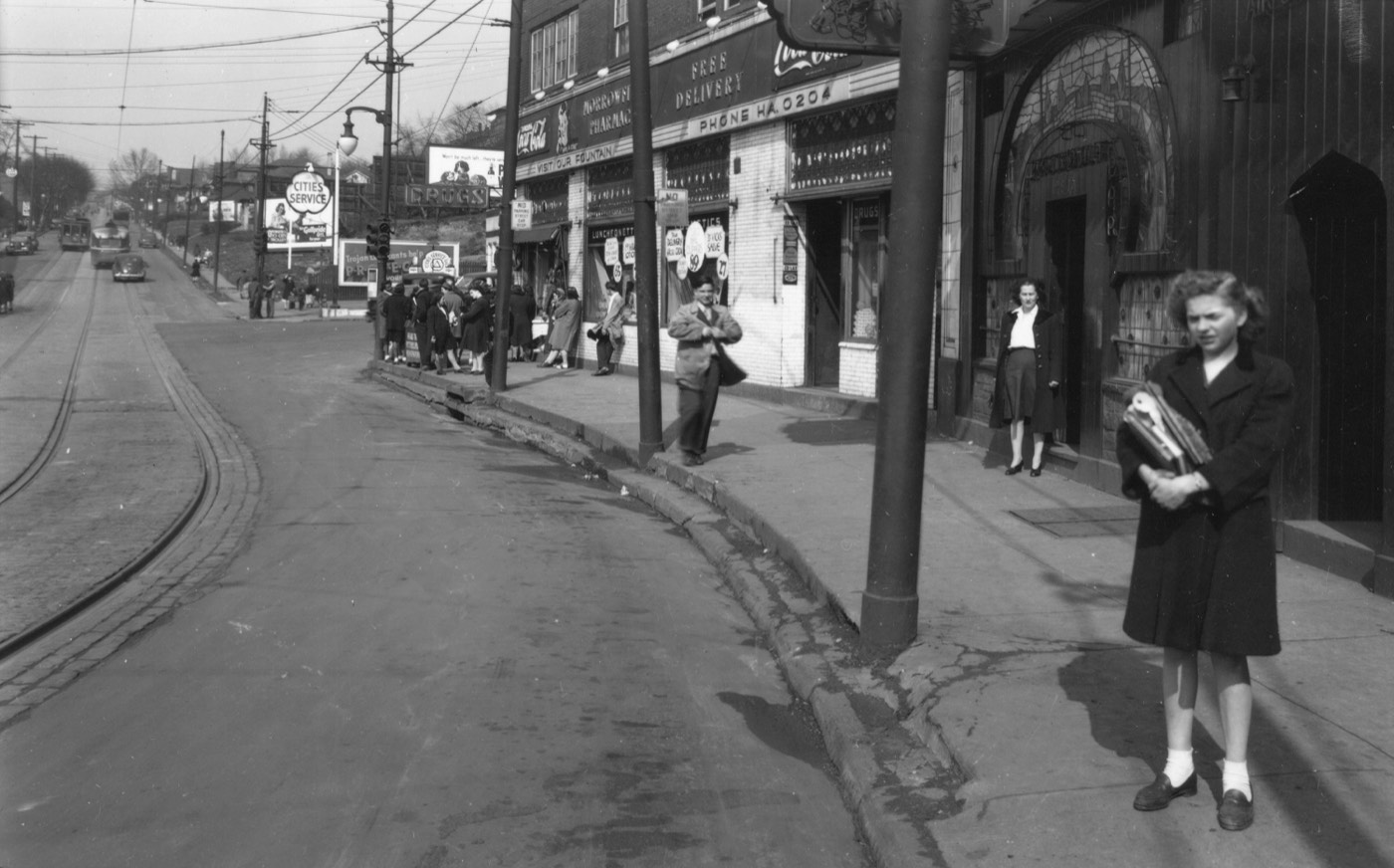
Walk the upstreet stretch where Forbes Avenue meets Murray, and the rhythm of the place tells you everything. A kosher butcher counter, a Judaica bookshop, a bakery braiding challah for Friday, men in dark hats crossing toward afternoon prayers. For more than a century, the Jews in Squirrel Hill have made this leafy corner of eastern Pittsburgh into something rare in American life: an urban Jewish neighbourhood that never emptied out, never decamped wholesale to the suburbs, never became a memory. It simply stayed.
The Place
Squirrel Hill sits on the eastern edge of Pittsburgh, a district of brick and stone houses on tree-shaded streets, bounded by Shadyside, Point Breeze, Oakland, Regent Square and Greenfield. It was named, plainly enough, for the grey squirrels that filled its woods, and the first recorded house went up in 1760.
Two great green spaces frame it: Schenley Park, established in 1889, and Frick Park, opened in 1927, which together wrap the neighbourhood in nearly a thousand acres of ravines and trails. Carnegie Mellon University and Chatham University lie at its edges, giving the district a steady current of students and academics.
By the 2020 census the combined North and South Squirrel Hill neighbourhoods counted roughly 27,000 residents across the 15217 and 15232 ZIP codes. It is, by most measures, one of Pittsburgh’s most prosperous and stable corners.
How It Became Jewish
The story of the Jews in Squirrel Hill does not begin in Squirrel Hill at all. It begins downhill, in the crowded Hill District above downtown Pittsburgh, and before that, across an ocean.
From Allegheny City to the Hill
In 1850 there were about thirty Jewish families in Pittsburgh, most of them living in Allegheny City, now the North Side. Lithuanian, Polish and Dutch Jews began arriving through the 1860s. Then came the larger wave: Jews fleeing the Russian pogroms and the poverty of the Pale, arriving from Russia, Poland, Lithuania, Romania and Austria-Hungary.
Many of these newcomers, impoverished and Yiddish-speaking, settled in the Hill District, the dense immigrant quarter rising just east of downtown. By 1900 Pittsburgh’s Jewish population had reached roughly 13,000. It would peak at around 55,000 by 1930. The Hill was the beating heart of it: synagogues, pushcarts, landsmanshaftn, the whole texture of Eastern European Jewish life transplanted to a Pennsylvania hillside.
The move uphill in the 1920s
What pulled the community east toward Squirrel Hill was, in part, the automobile and the road. An electric trolley had reached the area in 1893, and in 1927 the Boulevard of the Allies linked Squirrel Hill directly to downtown. Suddenly a neighbourhood of spacious lots and new single-family homes lay within easy reach.
Through the 1920s, Eastern European and Russian Jews who had established themselves in the Hill District and in Oakland began moving into central and southern Squirrel Hill. They were no longer the penniless arrivals of 1900. They were shopkeepers, tradesmen and professionals, ready for lawns and porches and good schools.
The neighbourhood takes shape
By the 1930s, Squirrel Hill had become the centre of Jewish culture in Pittsburgh. Kosher butcher shops, delicatessens, bookshops and Jewish restaurants lined the business district along Forbes and Murray Avenues. Most of the available land had been filled, and the district had settled into the form it largely holds today.
The congregations followed their members. Tree of Life, founded in 1864 as a breakaway from the older Rodef Shalom and the oldest Conservative-affiliated congregation in Western Pennsylvania, broke ground on its Squirrel Hill synagogue in 1947 and dedicated the building in 1952. Congregation Poale Zedeck, organised in 1881 by Austro-Hungarian Jews, had already purchased its Phillips Avenue lot in 1926 and dedicated its synagogue there in 1929.
What distinguishes Squirrel Hill from nearly every comparable American neighbourhood is what came next, which is to say, very little. The flight to the suburbs that hollowed out urban Jewish districts in city after city, and built places like Hewlett, New York, largely passed Squirrel Hill by. The community dispersed somewhat, but its core held. For a counterpoint within Pennsylvania, the Ukrainian community of Jenkintown outside Philadelphia shows how other immigrant groups across the state found their own footholds.
The Landmarks
Tree of Life, 5898 Wilkins Avenue. The congregation traces to 1864, when sixteen members met in the home of Gustavus Grafner under the Hebrew name Etz Chayyim. Its Squirrel Hill synagogue was dedicated in 1952. On 27 October 2018 it became the site of the deadliest antisemitic attack in United States history, and its name has since stood, painfully, for both loss and the resolve to rebuild.
Congregation Poale Zedeck, 6318 Phillips Avenue. Organised in 1881 by Austro-Hungarian immigrants and chartered in 1883, this modern Orthodox congregation built its present synagogue at the corner of Shady and Phillips Avenues, dedicating it in 1929. It remains one of the anchors of Orthodox life in the neighbourhood.
Jewish Community Center of Greater Pittsburgh, 5738 Forbes Avenue. Standing near the intersection of Forbes and Murray, the JCC carries the formal name of the Young Men and Women’s Hebrew Association and Irene Kaufmann Centers. With its pool, fitness centre, daycare and classes, it functions as the neighbourhood’s secular living room as much as its gym.
Pinsker’s Books and Judaica, 2028 Murray Avenue. Opened in 1953, Pinsker’s has outlasted every other Judaica store in the city. After hard years it kept its doors open, sharing its space with the kosher Eighteen Cafe, a quiet emblem of the neighbourhood’s stubborn continuity.
Murray Avenue Kosher, Murray Avenue. A kosher grocery long woven into the daily life of observant families, it expanded into the former Smallman Street Deli space, keeping the supply of kosher meat, groceries and prepared food flowing through the upstreet.
Carnegie Library of Pittsburgh, Squirrel Hill branch, corner of Forbes and Murray. Sitting at the very crossroads of the business district, the branch is a modern, open civic space and a natural meeting point for a neighbourhood that prizes books and learning.
Shaare Torah, 2319 Murray Avenue. One of the district’s Orthodox congregations, Shaare Torah sits right on Murray Avenue, part of the close weave of synagogues that gives Squirrel Hill its concentration of Jewish religious life, with more than twenty congregations across the neighbourhood.
Where They Came From
The Jews of Squirrel Hill descend overwhelmingly from the great Eastern European migration of the late nineteenth and early twentieth centuries. Their grandparents and great-grandparents came from Russia, Poland, Lithuania, Romania and Austria-Hungary, fleeing pogroms, conscription and grinding poverty in the Pale of Settlement.
Earlier still, a smaller German and Central European Jewish presence had established institutions like Rodef Shalom, from which Tree of Life split in 1864. But the population that filled the Hill District and then climbed into Squirrel Hill was largely Yiddish-speaking and Eastern European, the same stream that built Jewish neighbourhoods in dozens of American cities.
What set Pittsburgh apart was geography and steel. The city’s mills offered work, and the Jewish community that grew alongside them found, in Squirrel Hill, a place affluent enough to aspire to and close enough to downtown to never feel exiled from the life of the city. Families who might elsewhere have pushed ever outward instead settled in and stayed, their roots reaching back to the shtetls of Lithuania and the cities of Galicia.
That same Eastern European stream built Jewish neighbourhoods across the country, from the suburbs of New York to the heart of the Midwest. You can trace its echoes in the Jewish enclaves of Cleveland Heights and the established communities of University Heights, Ohio, or in the New York suburbs of Riverdale and Lawrence. Each grew from the same migration, though few held their urban ground as tenaciously as Squirrel Hill.
Squirrel Hill Today
Squirrel Hill remains, as it has for nearly a century, the centre of Jewish life in Pittsburgh. Around 40 per cent of the neighbourhood’s residents are Jewish, and the upstreet still carries kosher bakeries, butchers, groceries and more than twenty synagogues spanning Orthodox, Conservative, Reform and Reconstructionist practice. For an American Jewish neighbourhood, that density and durability are genuinely unusual.
The community has also changed. A regional study found Pittsburgh’s Jewish population growing, highly educated and increasingly dispersed, with the share living in Squirrel Hill itself declining from roughly half the region’s Jews two decades ago to around a quarter today. At the same time the neighbourhood has grown more diverse, with a substantial Asian population and an annual Lunar New Year celebration that has made the upstreet one of Pittsburgh’s emerging Chinatowns.
And then there is 27 October 2018, the morning a gunman murdered eleven worshippers at the Tree of Life building. The attack was the deadliest act of antisemitism in American history, and it broke something open in Squirrel Hill. But the response, the vigils, the rebuilding, the refusal to leave, said as much about the neighbourhood as the loss itself. Squirrel Hill grieved, and then Squirrel Hill stayed.
If you came here today on a Friday afternoon, you would see it plainly: the bakeries at work, the JCC busy, families walking home from the butcher with the week’s order. A century of Jewish life, still living, on the same few streets.
Frequently Asked Questions
Why are there so many Jews in Squirrel Hill, Pennsylvania?
The Jews in Squirrel Hill arrived chiefly in the 1920s, moving uphill from Pittsburgh’s crowded Hill District as new roads and the automobile opened up the spacious, affordable lots of this eastern neighbourhood. Unlike most American cities, where Jewish districts emptied toward the suburbs, Squirrel Hill’s community stayed and deepened over the following century.
What share of Squirrel Hill is Jewish?
Roughly 40 per cent of Squirrel Hill’s residents are Jewish, making it one of the most concentrated urban Jewish neighbourhoods in the United States. Across the wider Pittsburgh region, about a quarter of the area’s Jews live in Squirrel Hill, down from nearly half two decades ago as the community has become more dispersed.
What is the oldest synagogue in Squirrel Hill?
Tree of Life congregation dates to 1864, founded as a breakaway from the older Rodef Shalom, and is the oldest Conservative-affiliated congregation in Western Pennsylvania. It relocated to Squirrel Hill in the late 1940s and dedicated its Wilkins Avenue building in 1952. Congregation Poale Zedeck, organised in 1881, dedicated its Phillips Avenue synagogue in 1929.
Where did Squirrel Hill’s Jewish families originally come from?
Most descend from Eastern European Jews who fled Russia, Poland, Lithuania, Romania and Austria-Hungary during the migrations of the late 1800s and early 1900s. They first settled in Pittsburgh’s Hill District before moving up to Squirrel Hill, where the Jews in Squirrel Hill built the synagogues and businesses that still define the neighbourhood.
Is Squirrel Hill still a kosher and observant neighbourhood?
Yes. Murray and Forbes Avenues still support kosher butchers, bakeries and groceries such as Murray Avenue Kosher, alongside Judaica shops like Pinsker’s and a network of Orthodox congregations. The neighbourhood is home to more than twenty synagogues spanning every major branch of American Judaism.
What happened at the Tree of Life synagogue?
On 27 October 2018 a gunman attacked the Tree of Life building at 5898 Wilkins Avenue, killing eleven worshippers in what remains the deadliest antisemitic attack in United States history. The neighbourhood responded with vigils, solidarity and a commitment to rebuild, and the Jews in Squirrel Hill chose to remain rather than disperse.
If your family’s story passed through Squirrel Hill, or any of the places Jews have made home in America, Atlas of Home can trace that journey. From the shtetls of Lithuania and the cities of Galicia, to a brick house on a tree-lined street above Forbes and Murray, to wherever you are now.