
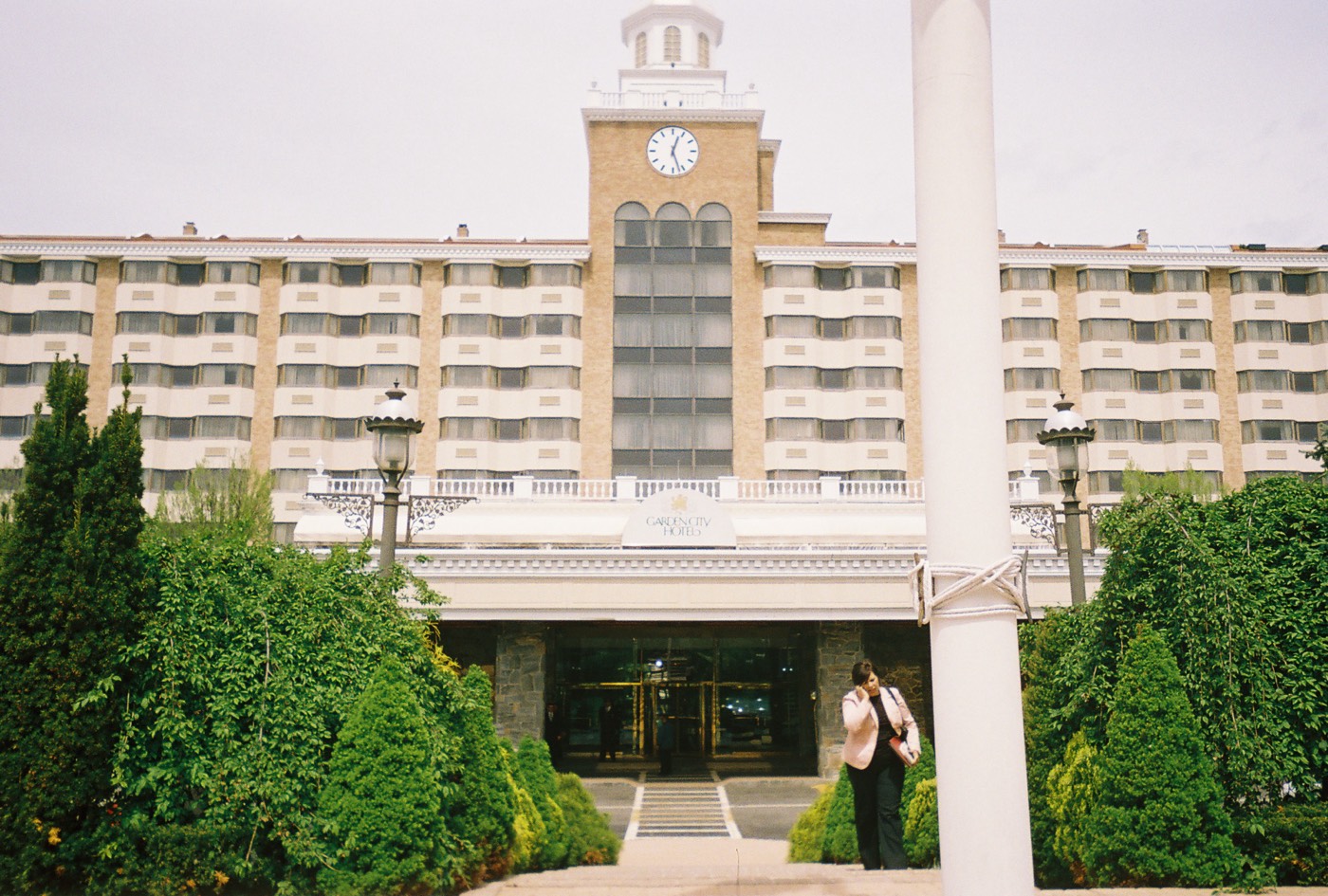
Drive the wide, tree-lined avenues of Garden City on a Sunday morning and you will pass a Cathedral built for one man, a hotel where Lindbergh slept before crossing the Atlantic, and a deli counter where the man behind it still calls the soppressata by its proper name. The Italians in Garden City did not build this village. They inherited it, polished it, and made it quietly, unmistakably their own.
The Place
Garden City sits in central Nassau County, about twenty miles east of Manhattan on the flat expanse once called the Hempstead Plains. It is one of the wealthiest incorporated villages on Long Island, with a 2024 median household income above $240,000 and a population of roughly 23,000.
The streets are unusually wide for the New York suburbs, the lots generous, the trees old. It feels planned because it was, down to the last hedge. And among the families who have filled those houses over the past seventy years, two ancestries stand out above all others: Italian and Irish, each accounting for roughly a quarter of residents.
How It Became Italian
Garden City was never meant to be an immigrant town. Its origins were aristocratic, and the Italian arrival here is a story of patient social ascent rather than tenement chain-migration. To understand it, you have to start with a department-store magnate and a grieving widow.
A village built by a millionaire
In 1869 the Irish-born dry-goods king Alexander Turney Stewart bought roughly 7,000 acres of the Hempstead Plains and set about building a model village. He laid out wide avenues, planted hundreds of trees, ran his own railroad line to the door, and opened the first Garden City Hotel in 1874. When Stewart died in 1876, his widow Cornelia raised a memorial to him that still defines the skyline: the Cathedral of the Incarnation, consecrated in 1885, the only cathedral in the United States built in memory of a single person.
This was a Protestant, Episcopal village by design, governed for decades by the Garden City Company until incorporation in 1919. There was no obvious door through which a Catholic son of Naples might walk. The door, when it opened, was opened by the wider transformation of Long Island itself.
The road out of Brooklyn
Between 1900 and 1915 some three million Italians arrived in the United States, and by 1920 more than 800,000 Italian Americans lived in New York City, packed into Lower Manhattan, the Bronx, and above all the southern tier of Brooklyn. Their children and grandchildren came of age after the Second World War with money, mortgages, and a hunger for lawns.
The settlement trail was well worn: from Ellis Island to the Lower East Side, then a spell in Brooklyn or Queens, then a final move out to Nassau or Suffolk. As factories left Brooklyn in the 1950s and the borough’s makeup changed, Italian families who had built businesses in Bensonhurst and Bushwick followed the parkways east. Nassau County is today nearly a quarter Italian American, the residue of that exodus.
Most of those families landed first in the more modest grid towns: Franklin Square, Elmont, Mineola, Garden City Park, Floral Park. Garden City proper, with its higher prices and old social codes, came a generation later, as the doctors, lawyers, contractors, and restaurateurs among them earned their way in. The Italian story here is largely a story of the second and third generation, of people who arrived not off a boat but out of a starter house a few miles south.
Catholic Garden City
If the Cathedral was Episcopal, the Catholic parishes were where the new arrivals announced themselves. The Church of St. Joseph on Fifth Street and the Church of St. Anne on Dartmouth Street, both within the Diocese of Rockville Centre, became the spiritual centres of a growing Italian and Irish Catholic population.
By the postwar decades the parish calendar, the Communion breakfasts, the CYO leagues, and the long lines for confession on Saturday afternoons told you how thoroughly the village had become Catholic in fact, whatever its founder had intended. A community measures its arrival by where it baptises its children, and in Garden City the Italians did so a short walk from a Cathedral raised by a Protestant widow.
The making of a professional suburb
What sealed Garden City as an Italian destination was the same thing that drew everyone else: the schools and the work. Roosevelt Field, the airfield from which Lindbergh departed in 1927, closed in 1951 and reopened in 1956 as a shopping mall designed in part by I. M. Pei, briefly the largest in North America. Adelphi University, which moved from Brooklyn to Garden City in 1929, anchored the village with a campus and a payroll.
Garden City High School climbed into the top tier of New York State rankings, regularly cited as one of the best public high schools on Long Island. For a family that had clawed its way up from a Brooklyn flat, that ranking was the whole argument. You moved to Garden City so your children would never have to explain where they came from.
The Landmarks
Iavarone Bros, 140 7th Street. No business tells the Italian arc more completely. The Iavarone family began as five partners from a town near Naples who opened a sausage shop in East New York around 1919; by 1927 it was Iavarone Bros, and over the decades it followed its customers from Brooklyn to Queens to Long Island. The Garden City market, all glistening salumi and house-made mozzarella, is the destination at the end of that journey made visible behind glass.
Sansone Market, 2147 Jericho Turnpike. A gourmet Italian specialty market trading since 1930, just over the village line in Garden City Park. The cases hold fresh cheeses, cured meats, specialty pasta, olives, gelato, and Lavazza coffee, and the tagline, “We bring Italy to your kitchen,” is the unembarrassed creed of a Long Island Italian deli.
Uncle Bacala’s, 2370 Jericho Turnpike, Garden City Park. Red-and-white checked tablecloths, tile and brick, and Italian seafood served in the volume that Long Island weddings and christenings require. It is the kind of room where three generations sit at one long table and nobody reads the menu because they already know.
King Umberto, 1343 Hempstead Turnpike, Elmont. A fixture since 1976, just south of Garden City, the restaurant and pizzeria that locals have driven to for forty years for the brick-oven pies. In 2025 it unveiled an upscale concept called Serata, proof that even the old neighbourhood standbys are reaching for white tablecloths now.
Church of St. Joseph, 130 Fifth Street. A pillar of Catholic Garden City within the Diocese of Rockville Centre, and for many Italian families the parish where the milestones happened: the baptisms, the First Communions in white, the funerals attended in dark suits by men who had grown up three towns over.
The Garden City Hotel, 45 Seventh Street. Stewart’s hotel, rebuilt across the generations, where the Astors and the Kennedys stayed and where Charles Lindbergh slept on the night of 19 May 1927 before his flight to Paris. Today it is where Garden City’s Italian families hold their weddings, a Protestant founder’s monument turned into the backdrop for a thousand tarantellas.
Cathedral of the Incarnation, 50 Cathedral Avenue. The 1885 spire that orients the whole village, the only American cathedral built in memory of one person. It is Episcopal, not Catholic, but it is the landmark every Italian grandmother points to when she gives directions, the fixed star of a town her grandchildren now call home.
Where They Came From
The Italians of Garden City carry, by and large, southern roots: the Campania of Naples, the towns around Salerno and Avellino, Sicily, and Calabria. These were the regions that supplied the great migration of 1900 to 1915, and the surnames behind Garden City’s deli counters and law offices echo them still.
But the immediate origin point for most Garden City families is not a hill town in the Mezzogiorno. It is Brooklyn. It is Bensonhurst, where Italian Long Island was incubated, and the streets of Bushwick and East New York where shops like Iavarone Bros first opened. The grandparents came from Italy; the parents came from the Italian heart of Bensonhurst, Brooklyn, and from the wider Brooklyn that fed all of Italian Long Island.
That two-step migration, Italy to Brooklyn to the suburbs, is the defining shape of Italian Nassau County. You can trace the same arc east through the Italian families of Massapequa and across the harbour to the Italians who settled Staten Island, each a different exit ramp off the same crowded borough.
Garden City Today
Italian Garden City today is not a neighbourhood you can photograph the way you can photograph Bensonhurst’s Eighteenth Avenue or Arthur Avenue in the Bronx. There is no Italian quarter, no festival shutting a main street, no cluster of social clubs. The Italian presence here is diffused into the general affluence, expressed in the parish roster, the deli line, and the surnames on the high school honour roll rather than in any single block.
That is, in a sense, the point. Garden City was the destination, the place where being Italian stopped being a marker of where you started and became simply one strand of an established American life. The mozzarella is still pulled fresh at Iavarone Bros, the wedding is still held at the Garden City Hotel, and the Sunday gravy still simmers, but it happens behind the hedges of a village that asks no one to prove they belong.
Drive Jericho Turnpike on a Saturday and you will see it plainly: the specialty markets, the seafood houses, the bakeries with their trays of struffoli at Christmas. Garden City keeps its Italian heart the way it keeps everything else, quietly, comfortably, and without needing to announce it.
Frequently Asked Questions
Are there many Italians in Garden City, New York?
Yes. Italian ancestry accounts for roughly a quarter of Garden City residents, making the Italians in Garden City one of the two largest ancestry groups in the village alongside the Irish. Nassau County as a whole is nearly a quarter Italian American.
When did Italians move to Garden City?
Most Italian families arrived from the 1950s onward, part of the postwar movement of Italian Americans out of Brooklyn and Queens into the Nassau County suburbs. Many settled first in nearby towns like Franklin Square and Mineola before moving up to Garden City.
Where did Garden City’s Italian families come from originally?
Predominantly from southern Italy, especially the Naples region of Campania, along with Sicily and Calabria. The more immediate origin for most families was Brooklyn, above all Italian neighbourhoods like Bensonhurst, before the move east to Long Island.
What are the best Italian places in the Garden City area?
Iavarone Bros on 7th Street and Sansone Market on Jericho Turnpike are the landmark Italian specialty markets, while Uncle Bacala’s in Garden City Park and King Umberto in nearby Elmont are longtime Italian restaurants. Several family-run Italian bakeries dot the surrounding towns.
Is Garden City a Catholic community?
Though founded as an Episcopal village around the Cathedral of the Incarnation, Garden City became heavily Catholic through its Italian and Irish residents. The Catholic parishes of St. Joseph and St. Anne, in the Diocese of Rockville Centre, anchor that community.
Why did Italian families choose Garden City specifically?
Garden City offered top-ranked public schools, including a high school regularly ranked among the best on Long Island, along with proximity to Adelphi University, Roosevelt Field, and Manhattan. For Italian families rising out of Brooklyn, it represented arrival.
If your family’s story passed through Garden City, or any of the places Italians have made home in America, Atlas of Home can trace that journey. From a town near Naples, to a sausage shop in Brooklyn, to a wide green street in Garden City, to wherever you are now.