
The espresso machine at the back of the Arthur Avenue Retail Market has been hissing since six. A man in an apron pulls a tray of cured capicola at Mike’s Deli, and the smell of fennel sausage and aged provolone rolls down the line of stalls. At La Casa Grande, the cigar rollers are folding tobacco leaves by hand. By eight, a delivery truck has reversed up to Borgatti’s on East 187th Street, and the noodle machines have been running for two hours. This is what people mean when they say the real Little Italy is in the Bronx.
Belmont and Arthur Avenue, The Place
Belmont sits in the west Bronx, wedged between Fordham University to the north and the New York Botanical Garden and Bronx Zoo to the east. Arthur Avenue is its commercial spine, running through the neighbourhood from about East 184th Street up to Fordham Road.
The street takes its name from Chester A. Arthur, the 21st president. Catherine Lorillard Wolfe, who inherited the old Lorillard tobacco estate that became Belmont, named it for her favourite president when the land was divided for sale in the 1880s.
The housing is mostly low-rise brick. Tenements and two and three-storey buildings line the side streets, with apartments above the shops on Arthur Avenue itself. The B and D trains stop at Fordham Road, and the Metro-North’s Fordham station handles the commuter traffic. The neighbourhood feels enclosed, almost villagey, which is part of why it stayed Italian when other enclaves did not.
How Arthur Avenue Became Italian
Before the Italians
Before Belmont was Italian, it was a country estate. The Lorillard family, French Huguenots who founded the Lorillard Tobacco Company in 1760, owned a vast tract along the Bronx River and built a mansion they called Belle Mont on the high ground above the water. By the 1880s the estate was being broken up. Catherine Lorillard Wolfe donated the mansion to the Home for Incurables, later St. Barnabas Hospital. Other portions of the land became the Bronx Zoo and the New York Botanical Garden.
The street grid that replaced the estate was laid out in the 1880s. Arthur Avenue, Hoffman Street, Crescent Avenue, Cambreleng Avenue. The lots were small and the rents were cheap. It was a place where a working family could afford a flat above a storefront.
The Italians Arrive
The first Italians came as workers. Construction on the Bronx Zoo began in 1898. The New York Botanical Garden opened in stages from 1891. Fordham University, then St. John’s College, was already on the next ridge over. All three needed masons, landscapers, stonecutters, and labourers, and the contractors recruited from the Italian immigrant pool flooding into New York.
Many of those workers stopped working at the end of the shift, walked a few blocks west, and rented a room. By the early 1900s, whole blocks of Belmont were Italian. Pasquale Egidio opened his pastry shop at 622 East 187th Street in 1912, and within a year it was operating partly as an informal village hall, with Egidio helping immigrants who could not read or write English sign papers and navigate the new country.
The parish came next. Our Lady of Mount Carmel opened as a mission in a storefront at 659 East 187th Street in 1906 and laid the cornerstone of a permanent church at 627 East 187th Street in 1907. The basement church opened on Christmas Day 1907 with seating for 750. The upper church, completed in 1912, added another 500 seats. From the start, this was the Italian parish of the Bronx.
Belmont at Its Peak
Between the 1910s and the 1930s, Belmont matured into a self-contained Italian world. Subway extensions brought more arrivals after the First World War. Pork stores, fishmongers, bread ovens, and pasta makers settled along Arthur Avenue and the side streets, each block essentially functioning as a piece of a larger village economy.
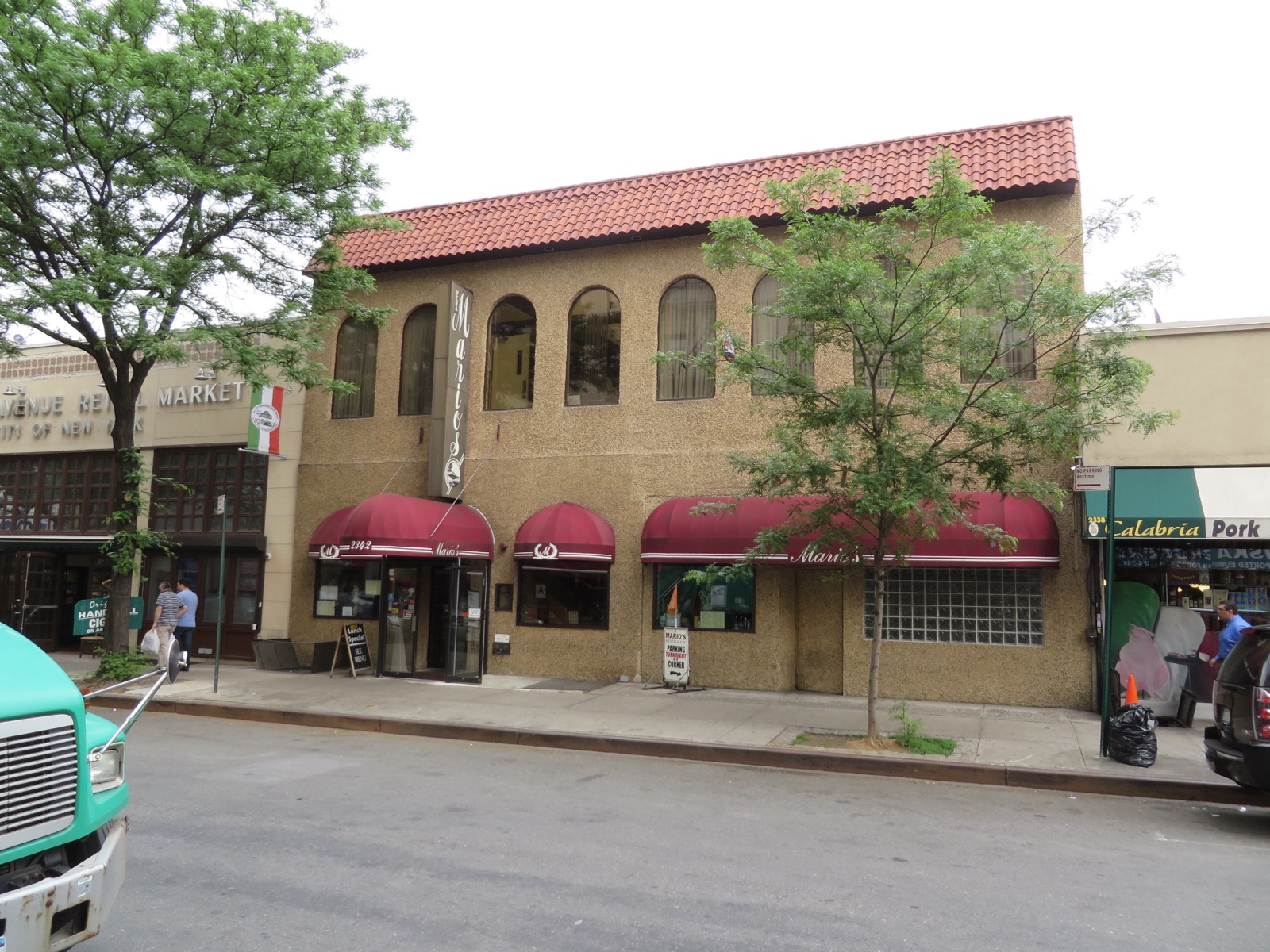
Mario Madonia, a baker from Monreale in Sicily, sold loaves door to door from a pushcart until he had saved enough to open Madonia Brothers Bakery at 2348 Arthur Avenue in 1918. In 1919, Scolastica Migliucci and her son Giuseppe opened a six-table pizzeria at 2342 Arthur Avenue. Scolastica sold five-cent slices on the sidewalk while her son baked inside. By 1935 it was a full restaurant under the name Mario’s.
That same year, Lindo and Maria Borgatti, who had come from Bologna with Maria’s family ravioli recipes, pooled less than $300 and rented a storefront at 632 East 187th Street to make fresh pasta. They sold their first pound of egg noodles for fifteen cents.
By the 1940s, Italians made up more than seventy percent of Belmont. The streets ran on parish saints and pushcarts. There were so many pushcarts, in fact, that Mayor Fiorello LaGuardia decided to bring them indoors. He set the plans in motion in March 1940, and on 29 October 1940 the Arthur Avenue Retail Market opened at 2344 Arthur Avenue with 117 stalls under one roof. It is still operating today, with the deli counters, espresso bar, and hand-rolled cigars that have anchored the building for more than eighty years.
The post-war decades were the high noon. Chazz Palminteri grew up on these streets in the late 1950s and early 1960s, watching corner men, priests, shopkeepers, and wiseguys move through the same compressed world. He turned what he saw into a one-man play, A Bronx Tale, in 1988. Robert De Niro filmed it where it happened.
Dion DiMucci, who fronted Dion and the Belmonts, took the group’s name from Belmont Avenue, one block east of Arthur.
The Change
The shift began in the 1960s and accelerated through the 1970s. Younger Italian families with cars and savings moved out to the north Bronx, Westchester, Queens, and New Jersey. The South Bronx burned in the late 1970s, and although Belmont itself was largely spared, the surrounding neighbourhoods emptied and changed. The Italian population that had been over seventy percent in the 1940s was a fraction of that by the 1990s.
The shops on Arthur Avenue stayed, but only just. What kept them alive was something nobody planned: a second wave of immigrants who knew the same trade. Albanian families, fleeing the political collapse of the late 1980s and the Balkan conflicts of the 1990s, began arriving in Belmont in numbers. Many already spoke Italian. Many came from villages where the cuisine, the Catholicism, and the family structure overlapped with what the Italians had built.
They started by working in the Italian shops. Then they started buying the Italian shops. Today, Albanian-American owners run a substantial share of the Italian-American pizzerias, restaurants, and corner businesses in the Bronx, often under the original Italian names. About one in three Bronx buildings is now Albanian-owned. The neighbourhood’s Italian character did not so much fade as get adopted.
The Landmarks of Italian Arthur Avenue
Arthur Avenue Retail Market, 2344 Arthur Avenue. Opened by Mayor LaGuardia in October 1940 to consolidate the pushcart vendors who had filled the avenue. Inside today are Mike’s Deli, Peter’s Meat Market, La Casa Grande Cigars, the Bronx Beer Hall, and Mount Carmel Gourmet, among others. It is the anchor of the whole street.
Mario’s Restaurant, 2342 Arthur Avenue. Opened in 1919 by Scolastica Migliucci as a six-table pizzeria, now in its fifth generation under Regina Migliucci-Delfino. Named an America’s Classic by the James Beard Foundation in 2000. The kind of place where the family has been baking the same Neapolitan pizza on the same block for more than a century.
Borgatti’s Ravioli & Egg Noodles, 632 East 187th Street. Lindo and Maria Borgatti opened the shop in November 1935, the same week their son George married Mary across the street at Our Lady of Mount Carmel. They still cut ravioli and egg noodles to order. The machines are old, the recipes are older, and the family is now into its fourth generation of pasta makers.
Madonia Brothers Bakery, 2348 Arthur Avenue. Mario Madonia opened the storefront in 1918 after years of selling bread from a pushcart. Family legend has it that in 1925 a bootlegger’s car crashed through the window during a chase and Rose Madonia went into labour six months pregnant. The baby, Peter, was kept warm in a bread box by the oven.
Egidio Pastry Shop, 622 East 187th Street. Pasquale Egidio opened it in 1912 and ran it as the unofficial paperwork desk of the Italian Bronx for decades. The pastry case still holds the same sfogliatelle, cannoli, and rainbow cookies. It is the oldest pastry shop on Arthur Avenue.
Calabria Pork Store, 2338 Arthur Avenue. The last full salumeria on the avenue, recognisable by the chandelier of sausages hanging from the ceiling. The store cures meats with herbs and spices brought from the Calabria region of southern Italy, which is where most of the family it serves came from.
Our Lady of Mount Carmel Church, 627 East 187th Street. The Italian parish of Belmont since 1906. The annual Feast of Our Lady of Mount Carmel in mid-July is the religious high point of the year for the neighbourhood’s older Italian-American families, with a procession that moves down 187th Street and turns onto Arthur Avenue.
Ferragosto, Arthur Avenue between East 187th Street and Crescent Avenue. The street festival, held the Sunday after Labor Day for more than twenty-five years, draws over 20,000 people. It is the closest thing the modern neighbourhood has to a homecoming.
Where the Arthur Avenue Italians Came From
Most of the Italians who built Belmont came from the south. Of the roughly five million Italians who reached the United States between 1876 and 1930, around eighty percent left from the southern regions: Campania (around Naples and Salerno), Calabria (the toe of the boot), Sicily, Apulia (the heel), and Basilicata. The Bronx pulled disproportionately from this same map.
The names of the Arthur Avenue businesses are a roll-call of the home regions. Madonia’s from Monreale in Sicily. Calabria Pork Store named for the place its recipes come from. Mario’s built on the Neapolitan pizza tradition. The Migliucci family from Campania. Borgatti’s is the exception that proves the pattern, a northern Italian family from Bologna who arrived in a sea of southerners and stayed.
The pull factor was work, the push factor was poverty. The southern Italian countryside in the late nineteenth century was a place of failing land, absentee landlords, and earthquakes. Chain migration did the rest. A man would come, find work, send for a brother, then a cousin, then a wife. By the 1920s, entire Belmont blocks had been seeded from the same handful of villages back home.
Arthur Avenue Today
Belmont in the 2020s is not the Italian neighbourhood it was in 1955. Census figures for the wider Belmont and East Tremont area put the Hispanic population, mostly Mexican and Dominican, at over sixty percent. The local Cinco de Mayo celebration now takes place on the same street as Ferragosto.
And yet, the commercial identity is still Italian. The food businesses are still here, most of them family-owned, several of them well over a century old. The new owners are often Albanian-American, and they have largely kept the recipes, the names, and the rhythm of the old neighbourhood intact. Walk into Calabria Pork Store, or Mario’s, or the Retail Market on a Saturday morning, and the language behind the counter might switch between Italian, English, Albanian, and Spanish in the same conversation.
The third and fourth generation families who grew up on these streets mostly live elsewhere now. They drive back from Westchester and the north Bronx and Long Island on the weekends, to buy bread at Madonia, sausage at Calabria, ravioli at Borgatti’s, and cannoli at Egidio. Then they sit at the espresso bar in the Retail Market, eat a slice at Mario’s, and head home.
The neighbourhood has become a place you visit to be Italian for a few hours, even if you no longer live the rest of the week as one. That is not a decline. It is the next chapter.
Frequently Asked Questions
Why did Italians settle on Arthur Avenue?
Italian labourers were recruited to build the Bronx Zoo, the New York Botanical Garden, and the expanding Fordham University campus from 1898 onward. The Belmont blocks just west of those construction sites had cheap rents and small lots, so the workers stayed. Within a generation, Arthur Avenue and the side streets had become a self-contained Italian quarter with its own bakeries, churches, and parish life.
Is Arthur Avenue still Italian today?
The commercial street is still Italian in character, but the residential neighbourhood is mostly Hispanic, with a long-standing Albanian-American community that now owns and runs many of the historic Italian businesses. The food shops, Mario’s, Borgatti’s, Madonia, Calabria Pork Store, Egidio, and the Retail Market, are still operating with their original recipes and often their original families. Belmont is layered rather than vanished.
What are the most famous Italian landmarks on Arthur Avenue?
The Arthur Avenue Retail Market at 2344 Arthur Avenue, opened by Mayor Fiorello LaGuardia in 1940. Mario’s Restaurant at 2342 Arthur Avenue, open since 1919. Borgatti’s Ravioli at 632 East 187th Street, since 1935. Madonia Brothers Bakery at 2348 Arthur Avenue, since 1918. Egidio Pastry Shop at 622 East 187th Street, since 1912. And Our Lady of Mount Carmel Church at 627 East 187th Street, the Italian parish of the Bronx since 1906.
Where in Italy did the Arthur Avenue Italians come from?
Overwhelmingly from the south. The largest groups came from Campania (around Naples and Salerno), Calabria, Sicily (including towns like Monreale near Palermo), and Apulia, with smaller numbers from Basilicata. A small northern Italian contingent, including the Borgatti family from Bologna, also settled in. The southern Italian roots are still visible in the recipes, the festivals, and the shop names along Arthur Avenue today.
When did Italians first arrive on Arthur Avenue?
The first Italian workers arrived in Belmont in the late 1890s to build the Bronx Zoo and the New York Botanical Garden, with construction beginning in 1898. The neighbourhood developed into a recognisable Italian quarter through the 1900s and 1910s, anchored by Our Lady of Mount Carmel Church in 1906, Egidio Pastry Shop in 1912, and Madonia Brothers Bakery in 1918. Italian dominance peaked in the 1940s, when more than seventy percent of Belmont was Italian-American.
If your family’s story passed through Arthur Avenue, or a hill town in Calabria, or a Sicilian village near Palermo, Atlas of Home can help you trace the line. From the village in Italy, to Belmont, to wherever the journey has carried you since.