
They called 18th Avenue Cristoforo Colombo Boulevard. Not on the original street signs, but if you walked it on a Saturday in August any time between 1955 and 1995, you were in Sicily. The bakeries running cannoli faster than the customers could line up. The Festa di Santa Rosalia procession turning the corner at 75th Street. By the 1980 Census, 150,000 Italian Americans lived in Bensonhurst. It was the largest single Italian community in New York City, and you could hear Sicilian dialect on the corner of 18th Avenue and Bay Parkway like it was the high street of Palermo.
Bensonhurst, The Place
Bensonhurst sits in southwestern Brooklyn, bordered by Dyker Heights to the west, Bath Beach and Gravesend to the south, and Borough Park to the north. The D train runs along 86th Street on an elevated track that has been roaring overhead since 1916; the N train cuts down 18th Avenue.
The two main spines are 18th Avenue, which the city co-named Cristoforo Colombo Boulevard, and 86th Street, the wide shopping strip that runs east to west under the elevated. The housing is mostly attached brick row-houses and two-family homes packed on numbered cross-streets, with the occasional walk-up apartment block above a storefront.
How Bensonhurst Became Italian
Before the Italians
The land was farmland owned by the Polhemus family for most of the eighteenth century. In 1835, a Brooklyn Gas Light Company executive named Arthur W. Benson began buying it up.
Between 1835 and 1850, Benson carved his holdings into generous lots and marketed a new shoreline suburb he called “Bensonhurst by the Sea.” The current Bath Beach section is what remained of that branding. The area was annexed into Brooklyn’s 30th Ward in the 1890s and the suburban dream became a city neighbourhood within a decade.
The early twentieth-century arrivals were a mix. Jewish families from the Lower East Side, escaping the tenements; Italian families chain-migrating from the small Sicilian and Neapolitan villages they had left behind a generation before. By the 1920s, Bensonhurst was already one of New York’s largest Italian-American communities, rivalling East Harlem’s Little Italy.
The Italians Arrive
Before the Second World War, Bensonhurst was roughly half Italian and half Jewish, with smaller German and Irish pockets. The two communities worshipped, schooled, and shopped on parallel tracks.
The decisive Italian wave came after 1945. Sicily had been ground down by the war, and the island’s sulfur mines, which had employed entire villages, were closing. Postwar U.S. immigration law made room for thousands of southern Italians a year. Most of those bound for Brooklyn ended up in Bensonhurst, Dyker Heights, or Gravesend.
The Jewish population began leaving in the 1950s, mostly out to Long Island. By 1960 the neighbourhood was unambiguously Italian-American, and the new arrivals kept coming. The 1960s and 1970s brought another wave, predominantly Sicilian, who slotted into the same tenement blocks their cousins had taken a decade earlier.
Bensonhurst at Its Peak
The 1980 Census put 150,000 Italian Americans in Bensonhurst. It was, by that single measure, the largest Italian-American community in New York City.
The cultural anchor of those decades was 18th Avenue. Family-run bakeries, butchers, pasta shops, grocers, and coffee bars lined the street from 60th down to Shore Parkway. Most were owned by the same family that had opened them, and many were still in those families’ hands in the 1990s.
The neighbourhood produced the pop-cultural template for Italian-American Brooklyn. Welcome Back, Kotter set its classroom at New Utrecht High School. The Honeymooners placed Ralph Kramden’s apartment in a Bensonhurst-coded address. Barbra Streisand grew up here. So did the actor Paul Sorvino and the medical doctor Anthony Fauci, whose parents both attended New Utrecht.
The defining piece of Bensonhurst pop culture was Saturday Night Fever, released in December 1977. The film’s opening shot follows Tony Manero down 86th Street, paint can in hand, the Bee Gees’ “Stayin’ Alive” cutting across the elevated.
The pizza Tony buys two slices of, stacked one on top of the other, was at Lenny’s at 1969 86th Street. The dance studio where he rehearsed with Stephanie was Phillips School of Dancing at Bay Parkway. The disco, 2001 Odyssey, had a lit dance floor installed specifically for the production and never lost its halo for the rest of its run.
The Change
Two things broke Italian Bensonhurst’s hold on the neighbourhood, and they happened in roughly the same five years.
The first was a murder. On August 23, 1989, a sixteen-year-old Black teenager named Yusuf Hawkins came to Bensonhurst with three friends to look at a used 1982 Pontiac listed for sale. A mob of white youths, expecting Black kids attending a party nearby, attacked the group with bats. One member of the mob pulled a handgun and shot Hawkins twice in the chest.
The killing set off weeks of protest marches led by the Reverend Al Sharpton, and it cemented a national reputation for Bensonhurst as racially insular. Older Italian-American residents will tell you, often correctly, that the mob did not represent the neighbourhood. The damage to the neighbourhood’s image was permanent.
The second change was demographic and slower. Around 1989, Chinese families and former Soviet families began arriving in large numbers. The Chinese came largely from Fujian and Guangdong, often via Manhattan’s Chinatown and Brooklyn’s Sunset Park. The Russians and Ukrainians came mostly via Brighton Beach.
By the 2010 Census, the demographic centre of gravity had shifted. By 2020, Asian residents outnumbered white residents in Bensonhurst for the first time in the neighbourhood’s history. Italian-Americans had fallen to about 9% of the population.
The Landmarks of Italian Bensonhurst
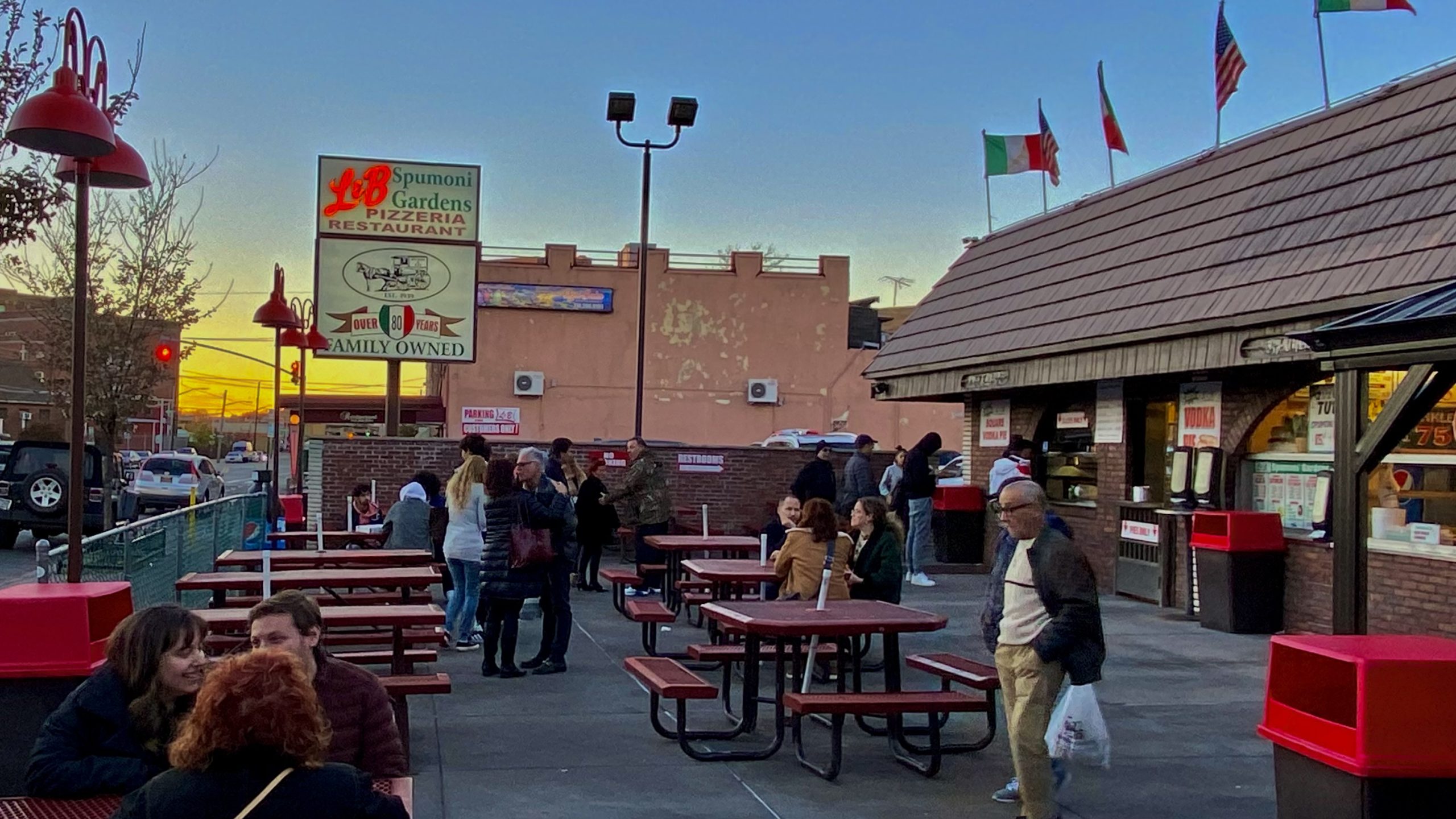
L&B Spumoni Gardens, 2725 86th Street. Ludovico Barbati arrived from Italy in 1917 and learned to make Italian ices in a Brooklyn garage in 1938. He sold spumoni door-to-door from a horse-drawn wagon called Babe before buying a vacant lot at 2725 86th Street in 1939 and building the first storefront. Four generations of the Barbati family have run the place since. The Sicilian-square pizza is the headline, the pistachio spumoni is the institution.
Villabate Alba, 7001 18th Avenue. Angelo Alaimo and his son Emanuele opened Villabate in 1979, naming the bakery for the small town in northern Sicily they had come from. When the owner of the neighbouring Alba pastry shop retired, they bought him out and combined the two into Villabate Alba. The cannoli, sfogliatelle, and cassata Siciliana are the closest thing in New York to a Palermo pasticceria.
Lenny’s Pizza, 1969 86th Street. The corner where Tony Manero buys two slices stacked one on the other in the opening sequence of Saturday Night Fever. Lenny’s has been on that corner since 1953, and the double-decker pose has been printed on the wall for decades.
Our Lady of Guadalupe Church, 15th Avenue. The Bensonhurst parish where the Festa di Santa Rosalia mass is said every August. The procession leaves the church, runs east up 18th Avenue, and returns down 20th Avenue to Saint Dominic’s. The route has not changed in fifty years.
The Feast of Santa Rosalia, 18th Avenue. Eleven days every August, between Bay Ridge Parkway and 66th Street. The Feast began in Brooklyn in 1974 and celebrates the patron saint of Palermo, brought to New York by the postwar Sicilian migration. The carnival rides, the sausage-and-pepper stands, the zeppole, the live music, and the procession draw an audience that is now both Italian and Chinese, both old residents and newcomers.
New Utrecht High School, 1601 80th Street. Anthony Fauci’s parents went here. So did Paul Sorvino, Vic Damone, and the cast of TV’s Welcome Back, Kotter, which used the school’s exterior as its on-screen setting. The class of 1985 was about three-quarters Italian-American. The class of 2024 was about two-thirds Asian-American. Both classes graduated under the same Romanesque bell tower.
2001 Odyssey, 802 64th Street. The Saturday Night Fever disco at the corner of 64th and 8th Avenue. Renamed Spectrum after the film, it operated as a gay club and then as a Latin venue, before closing entirely. The illuminated dance floor was eventually removed. The building stands; its ghost is what matters.
Where the Bensonhurst Italians Came From
The Italians who built Bensonhurst came overwhelmingly from southern Italy and Sicily. The single largest contingent was Sicilian: from Palermo and the towns inland of it, from Trapani and the western coast, from Catania and the Ionian side.
Smaller but significant streams came from Campania, the region around Naples; from Apulia, the heel of the boot; from Basilicata and Calabria, the mountain south. The bias toward the Mezzogiorno was overwhelming. Across the broader Italian-American population in New York, more than nine out of ten families trace their origin to the south.
You can read the migration map directly off Bensonhurst’s bakeries. Villabate-Alba is named for a Sicilian hill town in Palermo province. The Festa di Santa Rosalia is a Palermo feast lifted block-for-block from the city’s centro storico. The names on the funeral home awnings and the parish rolls run heavily toward the dialects of the western Sicilian coast.
The migration was a chain. The first cousin came; he wrote to his brother. His brother sent for his wife. The Naples cousins in the 1950s helped the Sicilian cousins of the 1960s and the Sicilian cousins of the 1970s. Bensonhurst was built, block by block, on that long letter home.
Bensonhurst Today
Bensonhurst today is a layered place. The 2020 Census found 104,934 residents: 43.9% Asian, 34.8% white, 17.2% Hispanic, 1% Black. The Asian community is overwhelmingly Chinese, and Bensonhurst is now home to more residents born in mainland China or Hong Kong than any other neighbourhood in New York City. The local press regularly calls it Brooklyn’s Chinatown.
The Italian-American share is down to about 9%. Many of the families that built the place have moved out to Staten Island, to New Jersey, to Long Island, to suburbs where the kids can afford a driveway and the grandparents can keep a tomato garden.
But the institutions that defined Italian Bensonhurst are still here. L&B Spumoni Gardens still pulls its Sicilian squares out of the oven. Villabate Alba still ships pignoli cookies up to Connecticut and out to Long Island for Easter. The Feast of Santa Rosalia still walks 18th Avenue every August, fifty-plus years on.
The Italian-speaking community of Bensonhurst is older now, smaller, and more dispersed. The Sicilian dialect is harder to find on the corner. The Chinese signage outnumbers the Italian on most of 86th Street.
What did not move out is the texture: the bakery counters, the parish bells, the cannoli at five o’clock on a Saturday, the procession in late August. The Italian half of Bensonhurst is no longer the whole place. It is now one of several deeply rooted communities sharing the same numbered streets, and the story of how the Italians made a home here is a story their grandchildren are now carrying outward, to wherever home is next.
Frequently Asked Questions
Why did the Italians settle in Bensonhurst?
Italians began arriving in Bensonhurst in the early 1900s through chain migration from southern Italy and Sicily, drawn by the cheap rents on the newly built numbered streets and the existing network of family members in the borough. The decisive wave came after 1945, when postwar U.S. immigration law and the collapse of Sicily’s sulfur mining economy pushed hundreds of thousands of southern Italians toward Brooklyn. Bensonhurst, Dyker Heights, and Gravesend absorbed most of those who settled in southern Brooklyn.
Is Bensonhurst still Italian today?
Bensonhurst is no longer the predominantly Italian neighbourhood it was for most of the twentieth century. By the 2020 Census, Asian residents outnumbered white residents and Italian-Americans had fallen to about 9% of the population. The Italian community is older and smaller, but institutions like L&B Spumoni Gardens, Villabate Alba, and the annual Feast of Santa Rosalia still anchor the neighbourhood and draw Italian-Americans from across the region.
What are the most famous Italian landmarks in Bensonhurst?
The best-known landmarks of the Italians in Bensonhurst are L&B Spumoni Gardens (2725 86th Street, since 1939), Villabate Alba bakery (7001 18th Avenue), Lenny’s Pizza (1969 86th Street, made famous by Saturday Night Fever), Our Lady of Guadalupe Church on 15th Avenue, and the annual Feast of Santa Rosalia along 18th Avenue every August. New Utrecht High School at 1601 80th Street, alma mater of Paul Sorvino and Anthony Fauci’s parents, is the neighbourhood’s signature institution.
Where in Italy did the Bensonhurst Italians come from?
The Italians who built Bensonhurst came overwhelmingly from southern Italy and Sicily. The largest contingent was Sicilian, particularly from the Palermo region. Significant streams also came from Campania (around Naples), Apulia, Basilicata, and Calabria. The cultural traces are direct: the Feast of Santa Rosalia is the patron saint celebration of Palermo, and Villabate Alba is named for the Sicilian hill town its founders came from.
When did Italians first arrive in Bensonhurst?
Italians began arriving in Bensonhurst in significant numbers in the early 1900s, alongside a parallel wave of Jewish families from the Lower East Side. By the 1920s, Bensonhurst was already one of the largest Italian-American communities in New York. The decisive wave came after the Second World War, with continued arrivals through the 1950s, 1960s, and 1970s, peaking at 150,000 Italian Americans in the 1980 Census.
If your family’s story passed through Bensonhurst, or through the small Sicilian towns and Neapolitan villages that fed it, Atlas of Home can trace that journey. From Palermo to 18th Avenue, from a hill town in Campania to a two-family house on Bay Parkway, to wherever you are now.