
On a summer Saturday on Grant Street, the sound carries before the sight does: water hitting pavement, buckets and hoses and laughing children, a Burmese pop song from a speaker propped in a doorway. This is Thingyan, the New Year soaking that washes away the old year, transplanted from the rivers of Southeast Asia to a corner of Buffalo’s West Side that two decades ago was mostly boarded plywood and weeds. Karen dancers move in costume past a storefront selling tea-leaf salad. The people drenching one another grew up in bamboo huts in refugee camps along the Thai border, and many of them now own the houses behind these shops.
The Burmese in Buffalo did not come for the weather. They came because someone opened a door, and then thousands more walked through it, turning one of America’s emptiest cities into a place that is growing again.
Buffalo’s West Side: The Place
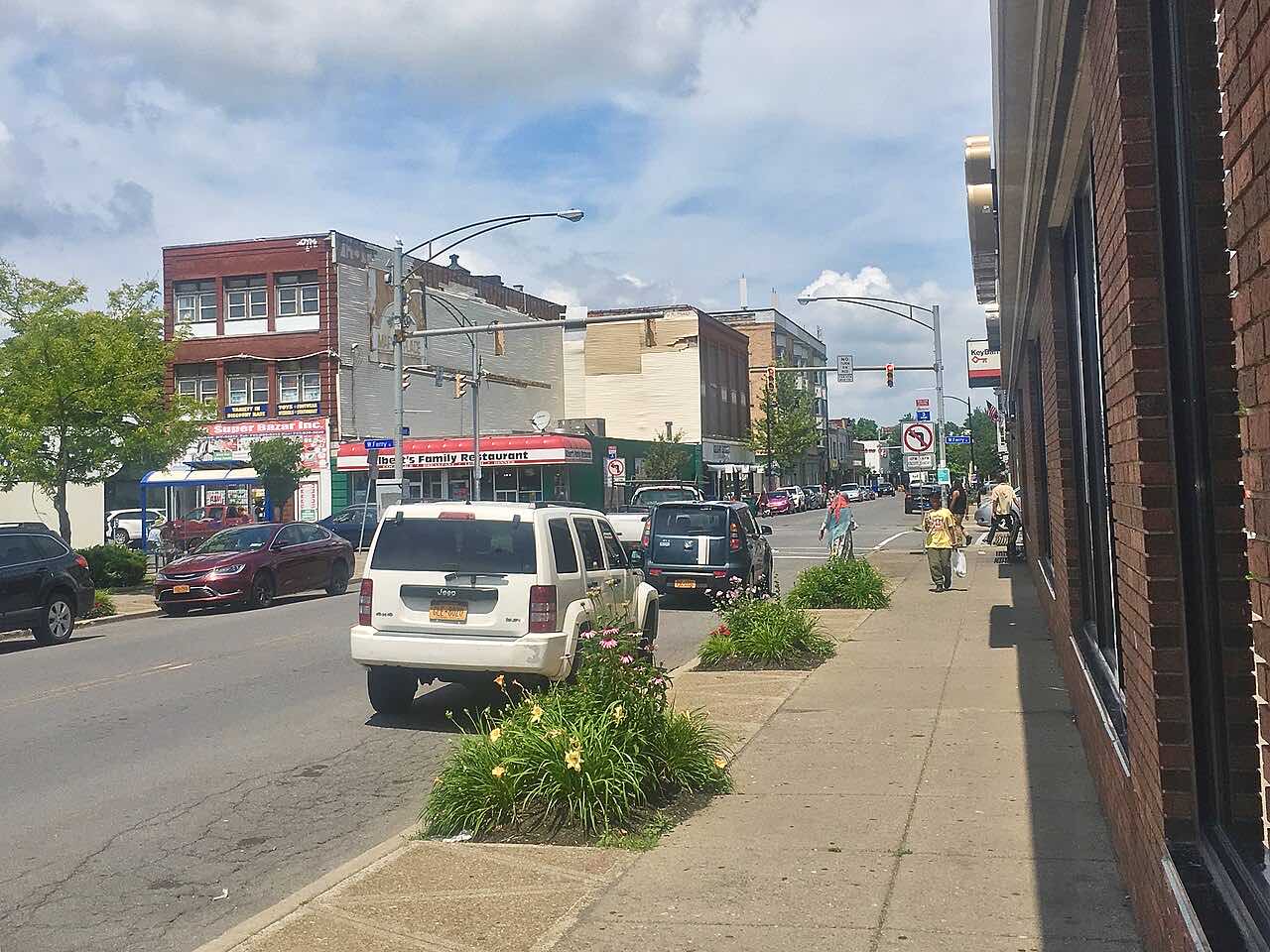
The West Side runs north and west of downtown Buffalo, bounded roughly by the Niagara River, Porter Avenue, and the elevated stretch of the I-190. Grant Street is its commercial spine, with West Ferry Street crossing it near the heart of the district. The housing is dense and old: narrow wood-frame doubles and Victorian singles, much of it built before 1920 for an earlier wave of arrivals. For decades this was Buffalo’s Little Italy.
How the West Side Became Buffalo’s Little Burma
Before the Burmese
The Irish came first, settling the West Side after the famine years of the 1840s. Italians followed in the mid-1880s and so thoroughly dominated the streets that the area earned the name Little Italy. They built the churches, the social clubs, and the corner groceries, and they held the neighborhood until the 1960s.
Then they left. Urban renewal cleared the Lower West Side, the old canal was filled in, tenements came down, and Italian families decamped for North Buffalo and the suburbs through the 1970s and 1980s. Buffalo itself was hemorrhaging people. The city that had topped half a million residents in 1950 lost population in every census for the rest of the century. By the 1990s, Grant Street was a stretch of vacant shopfronts and absentee landlords, the kind of place a city stops expecting much from.
The Burmese Arrive
The first refugees from Burma reached New York State around 2000, a trickle at first. The stream began after 2005, when the United States struck a deal with Thailand to begin resettling people from the camps strung along the border, starting with a single camp and widening from there. Buffalo’s resettlement agencies, hunting for affordable housing and willing to take families others would not, raised their hands.
Most of the newcomers were Karen, an ethnic people from eastern Burma who had spent decades fighting and fleeing the military government. Others were Karenni, Chin, Burman, Mon, and Shan. The umbrella term is Burmese, after the country of origin, but the people under it are distinct, with their own languages, faiths, and histories. Steven Sanyu, who founded Burmese Community Services in Buffalo, puts the local population at around 10,000 and is careful about the name itself. The country was renamed Myanmar by the military without the people’s consent, he notes, which is why many here still say Burma.
They arrived through a small network of agencies that became the scaffolding of a community: Journey’s End Refugee Services, Jewish Family Services of Buffalo and Erie County, and the International Institute, with staff who spoke Karen, Karenni, Chin, and Burmese. Of the roughly 13,500 refugees Erie County welcomed after 2008, about a third, some 4,384 people, came from Burma. By the Karen Society of Buffalo’s own count, more than 10,000 Karen, Karenni, Chin, and Burmese arrived over fifteen years. Burma became the single largest source country for the region’s refugees.
The West Side at Its Peak
Word traveled, and so did people. Families resettled in other American cities heard about the Burmese groceries opening on Grant Street, the temples, the familiar faces, and they moved to Buffalo on their own. The arrival became self-sustaining. Karen is now the second most spoken foreign language in Buffalo Public Schools, behind only Spanish.
Grant Street filled back in. Vacant storefronts reopened as Asian markets, noodle shops, and money-transfer counters, their signs in scripts most of Buffalo could not read. A medical safety net was already in place. Jericho Road Community Health Center, founded in 1997 by Dr. Myron Glick and his wife Joyce in a small West Side office at 184 Barton Street, found itself caring for thousands of refugees, many of whom had never seen a doctor. What began as a family practice grew into a network of five centers serving more than 24,000 patients a year.
The Buddhist Burmese clustered on the West Side around Grant and West Ferry. The Muslim Rohingya, a separate and even more persecuted people from Burma’s west, settled mostly on the East Side. Two communities from one country, carrying two very different histories, putting down roots in the same city.
The Change
Something rare happened. The 2020 census showed Buffalo had grown, adding roughly 17,000 residents, its first population increase in seventy years. Demographers credited immigrants and refugees, and the West Side was the clearest evidence. The change was not just statistical. It was on the sidewalks, in the school enrollment numbers, in the smell of curry and the crowds at the summer water festival.
The Landmarks of Little Burma
West Side Bazaar, originally 25 Grant Street. Opened in 2011 by the Westminster Economic Development Initiative inside a former Blockbuster Video of about 3,200 square feet, the Bazaar was a low-rent incubator where refugee cooks and shopkeepers could test a business without signing a lease they could not afford. Its Burmese stalls, among them Ramree, drew Buffalonians from across the city for tea-leaf salad and coconut curry noodle soup. It became the public face of the new West Side.
The new West Side Bazaar, 1432 Niagara Street. In September 2022 a spark from a cash register burned the Grant Street location down. Rather than fold, the organization rebuilt inside a 1910 brick warehouse on Niagara Street that had once housed a Prohibition-era bootlegging operation. The new Bazaar opened on October 31, 2023, roughly five times larger, with eight incubating restaurants chosen from more than a hundred applicants. A burned-out market had become a city showpiece.
Lin Asian Market and Khin’s Lin Restaurant, Tonawanda Street. Khin Maung Soe survived the persecution of the Karen before reaching Buffalo. He opened his first grocery on Grant Street in 2010, then expanded in 2014 to the market and restaurant on Tonawanda Street that became an anchor of the community, the kind of place where you can buy fish paste and a hot meal in the same trip.
Golden Burma Market, Grant Street near Breckenridge. One of the groceries that returned life to a dead block, stocking the rice, dried chilies, and pickled tea the camps never had enough of. Shops like it turned Grant Street from a place residents avoided into one they traveled to.
Jericho Road Community Health Center, 184 Barton Street. The clinic that became the medical home for Buffalo’s refugees, treating people in dozens of languages and following them from the airport into American life. Its growth from one office into a regional institution tracked the arrival of the Burmese almost exactly.
Karen Society of Buffalo, 246 Lafayette Avenue. Founded to help Karen and other Burma-origin families navigate American systems, the Society runs a youth program, the Golden Star senior program, and a soccer league that has become a fixture of West Side life. Its events pull Asian families from Rochester, Syracuse, and as far as Albany.
Where the Buffalo Burmese Came From
Most trace their path through the refugee camps of western Thailand, above all Mae La, established in 1984 in Tak Province and grown into the largest camp on the border, home to roughly 50,000 people, the great majority of them Karen. Behind the camps lay the villages of eastern Burma’s Karen, Karenni, and Shan states, and the Chin hills to the northwest, regions where the Burmese army’s long campaigns against ethnic minorities burned and emptied whole communities.
For many Buffalo families, the camp was not a stopover but a lifetime. Children were born stateless behind the fences and grew up never having set foot in the country on their papers. Some families waited two decades or more for a third country to take them. When the call finally came, it sent them to a cold city on a Great Lake they had never heard of.
The West Side Today
Walk Grant Street now and the transformation is plain. The groceries and restaurants are full, the festival fills the street every summer, and a second generation that arrived as toddlers or was born here is moving through Lafayette International High School, the West Side school built for newcomer and refugee students, and on toward college and work.
The story has also spread north. As West Side prices rose, Burmese families pushed into Riverside, where the houses were cheaper still. The pattern began early. In 2009 a Burmese refugee bought a Riverside home for $15,000 at a city foreclosure auction, and dozens of people from his home region followed him onto the block, many buying their own homes. One couple with two children bought a six-bedroom double for $50,000, their mortgage no higher than the rent they had paid. People who had owned nothing became homeowners in a country that had taken them in.
It is not a finished story, and the community would be the first to say so. The ethnic distinctions that mattered in Burma still matter here, persecution leaves marks that do not fade on schedule, and the work of building a life in a new language is slow. But the direction is unmistakable. A neighborhood the city had given up on is crowded again, and the people who refilled it walked out of camps to do it. The West Side did not just survive. It was handed back its future by strangers who decided to stay.
Frequently Asked Questions
Why did the Burmese settle in Buffalo?
Buffalo’s resettlement agencies actively invited refugees in the mid-2000s, drawn by the city’s abundant cheap housing and willingness to take large families. Once the first families from Burma arrived on the West Side, chain migration took over, as relatives and people from the same camps moved to Buffalo on their own. The Burmese in Buffalo grew from a trickle into the region’s largest refugee community within about fifteen years.
Is Buffalo’s West Side still a Burmese neighborhood today?
Yes, very much so. Grant Street remains lined with Burmese and other Asian groceries, restaurants, and the West Side Bazaar, and Karen is the second most spoken foreign language in Buffalo Public Schools. The community has also expanded into the Riverside neighborhood, where many families have bought and renovated homes.
What are the most famous landmarks of Buffalo’s Little Burma?
The West Side Bazaar is the best known, a business incubator that started on Grant Street in 2011 and reopened in a far larger space on Niagara Street in 2023. Other anchors include Lin Asian Market on Tonawanda Street, Jericho Road Community Health Center, and the Karen Society of Buffalo on Lafayette Avenue.
Where did the Buffalo Burmese come from?
Most came by way of refugee camps in western Thailand, especially Mae La camp, after fleeing the Burmese military’s campaigns against ethnic minorities. They belong to several distinct peoples, mainly Karen, along with Karenni, Chin, Burman, and others. Many spent years or even decades in the camps before being resettled.
When did the Burmese first arrive in Buffalo?
The first refugees from Burma reached New York State around 2000, with the major flow into Buffalo beginning after a 2005 United States agreement with Thailand to resettle people from the border camps. By the 2020 census, the Burmese in Buffalo and other newcomers had helped the city grow for the first time in seventy years.
If your family’s story passed through a camp on the Thai border, a crossing at an airport, or a reopened storefront on Grant Street, it deserves to be told with the same care as any old-country tale. The journeys of Buffalo’s newest arrivals echo those of communities like the Burmese of Fort Wayne, Indiana, the Bhutanese of Akron, Ohio, and the Somalis of Lewiston, Maine, refugee communities that quietly remade American cities.